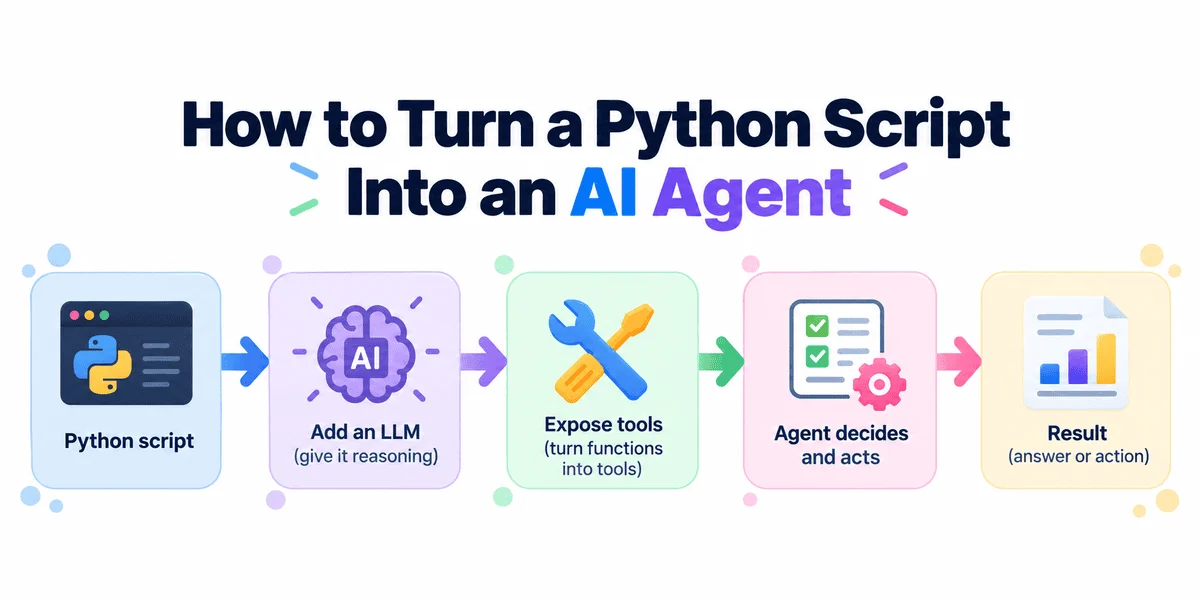
The landscape of software development is undergoing a paradigm shift as developers increasingly seek ways to integrate artificial intelligence into traditional codebases without undertaking massive architectural overhauls. Historically, incorporating large language models (LLMs) into legacy Python scripts or standard operational workflows required developers to completely rewrite their applications to accommodate complex prompt chains and rigid control flows. However, recent advancements in software development kits and developer tooling have introduced a more modular approach: transforming existing, deterministic Python functions into dynamic tools that an LLM can invoke autonomously.
This evolution in programming allows enterprises and independent developers alike to bridge the gap between traditional procedural programming and autonomous agentic workflows. By leveraging modern frameworks such as the OpenAI Agents SDK, engineers can expose standard functional logic—such as database queries, API requests, or file system operations—directly to an AI model. The model then assumes the responsibility of orchestrating these functions, determining when to execute them, managing parameter inputs, and interpreting outputs to achieve a broader, high-level objective defined entirely in natural language.
The Shift From Procedural Automation to Agentic Workflows
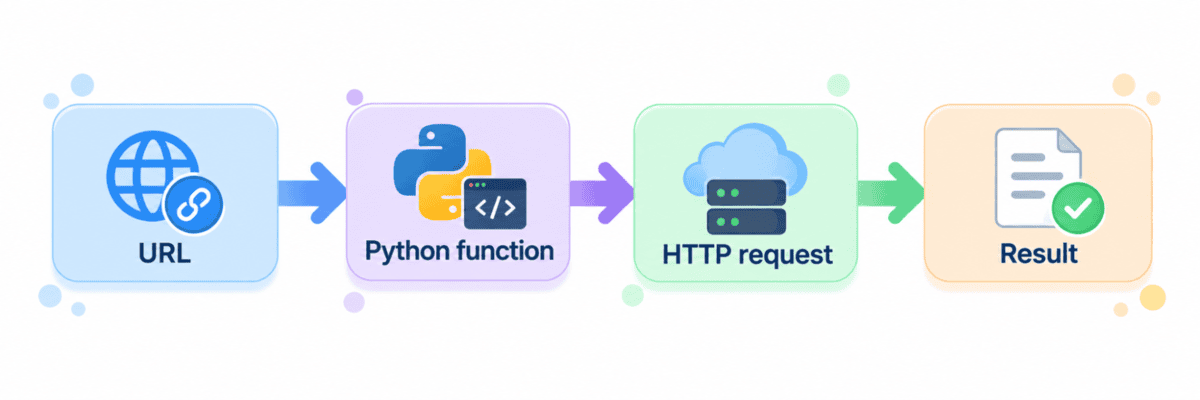
To understand the practical implications of this architectural shift, one must examine the limitations of traditional Python automation. In a conventional software environment, every possible execution path must be explicitly mapped out by the programmer. For instance, consider a routine system administration task, such as monitoring the operational health and response latency of a series of web servers. A standard Python script utilizing the popular requests library can systematically ping a predefined list of URLs, measure the time elapsed before receiving an HTTP response code, and print the resulting metrics to a console.
While highly reliable, this procedural model is fundamentally rigid. If an operator wishes to expand the scope of the operation—such as dynamically discovering URLs from an external database, comparing latencies across dozens of endpoints, filtering out intermittently failing servers, or generating a contextual executive summary of system health—the developer must write custom logic to handle each new conditional branch. As enterprise workflows grow increasingly complex, maintaining these hardcoded decision trees becomes cumbersome and resource-intensive.
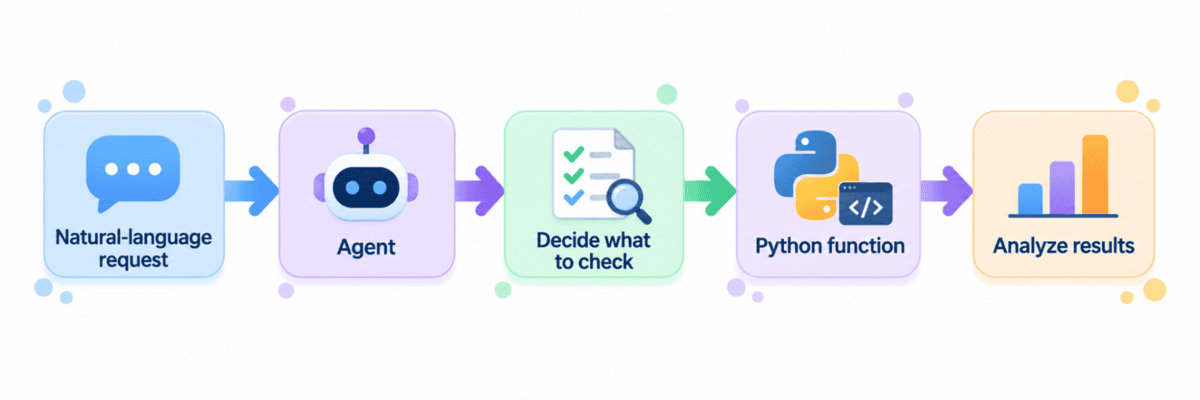
Agentic AI introduces a fundamentally different design pattern. Rather than prescribing the exact sequence of operations, the developer provides the model with a defined goal—such as identifying the slowest-performing server among a dynamic set of endpoints—alongside a collection of authorized capabilities, known as tools. The AI agent evaluates the user’s intent, dynamically selects the appropriate function, supplies the necessary arguments based on real-time context, evaluates the returned data, and decides whether further actions are required before delivering a final, synthesized answer.
The Mechanics of Tool Integration Using the OpenAI Agents SDK
The process of converting a standard Python function into an AI-driven tool has been significantly streamlined with the release of developer-focused runtimes like the OpenAI Agents SDK. Designed to provide a lightweight environment for managing agents, function tools, multi-agent handoffs, execution sessions, and tracing, the SDK abstracts away much of the underlying complexity associated with managing API payloads and JSON schema generation.
In a typical implementation, developers can retain the core business logic of their existing Python codebases virtually untouched. By importing the function_tool decorator from the SDK and applying it to a standard function, the framework automatically introspects the Python function signature, parameter types, and docstrings. It translates this metadata into the precise JSON schema required by the underlying language model, eliminating the need for developers to manually author and maintain tool definitions.
For example, a standard website monitoring function can be adapted for agentic use with minimal modification:
from time import perf_counter
import requests
from agents import function_tool

@function_tool
def check_website(url: str) -> str:
    """Check a website's HTTP status and response time."""
    start = perf_counter()
    try:
        response = requests.get(url, timeout=10)
        latency = perf_counter() - start
        return (
            f"URL: urln"
            f"Status: response.status_coden"
            f"Response time: latency:.2fs"
        )
    except requests.RequestException as error:
        return f"URL: urlnError: error"
Once decorated, the function is registered within an Agent instance, alongside a set of behavioral instructions and a specified model identifier. The agent runtime, managed by a component typically referred to as a Runner, orchestrates the iterative loop between the model’s reasoning engine and the local execution environment. When a user submits a query—such as requesting an evaluation of multiple high-profile web domains—the model evaluates the prompt, invokes the check_website tool autonomously for each domain, aggregates the latencies, and compiles a comprehensive comparative analysis.
Industry Context and Economic Factors Driving Agent Adoption
The rapid proliferation of agentic frameworks coincides with broader economic and technological trends within the artificial intelligence sector. Over the past several years, the cost of inference has declined precipitously, while the reasoning capabilities and speed of frontier and specialized models have continued to advance. The introduction of cost-efficient, high-performance models—such as specialized reasoning checkpoints optimized for tool use—has fundamentally altered the economic calculus of running multi-step agentic systems at scale.
Previously, executing complex agent loops involving multiple tool calls, validation steps, and conversational memory incurred prohibitive computational expenses, restricting such architectures to well-funded research laboratories or high-budget enterprise deployments. Today, with the availability of economical models capable of robust function calling, organizations of all sizes can embed agentic orchestration directly into standard production pipelines, customer service bots, automated data pipelines, and internal DevOps tooling.
Industry analysts note that this transition reflects a maturation of the generative AI market. While the initial wave of adoption centered on standalone chatbots and static content generation, the current phase emphasizes utility, systems integration, and autonomous task execution. Enterprises are increasingly prioritizing architectures that allow AI to interface directly with enterprise software, databases, and APIs securely and reliably.
Broader Implications for Software Engineering Practices
The ability to seamlessly layer natural-language intelligence on top of deterministic Python scripts carries profound implications for the future of software engineering. Rather than viewing artificial intelligence and traditional programming as mutually exclusive paradigms, modern development methodologies are increasingly embracing a hybrid approach where deterministic code handles heavy computation, input validation, and secure execution, while probabilistic models handle orchestration, intent recognition, and unstructured data synthesis.
This division of labor mitigates some of the primary concerns associated with generative AI, such as hallucinations and unpredictable behavior. Because the actual execution of tasks—such as sending network requests, querying databases, or modifying files—is performed by deterministic Python functions written by human engineers, the agent is constrained to operate within safe, predefined boundaries. The AI cannot execute arbitrary system commands unless an explicit function tool has been provided to permit such actions.
Furthermore, this modular architecture enhances code maintainability and testability. Developers can unit-test their Python functions independently of the AI model, ensuring that the underlying data processing logic remains robust and error-free. The AI layer simply acts as an intelligent consumer of these tested components, significantly reducing debugging complexity when system errors occur.
Looking Ahead: The Future of Tool-Using Applications
As developer ecosystems continue to mature, industry experts anticipate the emergence of standardized protocols for exposing application functionality to AI agents. Frameworks like the OpenAI Agents SDK represent early iterations of a broader movement toward universal agentic interoperability, where applications are inherently designed to be extensible by external or internal autonomous agents.
For software developers, mastering the integration of traditional scripts with agentic runtimes is rapidly becoming a core competency. By learning to structure functions as reusable tools, engineering teams can future-proof their applications, enabling them to adapt effortlessly to subsequent generations of language models and autonomous reasoning engines. The fundamental principle remains straightforward: provide the model with a clear objective, equip it with well-defined programmatic tools, and allow modern runtime infrastructure to manage the dynamic orchestration required to complete complex, multi-step tasks.