Invisible, high-speed messengers from deep space constantly bombard the Earth, passing through our bodies, buildings, and landscapes every second of every day without leaving a trace. These subatomic visitors originate from some of the most violent and energetic phenomena in the universe, including exploding stars, galactic collisions, and distant active galactic nuclei. When these cosmic rays collide with atoms in Earth’s upper atmosphere, they trigger a cascade of secondary particles, most notably muons. Until recently, studying these particles required bulky, expensive laboratory equipment accessible only to elite research institutions. That paradigm is shifting rapidly thanks to a compact, low-cost device called CosmicWatch.
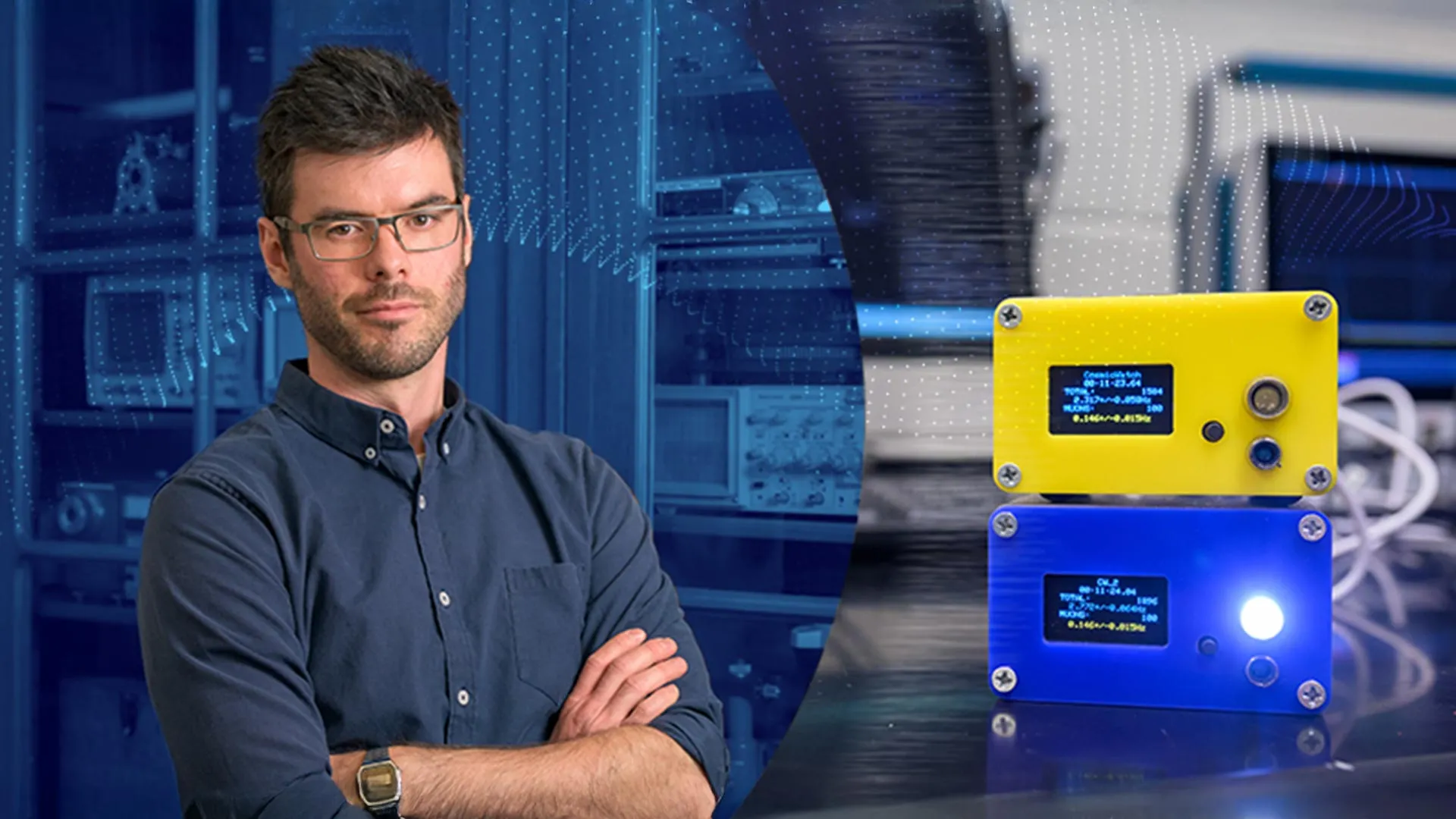
Invented by University of Delaware physics professor Spencer Axani, CosmicWatch is roughly the size of a box of animal crackers and costs approximately $100 in standard electronic components. Despite its modest dimensions and price tag, the device flashes and logs data every time a muon passes through its solid-state sensor. Originally designed as a humble pedagogical tool, the detector has quietly transcended its academic origins, finding a home in cutting-edge international astrophysics experiments, high-altitude space balloon payloads, and undergraduate laboratories across the globe. As researchers push the boundaries of portable particle physics, CosmicWatch stands as a testament to how democratized technology can alter the landscape of modern scientific research.
The Journey from Antarctic Ice to Global Classrooms
The origins of CosmicWatch trace back to 2017, when Axani was working as a graduate student at the Massachusetts Institute of Technology (MIT). At the time, his primary objective was to engineer a compact, energy-efficient muon detector for deployment at the IceCube Neutrino Observatory, a massive scientific installation buried a mile beneath the Antarctic ice sheet. IceCube was constructed to detect elusive subatomic particles known as neutrinos, but isolating them requires filtering out a massive background noise of atmospheric muons. Axani needed a reliable, low-power sensor to help distinguish between the two phenomena in the harsh polar environment.
As the development process unfolded, Axani realized that the underlying circuitry could be adapted for a completely different purpose. By stripping away specialized aerospace requirements and optimizing the design for accessibility, he recognized that the technology could serve as an invaluable educational tool. The device evolved into a portable platform capable of introducing students to the fundamentals of particle physics without requiring the million-dollar budgets traditionally associated with the field.
Following his appointment to the University of Delaware faculty in 2022, Axani continued refining the architecture of the device. This iterative process culminated in the recent release of the third-generation CosmicWatch model, detailed in an article published in the Journal of Instrumentation. The upgraded iteration incorporates advanced capabilities, including environmental self-monitoring, high-radiation tolerance, and significantly accelerated data-gathering speeds. Masooma Sarfraz, a doctoral student in Axani’s laboratory and the primary author of the journal study, noted that the project offered theoretical researchers a rare bridge into experimental science. For students accustomed to working strictly with equations and abstract models, the ability to physically construct a device that captures remnants of cataclysmic events hundreds of light-years away represents a transformative academic milestone.
Decoding the Universe Through Muons
To understand why the democratization of muon detection matters to the broader scientific community, one must examine the unique properties of muons themselves. When primary cosmic rays—predominantly high-energy protons and atomic nuclei—interact with nitrogen and oxygen molecules in the stratosphere, they generate unstable subatomic particles called pions. These pions rapidly decay into muons, which then streak toward the Earth’s surface at nearly the speed of light. Because of their mass and relativistic velocity, muons can traverse miles of the atmosphere and penetrate deep underground or pass straight through solid stone structures.
Astrophysicists study these particles because they preserve critical signatures of their cosmic origins. By measuring the directional vector, energy distribution, and flux of incoming muons, researchers can deduce the characteristics of the primary cosmic rays that generated them, providing indirect windows into distant supernovae, gamma-ray bursts, and blazars. Furthermore, muon detection holds a foundational place in the history of modern physics. In the early 1940s, precise measurements of atmospheric muons provided some of the earliest experimental validations of Albert Einstein’s theory of special relativity, specifically confirming the phenomenon of time dilation as fast-moving particles survived longer than their stationary counterparts would allow.
Beyond fundamental astrophysics, muons serve practical applications in geophysics and archaeology. Because these particles pass harmlessly through matter while leaving a predictable energy trail, scientists can use them to "image" the interior of dense objects through a technique known as muon radiography or muography. In 2016, this technology made global headlines when researchers used cosmic-ray muons to discover a previously unknown, massive internal void within the Great Pyramid of Giza without drilling a single hole or disturbing the ancient monument. Similar techniques are routinely deployed to monitor the internal magma chambers of active volcanoes and inspect the structural integrity of aging nuclear reactors.
Despite these wide-ranging applications, traditional muon detectors have historically posed significant logistical barriers. Conventional university laboratories often rely on massive racks of nuclear instrumentation modules—systems roughly the footprint of a small bookshelf—that cost thousands of dollars, require fragile photomultiplier tubes, and demand complex power supplies. This hardware-heavy approach restricts hands-on learning to advanced undergraduate or graduate programs with well-funded department budgets, leaving introductory students to observe demonstrations rather than engage in active experimentation.
Hands-On Physics and High-Altitude Balloons
By shrinking the necessary detection apparatus to a handheld, battery-powered footprint, CosmicWatch has fundamentally altered how institutions approach physics education. Natasha Holmes, the Ann S. Bowers Associate Professor of Physics at Cornell University, integrates the devices directly into her introductory undergraduate courses. According to Holmes, giving students the responsibility of assembling circuits, writing basic code to interpret data streams, and troubleshooting hardware failures creates an academic environment that mirrors professional experimental laboratories. Rather than following a rigid cookbook procedure with predetermined outcomes, students confront the unpredictable nature of real-world scientific inquiry—complete with occasional equipment mishaps and the subsequent lessons in hardware preservation.
This hands-on ethos extends directly to advanced student-led research initiatives at the University of Delaware. Musarate Shams, a doctoral candidate in UD’s quantum science and engineering program, took the modularity of the CosmicWatch design a step further by integrating custom temperature and pressure sensors into the device architecture. His objective was to investigate how cosmic-ray flux fluctuates across varying layers of the Earth’s atmosphere.
In May, Shams’ modified detector embarked on a high-altitude scientific balloon mission, ascending nearly 100,000 feet into the stratosphere near the edge of space. Upon retrieving the payload and analyzing the telemetry, Shams successfully mapped out the precise altitude profile of cosmic-ray intensity, demonstrating how particle concentrations shift as atmospheric shielding thinned out. The experiment underscored the versatility of the platform, proving that $100 worth of commercial electronics could successfully execute missions previously reserved for specialized aerospace instrumentation.
From Dark Matter Laboratories to Orbital Networks
While education remains a core pillar of the CosmicWatch initiative, the technology has increasingly woven itself into the fabric of advanced, large-scale physics experiments. The latest generation of the detector is currently deployed as a critical calibration tool within major research facilities, including the NuDot experiment at the University of Delaware and the Coherent CAPTAIN-Mills (CCM) dark matter detector located at Los Alamos National Laboratory in New Mexico. In these environments, precisely tracking muon backgrounds is vital for isolating rare, elusive signals that might indicate interactions with dark matter or sterile neutrinos.
Looking toward the future, Axani and his research team are actively developing specialized iterations of the detector engineered to withstand the extreme thermal and radiation environments of spaceflight. These space-rated variants could soon be integrated into upcoming rocket payloads and satellite buses to measure primary cosmic rays directly outside the protective envelope of Earth’s magnetic field and atmosphere.
Furthermore, the scalability of the hardware has unlocked ambitions for a planetary-scale citizen science initiative. Axani envisions a global network wherein thousands of independent operators—ranging from high school classrooms to amateur science enthusiasts—construct their own detectors and upload local muon monitoring data to a centralized cloud database. If realized, such a distributed sensor grid could provide real-time, high-resolution mapping of transient atmospheric phenomena and cosmic-ray variations across different geographic latitudes and weather systems.
Beyond ground-based applications, related detector systems conceptualized by Axani’s lab could soon alter how orbital infrastructure responds to space weather. By deploying coordinated detector networks across constellations of satellites, spacecraft could automatically communicate regarding localized radiation spikes caused by solar flares or coronal mass ejections. This localized environmental awareness would allow commercial and scientific satellites to autonomously enter safe modes or power down sensitive electronics before severe space weather damages critical onboard systems.
What began eight years ago as a graduate student’s makeshift solution for an Antarctic ice observatory has blossomed into a multifaceted technological platform influencing pedagogy, geophysics, dark matter research, and aerospace engineering. As thousands of these compact devices continue to tick away in classrooms and laboratories worldwide, they quietly capture the invisible history of the cosmos, one fleeting muon at a time.