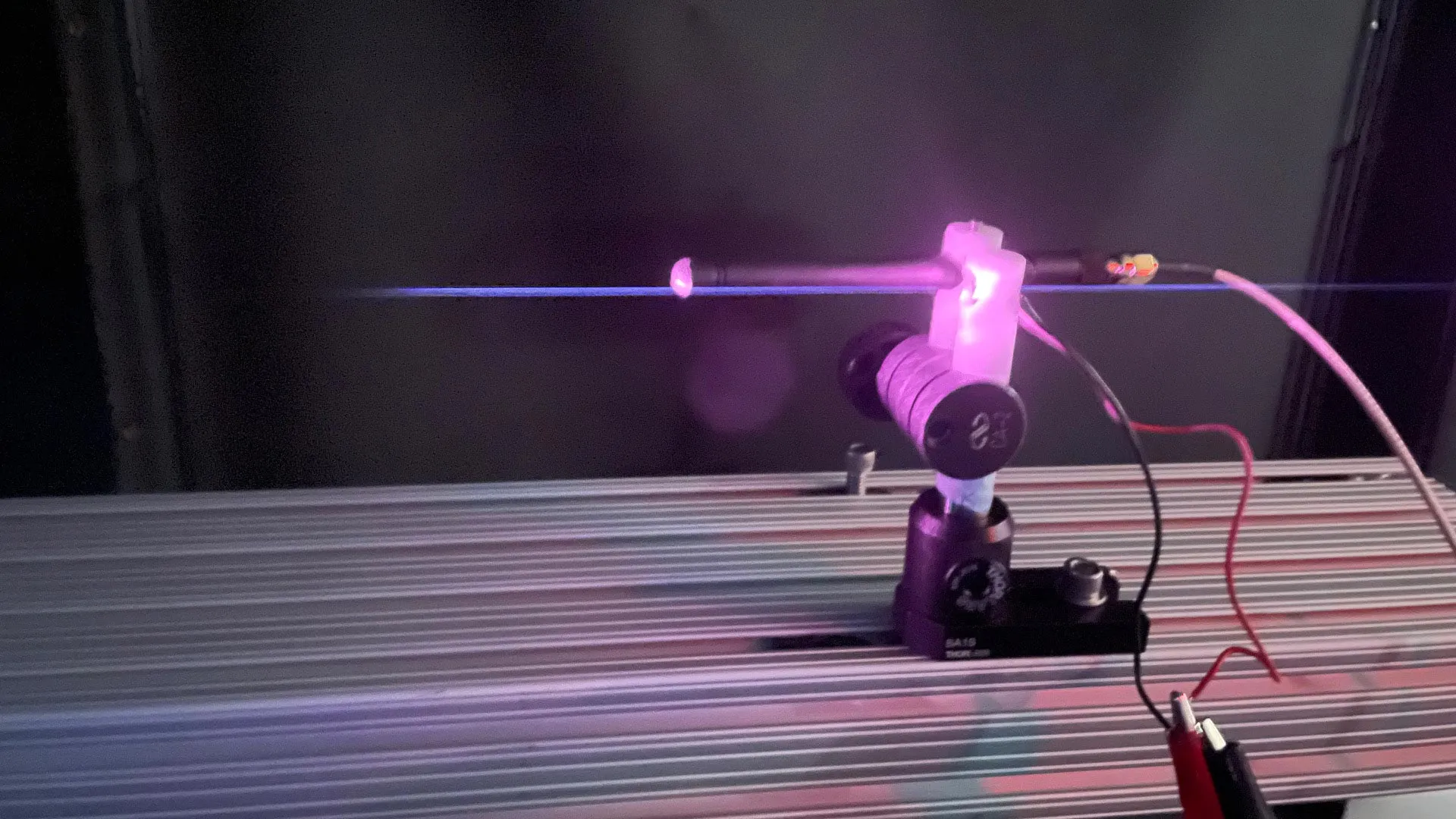
In a striking convergence of science fiction and cutting-edge electrical engineering, researchers at North Carolina State University have successfully demonstrated a radical new type of radio frequency antenna that bears an uncanny resemblance to a science-fiction lightsaber. Abandoning traditional metallic structures entirely, this novel device utilizes a precisely controlled laser beam to carve a narrow channel of plasma through the air, creating a functional, glowing conduit capable of transmitting robust radio waves. This breakthrough bypasses decades-old engineering constraints that have long governed wireless communications, opening a promising frontier for dynamic frequency modulation, aerospace engineering, radar systems, and deep-space exploration.
The foundational research, detailed in the open-access publication of the IEEE Journal of Microwaves under the title Laser-Induced-Plasma-Filament Antenna Transmitting 30 MHz VHF, was spearheaded by a multidisciplinary team. The corresponding author of the study is Prya Darshni, a Ph.D. student in electrical and computer engineering at NC State, alongside co-author Paul Franzon, the Cirrus Logic Distinguished Professor of Electrical and Computer Engineering at the institution. Additional critical contributions to the experimental measurements and design came from Arthur Dogariu of Texas A&M University and Princeton University, as well as specialized fabrication support from the NC State Instrument Shop.
The Engineering Challenge: Rigid Metal and Mechanical Limits
To understand the profound significance of this plasma-based breakthrough, one must examine the limitations inherent in conventional radio frequency (RF) architecture. Since the dawn of wireless telecommunications, antennas have relied overwhelmingly on solid conductors—typically copper, aluminum, or other metals—to capture and broadcast electromagnetic radiation.
A fundamental principle governing these traditional systems is that an antenna’s physical dimensions dictate its resonant frequency. The length of a dipole or monopole antenna, for instance, correlates directly with the wavelengths it can efficiently transmit or receive. Engineers frequently need to alter these parameters to switch between disparate communication frequencies. However, doing so traditionally requires bulky, failure-prone mechanical deployment systems, motorized telescoping booms, or complex switching networks.
These rigid physical constraints become exponentially more problematic in aerospace and satellite engineering, where every gram of payload weight and cubic centimeter of volume carries a steep financial and operational penalty. Traditional antennas deployed in space must be meticulously folded, stowed inside launch vehicles, and subsequently unfurled via complex mechanical linkages—systems that present numerous points of potential mechanical failure in the harsh vacuum of orbit.
For years, researchers theorized about the potential advantages of plasma antennas. Because plasma—frequently termed the fourth state of matter—consists of a hot, ionized gas containing free-flowing ions and electrons, it possesses electrical conductivity. When properly contained or guided, plasma can interact dynamically with electromagnetic fields, effectively mimicking a metallic conductor. Previous attempts to harness plasma for communications relied heavily on gas-discharge tubes, glass enclosures, or confined chemical chambers. While functional, these enclosed plasma devices remained rigid, heavy, and bounded by the physical glass or ceramic containers holding the ionized gas, defeating many of the weight-saving and dynamic advantages plasma theoretically offered.
Chronology and Experimentation: Forging Plasma in Open Air
The journey toward the laser-induced plasma filament antenna represents a methodical evolution in laser-matter interaction physics. The concept of utilizing high-intensity lasers to ionize atmospheric air has been studied for decades in contexts such as atmospheric remote sensing, lightning control, and directed energy research. However, applying this phenomenon specifically to wireless telecommunications as a transient, on-demand antenna element is entirely unprecedented.
The experimental timeline leading to this publication began with theoretical modeling of laser-induced filamentation. When an ultra-short, high-intensity laser pulse propagates through the atmosphere, a delicate balance is struck between optical Kerr self-focusing—which pulls the light beam inward—and plasma defocusing caused by the ionization of air molecules. This equilibrium results in a narrow, high-intensity beam of light capable of traveling significant distances without spreading, leaving behind a stable, micro-channel of plasma in its wake.
In their laboratory setup, the NC State research team directed an advanced pulsed laser through ambient laboratory air. By meticulously calibrating the laser’s power output, pulse duration, and beam diameter, the team successfully stripped electrons from atmospheric molecules, ionizing a narrow, pencil-thin region of air. This process generated what scientists call a plasma filament—a luminous, highly conductive channel acting as the core structural component of the new antenna.
However, generating the plasma beam solved only half the engineering equation. The critical hurdle remaining was how to couple radio frequency electrical energy into a transient, non-solid column of ionized air without physically welding or wiring a metal terminal to it.
To achieve this contactless coupling, the researchers engineered a specialized feeding mechanism centered around a high-precision metal ring acting as a capacitor. The laser beam was directed straight through the center of this ring. As the laser ionized the air, the resulting plasma filament extended directly through the capacitor’s intense localized electromagnetic field. This clever contactless architecture permitted the team to transfer electrical energy efficiently from a radio frequency generator directly into the floating plasma column without any physical tethers.
Upon energizing the system, the plasma filament successfully interacted with the applied electromagnetic fields, broadcasting crisp radio waves at 30 megahertz (MHz)—firmly establishing functionality within the very high frequency (VHF) radio band.
Official Responses and Academic Analysis
The academic community has responded to the demonstration with considerable enthusiasm, viewing it as a watershed moment for applied electromagnetics.
"This is an exciting new concept that enables one to be able to have a customized antenna without complex mechanical deployment mechanisms," noted Paul Franzon, emphasizing the massive reduction in mechanical complexity this technology promises. By eliminating heavy gears, hinges, and motors, spacecraft and remote sensing platforms could theoretically shed significant structural weight.
Prya Darshni underscored the unprecedented nature of the achievement, highlighting both the immediate success and the broad horizons left to explore. "The plasma beam antenna looks like a lightsaber and is tunable, meaning we should be able to transmit across a broad range of frequencies," Darshni stated. "And while we have not demonstrated its ability to serve as an antenna that can receive radio signals, there’s no reason to believe it wouldn’t also work as a receiver."
Furthermore, Darshni pointed out the dual advantages of tunability and directional agility. "By controlling the parameters of the laser, you can control the characteristics of the plasma filament—including its length. This is valuable for applications where you need an antenna that can sweep all frequencies. There are also applications where it is important to be able to control the angle of the antenna, in order to target the direction of radar sweeps or to improve the strength of a signal you want to pick up. The technique we’ve demonstrated here would allow users to control the angle of the plasma filament antenna via beam steering—simply shifting the direction of the laser."
Broader Impact and Future Implications
The implications of a laser-generated, lightsaber-style plasma antenna extend far across commercial, scientific, and defense sectors. While the research is currently categorized as a fundamental proof-of-concept, the prospective real-world applications merit serious consideration from systems architects across multiple industries.
In the realm of satellite communications and deep-space exploration, weight budgets are tightly managed. Launch providers charge exorbitant fees per kilogram of payload delivered to low Earth orbit (LEO) or geostationary transfer orbits. Traditional deployable antennas are heavy, mechanically fragile, and occupy considerable volumetric space within the fairing of a rocket. A spacecraft equipped with a laser-plasma antenna system would theoretically only need a compact laser emitter and a beam-steering mirror assembly. When radio communications or radar mapping operations are required, the spacecraft could instantaneously "draw" an antenna of precise length and orientation out of the surrounding thin atmosphere or localized gas containment system, and dissolve it just as quickly when operations cease.
Addressing the viability of space deployment, Franzon noted, "In low earth orbit, there is sufficient air to form a plasma." Although Earth’s upper atmosphere features a vastly reduced density compared to sea level, specialized laser configurations could theoretically ionize residual atmospheric particles or utilize onboard noble gases to maintain the plasma conduit in a vacuum environment.
Beyond aerospace, defense radar systems could experience a paradigm shift. Conventional phased-array radar systems rely on thousands of stationary solid-state elements, phase shifters, and complex beam-forming networks to steer radar beams electronically without moving parts. A plasma-filament antenna offers an alternative paradigm: dynamic, high-speed beam steering achieved simply by redirecting the optical path of an ionizing laser. Because light travels at maximum velocity, the agility of a laser-steered plasma antenna could theoretically outpace conventional electronic switching speeds in specific high-interference environments.
The Road Ahead: Overcoming Technical Hurdles
Despite the excitement surrounding the demonstration, the research team is quick to emphasize that the technology remains in its infancy. Several critical engineering milestones must be achieved before plasma-filament antennas replace traditional hardware in commercial or aerospace products.
First, while the team has definitively proven that a laser-induced plasma filament can act as an effective transmitter in the 30 MHz VHF band, comprehensive testing is still required to verify its capabilities as a receiver. Receiving incoming radio waves requires the plasma column to capture faint electromagnetic variations and translate them back into measurable electrical currents via the contactless capacitor feed—a process that introduces unique signal-to-noise ratio challenges.
Second, researchers must evaluate the energy efficiency of the system. Generating plasma via laser filamentation requires substantial optical energy. For the technology to become commercially viable in remote or battery-powered deployments, the net energy expended by the laser must be carefully balanced against the operational advantages gained in transmission quality and mechanical simplicity.
Finally, atmospheric interference—such as severe weather, high winds, and moisture—can scatter or disrupt laser propagation outdoors. Understanding how plasma-filament antennas perform under turbulent, real-world meteorological conditions will dictate whether terrestrial applications are feasible or if the technology will remain primarily localized to high-altitude, stratospheric, or space-based environments.
For now, the NC State team views their achievement as a monumental first step that shatters long-held assumptions regarding antenna design. "This is the first step, but it is a big step—it is the first time anyone has ever demonstrated that plasma-filament antennas can work," Darshni concluded. "Now that we’ve shown it is possible, we can begin improving its performance." As laboratories worldwide review these findings, the science-fiction aesthetic of the lightsaber antenna may soon become a cornerstone of next-generation global and interplanetary telecommunications.