Artificial intelligence is fundamentally transforming the lifecycle of software development, altering how digital products are conceptualized, constructed, deployed, and evaluated across industries. As enterprises increasingly transition from experimental machine learning proofs-of-concept to production-grade offerings, industry observers note that the primary hurdle is no longer constrained by academic research or algorithmic capability. Instead, the persistent challenge lies in the domain of product execution: bridging the chasm between a promising artificial intelligence prototype and a robust application that end-user populations can reliably trust. Navigating this operational and strategic chasm is the core mandate of the modern artificial intelligence product manager.
Unlike traditional software product managers who operate within deterministic systems characterized by predictable, rule-based inputs and outputs, artificial intelligence product managers must navigate stochastic environments. In these systems, model outputs dynamically shift, occasionally hallucinate, and exhibit variance across diverse user demographics and edge cases. Consequently, the contemporary product management role demands deep cross-functional literacy spanning machine learning trade-offs, systematic evaluation infrastructures, compute economics, and evolving regulatory frameworks. Furthermore, these professionals must translate these complex technical dynamics clearly across disparate stakeholders, including software engineers, legal counsel, compliance officers, and executive leadership.
Industry analysts trace the rapid evolution of the artificial intelligence product management discipline across a distinct timeline over recent years. Between 2022 and 2023, the industry experienced a chaotic proliferation of generative models and application programming interface wrappers, largely driven by executive enthusiasm and a gold-rush mentality. During this foundational era, traditional product managers often relied on superficial prompt engineering and basic wrappers to ship rapid prototypes. By 2024 and 2025, market realities forced a structural correction. Escalating inference costs, unexpected model drift, high-profile hallucinations, and emerging data privacy regulations exposed the fragility of naive implementations. Organizations realized that sustainable artificial intelligence initiatives required rigorous architectural planning, quantitative unit economic modeling, and continuous evaluation methodologies. Looking toward 2026, the artificial intelligence product manager has crystallized into a distinct, highly specialized professional discipline, moving away from generalized tech product oversight toward rigorous, compliance-aware, and cost-optimized orchestration.
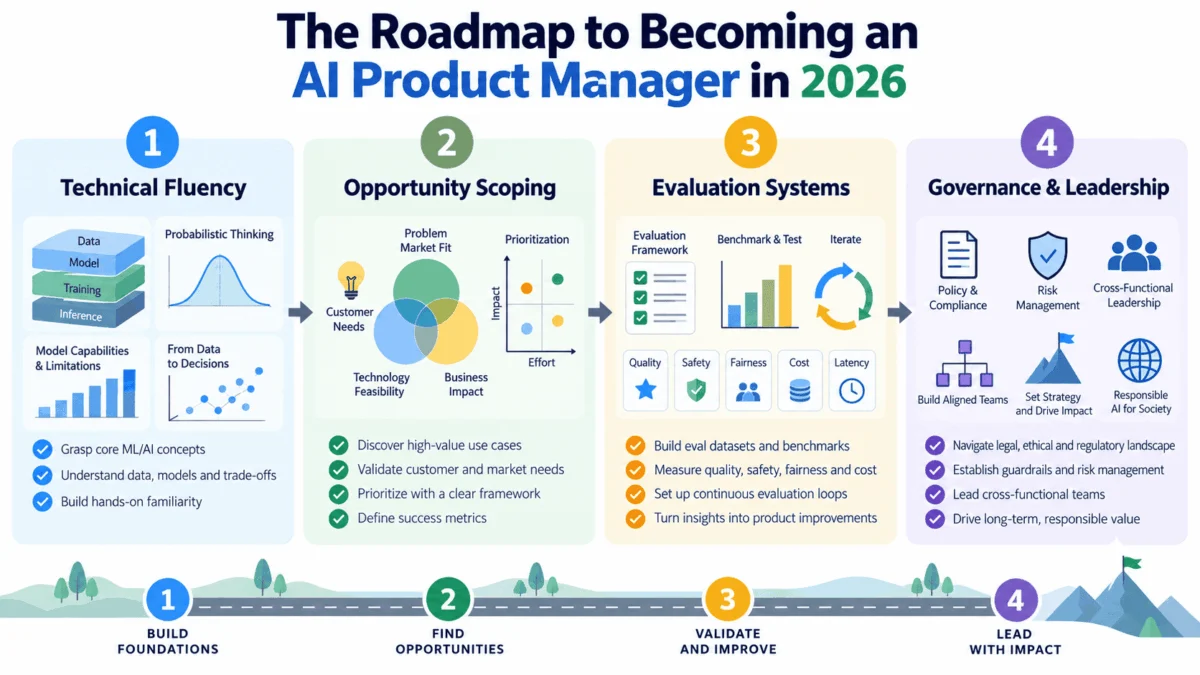
To demystify this career trajectory and establish a structured pathway for aspiring practitioners, industry experts have mapped the transition into a four-phase competency framework. This progression moves systematically from foundational technical fluency to organizational leadership, emphasizing that each developmental stage builds directly upon the preceding mindset shifts.
Cultivating Technical Fluency and the Probabilistic Mindset
The primary psychological and operational adjustment required for an aspiring artificial intelligence product manager is the abandonment of deterministic thinking in favor of a probabilistic framework. Traditional software engineering operates on clear, deterministic principles: given a specific input A, the system consistently yields a predictable output B. Conversely, artificial intelligence architectures produce outputs that are inherently probabilistic, approximate, and context-dependent. Rather than viewing this non-determinism as a software defect to be engineered away, effective product managers treat variable outputs as the primary operational terrain to be managed and bounded.
Achieving this perspective requires building working intuition around major architectural patterns and design choices commonly encountered in modern machine learning stacks. Practitioners must understand the structural differences and trade-offs inherent in fine-tuning foundational models versus implementing Retrieval-Augmented Generation architectures. Additionally, product managers need to comprehend the operational mechanics of vector databases, embedding spaces, and context-window constraints. While product managers are rarely expected to write production-grade model training scripts, they must possess sufficient technical depth to challenge engineering assumptions during roadmap planning, evaluate technical feasibility accurately, and ask incisive questions during architectural reviews.
Throughout this initial phase, professionals must simultaneously master the management of three persistent, interconnected tensions: latency, operational cost, and output accuracy. Metrics such as token consumption rates, time-to-first-token latency, and context-window sizing surface continuously in day-to-day technical discussions. Industry veterans recommend immersing oneself in comprehensive technical literature, such as "Hands-On Large Language Models" by Jay Alammar and Maarten Grootendorst, alongside practical machine learning curricula like fast.ai, to develop architectural intuition without demanding heavy advanced mathematics prerequisites. To solidify these concepts, aspiring practitioners are encouraged to construct a comprehensive evaluation matrix comparing multiple architectural approaches applied to a singular business case, such as enterprise customer support automation, and document the underlying trade-offs in writing.
AI Opportunity Discovery and Feasibility Scoping
Once a foundational technical vocabulary is established, the secondary competency involves identifying which artificial intelligence opportunities are genuinely viable for commercial deployment and separating high-value initiatives from unfeasible novelties. Strategic opportunity discovery requires analytical frameworks that look past the novelty of generative technologies to evaluate tangible business value and systemic risk.
Industry frameworks such as the artificial intelligence product canvas assist teams in mapping specific business tasks along two distinct axes: the quantitative value delivered if the system performs optimally, versus the operational or reputational risk incurred if the model fails. High-leverage, low-risk use cases—such as routine document summarization, automated text classification, and structured information extraction—frequently serve as optimal candidates for initial enterprise deployment. Conversely, high-risk tasks involving automated financial transactions, medical diagnoses, legal compliance, or irreversible actions demand substantial evaluation and guardrail infrastructure before any production rollout can be considered.
A critical operational responsibility within this phase involves executing the complex build-versus-buy-versus-assemble evaluation. This decision matrix requires balancing technical capabilities against financial realities, most notably through modeling the unit economics of compute. Product managers must project how gross margins will hold up as token consumption scales across enterprise user bases. They must analyze how GPU cloud hosting expenses compare against per-call application programming interface fees under varying volume scenarios, and calculate the infrastructural costs associated with deep vector database queries. Establishing mastery over inference-layer cost modeling distinguishes sustainable artificial intelligence products from impressive technical demonstrations that experience catastrophic financial failure under production loads.
To navigate this landscape, industry leaders frequently reference continuous discovery methodologies pioneered by product strategists like Teresa Torres, alongside market analyses from venture capital firms tracking macro-level technology shifts. Aspiring product managers can strengthen their portfolios by drafting formal build-versus-buy recommendations for specific enterprise use cases, complete with detailed token cost projections and infrastructure cost models.
User Experience Design, Evaluation Systems, and Iterative Improvement
The third phase of the roadmap highlights the sharpest divergence between conventional software product management and artificial intelligence product management. Because modern machine learning outputs are inherently probabilistic, development teams cannot rely exclusively on binary pass-or-fail unit testing. Instead, organizations must build and maintain comprehensive evaluation infrastructures designed specifically for non-deterministic software.
Designing user interfaces for probabilistic systems introduces unique human-computer interaction challenges. Product managers must determine how to communicate system uncertainty to end-users without systematically eroding trust. They must establish graceful degradation states for scenarios where the model yields incorrect or incomplete information, and they must strategically integrate human-in-the-loop checkpoints. Furthermore, product systems must capture continuous feedback signals—ranging from explicit user ratings to implicit behavioral metrics—that allow the underlying application to improve over time.
On the technical evaluation front, teams must embrace evaluation-driven development. This methodology requires establishing golden datasets, automated evaluation pipelines, and continuous regression testing frameworks to measure model performance drift whenever underlying model weights or prompt templates change. Comprehensive adversarial testing, commonly referred to as red-teaming, is an absolute prerequisite prior to launching any user-facing artificial intelligence capability. Structured red-teaming protocols—including prompt injection simulations, boundary probing, and worst-case scenario stress tests—must be embedded directly into pre-launch engineering checklists rather than treated as post-deployment considerations. Specialized resources, such as chip-level system design guides and evaluation libraries like RAGAS and PromptFoo, provide essential technical tooling for this phase.
Governance, Compliance, and Organizational Leadership
The final maturity phase of the artificial intelligence product management roadmap shifts the operational focus from initial product building to enterprise-level scaling, transitioning individual technical contributions into broad organizational influence. As artificial intelligence applications scale across global markets, they encounter complex regulatory, legal, and cultural environments that require the product manager to act as an effective translator between technical engineering squads, legal departments, and executive leadership.
Regulatory literacy has rapidly transformed from a specialized legal concern into a core operational requirement for product management professionals. Legislative milestones, including the European Union Artificial Intelligence Act, national executive orders regarding artificial intelligence development, and sector-specific compliance mandates within healthcare, insurance, and financial services, directly dictate permissible product architectures, deployment jurisdictions, and mandatory documentation standards. While product managers are not expected to function as licensed attorneys, they must possess sufficient regulatory awareness to flag compliance exposure early in the product lifecycle and collaborate productively with corporate legal counsel.
Concurrently, data lineage and privacy management remain ongoing operational priorities. Product managers must oversee data sanitization pipelines, audit which customer inputs are transmitted to external model providers, and define transparent enterprise opt-out policies. In enterprise sales cycles, strict adherence to SOC 2, ISO, and HIPAA standards frequently dictates architectural decisions regarding data residency and model hosting options.
Industry observers note that the most critical, yet underappreciated, skill at this advanced leadership level is cross-functional orchestration. The artificial intelligence product manager must successfully align research engineers who think strictly in benchmark metrics, legal teams focused on liability mitigation, and business executives prioritizing revenue generation and risk management. By maintaining narrative and strategic fidelity across these diverse groups, the product manager ensures that artificial intelligence initiatives deliver sustainable commercial value while maintaining rigorous safety and ethical standards.