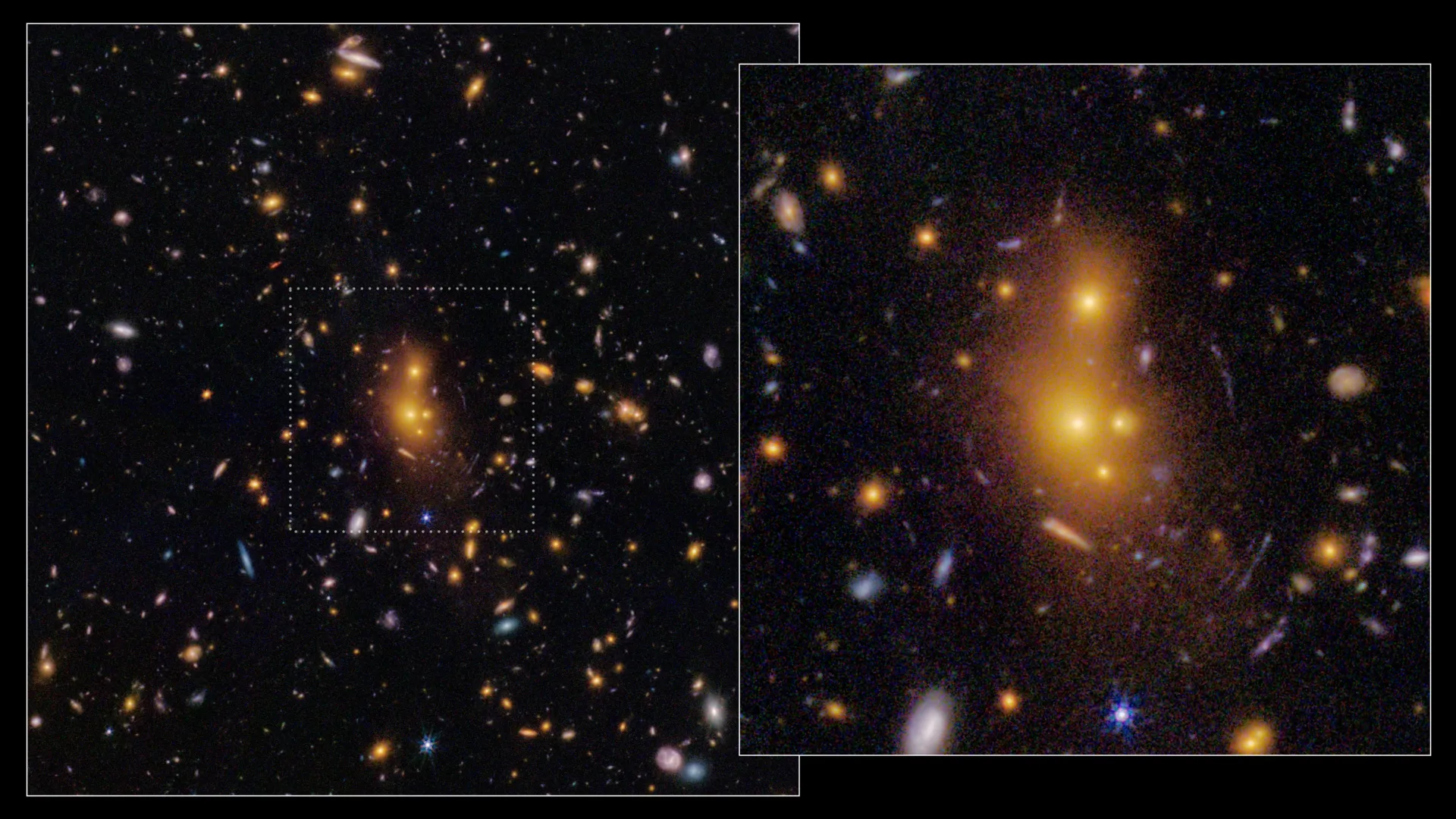
The scientific consensus regarding the evolution of the early universe is facing a rigorous test following new observations from the James Webb Space Telescope (JWST). Astronomers analyzing data concerning a massive, distant galaxy cluster known as XLSSC 122 have discovered an exceptionally dense concentration of matter dating back to an era when such colossal structures were theoretically in their infancy. Presented on June 17, 2026, during the 248th meeting of the American Astronomical Society, a trio of recent studies led by researchers at IPAC—Caltech’s science and data center for astrophysics and planetary science—has established this system as the most distant galaxy cluster known to exhibit strong gravitational lensing. This unprecedented finding suggests that certain cosmic structures developed at a significantly faster rate than current standard cosmological models predict, forcing astrophysicists to reevaluate how galaxies and dark matter aggregated during the formative epochs of the universe.
Chronology of Discovery: From XMM-Newton to JWST
The identification of XLSSC 122 represents a triumph of multi-wavelength astronomy, unfolding across more than a decade of technological advancements. The timeline of its discovery and analysis illustrates the rapid evolution of observational capabilities in modern astrophysics:
- 2014: European Space Agency’s XMM-Newton spacecraft initially flags XLSSC 122 during a routine wide-area X-ray survey, identifying it as a promising candidate for a distant, massive cluster.
- Post-2014 (Hubble Era): Subsequent observations utilizing the Hubble Space Telescope confirm that the cluster is situated approximately 10.4 billion light-years from Earth. Hubble data also indicates that the system possesses a level of maturity and organization uncharacteristic of its age, though it fails to capture definitive evidence of strong gravitational lensing.
- Present Era (JWST Observations): The James Webb Space Telescope captures high-resolution infrared imagery of XLSSC 122. The telescope reveals distinct, curved arcs of light encircling the cluster’s core, confirming the presence of strong gravitational lensing and allowing researchers to map its mass with unprecedented precision.
- June 17, 2026: Researchers from IPAC and Yonsei University formally present three comprehensive studies on XLSSC 122 at the 248th meeting of the American Astronomical Society, detailing its mass concentration, merger status, and intracluster light distribution.
Located approximately 10.4 billion light-years away, XLSSC 122 exists within a temporal milestone known to astronomers as "cosmic noon." Occurring roughly 10 billion years ago, this period was characterized by the universe’s most intense phase of star formation, during which galaxies generated stars at rates up to 100 times higher than those observed in the present epoch. Simultaneously, smaller galactic systems were systematically coalescing into larger clusters. However, the physical dimensions and structural organization of XLSSC 122 closely mirror those of mature clusters found in the modern universe, presenting an immediate chronological paradox for cosmological simulations.
Unlocking the Invisible: Strong Gravitational Lensing and Dark Matter
The primary breakthrough enabled by the James Webb Space Telescope involves the phenomenon of strong gravitational lensing. XLSSC 122 fortuitously lies directly along the line of sight between Earth and one or more background galaxies situated at even greater distances. The immense gravitational field exerted by the cluster acts as a cosmic magnifying glass, bending and distorting the light originating from these background systems into prominent, curved arcs.
This optical distortion provides astrophysicists with a direct methodology for measuring the total mass of the foreground cluster, independent of its luminous content. Kyle Finner, a staff scientist at IPAC and lead author of the primary study, emphasized the significance of this observation. When the initial images were processed, the research team immediately recognized the rare signature of strong lensing. By establishing XLSSC 122 as the most distant cluster to exhibit this effect, the team secured a vital empirical benchmark for probing the distribution of mass in the early cosmos.
Crucially, the vast majority of the mass revealed through gravitational lensing is invisible. While XLSSC 122 contains luminous stars, dense interstellar gas, and plasma, these conventional forms of matter account for only a minor fraction of the cluster’s total gravitational pull. The lion’s share of the distortion is driven by dark matter—an elusive substance that does not emit, absorb, or reflect electromagnetic radiation, yet is estimated to be approximately five times more abundant than ordinary baryonic matter.
Dark matter forms the structural scaffolding of the universe, providing the gravitational backbone necessary to hold galaxies within clusters and filaments. Because dark matter dictates the growth rate of cosmic structures, determining its spatial distribution during cosmic noon serves as a strict test of the Lambda-CDM model, the standard paradigm of cosmology that describes the universe’s expansion and evolution since the Big Bang 13.8 billion years ago.
Weak Lensing, Cluster Mergers, and Intracluster Light
To construct a comprehensive profile of XLSSC 122, the research team—including first authors Zachary Scofield and Hyungjin Joo of Yonsei University—expanded their investigation beyond strong lensing to incorporate weak gravitational lensing. While strong lensing produces striking optical arcs near a cluster’s core, weak lensing induces subtle, statistically measurable distortions in the shapes of a multitude of distant background galaxies across a wider field.
By combining strong and weak lensing analyses with auxiliary X-ray and radio observations, the scientists determined that XLSSC 122 is actively undergoing a major cluster merger. The constituent sub-clusters are presently colliding and integrating, a dynamic process that accounts for the distorted morphology observed in the outer regions. Furthermore, these combined datasets reinforced the initial anomaly: an unusually large fraction of the cluster’s total mass is heavily concentrated within its central core. Standard cosmological simulations generally dictate that such concentrated mass distributions require a longer duration to assemble than the age of XLSSC 122 permits.
The third study conducted by the team uncovered another diagnostic feature: diffuse intracluster light (ICL). This faint starlight originates from stars that have been stripped away from their host galaxies during gravitational encounters and galactic collisions, leaving them to drift freely within the intergalactic space of the cluster. JWST’s high sensitivity allowed the team to capture what is currently the earliest known detection of intracluster light in the distant universe.
Intriguingly, spatial mapping revealed a direct correlation between the distribution of this wandering starlight and the underlying dark matter inferred from strong gravitational lensing near the cluster’s core. The alignment indicates that intracluster light can serve as a visible tracer for invisible dark matter in distant systems, offering astronomers an accessible proxy for mapping dark matter distribution without relying exclusively on lensing calculations.
Implications for Modern Cosmology and Future Research
The discovery surrounding XLSSC 122 carries profound implications for our understanding of cosmic evolution. If additional galaxy clusters from the era of cosmic noon are found to possess similarly advanced development and hyper-concentrated dark matter profiles, theoretical physicists may be forced to revise foundational assumptions regarding structure formation in the early universe. Accelerated assembly rates could indicate gaps in current dark matter theories, modified understandings of gravitational dynamics on cosmological scales, or the need to adjust parameters governing the initial density fluctuations seeded during inflation.
Addressing these broader questions will require expanding the observational sample size significantly. Due to its high-resolution optics, the James Webb Space Telescope features a relatively narrow field of view, making it an efficient instrument for targeted deep-dive analyses rather than wide-area sky mapping. Consequently, astronomers must rely on a complementary strategy.
Future research will utilize wide-area X-ray surveys and radio observations—particularly those exploiting the Sunyaev-Zel’dovich effect, wherein high-energy electrons within massive clusters thermally alter the cosmic microwave background radiation—to identify prospective ancient cluster candidates. Once cataloged by these large-scale surveys, individual targets can be subjected to targeted high-resolution imaging via JWST.
As researchers prepare to analyze subsequent targets, XLSSC 122 stands as a compelling anomaly that tests the limits of contemporary astrophysical theory. Whether this ancient mega-cluster represents an exceptionally rare statistical outlier or the first discovered member of a widespread population of accelerated cosmic structures remains to be determined. As the astronomical community enters a new phase of observation, assembling a comprehensive census of dozens or hundreds of similar systems will be essential to verify whether current cosmological models require fundamental revision.