A hidden microenvironmental factor has long dictated the success or failure of numerous chemical reactions, silently undermining experiments even when macro-level conditions appeared ideal. Recently, a team of researchers at the Seoul National University College of Engineering identified this variable—termed "local pH"—and successfully harnessed it to drastically improve chemical manufacturing efficiency. By dynamically managing the microscopic acidity and alkalinity directly adjacent to reaction electrodes, the research team elevated the proportion of a desired target product from roughly 16 percent to an astonishing 97 percent.
Led by Professor Jaeyune Ryu of the Department of Chemical and Biological Engineering, alongside co-first authors Seonghyeon Min and Junghoon Lee and integrated M.S./Ph.D. student Hanju Kim, the breakthrough paves the way for cleaner, safer, and more efficient production methods. Published in the prestigious Journal of the American Chemical Society (JACS), the discovery centers on organic electrosynthesis, an electrical approach to driving carbon-based chemical transformations. By utilizing ambient oxygen and electrical current rather than hazardous external chemical oxidants, the team demonstrated a versatile framework for synthesizing vital industrial components, including lactones and epoxides, which serve as foundational building blocks for biodegradable plastics, pharmaceuticals, electronics, and advanced adhesives.
Main Facts and the Mechanics of Local pH
At the heart of the discovery is a physical reality often overlooked in electrochemistry: the microscopic chemical environment immediately surrounding an electrode differs vastly from the bulk solution in which it is immersed. During electrochemical reactions, hydrogen ions—commonly referred to as protons—are continuously generated or consumed at the electrode surfaces. If these protons are produced or removed faster than they can diffuse through the liquid medium, sharp gradients in acidity and alkalinity form.
For years, scientists optimizing organic electrosynthesis have concentrated primarily on macro-level variables: applied electrical voltage, electrode materials, catalysts, and the bulk composition of the electrolyte solution. However, the Seoul National University team suspected that microscopic conditions at the exact point of electron exchange were driving unexpected reaction failures.
To quantify this phenomenon, the researchers analyzed over 600 scientific papers on organic electrosynthesis published globally since 2010. Their investigation revealed that approximately 89 percent of these studies involved reactions at one or more electrodes where both electrons and protons were simultaneously transferred. This widespread overlap confirms that uncontrolled local pH variations are likely a pervasive, hidden issue across a vast spectrum of electrochemical processes.
Measurements conducted by the team illustrated the extreme nature of these gradients. Even when the bulk solution remained entirely neutral, conditions at the cathode—where reduction reactions take place—could spike to roughly pH 11, creating a deeply alkaline environment. Conversely, the region surrounding the anode, site of oxidation, could plummet to roughly pH 2.5, establishing a highly acidic microclimate. These localized extremes severely disrupt chemical stability, alter starting materials, diminish the availability of necessary reactive oxygen species, and cause newly formed products to prematurely degrade.
Chronology and Research Timeline
The foundational work leading to this milestone spanned several years of rigorous laboratory experimentation, computational simulation, and literature review within Professor Ryu’s laboratory at Seoul National University.
The investigative phase began with an exhaustive meta-analysis of electrochemical literature from the past decade to map how frequently proton-coupled electron transfers occurred in modern organic synthesis. Recognizing that nearly nine out of ten recent studies operated under conditions vulnerable to local pH fluctuations, the team shifted their focus to a classic benchmark transformation: the Baeyer-Villiger oxidation.
Traditionally, the Baeyer-Villiger reaction—which converts ketones into esters or lactones via oxygen insertion—relies heavily on hazardous peroxyacids and other external chemical oxidizing agents. These conventional reactants introduce significant safety hurdles, demanding rigorous handling protocols and generating substantial chemical waste.
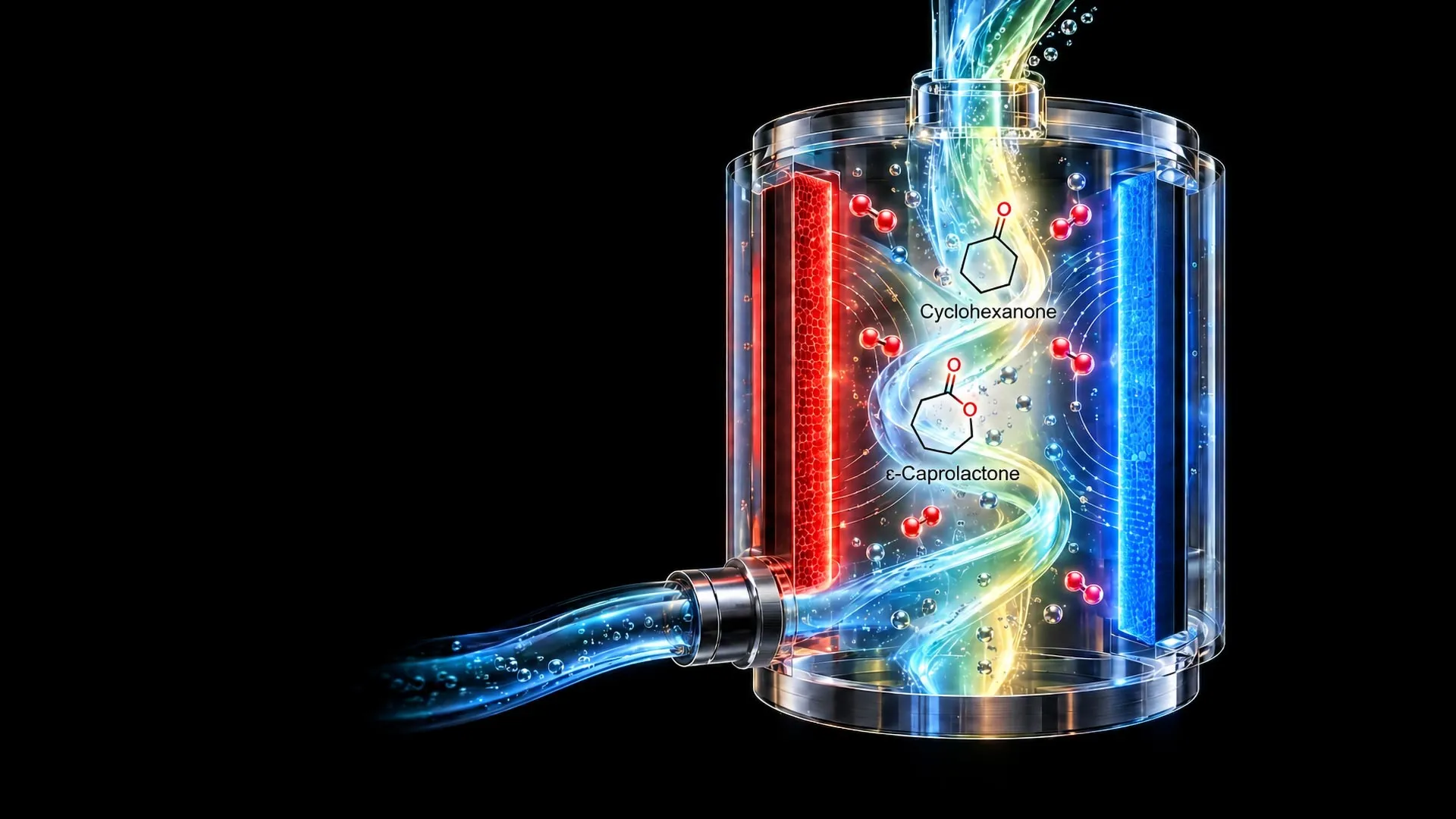
During the primary experimental phase, the Seoul National University researchers designed an electrosynthetic system that bypassed external oxidants entirely, using electrical energy to activate ambient oxygen gas directly at the electrode. Through meticulous isotope-tracing experiments, the team verified that the oxygen incorporated into the final organic molecules originated directly from oxygen gas rather than water molecules in the solvent.
However, early iterations of the setup yielded inconsistent performance. The breakthrough occurred when the team combined electrochemical measurements with advanced computer simulations to model fluid dynamics and ion transport near the electrodes. By redesigning the chemical reactor architecture to shorten the distance between electrodes and force a controlled, continuous flow of the conductive electrolyte solution between them, the team successfully neutralized extreme local pH build-ups.
Subsequent application of this optimized reactor to a broad library of chemical substrates confirmed the technique’s versatility, culminating in the successful synthesis of lactones from 18 distinct ketone compounds and epoxides from six different alkene starting materials.
Supporting Data and Performance Metrics
The quantitative improvements achieved through the reactor redesign and local pH management are among the most striking aspects of the study.
Under baseline laboratory conditions where local pH gradients were allowed to form unchecked, the selectivity of the Baeyer-Villiger oxidation—meaning the proportion of the desired lactone relative to unwanted byproducts—hovered at a modest 16 percent. Following the implementation of the optimized flow reactor, which balanced the acidic anode zone and alkaline cathode zone through controlled liquid circulation, selectivity surged to an exceptional 97 percent.
Furthermore, the team systematically tested the operational parameters of their reactor to understand how physical variables influenced output:
- Electrolyte Flow Rate: Varying the flow velocity of the liquid electrolyte yielded a dramatic 14-fold increase in product generation per unit time between the lowest and highest tested flow rates, underscoring the necessity of continuous fluid movement in mitigating stagnant local acidity.
- Inter-electrode Distance: Reducing the physical gap between the anode and cathode from 20 millimeters down to 4 millimeters resulted in a 2.2-fold boost in the overall production rate.
- The Stagnation Test: When fluid flow was entirely halted while maintaining identical voltage and bulk solution composition, the formation of the desired target product dropped to near zero. This stark contrast proved that reactor geometry and microscopic mass transport are just as critical to chemical success as the chemical reagents themselves.
Among specific synthesized targets, the team successfully produced $varepsilon$-caprolactone—a critical precursor for polycaprolactone, a biodegradable polymer utilized extensively in medical sutures and advanced drug-delivery systems—with an 82 percent isolated yield.
Broader Impact, Industrial Implications, and Sustainability
The implications of this research extend far beyond academic chemistry, offering a viable pathway toward greener, safer, and more economical industrial manufacturing.
Traditional chemical manufacturing often requires elevated temperatures, high pressures, and stoichiometric quantities of hazardous reagents that generate massive volumes of chemical waste. In contrast, the electrosynthetic approach pioneered by Professor Ryu’s team operates at standard room temperature and normal atmospheric pressure. By utilizing electricity to drive reactions and employing clean oxygen gas rather than dangerous peroxyacids, the method eliminates multiple safety hazards associated with oxidant storage, transport, and disposal.
Because the electrical energy required to power these electrochemical reactors can theoretically be sourced from renewable energy generation—such as solar, wind, or hydroelectric power—the technique aligns closely with global corporate and governmental mandates for sustainable, low-carbon chemical production.
Industry observers note that high-value specialty sectors, particularly the pharmaceutical industry and fine chemical manufacturing, stand to benefit most immediately. These sectors demand strict adherence to purity standards and rigorous safety compliance. Electrochemical methods that bypass hazardous chemical reagents while operating in compact modular equipment could significantly reduce capital expenditure and operational risk.
Nevertheless, commercialization will require sustained development. Moving from a controlled university laboratory setting to continuous industrial-scale production introduces engineering challenges related to long-term electrode durability, energy scaling, and economic feasibility. Research groups and industrial partners must collaborate to determine whether these laboratory efficiencies can be scaled reliably across multi-ton production volumes.
Expert Perspectives and Future Outlook
Reflecting on the broader philosophical shift represented by the study, Professor Ryu emphasized the necessity of rethinking reactor engineering from the bottom up.
"This study transforms ‘local pH’ near the electrode from a hidden variable into a controllable design principle," Professor Ryu stated. He added, "To improve the efficiency of organic electrosynthesis, we need to design not only the reaction substrates and catalysts, but also the environment in which the molecules actually react."
Rather than viewing localized acidity and alkalinity as an unavoidable nuisance of electrochemical systems, future chemical engineers may intentionally sculpt reactor geometries to maintain micro-environments tailored to specific reaction pathways.
Co-first authors Seonghyeon Min and Junghoon Lee plan to build upon these findings by expanding the local pH control strategy to a wider array of electrochemical transformations. Their ongoing research aims to map out additional hidden microenvironmental variables, potentially unlocking new classes of reactions that have historically suffered from poor yields and low selectivity.
Financial and institutional support for the research was provided by Seoul National University, the National Research Foundation of Korea, and the Institute for Basic Science (IBS), underscoring the national and international commitment to advancing sustainable chemical engineering technologies.