The landscape of artificial intelligence application development has undergone a paradigm shift, transitioning from static, single-turn language model queries to dynamic, multi-step autonomous workflows. Historically, developers seeking to construct functional AI agents were required to manually engineer complex tool-calling loops, parse unstructured JSON outputs, manage state transitions across multiple execution phases, and write extensive boilerplate code to handle API retries and session management. This intricate overhead frequently served as a significant barrier to entry for software engineers looking to integrate intelligent automation into production systems.
To address these engineering bottlenecks, the introduction of the OpenAI Agents SDK has fundamentally simplified the implementation process. By providing a native framework that abstracts away the underlying execution loops, the SDK allows developers to instantiate agents, securely connect external tools, maintain conversational context across disparate sessions, and execute sophisticated workflows with minimal code. This technical overview examines the structural evolution of large language model applications, details the implementation mechanics of the OpenAI Agents SDK, and evaluates the broader implications of accessible agentic workflows for software architecture.
The Structural Evolution: From Static Prompts to Autonomous Agents
To understand the operational significance of the OpenAI Agents SDK, one must first examine the architectural distinction between traditional Large Language Model (LLM) integrations and modern autonomous agents. A conventional LLM application typically adheres to a rigid, linear pipeline: the user submits a prompt, the underlying model processes the input tokens, generates a discrete response, and immediately terminates the execution thread. This paradigm lacks environmental feedback loops, memory persistence, and the capacity to dynamically acquire external data required to answer complex queries accurately.
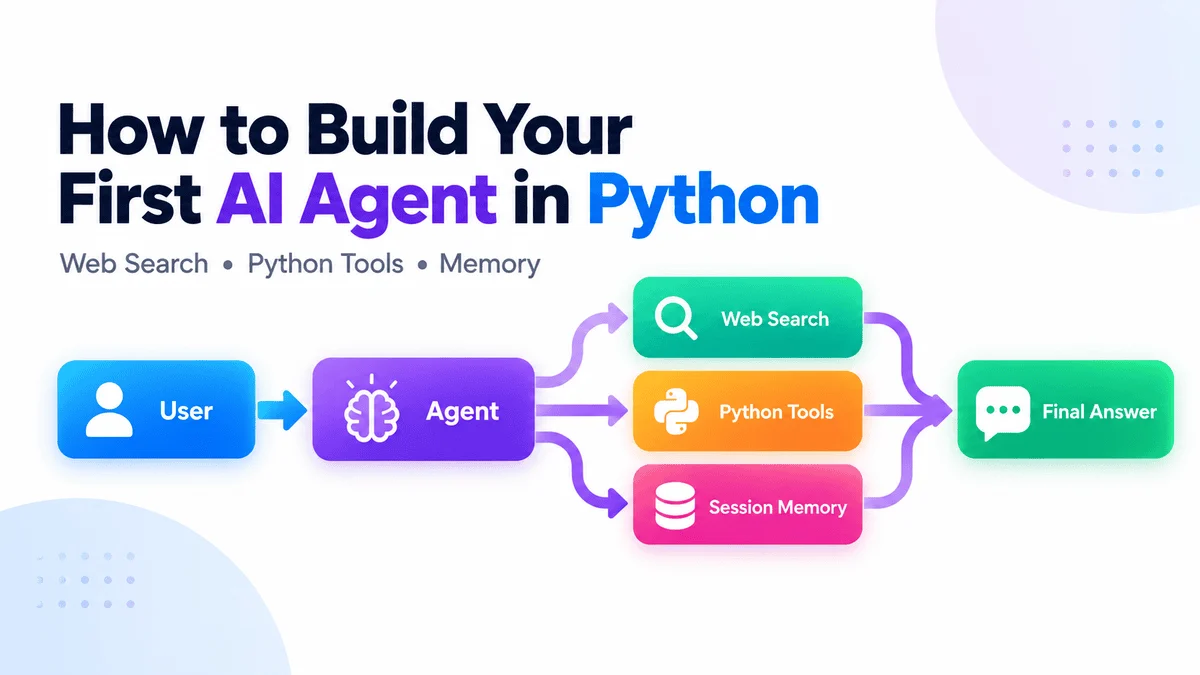
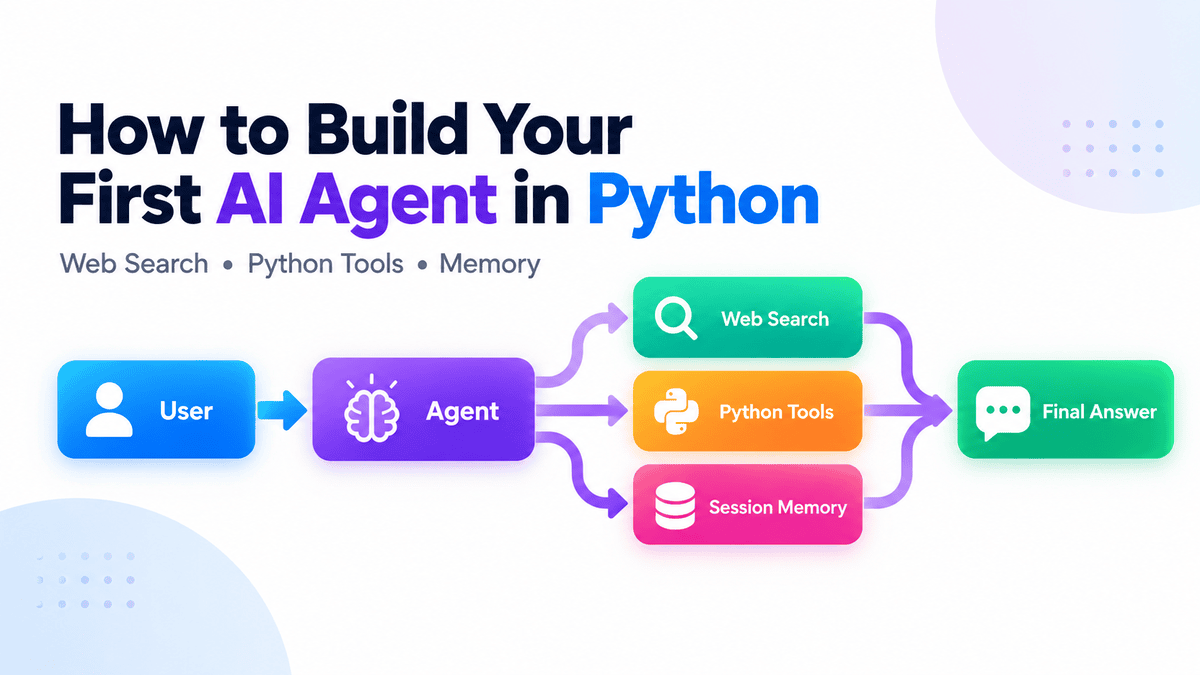
Conversely, an AI agent introduces a sophisticated execution loop that bridges reasoning and action. In an agentic framework, the user interacts with an agent that evaluates the request, determines whether supplemental capabilities—such as real-time web searches, database queries, or mathematical execution engines—are necessary, invokes the appropriate tool, analyzes the returned data, and subsequently synthesizes a final response.
The core mechanism governing this behavior is the execution runner. In the OpenAI Agents SDK, the Runner class acts as the orchestrator. It manages the lifecycle of the request by transmitting the user prompt to the model, intercepting tool invocation requests, executing the specified functions within a secure sandbox environment, relaying the results back to the agentic core, and sustaining the loop until a definitive answer is reached. This iterative reasoning and execution capability transforms a static text generator into an active problem-solving assistant.
Project Initialization and Environment Configuration
Deploying a production-ready development environment for modern Python applications necessitates reliable package management and secure credential handling. Modern Python tooling, such as the uv package manager, has streamlined dependency resolution and environment creation, significantly accelerating project bootstrapping compared to legacy virtual environment configurations.
To establish a dedicated project repository and configure the required dependencies, developers initialize a new environment and install the OpenAI Agents SDK.
mkdir first-ai-agent
cd first-ai-agent

uv init
uv add openai-agents
For environments utilizing standard Python package management distributions, the installation can be executed via the Python Package Index (PyPI):
pip install openai-agentsAuthentication requires the secure storage of the OpenAI API key within the host operating system’s environment variables. On Unix-based systems and Git Bash environments, this is achieved via:
export OPENAI_API_KEY="your-api-key"For Windows Command Prompt or PowerShell environments, persistent environment variables are established using system utilities:
setx OPENAI_API_KEY "your-api-key"Implementing Web Search Capabilities via Hosted Tools
A foundational requirement for advanced research assistants is the ability to retrieve up-to-date, real-time information that extends beyond the static training cutoff of the underlying language model. Rather than forcing developers to manually integrate third-party search APIs, parse search result pages, and format the output into model-readable schemas, the OpenAI Agents SDK provides native hosted tools such as the WebSearchTool().
By incorporating this hosted tool into an agent definition, the model retains autonomous discretion over when to query the live internet versus relying on its parametric memory. The following implementation demonstrates the instantiation of a research assistant configured to utilize real-time web search capabilities:
from agents import Agent, Runner, WebSearchTool

agent = Agent(
    name="Research Assistant",
    instructions=(
        "You are a concise research assistant. "
        "Use web search when current information is required."
    ),
    tools=[WebSearchTool()],
)

result = Runner.run_sync(
    agent,
    "What are the latest developments in Python?"
)

print(result.final_output)
Execution of this script initiates the automated runner, allowing the model to analyze the query, determine the necessity of temporal data retrieval, execute the search query, and synthesize the findings. The resulting output accurately reflects current software release cycles and version statuses without manual intervention in the retrieval loop.
Integrating Custom Python Functions as Agent Tools
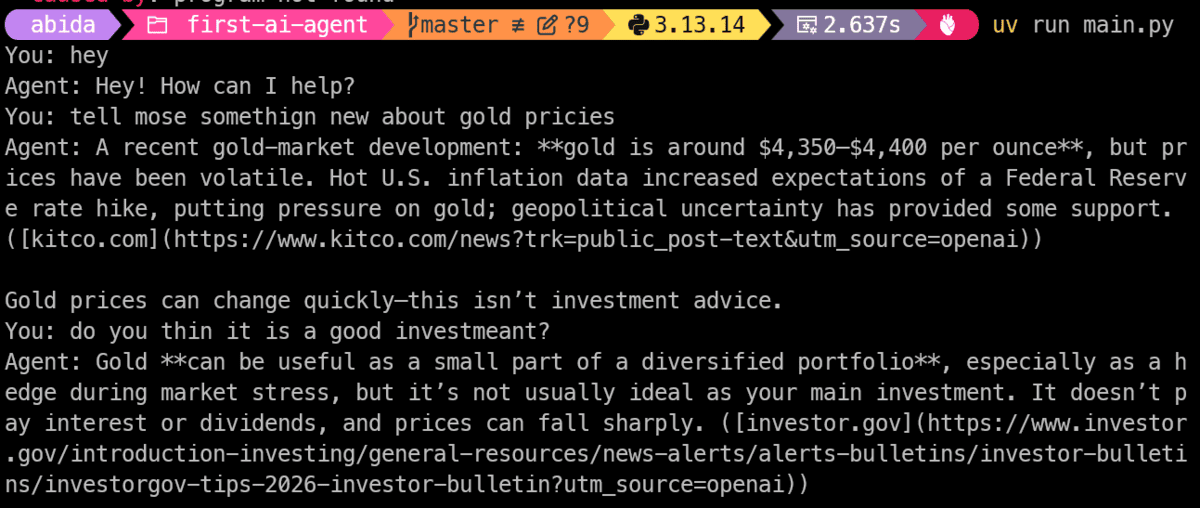
While web search provides broad contextual awareness, the true utility of AI agents in enterprise environments emerges when they can interact directly with proprietary codebases, internal databases, and specialized computational logic. The OpenAI Agents SDK simplifies this integration through decorator patterns that automatically translate standard Python functions into executable tool schemas.
By leveraging the @tool decorator, developers can expose custom Python functions to the agent. The SDK automatically parses the function signature, argument type hints, and docstrings to construct a JSON schema that the underlying language model interprets during execution. This eliminates the need to manually define tool schemas or write custom parsing logic for incoming model tool calls.
from agents.decorators import tool

@tool
def calculate_total(
    price: float,
    quantity: int
) -> float:
    """Calculate the total cost of an order."""
    return price * quantity
Once defined, the custom tool is passed alongside hosted tools into the agent configuration:
agent = Agent(
    name="Assistant",
    instructions="Help with research and calculations.",
    tools=[
        WebSearchTool(),
        calculate_total,
    ],
)

result = Runner.run_sync(
    agent,
    "I need 14 GPUs costing $2.49 each per hour. "
    "What will they cost per hour?"
)

print(result.final_output)
The underlying execution engine seamlessly routes the computational request to the calculate_total function, validates the numerical parameters based on the defined type hints, and incorporates the computed result into the final narrative response. Clear, descriptive docstrings remain critical during this phase, as they guide the model in correctly identifying when and how to invoke the custom logic.
Maintaining Conversational Continuity via Persistent Session Management
Stateless interactions limit the utility of conversational agents in complex analytical workflows. To support multi-turn dialogues where an agent retains awareness of prior inputs, context windows must be preserved across execution threads. The OpenAI Agents SDK addresses this requirement through flexible session backends capable of persisting message history locally or within enterprise data stores.
For lightweight applications, the SDK provides a built-in SQLite session manager that records conversation states to a local database file. This ensures that conversational context—such as pronominal references like "the latest version"—is accurately resolved across successive user inputs.
from agents import SQLiteSession

session = SQLiteSession(
    "user_1",
    "conversations.db"
)

# Execution loop integrating the session state
while True:
    message = input("You: ")

    if message.lower() in "exit", "quit":
        break

    result = Runner.run_sync(
        agent,
        message,
        session=session,
    )

    print("Agent:", result.final_output)
For large-scale enterprise deployments requiring high availability and distributed state management, the SDK architecture extends to support robust session backends including Redis, SQLAlchemy-compliant relational databases, and MongoDB document stores. This modular persistence layer ensures that conversational memory scales seamlessly alongside application infrastructure.
Architectural Synthesis and Complete Implementation
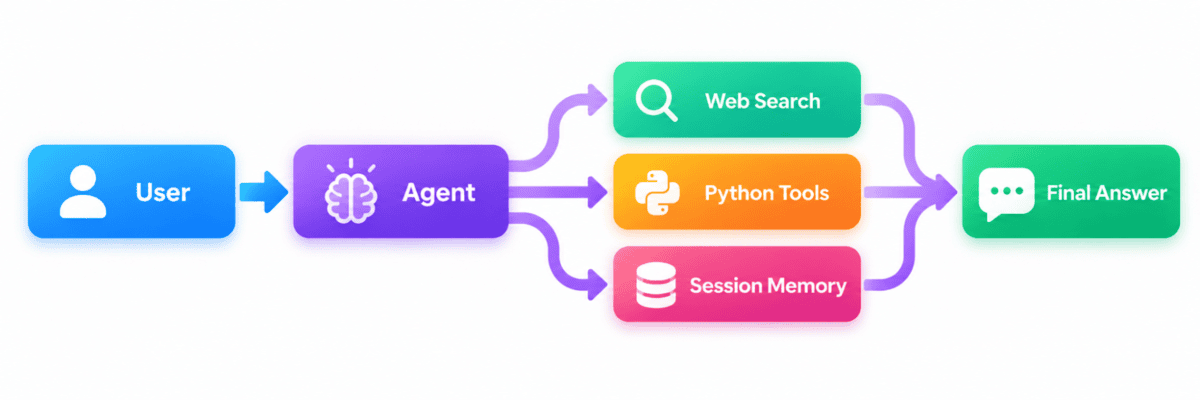
Combining tool integration, real-time data retrieval, and persistent session management yields a comprehensive, production-ready agent architecture. The complete implementation encapsulates error handling, command parsing, environment validation, and continuous input loops within a modular structure:
import os
import sys

from agents import Agent, Runner, SQLiteSession, WebSearchTool
from agents.decorators import tool

@tool
def calculate_total(
    price: float,
    quantity: int
) -> float:
    """Calculate the total cost of an order."""
    return price * quantity

def main() -> None:
    if not os.environ.get("OPENAI_API_KEY"):
        sys.exit(
            "Error: set the OPENAI_API_KEY environment variable first."
        )

    agent = Agent(
        name="Assistant",
        instructions="""
        Help the user with research and calculations.
        Use the available tools when necessary.
        """,
        tools=[
            WebSearchTool(),
            calculate_total,
        ],
    )

    session = SQLiteSession(
        "user_1",
        "conversations.db"
    )

    try:
        while True:
            try:
                message = input("You: ")
            except (EOFError, KeyboardInterrupt):
                print()
                break

            command = message.strip().lower()

            if command in "exit", "quit":
                break

            if not command:
                continue

            try:
                result = Runner.run_sync(
                    agent,
                    message,
                    session=session,
                )
            except Exception as exc:
                print(
                    f"Agent error "
                    f"(type(exc).__name__): exc"
                )
                continue

            print("Agent:", result.final_output)

    finally:
        session.close()

if __name__ == "__main__":
    main()
Observability, Tracing, and System Debugging
As agentic workflows scale in complexity—incorporating multi-agent handoffs, recursive tool calls, and conditional branching—debugging unexpected execution paths becomes a primary operational challenge. To mitigate this complexity, the OpenAI Agents SDK enables comprehensive tracing by default.
System traces capture every discrete step executed during an agent run, including model prompt generation, raw token consumption, tool selection rationale, function argument payloads, and execution latency. Developers can access and inspect these granular traces directly within the OpenAI dashboard. This telemetry data is instrumental in diagnosing tool-calling failures, refining system instructions, and optimizing token efficiency in production environments.
Broader Implications and Industry Impact
The democratization of autonomous agent development via standardized SDKs marks a significant maturation in software engineering practices surrounding artificial intelligence. By abstracting the complex mechanics of orchestration loops and state persistence, frameworks like the OpenAI Agents SDK empower developers to transition from writing brittle integration glue to focusing on domain-specific logic and tool design.
From an economic perspective, lowering the technical barrier to agent implementation accelerates enterprise AI adoption. Organizations across financial services, software engineering, logistics, and customer operations can rapidly prototype and deploy specialized autonomous assistants capable of executing multi-step business processes.
However, this increased accessibility also underscores the necessity of robust governance frameworks. As agents gain autonomous execution capabilities over external APIs, databases, and computational resources, the implementation of strict guardrails, permission boundaries, and comprehensive tracing becomes paramount to prevent unintended operational states.
Ultimately, building effective AI agents relies on a disciplined architectural approach: providing models with precise, well-documented tools, maintaining clean state boundaries, and allowing native execution frameworks to handle the underlying control flow. By adhering to these foundational principles, developers can construct resilient, scalable agentic systems capable of meeting the rigorous demands of modern enterprise applications.