In a significant departure from traditional thermodynamic constraints, a multi-institutional research team led by Carnegie Mellon University has demonstrated a novel method for manipulating heat at the nanoscale using engineered metamaterials. The study, published in the journal Nature, provides the first robust experimental evidence that radiative heat transfer can be intentionally amplified and directed by tailoring the microscopic geometry of materials. By achieving heat transfer rates nearly four times higher than those seen in non-patterned systems, the researchers have opened a new frontier in thermal management, with profound implications for the future of microelectronics, renewable energy harvesting, and sensitive infrared detection.
The collaborative effort included specialists from Stanford University and Purdue University, combining expertise in mechanical engineering, nanophotonics, and materials science. The findings address a long-standing challenge in physics: the "blackbody limit." For over a century, the Stefan-Boltzmann Law has defined the maximum amount of energy an object can radiate. However, at distances smaller than the wavelength of thermal radiation—specifically at the nanoscale—these classical laws break down, allowing for a phenomenon known as near-field radiative heat transfer (NFRHT). While NFRHT has been observed previously, the ability to actively "engineer" this transfer through structural design rather than just material selection marks a transformative milestone.
The Evolution of Nanoscale Thermal Physics: A Brief Chronology
To understand the magnitude of this breakthrough, one must look at the historical progression of thermal radiation theory. In the late 19th century, Max Planck and others established the foundations of far-field radiation, which describes how heat moves across large distances, such as from the sun to the Earth. In this regime, heat transfer is limited by the surface area and temperature of the objects involved.
By the 1970s, theorists Polder and Van Hove predicted that if two objects were brought close enough—within a few hundred nanometers—the heat transfer would increase exponentially. This occurs because of "evanescent waves," which are electromagnetic fields that decay rapidly away from a surface. In the far-field, these waves vanish; in the near-field, they can "tunnel" across the gap.
Throughout the early 2000s, experimentalists began to prove this theory, showing that heat could indeed exceed the blackbody limit at tiny scales. However, these experiments were often limited to simple, flat surfaces. The challenge remained: could we move beyond observing this effect to actively controlling it? The new research from Carnegie Mellon, Stanford, and Purdue confirms that by using metamaterials—substances engineered with periodic patterns not found in nature—scientists can finally dictate the flow of thermal energy with the same precision that electrical engineers control current.
Mechanics of the Experiment: Gold Patterns and Nanoscale Gaps
The core of the team’s success lies in the design of specialized metamaterials. The researchers patterned microscopic gold structures onto extremely thin membranes. These patterns consist of repeating geometric shapes designed to interact with electromagnetic waves at specific frequencies.
"Unlike conventional materials, metamaterials are built with tiny, repeating patterns that interact with energy in precise ways," explained Sheng Shen, a professor of mechanical engineering at Carnegie Mellon University and the study’s senior author. "We patterned microscopic gold structures onto thin membranes and positioned them face-to-face across a nanoscale gap. This increased heat transfer by as much as four times compared to similar setups without metamaterials, which is far beyond what traditional physics would predict at larger distances."
The experimental setup required extreme precision. Maintaining a uniform gap of only a few hundred nanometers between two surfaces is a daunting engineering feat, as even the slightest tilt or vibration can cause the surfaces to touch, leading to conductive rather than radiative heat transfer. The team utilized advanced nanofabrication techniques to ensure the gold-patterned membranes remained parallel and stable throughout the measurement process.
The Science of Resonance and Surface Phonon Polaritons
The four-fold increase in heat transfer is not merely a result of the gold providing more surface area. Instead, it is the result of a complex interaction between the gold structures and the underlying material’s natural vibrations.
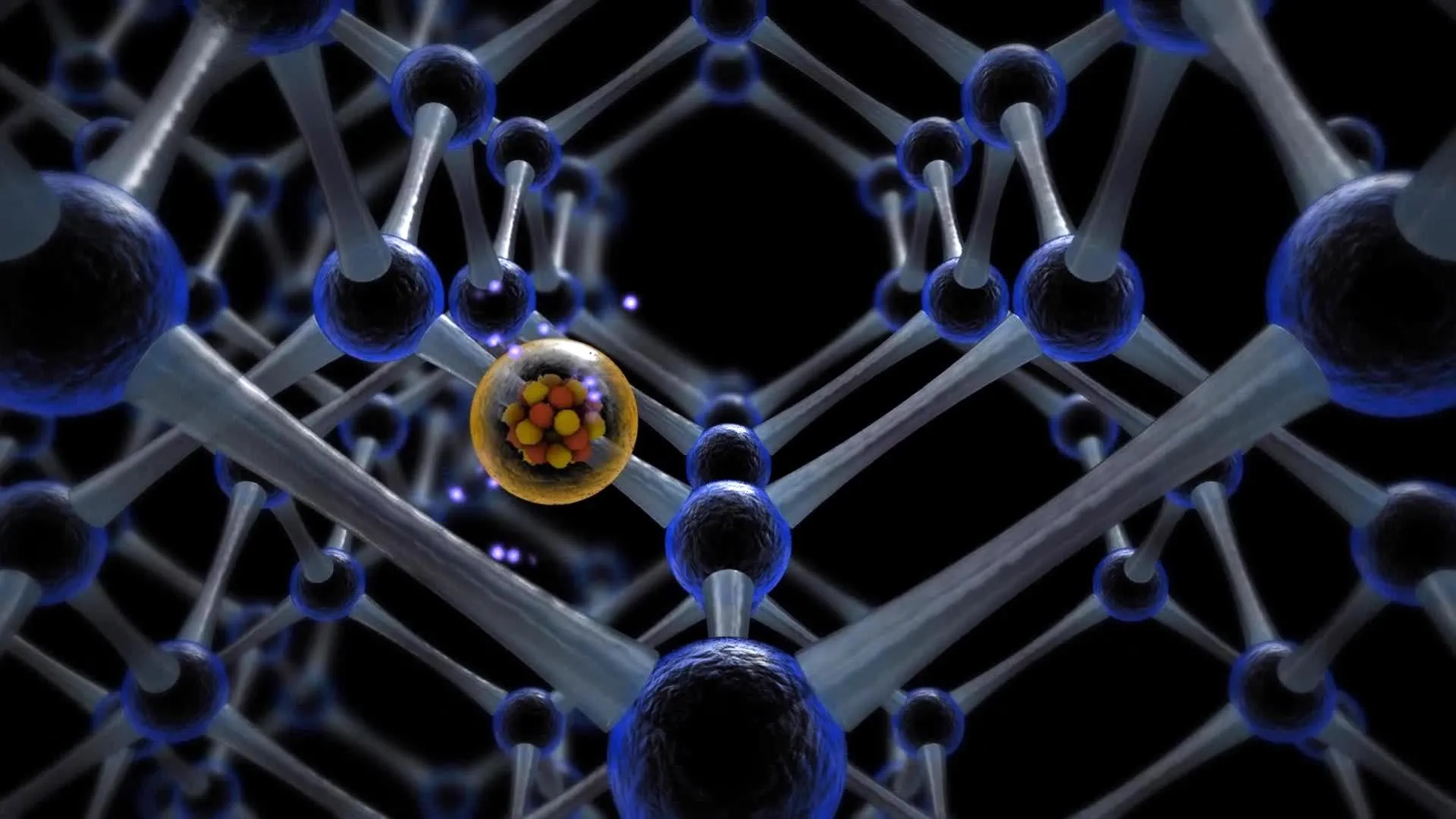
In many dielectric materials, heat is carried by phonons—vibrational energy in the atomic lattice. When these vibrations couple with electromagnetic fields at the surface, they create "surface phonon polaritons" (SPhPs). These polaritons are the primary carriers of energy in near-field heat transfer.
"Rather than simply adding more pathways for heat, the gold structures interact with naturally occurring energy waves in the material, known as surface phonon polaritons, creating a resonance effect," said Zexiao Wang, a PhD student in Professor Shen’s research group and co-first author of the study. "These coupled vibrations allow energy to move more freely and efficiently across the gap."
The gold patterns act as a sort of "antenna" for heat. Just as a radio antenna is tuned to a specific frequency to catch a signal, the metamaterial structures are tuned to the frequency of the SPhPs. This creates a cooperative resonance that amplifies the energy exchange. This "matching" of frequencies allows the two surfaces to communicate thermally at a much higher "bandwidth" than previously possible.
Data and Experimental Validation
The study’s data suggests that the metamaterial enhancement is most effective at gaps ranging from 100 to 500 nanometers. In this "sweet spot," the resonance effect is maximized. The researchers compared their results against a baseline of non-patterned surfaces of the same material. The data showed that while the non-patterned surfaces followed the standard NFRHT curves, the metamaterial surfaces exhibited a sharp spike in energy transfer that correlated exactly with the predicted resonance of the gold patterns.
This experimental validation is crucial. While theoretical models had suggested metamaterials could enhance NFRHT, the physical demonstration proves that these effects are robust enough to be used in practical applications. The study also highlighted that the effect is highly tunable; by changing the shape, size, or spacing of the gold patterns, engineers can effectively "program" the material to transfer heat at specific rates or even at specific temperatures.
Industrial Implications: From Computer Chips to Clean Energy
The ability to control heat at the nanoscale has immediate and far-reaching implications for several high-tech industries.
1. Advanced Microelectronics Cooling
As the semiconductor industry continues to shrink transistors to the 3-nanometer and 2-nanometer nodes, thermal management has become the primary bottleneck for performance. When electronic components become too hot, they suffer from "thermal throttling," where the system automatically slows down to prevent physical damage. Traditional cooling methods, such as fans and heat sinks, are becoming less effective as devices become more densely packed.
By integrating metamaterial heat-transfer interfaces into chip packaging, manufacturers could potentially pull heat away from "hot spots" with unprecedented efficiency. This would allow for faster clock speeds and more powerful processors without the risk of overheating.
2. Thermophotovoltaic (TPV) Energy Conversion
Thermophotovoltaics are devices that convert heat into electricity using the photovoltaic effect—similar to how solar cells convert sunlight into power. However, TPVs use thermal radiation from a local heat source. One of the biggest challenges in TPV technology is the inefficiency of heat transfer from the emitter to the cell.
The 4x enhancement demonstrated by Shen’s team could revolutionize TPV efficiency. By using metamaterials to tune the emission spectrum to match the absorption characteristics of the photovoltaic cell, a much higher percentage of waste heat could be converted into usable electricity. This could lead to highly efficient "thermal batteries" or systems that capture waste heat from industrial furnaces and power plants.
3. Enhanced Infrared Sensing
Infrared (IR) sensors are critical for everything from night-vision goggles to environmental monitoring satellites. These sensors rely on detecting thermal signals. The resonance effects discovered in this study could be used to create hyper-sensitive IR detectors that can filter out noise and focus on specific thermal signatures. This has obvious applications in national security, enabling more precise tracking and identification of thermal targets.
Expert Reactions and the Road Ahead
The broader scientific community has reacted with optimism to the publication. Independent researchers note that the study bridges the gap between pure nanophotonics and practical mechanical engineering. While previous work in this field was often relegated to theoretical physics, this paper provides a roadmap for building actual devices.
Sheng Shen emphasizes that this is only the beginning. "If heat can be engineered with the same precision as electricity or light, it may open the door to a new class of technologies built not just to withstand heat, but to harness it," Shen said.
However, challenges remain for commercialization. The fabrication of these metamaterials currently requires cleanroom environments and sophisticated lithography, which can be expensive. To see this technology in consumer electronics or power plants, researchers will need to develop more cost-effective, large-scale manufacturing processes, such as roll-to-roll nanoimprinting.
Furthermore, the current experiments were conducted in vacuum conditions to isolate radiative heat transfer from air-based conduction and convection. Moving these systems into atmospheric conditions will require innovative vacuum-sealed packaging, similar to how micro-electromechanical systems (MEMS) are currently housed.
Conclusion
The work supported by the Defense Threat Reduction Agency, the National Science Foundation, and the Air Force Office of Scientific Research represents a paradigm shift in how we view thermal energy. For most of human history, heat has been seen as a chaotic byproduct to be managed or dissipated. Through the lens of this new research, heat is transformed into a controllable, tunable resource.
By leveraging the "cooperative effect" between engineered structures and natural energy waves, the team from Carnegie Mellon, Stanford, and Purdue has proven that the classical limits of thermodynamics are not as rigid as once thought. As we move into an era of increasingly miniaturized and energy-intensive technology, the ability to "engineer" heat at the nanoscale may become as fundamental to the 21st century as the control of electrons was to the 20th.