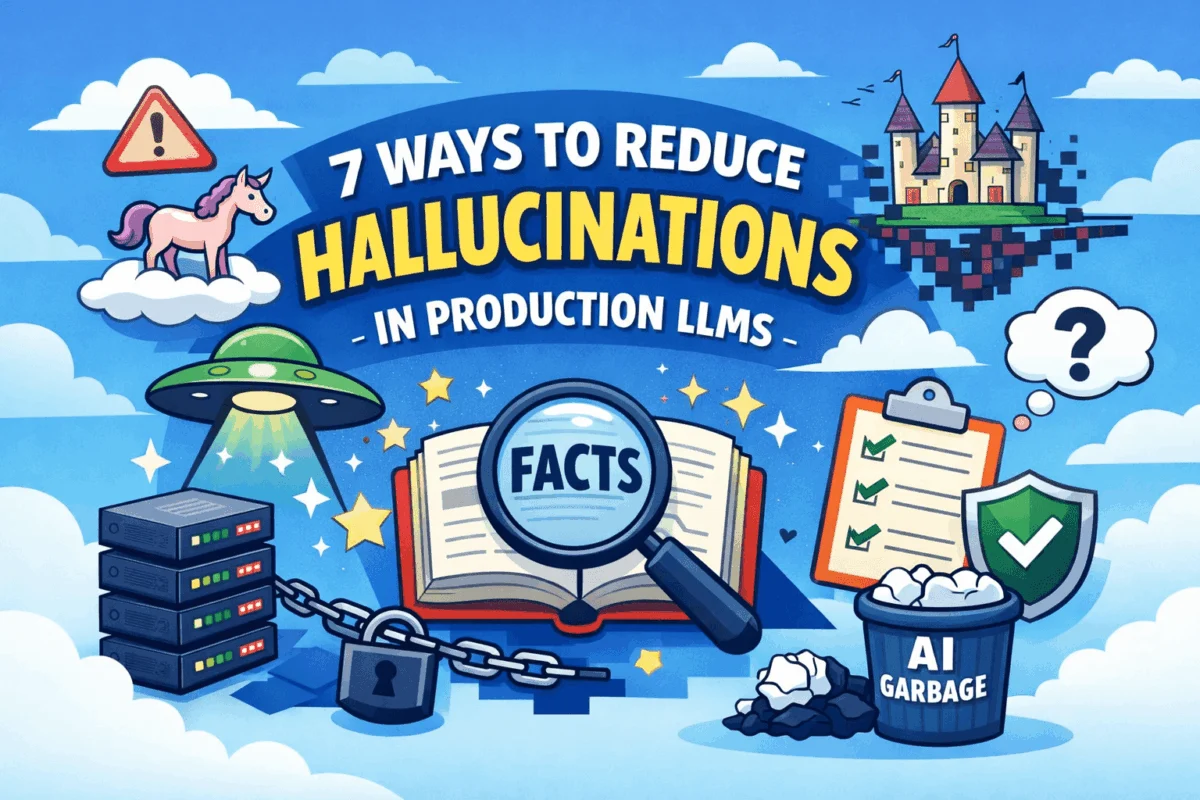
The proliferation of Large Language Models (LLMs) across diverse industries has heralded a new era of artificial intelligence capabilities, yet their inherent propensity for "hallucinations"—generating factually incorrect or nonsensical information—remains a formidable challenge. Far from being merely a model-centric issue, the problem of LLM hallucinations in production environments is increasingly recognized as a critical system design flaw, demanding robust architectural solutions rather than isolated algorithmic tweaks. Leading AI development teams are actively deploying a multifaceted strategy, anchoring models in verifiable data, mandating transparent traceability, and implementing rigorous automated checks alongside continuous evaluation protocols to significantly curb these inaccuracies. This article delves into seven proven and field-tested strategies that developers and AI teams are successfully employing today to enhance the reliability and trustworthiness of LLM applications in real-world scenarios.
The Rise of LLMs and the Hallucination Conundrum
The rapid ascent of LLMs, exemplified by models like GPT, Claude, and Llama, has transformed expectations for AI’s potential. From automating customer service and generating creative content to assisting in complex research and coding, these models promise unprecedented productivity gains. However, this powerful capability is often accompanied by the risk of confabulation, where an LLM confidently presents false information as fact. This phenomenon, termed "hallucination," can range from minor inaccuracies to completely fabricated details, posing significant risks in high-stakes applications such as healthcare, legal services, financial analysis, and critical infrastructure management. Early enthusiasm for LLMs was sometimes tempered by these unpredictable errors, leading to a strong industry push towards developing sophisticated guardrails and architectural patterns that prioritize factual accuracy and reliability. The challenge is particularly acute in enterprise settings where LLMs are expected to interact with proprietary data and adhere to strict compliance standards. A single hallucination in such a context could lead to severe financial repercussions, reputational damage, or even legal liabilities.
1. Grounding Responses Through Retrieval-Augmented Generation (RAG)
One of the most impactful strategies for reducing hallucinations, especially when an application requires precision regarding internal policies, product specifications, or sensitive customer data, is the implementation of Retrieval-Augmented Generation (RAG). Instead of allowing the LLM to rely on its pre-trained knowledge, which can be outdated or inaccurate for specific contexts, RAG enables the model to access, retrieve, and synthesize information from a designated, trusted external knowledge base. This process typically involves several steps: a user query is received, relevant documents or data snippets are retrieved from a curated database (e.g., internal documentation, knowledge base articles, database records, legal precedents) using advanced semantic search or vector embeddings, and then this retrieved context is provided to the LLM alongside the original query. The LLM is then instructed to generate a response solely based on this provided context.
The efficacy of RAG lies in its ability to circumvent the LLM’s "memory"—its vast, yet static and sometimes erroneous, internal knowledge representation. By acting as a sophisticated lookup and summarization engine, RAG drastically reduces the likelihood of the model inventing facts. For instance, a customer support bot powered by RAG can accurately answer questions about a company’s specific return policy by pulling directly from the official policy document, rather than attempting to recall general e-commerce return practices. This approach has become a cornerstone for enterprise LLM deployments, with many organizations investing heavily in robust data indexing, vector database technologies, and sophisticated retrieval algorithms to ensure high-quality contextual grounding. Industry reports suggest that RAG implementations can reduce hallucination rates by over 50% in domain-specific applications, significantly boosting user trust and operational efficiency.
2. Requiring Explicit Citations for Key Claims
A straightforward yet highly effective operational rule gaining traction in production-grade AI assistants is the principle: "no sources, no answer." This strategy mandates that for any key factual claim made by the LLM, it must provide verifiable citations or direct quotes from its source material. This not only makes the output auditable but also empowers users to cross-reference information and build confidence in the AI’s responses.
Leading AI developers, such as Anthropic, explicitly advocate for this guardrail. Their guidance often recommends configuring models to verify each claim by locating a supporting quote within the provided context, retracting any assertions that cannot be substantiated. This technique acts as a powerful self-correction mechanism. If the model cannot find direct evidence for a statement, it is instructed to either omit the claim, rephrase it with greater caution, or explicitly state its inability to find supporting information. The impact on hallucination reduction is often dramatic, as it forces a disciplined approach to information generation. For example, a legal research assistant could cite specific clauses from legal documents, or a medical assistant could reference particular paragraphs from peer-reviewed studies. This transparency is crucial for accountability and fostering user trust, especially in domains where accuracy is paramount.
3. Leveraging Tool Calling Instead of Free-Form Answers
For transactional queries, factual lookups, or actions requiring interaction with external systems, the most secure and reliable pattern involves transforming the LLM from a source of truth into an intelligent router and formatter. This paradigm, often referred to as "tool calling" or "function calling," establishes a workflow: LLM → Tool/API → Verified System of Record → Response.
In this setup, the LLM’s role is to interpret the user’s intent, identify the appropriate external tool or API to execute the task (e.g., a database query, an e-commerce API, a calculator, a weather service), formulate the correct API call, and then present the results returned by the external system to the user in a natural language format. Instead of "recalling" facts or performing calculations itself, the LLM fetches them from authoritative sources. This design decision inherently eliminates a large class of hallucinations because the factual burden is shifted from the probabilistic nature of the LLM to deterministic, verified external systems. For example, if a user asks for the current stock price of a company, the LLM doesn’t attempt to "know" this fact; instead, it triggers an API call to a financial data service, retrieves the real-time data, and then presents it. This approach is fundamental to building reliable AI agents capable of performing real-world actions and accessing up-to-the-minute, accurate information, significantly reducing the risk of generating outdated or fabricated data.
4. Implementing a Post-Generation Verification Step
To add an additional layer of scrutiny, many advanced production systems now incorporate a "judge" or "grader" model—often a separate, smaller LLM or a set of rule-based algorithms—that evaluates the initial response generated by the primary LLM. This workflow typically involves several stages: the primary LLM drafts an answer, this draft is then passed to the verification model, which cross-references it against the original prompt, retrieved sources, or known facts, and finally, either approves the response, requests a revision, or flags it for human review.
Some teams augment this process with lightweight lexical checks, such as keyword overlap analysis or BM25 scoring, to programmatically verify that key facts or entities mentioned in the generated answer indeed appear within the provided source text. A widely cited and effective research approach in this area is Chain-of-Verification (CoVe). Developed to systematically enhance factual accuracy, CoVe involves the LLM first drafting an answer, then generating a series of verification questions based on that answer, independently answering those verification questions, and finally producing a revised, verified response. This multi-step validation pipeline significantly reduces the incidence of unsupported claims by creating an internal "peer review" system for the LLM’s own outputs. Research on CoVe has demonstrated significant reductions in factual errors, particularly for complex queries requiring synthesis of multiple pieces of information.
5. Biasing Toward Quoting Instead of Paraphrasing
The act of paraphrasing, while seemingly innocuous, inherently introduces a risk of subtle factual drift or misinterpretation. Even minor rephrasing can inadvertently alter the original meaning, leading to inaccuracies. A highly practical and effective guardrail, particularly in domains where absolute fidelity to source material is non-negotiable, is to actively bias the LLM toward direct quoting rather than paraphrasing.
This means instructing the model to, wherever possible, extract and present verbatim segments from the source text, especially for critical facts, figures, or definitions. If direct quoting is not feasible for stylistic reasons, the instruction might be to paraphrase very closely to the source, perhaps highlighting any parts that are summaries rather than direct extracts. This approach works exceptionally well in high-stakes use cases such as legal document review, medical information dissemination, and compliance reporting, where precision and adherence to original wording are paramount. By minimizing the model’s creative interpretation and maximizing its role as an accurate information conduit, the likelihood of introducing new errors or distorting existing facts is substantially reduced. This strategy underscores a shift in perspective: for certain applications, the LLM is best utilized as a precise information retrieval and presentation tool, rather than a generative one that "understands" and reformulates.
6. Calibrating Uncertainty and Designing for Graceful Failure
Despite the best efforts to implement robust hallucination reduction strategies, it is an undeniable reality that hallucinations cannot be entirely eliminated. Recognizing this, mature production systems prioritize designing for safe failure, embracing the philosophy that returning uncertainty is always preferable to presenting confident fiction. This approach involves calibrating the LLM’s ability to express its level of confidence and providing mechanisms for graceful failure when confidence levels are low.
Common techniques include instructing the model to explicitly state when it doesn’t know an answer, providing a range of possible answers with associated probabilities, or escalating uncertain queries to a human operator for review. For example, an LLM in a financial advisory setting might state, "I cannot definitively answer that question based on the available data, but here are some general principles…" or, "I am not confident in this answer; would you like me to connect you with a human expert?" Implementing confidence scores, thresholding mechanisms, and "I don’t know" responses are critical. In enterprise environments, this design philosophy is often deemed more crucial than striving for marginal accuracy gains, as it safeguards against critical errors, maintains user trust, and adheres to ethical AI principles. By providing clear pathways for managing uncertainty, these systems prevent potentially harmful misinformation from reaching end-users and instead direct them towards reliable alternatives or human intervention.
7. Continuous Evaluation and Monitoring
Hallucination reduction is not a static achievement but an ongoing commitment. The effectiveness of any strategy can degrade over time due to factors such as model updates, changes in the underlying data sources, evolving user query patterns, or even subtle shifts in the LLM’s behavior. Consequently, production teams must implement continuous evaluation pipelines and robust monitoring systems to maintain accuracy over the long term.
These continuous evaluation pipelines typically involve automated testing frameworks that assess factual accuracy, relevance, and adherence to guardrails across a diverse set of test cases. Metrics might include precision, recall, F1-score for factual extraction, and specialized metrics for hallucination detection. Beyond automated checks, human-in-the-loop processes are vital. This includes "red teaming," where ethical hackers and domain experts intentionally try to provoke hallucinations to identify weaknesses, and robust user feedback loops. Every reported hallucination, whether through direct user feedback or internal quality assurance, should be logged, analyzed, and fed back into the development cycle. This data can then inform prompt adjustments, retrieval tuning for RAG systems, or even trigger re-training or fine-tuning of the models. This iterative process of deployment, monitoring, evaluation, and refinement is the fundamental difference between a demonstration that appears accurate and a resilient system that consistently delivers reliable outputs in a dynamic production environment.
Broader Impact and Implications
The concerted effort to mitigate LLM hallucinations is not merely a technical exercise; it carries profound implications for the widespread adoption and ethical deployment of AI. By transforming hallucination from a model problem into an architectural challenge, developers are moving towards creating more trustworthy, reliable, and accountable AI systems. This systemic approach fosters greater confidence among businesses, encouraging deeper integration of LLMs into critical workflows.
The enhanced reliability stemming from these strategies directly translates into tangible business benefits: reduced operational risks, improved decision-making based on accurate information, greater customer satisfaction, and a stronger foundation for regulatory compliance. As LLMs become increasingly pervasive, their trustworthiness will be a primary determinant of their long-term success and societal acceptance. The ongoing innovation in this space underscores a maturing AI industry that is moving beyond initial hype to address the practical complexities of deploying powerful, yet inherently imperfect, generative models responsibly. The future of AI relies heavily on our ability to build systems that not only generate intelligent responses but also do so with unwavering factual integrity.
Kanwal Mehreen is a machine learning engineer and a technical writer with a profound passion for data science and the intersection of AI with medicine. She co-authored the ebook "Maximizing Productivity with ChatGPT". As a Google Generation Scholar 2022 for APAC, she champions diversity and academic excellence. She’s also recognized as a Teradata Diversity in Tech Scholar, Mitacs Globalink Research Scholar, and Harvard WeCode Scholar. Kanwal is an ardent advocate for change, having founded FEMCodes to empower women in STEM fields.