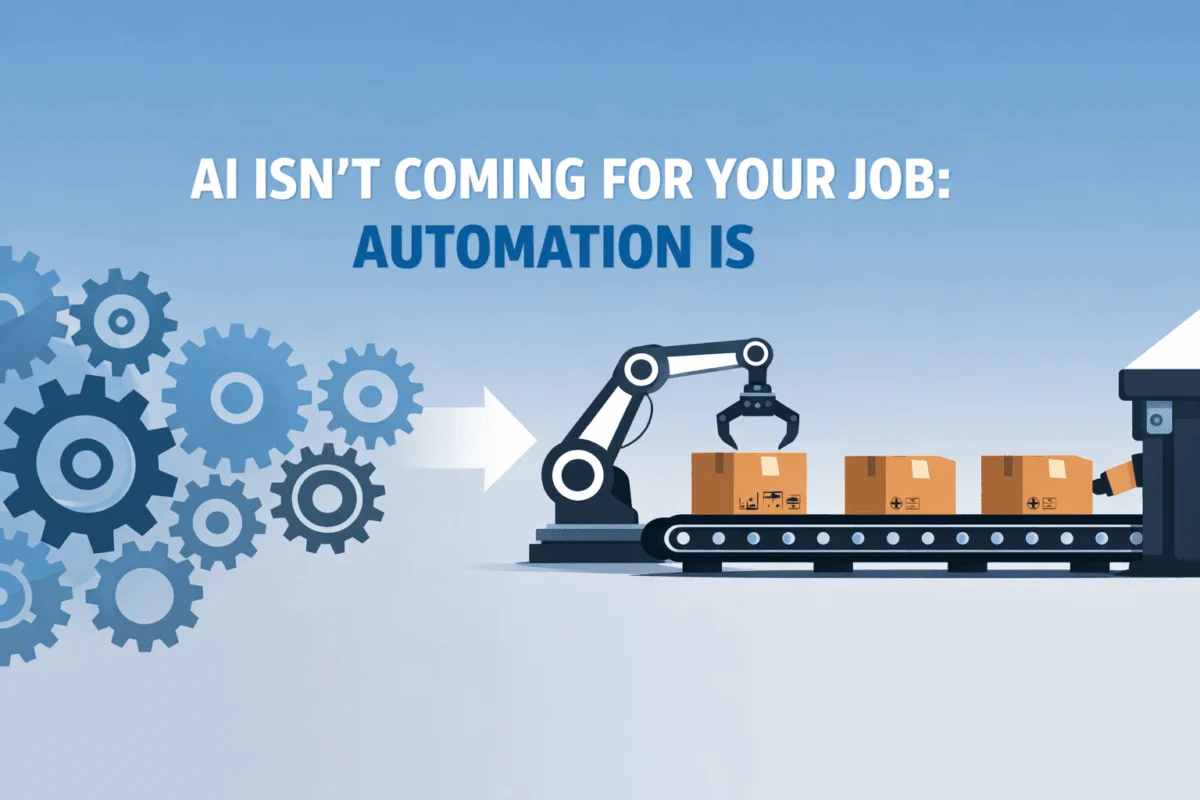
The public discourse surrounding artificial intelligence (AI) has become increasingly fraught with anxiety, often fueled by sensational headlines predicting widespread job displacement. Every few months, a new report surfaces, detailing how millions of jobs are purportedly on the brink of eradication by AI. This narrative frequently ignites a flurry of online activity, from LinkedIn discussions to Twitter spirals, prompting individuals to frantically search for "recession-proof careers" and inspiring desperate entrepreneurial ventures in fields deemed "artificial general intelligence-proof." However, a critical distinction, frequently overlooked, is essential for a clear understanding of the evolving professional landscape: the true architect of job transformation is not AI itself, but rather automation, a capability that AI often enhances but does not exclusively define. This is more than a semantic nuance; it is a fundamental clarification with profound implications for strategic career planning and workforce development.
The Historical Trajectory of Automation and the Rise of AI
The concept of automation is far from new. Its roots trace back to the First Industrial Revolution, where mechanical inventions mechanized agricultural and manufacturing processes, shifting labor from farms to factories. Subsequent waves of automation included the introduction of assembly lines in the early 20th century, the advent of computer-controlled machinery in the latter half of the century, and the rise of Robotic Process Automation (RPA) in the early 2000s, which mimicked human interaction with software to execute repetitive digital tasks. Each of these phases brought about significant shifts in employment, often eliminating highly repetitive, manual tasks while simultaneously creating new roles requiring different skill sets.
The current era, however, is marked by the unprecedented capabilities of artificial intelligence. The rapid advancements in machine learning, natural language processing, and computer vision, particularly evident with the public emergence of generative AI tools like ChatGPT in late 2022, have dramatically amplified the conversation around job impacts. This technological leap has led to a widespread conflation of "AI" and "automation," treating them as interchangeable terms. While AI can undoubtedly power sophisticated automation, it is crucial to understand that AI is fundamentally a capability – the ability of machines to perform tasks that typically require human intelligence, such as learning, problem-solving, and decision-making. Automation, by contrast, is the application of technology to execute processes or tasks with minimal human intervention. It is the operationalization of a capability, often plugging AI into a workflow to replace a repeatable human action.
For instance, an AI model can generate a compelling first draft of a marketing email or a product description. However, it is the automated system—comprising triggers, templates, routing logic, and integration with customer relationship management (CRM) software—that determines whether that draft is automatically sent to a customer, routed for human review, or integrated into a broader campaign. The AI generates the content; the surrounding automated system dictates its immediate fate and subsequent actions. Blaming the AI model for job displacement is akin to blaming the internal combustion engine for unemployment in the horse-and-buggy industry; the engine is a component, but the entire automotive assembly line and distribution network represent the true disruptive force.
Targeting Tasks, Not Entire Professions: A Granular Analysis
A critical aspect often misunderstood in the AI-job debate is that automation primarily targets specific tasks rather than entire jobs. Historically, automation has always focused on predictable, high-volume activities governed by clear rules. Data entry, invoice processing, basic customer support ticket routing, content formatting, and routine compliance checks are prime examples of tasks highly vulnerable to automation. These roles have, in essence, been prepped for obsolescence by their very nature: repetitive, rule-based, and often lacking in nuanced human judgment or complex interpersonal interaction.
The fear surrounding AI’s impact on junior roles, such as junior developers, often stems from an archaic perception of these positions as mere "code monkeys." While AI tools can significantly accelerate coding and bug fixing, enhancing productivity, they do not inherently eliminate the need for human creativity, problem-solving, and architectural design even at junior levels. Rather, they shift the focus of these roles towards higher-order tasks, potentially making foundational, repetitive coding less central.
To accurately assess one’s exposure to automation, professionals are encouraged to perform a mental exercise: identify tasks within their current role that could be reliably handed over to a reasonably intelligent intern operating from a precise checklist. These represent the "exposure points." Conversely, tasks that demand intricate relationship context, real-time adaptive judgment, creative problem-solving under ambiguity, ethical reasoning, or complex interpersonal negotiation remain on much safer ground, at least for the foreseeable future.
However, this self-assessment is notoriously challenging. Individuals tend to either fall into extreme panic, believing their entire profession is at risk, or harbor a false sense of security based on a sophisticated-sounding job title. The true determinant of value is the nature of the work performed. A quality assurance (QA) tester who critically analyzes edge cases and anticipates system failures is arguably more valuable in an automated world than a Chief Technology Officer (CTO) who makes high-level decisions without deep contextual understanding or rigorous evaluation.
Beyond Learning AI: Cultivating Essential Human Capabilities
The prevailing mantra of "learn AI or get left behind" is both useful and dangerously incomplete. While the AI market is indeed experiencing exponential growth—with some reports indicating over 120% year-over-year expansion in certain segments, driven by massive investments and widespread enterprise adoption—the skills that genuinely safeguard careers extend far beyond mere technical proficiency with AI tools. The enduring value in an increasingly automated world lies in uniquely human attributes that machines cannot replicate.
Paramount among these is judgment. This encompasses the ability to discern when AI output is plausible yet fundamentally flawed, to understand nuanced context that eludes even the most advanced models, and to possess the critical acumen to question algorithmic decisions. In a landscape where algorithms increasingly influence outcomes, being the human in the room who can explain a complex decision, justify a deviation from algorithmic recommendation, or build trust with stakeholders who are wary of machine-driven processes becomes invaluable.
Understanding failure modes is another critical skill. An automated system boasting a 95% success rate sounds impressive until one considers the implications of the remaining 5% and who bears the responsibility for identifying, diagnosing, and rectifying those exceptions. This burden almost invariably falls upon human operators who must possess a deep understanding of the automation tools, their underlying logic, and their potential points of failure. Prompt engineering—the art of crafting effective inputs for AI—is undoubtedly important. However, equally, if not more, crucial is the ability to understand why a specific automation pipeline consistently yields suboptimal or erroneous results in unique edge cases. This combination of domain expertise merged with sophisticated systems thinking represents a genuinely difficult-to-replicate skill set, one that companies are increasingly recognizing as indispensable.
Emerging Roles and the Evolution of the Workforce
While automation reshapes existing roles, it simultaneously catalyzes the creation of entirely new job categories. A closer examination of current hiring trends reveals a significant uptick in demand for roles such as AI oversight specialists, workflow architects, process automation consultants, and pipeline design engineers. These are not theoretical future jobs; they are actively being posted on professional platforms like LinkedIn, and their associated salaries reflect the acute industry need for individuals capable of performing them effectively.
These emerging roles share a common characteristic: they operate at the intricate intersection of human judgment and automated systems. They require professionals who can bridge the gap between technological capability and real-world operational context, ensuring that automated processes function robustly and ethically in production environments—where ambiguity and unforeseen variables are the norm. The supply of individuals capable of both strategic thinking and hands-on management of agentic automation systems remains notably smaller than the burgeoning demand.
Furthermore, a quieter but equally significant trend is the rise of "cleanup" work generated by poorly implemented automation. Companies that deploy automation too aggressively, without adequate oversight or thorough exception handling, inadvertently create new roles focused on quality control, human-in-the-loop review, and exception management. This highlights a crucial lesson: automation, when mismanaged, can merely shift the burden of complexity rather than eliminate it, often creating new categories of tedious work for humans to address the machine’s failures.
Strategic Implications for Businesses, Education, and Individuals
The distinction between AI and automation carries significant implications for businesses, educational institutions, and individual professionals alike. For businesses, a nuanced understanding is vital for developing effective workforce strategies, investing in the right technologies, and designing robust, resilient operational systems. It means focusing not just on deploying AI but on architecting intelligent automation pipelines that augment human capabilities rather than merely replacing them. Companies must prioritize reskilling and upskilling initiatives that foster critical thinking, problem-solving, and adaptability among their workforce.
Educational institutions face the imperative to reform curricula, moving beyond rote learning and specialized technical skills to emphasize interdisciplinary thinking, ethical reasoning, and collaboration. The future workforce will require individuals who are not just users of technology but intelligent architects and overseers of complex socio-technical systems.
For individuals, the message is clear: the focus should shift from fearing AI to understanding the mechanisms of automation and identifying where human value truly lies. Investing in skills that leverage unique human capacities—such as creativity, emotional intelligence, complex problem-solving, and ethical judgment—will be paramount. Learning how to effectively interact with, manage, and critically evaluate automated systems, rather than merely becoming a technical specialist in a specific AI tool, will offer a more durable form of career protection.
Final Thoughts: Leverage, Judgment, and the Future of Work
The ongoing debate about "AI taking your job" consistently misses the core dynamic at play: it’s not primarily about intelligence, but about leverage. Automation provides organizations with the capacity to achieve greater output with fewer human resources dedicated to mechanical, repetitive tasks. This phenomenon, while potentially disruptive, is not inherently negative. It presents an opportunity to elevate the human role in the workplace, redirecting energy from mundane tasks to activities that demand genuine judgment, nuanced contextual understanding, and critical oversight.
As individuals navigate this evolving landscape, the most prudent investment of time and effort is not solely in mastering the latest AI tools, but in cultivating the intellectual frameworks necessary to comprehend and critically engage with the systems in which these tools operate. Understanding the interplay of technology, process, and human factors—and the unique value proposition of human insight—will be the defining skill set that remains relevant and indispensable, irrespective of the technological advancements that the future may bring. The ultimate goal is not to compete with machines on their terms, but to redefine human value in an increasingly automated world.