The landscape of optical physics has undergone a significant transformation with the unveiling of a sophisticated imaging protocol capable of capturing the intricate dance of atoms and electrons at speeds previously thought to be nearly impossible to document with such precision. Developed by a dedicated team of scientists at the Extreme Optical Imaging Laboratory at East China Normal University, the new method, known as compressed spectral-temporal coherent modulation femtosecond imaging (CST-CMFI), represents a paradigm shift in how researchers observe events that occur on the femtosecond scale—one-quadrillionth of a second. This breakthrough, recently detailed in the prestigious journal Optica, provides a dual-lens view into the microscopic world, recording not just the brightness of light but also its phase, offering a comprehensive understanding of the fundamental nature of matter.
The Quest for the Ultrafast: Bridging the Gap in Microscopic Observation
For decades, the scientific community has grappled with the "speed limit" of observation. Many of the most vital processes in nature—chemical bonds breaking and forming, the movement of charge carriers in semiconductors, and the rapid excitation of biological molecules—unfold within hundreds of femtoseconds. To put this timescale into perspective, a femtosecond is to a second what a second is to approximately 31.7 million years. Traditional high-speed cameras, even those used in advanced industrial settings, are orders of magnitude too slow to capture these events.
Previously, researchers relied on "pump-probe" techniques, which involve repeating an event thousands of times and taking "snapshots" at different intervals to piece together a movie. However, this method is only viable for processes that are perfectly reversible and repeatable. For "single-shot" events—such as a laser-induced explosion, a unique chemical reaction, or the irreversible breakdown of a material—pump-probe methods fail. The CST-CMFI technique addresses this gap by enabling single-shot imaging, where a complete sequence of events is captured in a single exposure, effectively recording an entire "movie" in one go without the need for repetition.
Technical Architecture of CST-CMFI: A Fusion of Three Disciplines
The innovation behind CST-CMFI lies in its clever integration of three distinct optical strategies: time-spectrum mapping, compressive spectral imaging, and coherent modulation imaging. By synthesizing these approaches, the research team, led by Professor Yunhua Yao, has created a system that overcomes the traditional trade-offs between speed, data volume, and image resolution.
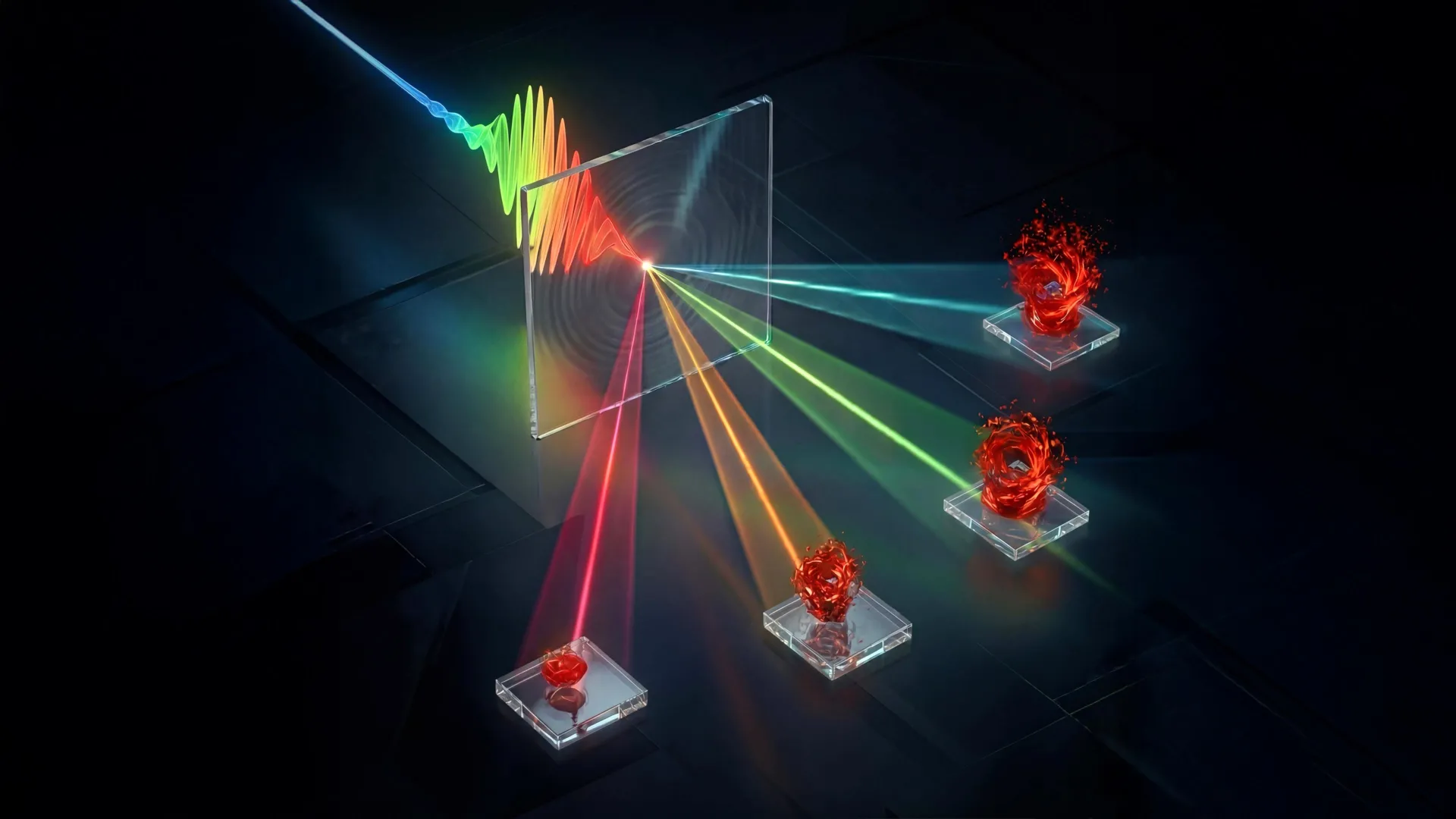
The process begins with a "chirped" laser pulse. Unlike a standard laser pulse where all wavelengths arrive simultaneously, a chirped pulse is stretched so that different colors (wavelengths) arrive at slightly different times. This creates a temporal yardstick where time is effectively mapped onto the color spectrum. When this pulse interacts with a fast-moving object or a changing material, the light is scattered. Because the pulse is chirped, the light scattered at the beginning of the event has a different wavelength than the light scattered at the end.
This scattered light, now rich with spatial and temporal data, passes through a dispersion-encoded coherent modulation system. Here, the information is compressed into a single, complex image. The final and perhaps most critical step involves a physics-informed neural network. This advanced artificial intelligence framework is tasked with the "reconstruction" of the data. It separates the intertwined wavelengths and reconstructs both the intensity (brightness) and the phase (the delay or shift in the light wave) for each moment in time. The result is a high-fidelity sequence of frames that reveals the evolution of the subject with unprecedented clarity.
Beyond Brightness: The Critical Importance of Phase Information
One of the most significant advancements of CST-CMFI over previous ultrafast imaging techniques is its ability to capture phase information. In traditional photography, we only record intensity—the amount of light hitting the sensor. However, light is a wave, and as it passes through a material, its "phase" changes based on the material’s refractive index and thickness.
"In the fields of physics, chemistry, biology and materials science, many important phenomena happen incredibly fast," noted Yunhua Yao. "Our new technique can capture the complete evolution of both the brightness and internal structure of an object in a single measurement. This is a big step forward for understanding the fundamental nature of matter."
Phase measurements are often far more sensitive than intensity measurements. For instance, in a transparent biological cell or a thin semiconductor film, the brightness of light passing through might not change significantly, but the phase will shift as the internal structure of the material fluctuates. By capturing this phase data, CST-CMFI allows scientists to see "invisible" changes in density, electron concentration, and molecular orientation that were previously hidden from view.
Experimental Validation: Plasma Formation and Electron Dynamics
To demonstrate the practical utility of CST-CMFI, the East China Normal University team conducted two landmark experiments targeting different areas of physical science.
The first experiment involved the observation of plasma formation in water following a femtosecond laser pulse. When a high-intensity laser hits water, it strips electrons from molecules, creating a plasma channel. This process happens in a flash and is critical for applications ranging from laser-based eye surgery to the development of new underwater communication technologies. The CST-CMFI system successfully mapped the birth and expansion of this plasma channel, revealing how a dense cloud of free electrons alters the refractive index of the water. The ability to see these phase shifts in real-time provides a blueprint for optimizing laser medical procedures to ensure maximum precision with minimal collateral damage to surrounding tissues.
The second experiment focused on the behavior of excited charge carriers in Zinc Selenide (ZnSe), a semiconductor material used in high-performance optics and electronics. By observing how electrons move and settle after being "kicked" by a laser pulse, the researchers gained insights into the material’s conductivity and response times. Yao pointed out that the phase variations captured by CST-CMFI were visible even when intensity changes were negligible, proving that the method could detect subtle carrier dynamics that would be missed by intensity-only cameras. This has direct implications for the semiconductor industry, which is constantly seeking to develop faster transistors and more efficient solar cells.
Chronology of Development and Institutional Context
The development of CST-CMFI is the latest milestone in a long-term research initiative at the Extreme Optical Imaging Laboratory. The laboratory has spent years refining "single-shot" technologies, moving from basic streak cameras to more complex compressive photography.
- Phase I: Development of Single-Shot Intensity Imaging. Early efforts focused on capturing the brightness of ultrafast events, leading to the creation of systems like Compressive Ultrafast Photography (CUP).
- Phase II: The Integration of Coherent Modulation. Recognizing the limitations of intensity-only data, the team began experimenting with coherent modulation to extract phase information, though initial versions lacked the necessary temporal resolution for femtosecond events.
- Phase III: The Birth of CST-CMFI. By incorporating chirped pulses and neural network reconstruction, the team successfully bridged the gap between phase-contrast imaging and femtosecond temporal resolution.
- Phase IV: Publication and Peer Review. The results were submitted to Optica, where the methodology underwent rigorous peer review before being shared with the global scientific community in late 2024.
Broader Impact: From Clean Energy to Advanced Manufacturing
The implications of CST-CMFI extend far beyond the laboratory. In the realm of clean energy, the technique is expected to play a vital role in laser-induced fusion research. Understanding the ultrafast dynamics of plasma is essential for stabilizing fusion reactions, which could eventually provide a near-limitless source of clean energy.
In advanced manufacturing, particularly in the field of "femtosecond laser machining," CST-CMFI provides a tool for real-time quality control. Manufacturers use ultrafast lasers to cut materials with micron-level precision. Being able to visualize the interaction between the laser and the material in real-time allows for the adjustment of laser parameters on the fly, reducing waste and increasing the efficiency of production lines for medical devices and aerospace components.
Furthermore, the technology holds promise for the field of "attosecond science"—the study of electron motion within atoms. While CST-CMFI currently operates in the femtosecond range, the principles of spectral-temporal mapping provide a foundation for even faster imaging systems in the future.
Future Horizons: Addressing Current Limitations
Despite its revolutionary capabilities, the CST-CMFI system currently faces a specific limitation: it relies on converting spectral (color) information into temporal (time) information. This means that if a process is highly sensitive to specific wavelengths of light—meaning the material changes its behavior depending on the color of the laser—the results could be skewed.
To solve this, Professor Yao and his team are already looking toward the next iteration of the technology. "Beyond helping scientists study materials that change instantly in response to laser light… CST-CMFI could help improve high-power laser technologies used for clean energy research," Yao explained. The team’s future roadmap involves merging CST-CMFI with compressive ultrafast photography to allow spectral and temporal data to be recorded on separate channels. This would provide a "three-dimensional" view of an event—capturing time, space, and spectrum simultaneously.
As the scientific community begins to adopt this new tool, the mysteries of the microscopic world are expected to unravel at an accelerated pace. From the way a drug molecule interacts with a cell membrane to the way electrons flow through a quantum computer’s processor, the CST-CMFI technique offers a new set of eyes for the 21st century, turning the "invisible" and "instantaneous" into the visible and understood. The work at East China Normal University stands as a testament to the power of combining classical optics with modern artificial intelligence, pushing the boundaries of what is possible in the realm of human observation.