The deep interiors of ice giant planets such as Uranus and Neptune may contain a previously unknown form of matter, according to new computer simulations conducted by Carnegie scientists Cong Liu and Ronald Cohen. Their study, published in the journal Nature Communications, suggests that carbon hydride could take on an unusual quasi-one-dimensional superionic state under the intense pressures and temperatures found far beneath the surfaces of these distant worlds. This discovery provides a significant leap forward in our understanding of planetary interiors, offering a potential explanation for the anomalous magnetic fields and heat-flow patterns observed in the outer reaches of our solar system.
The research arrives at a pivotal moment in planetary science, as the number of confirmed exoplanets has recently surpassed 6,000. Many of these distant worlds are classified as "sub-Neptunes" or "ice giants," making the internal dynamics of Uranus and Neptune a primary template for understanding a large portion of the observable universe. By combining advanced quantum simulations with machine-learning tools, Liu and Cohen have identified a phase of matter that challenges traditional classifications of solids and liquids, revealing a complex "spiral" architecture that could redefine the physics of extreme environments.
The Architecture of the Ice Giants
To understand the significance of this discovery, one must first consider the unique composition of Uranus and Neptune. Unlike the gas giants Jupiter and Saturn, which are primarily composed of hydrogen and helium, the ice giants are believed to possess massive "mantles" consisting of "hot ices"—specifically water, methane, and ammonia. However, the term "ice" is a misnomer in this context. At the depths of these planets, pressures reach millions of times that of Earth’s atmosphere, and temperatures soar to several thousand degrees. Under these conditions, molecules do not behave as they do on the surface of Earth; instead, they enter exotic states where the boundaries between states of matter blur.
Data collected from density measurements and gravitational modeling indicates that these planets possess a layered structure: a thin outer atmosphere of hydrogen and helium, a vast middle layer of compressed fluids and exotic ices, and a solid rocky core at the center. The Carnegie study focuses specifically on the behavior of carbon hydride (CH) within these middle layers. While carbon and hydrogen are two of the most abundant elements in the universe, their interaction under planetary conditions has remained one of the great mysteries of astrophysics.
Quantum Simulations and the Path to Discovery
The research led by Liu and Cohen utilized high-performance computing to run detailed quantum simulations of carbon hydride. Because it is currently impossible to replicate the sustained, extreme conditions of a planetary core in a laboratory setting, scientists rely on "first-principles" calculations. These calculations use the fundamental laws of physics to predict how atoms will interact.
The team modeled conditions ranging from 500 to 3,000 gigapascals (GPa)—approximately 5 million to 30 million times Earth’s atmospheric pressure—and temperatures between 4,000 and 6,000 Kelvin (6,740 to 10,340 degrees Fahrenheit). To manage the immense computational load required for these simulations, the researchers employed machine-learning algorithms. These tools allowed them to simulate the behavior of hundreds of atoms over longer timescales than previously possible, providing a high-resolution view of the material’s atomic structure.
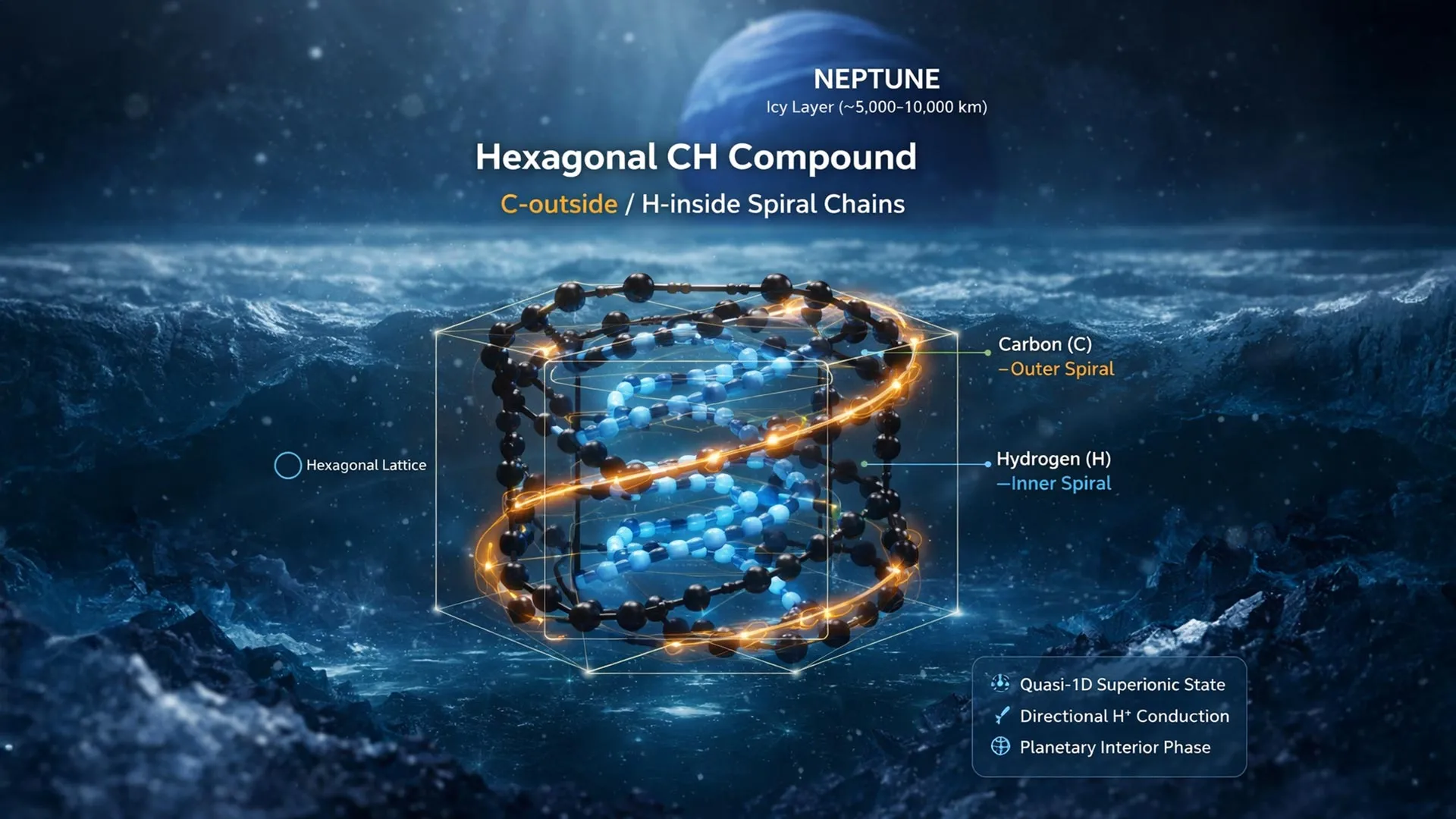
The results revealed a striking and unexpected configuration. In this newly identified phase, carbon atoms organize themselves into a stable, hexagonal framework—a rigid crystal lattice. However, the hydrogen atoms do not remain fixed. Instead, they move through this carbon framework along well-defined, spiral-like (helical) paths.
Defining the Superionic State
The discovery of a "quasi-one-dimensional" superionic state represents a departure from known superionic materials. A superionic state is a hybrid phase of matter that is simultaneously solid and liquid. In a typical superionic material, one element forms a solid crystalline "cage," while another element becomes mobile, flowing through the cage like a liquid. This allows the material to conduct electricity and heat in ways that a standard solid cannot.
In the case of the carbon hydride phase identified by Liu and Cohen, the hydrogen movement is restricted. "This newly predicted carbon-hydrogen phase is particularly striking because the atomic motion is not fully three-dimensional," explained Ronald Cohen. "Instead, hydrogen moves preferentially along well-defined helical pathways embedded within an ordered carbon structure."
This directional movement—essentially "one-dimensional" flow within a three-dimensional lattice—has profound implications for the physical properties of the material. It suggests that the transport of energy and charge within the planet is not uniform, but rather highly dependent on the orientation of these atomic spirals.
Implications for Planetary Magnetic Fields
One of the most enduring mysteries of Uranus and Neptune is the nature of their magnetic fields. Unlike Earth’s magnetic field, which is largely aligned with its axis of rotation and centered at the core, the magnetic fields of the ice giants are highly tilted and significantly offset from the planets’ centers. Uranus’s magnetic axis is tilted 59 degrees from its rotational axis, while Neptune’s is tilted 47 degrees.
Scientists have long theorized that these unusual magnetic fields are generated not in the core, but in the fluid layers of the mantle. This process, known as the "dynamo effect," requires a moving, electrically conductive fluid. The discovery of the superionic carbon hydride phase provides a new candidate for the source of this conductivity. Because the hydrogen ions move along specific paths, the resulting electrical conductivity would be anisotropic—meaning it varies depending on direction.
"The directional movement of hydrogen atoms could have major effects on how energy flows inside planets," the researchers noted. If large regions of the planetary interior are composed of this superionic matter, the resulting "lopsided" conductivity could explain why the magnetic fields of Uranus and Neptune are so distorted compared to other planets in our solar system.
A Chronology of Ice Giant Research
The quest to understand the interiors of Uranus and Neptune has spanned decades, marked by a few key milestones:
- 1986 & 1989: NASA’s Voyager 2 spacecraft performed the only flybys of Uranus and Neptune, respectively. The data it sent back—including the discovery of the tilted magnetic fields—remains the primary source of direct observation for these planets.
- 1990s: Theoretical models began to suggest that water could become superionic at high pressures, leading to the "hot ice" hypothesis.
- 2018: Experimental physicists at the Lawrence Livermore National Laboratory used high-powered lasers to briefly create superionic water ice in a lab, confirming the existence of the state for the first time.
- 2020-Present: The rise of machine learning in computational chemistry has allowed researchers like Liu and Cohen to explore more complex mixtures, such as carbon-hydrogen and carbon-nitrogen compounds, which were previously too complex to simulate accurately.
- 2023-2024: The Carnegie Institution’s discovery of the quasi-one-dimensional superionic state adds a new layer of complexity to the "hot ice" model, suggesting that the interior chemistry of these planets is more diverse than just water.
Broader Impact on Materials Science and Exoplanetology
The findings of Liu and Cohen extend beyond the borders of our own solar system. As astronomers continue to discover thousands of exoplanets, they are finding that "ice giants" may be the most common type of planet in the galaxy. Understanding the internal physics of these worlds is essential for determining their potential habitability and their evolutionary history. If the interiors of these planets are dominated by superionic materials, it changes how we calculate their cooling rates and their ability to protect atmospheres via magnetic shields.
Furthermore, this research has significant implications for the field of materials science on Earth. The discovery that simple elements like carbon and hydrogen can form highly organized, directional structures under pressure could inform the development of new synthetic materials. Engineers are constantly searching for materials with specific conductive or thermal properties; the helical pathways identified in this study represent a new template for "designing" matter at the atomic level.
"Carbon and hydrogen are among the most abundant elements in planetary materials, yet their combined behavior at giant-planet conditions remains far from fully understood," Cong Liu concluded. The study highlights how extreme environments can force even the most basic elements to behave in surprisingly complex ways.
Looking Forward: Future Missions
The scientific community is currently advocating for a dedicated mission to the ice giants. The 2023-2032 Planetary Science Decadal Survey, a report produced by the National Academies of Sciences, Engineering, and Medicine, identified a "Uranus Orbiter and Probe" (UOP) as the highest priority for a new flagship NASA mission.
Such a mission would involve an orbiter to study the planet’s atmosphere and magnetic field over several years, as well as a probe to descend into the atmosphere. The theoretical framework provided by Liu and Cohen will be vital for the scientists planning this mission, as it provides specific predictions about the planetary interior that the UOP could help verify. By measuring the gravity and magnetic field of Uranus with high precision, future spacecraft may finally confirm the existence of the "spiral" superionic matter that currently exists only in the realm of high-performance simulations.
As researchers continue to peel back the layers of these distant worlds, the work of the Carnegie team serves as a reminder that the most common elements in the universe still hold secrets that can only be unlocked under the most extreme conditions imaginable. The "hot ice" of Uranus and Neptune is no longer just a theoretical curiosity; it is a key to understanding the fundamental nature of matter across the cosmos.