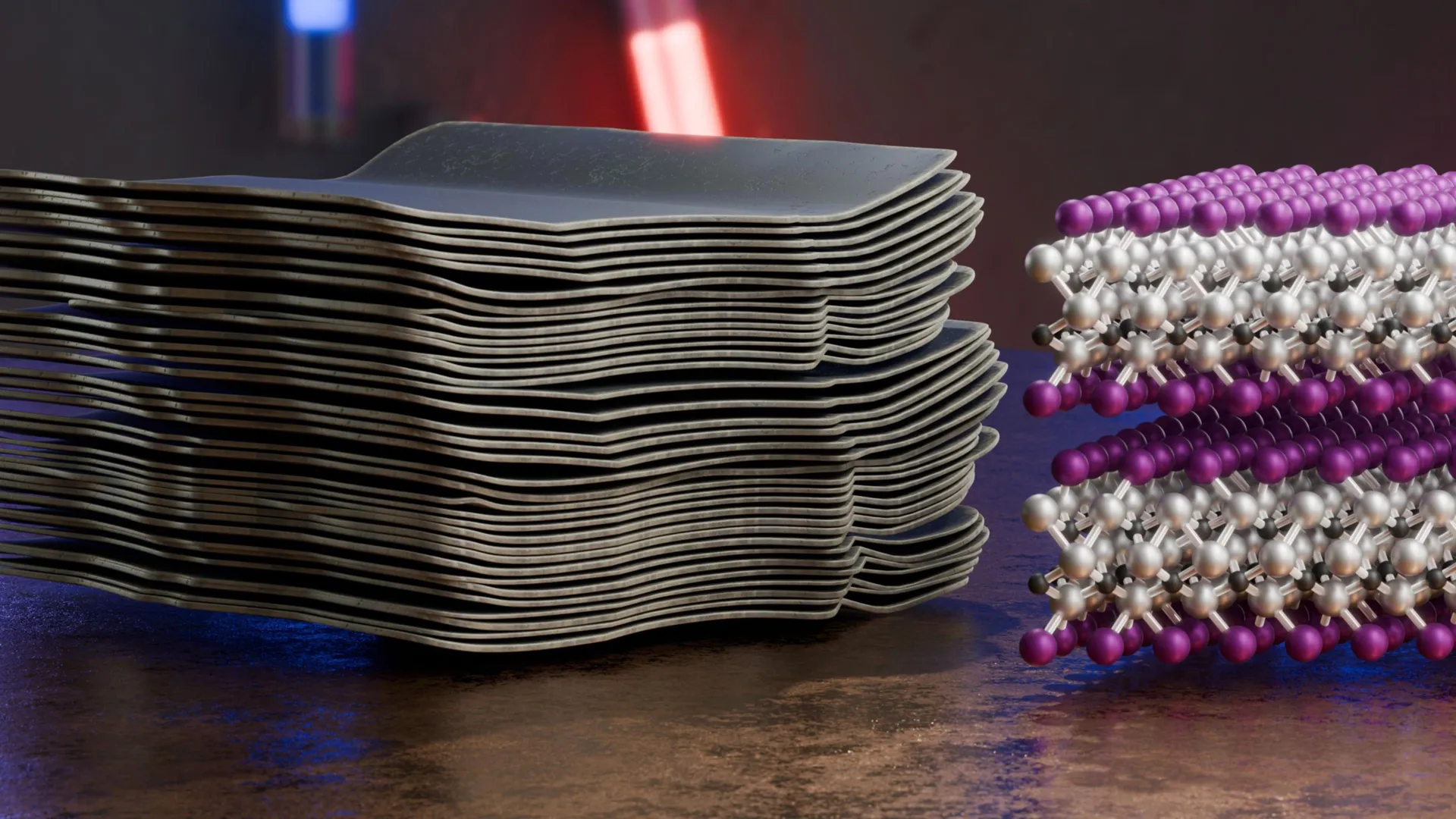
A collaborative research effort led by the Institute of Ion Beam Physics and Materials Research at the Helmholtz-Zentrum Dresden-Rossendorf (HZDR) and the Technische Universität Dresden (TU Dresden) has unveiled a transformative synthesis method for MXenes, a prominent family of two-dimensional (2D) inorganic materials. This new approach, termed the Gas-Liquid-Solid (GLS) method, addresses a decade-long challenge in material science: the inability to precisely control the atomic structure of MXene surfaces. By utilizing molten salts and iodine vapor instead of traditional harsh chemical etchants, researchers have produced MXenes with a 160-fold increase in macroscopic conductivity, marking a significant milestone in the development of next-generation electronics, energy storage, and electromagnetic shielding.
The Rise of MXenes and the Challenge of Atomic Disorder
Since their discovery in 2011 by researchers at Drexel University, MXenes have emerged as one of the most promising classes of 20th-century materials. Composed of transition metal carbides, nitrides, or carbonitrides, these materials are just a few atoms thick, offering a unique combination of metallic conductivity and hydrophilic (water-attracting) properties. Their structure typically consists of a transition metal layer—such as titanium or molybdenum—sandwiched between layers of carbon or nitrogen.
However, the true potential of MXenes has historically been throttled by the methods used to create them. Most MXenes are derived from "MAX phases," which are layered ternary carbides. To create a 2D MXene, the "A" layer (usually an element like aluminum) must be removed through a process called selective etching. For over a decade, this has primarily been achieved using hydrofluoric acid (HF) or similar fluoride-based salts.
While effective at removing the aluminum, this chemical "surgery" is messy. It leaves the surface of the MXene covered in a random, disorganized mixture of oxygen (-O), fluorine (-F), and hydroxyl (-OH) groups. Dr. Mahdi Ghorbani-Asl, a lead researcher at HZDR, notes that these surface atoms are far from being merely decorative. They are the primary gatekeepers of the material’s performance, dictating how electrons flow, how the material reacts to heat, and how it survives in corrosive environments. The randomness of these atoms creates "atomic potholes" that scatter electrons, significantly degrading the material’s electrical performance.
The GLS Method: A Paradigm Shift in Synthesis
The research team, including contributors from various European institutions, sought to replace the chaotic etching process with a more controlled chemical environment. The resulting GLS method represents a departure from liquid-acid chemistry toward a more sophisticated high-temperature vapor approach.
In the GLS process, the precursor MAX phase is exposed to a combination of molten halide salts and iodine vapor. This environment facilitates the selective removal of the "A" layer while simultaneously introducing specific halogen atoms—such as chlorine (Cl), bromine (Br), or iodine (I)—to the newly exposed surfaces. Unlike the random distribution seen in HF-etched materials, the GLS method allows these halogens to arrange themselves in a highly ordered, crystalline lattice.
"This atomic disorder limits performance because it traps and scatters electrons, much like potholes slowing traffic on a highway," explained Dr. Dongqi Li of TU Dresden. "By using the GLS method, we essentially pave the highway, allowing for a much smoother and faster transit of charge carriers."
The versatility of the GLS technique was demonstrated by its success across eight different MAX phases. This suggests that the method is not a niche solution for one specific material but a broad platform capable of producing a wide variety of "clean" MXenes with tailored surface chemistries.
Quantitative Analysis: Redefining Electrical Limits
To measure the impact of this new synthesis, the team focused on titanium carbide (Ti3C2), the most widely studied member of the MXene family. The performance gap between the traditional version and the GLS-produced version (Ti3C2Cl2) was found to be staggering.
- Macroscopic Conductivity: The chlorine-terminated MXene exhibited a 160-fold increase in macroscopic conductivity compared to traditional versions. This jump moves MXenes from being "good" conductors to being elite materials capable of competing with high-end metallic films.
- Terahertz Conductivity: In high-frequency ranges, which are critical for future 6G communication and advanced sensors, the material showed a 13-fold enhancement in terahertz conductivity.
- Charge Carrier Mobility: This metric, which measures how quickly an electron can move through a metal or semiconductor when pulled by an electric field, saw a nearly fourfold increase.
These improvements are not merely incremental; they represent a fundamental shift in the material’s utility. High charge carrier mobility is a prerequisite for high-speed transistors and efficient energy conversion devices. By reducing the "scattering" events—where electrons bounce off surface impurities—the researchers have effectively unlocked the theoretical performance limits of the Ti3C2 structure.
Theoretical Insights and Quantum Transport
The experimental success was reinforced by rigorous computational modeling. The team utilized Density Functional Theory (DFT) and quantum transport simulations to visualize what was happening at the sub-atomic level. These simulations confirmed that the "ordered" surface created by the GLS method minimizes the energy barriers that typically trap electrons.
Dr. Ghorbani-Asl emphasized the importance of this synergy between theory and experiment. "By combining theory with our experimental ability to precisely control surface terminations, we open a new path toward MXenes with improved stability and tailored functional properties," he stated. The simulations showed that when surface atoms like chlorine are arranged uniformly, they create a consistent electronic potential across the material’s surface, preventing the localized "traps" that characterize disordered, acid-etched MXenes.
Timeline of MXene Development and the Path to GLS
The journey to the GLS method follows a decade of intensive global research:
- 2011: Discovery of Ti3C2 at Drexel University using HF etching.
- 2014-2016: Identification of over 30 different MXene compositions, though surface control remains elusive.
- 2017-2019: Researchers begin exploring molten salt synthesis to avoid the dangers of hydrofluoric acid.
- 2020-2022: Initial attempts at halogen-terminated MXenes show promise but lack the extreme order and purity required for high-end electronics.
- 2024: The HZDR and TU Dresden team perfects the GLS method, achieving the first truly "clean" and highly conductive chlorine, bromine, and iodine variants.
Customization for Future Technologies: Electromagnetic Shielding and Beyond
One of the most exciting implications of the GLS method is the ability to "tune" MXenes for specific electromagnetic interactions. The study found that by changing the type of halogen on the surface (Cl, Br, or I), the material’s response to electromagnetic waves could be altered.
For example, chlorine-terminated MXenes demonstrated exceptionally strong absorption in the 14-18 GHz frequency range, known as the Ku-band. This frequency is vital for satellite communications and radar systems. By switching the surface atoms to bromine or iodine, the researchers could shift the absorption peaks to different frequencies.
This level of customization is a "holy grail" for industries involved in:
- Stealth Technology: Creating coatings that can absorb specific radar frequencies to make aircraft or vehicles less detectable.
- Electromagnetic Interference (EMI) Shielding: Protecting sensitive medical equipment or high-performance computers from "noise" generated by other electronic devices.
- Next-Generation Wireless: Designing components for 5G and 6G infrastructure that require precise control over signal reflection and absorption.
Furthermore, the team demonstrated the ability to create "hybrid" surfaces by mixing different halide salts. This allows for the creation of MXenes with two or even three types of surface halogens in specific ratios, offering a nearly infinite palette for material designers.
Broader Impact and Industrial Implications
The move away from hydrofluoric acid (HF) is also a significant win for industrial sustainability and safety. HF is notoriously dangerous, requiring specialized handling facilities and posing severe health risks to workers. The GLS method, while requiring high temperatures, utilizes more stable salts and vapors that are generally easier to manage in a large-scale manufacturing environment.
Industry analysts suggest that the ability to produce high-purity MXenes could accelerate their adoption in the energy sector. MXenes are already being tested as electrodes for supercapacitors and batteries because they can charge and discharge much faster than traditional carbon-based materials. With the 160-fold increase in conductivity provided by the GLS method, these energy storage devices could become even more efficient, potentially leading to smartphones that charge in seconds or electric vehicles with significantly improved power delivery.
In the realm of catalysis, the precise surface control offered by the GLS method allows for the placement of specific atoms that can speed up chemical reactions, such as the production of green hydrogen.
Conclusion: A New Era for 2D Materials
The work of the HZDR and TU Dresden team represents a major step forward in the chemistry of 2D materials. By solving the problem of surface disorder, they have transformed MXenes from experimental curiosities into high-performance materials ready for the demands of modern technology.
As the research moves toward commercialization, the focus will likely shift to scaling the GLS process and exploring the full "library" of potential MXene combinations. With the "highway" for electrons now paved, the race to integrate these materials into the hardware of the future has officially begun. The implications for flexible electronics, high-speed communication, and advanced optoelectronics are profound, signaling a new chapter where the atomic precision of a material’s surface is the key to its macroscopic success.