A stark riddle once posed: a giant barn owl, a hutia rodent, and a burrowing bee entered a cave. Only two emerged. The one that remained, by virtue of its inability to fly, was the hutia. This seemingly simple puzzle, however, unravels into a complex narrative of ancient predation, unexpected adaptation, and the remarkable preservation of life’s intricate dance within the fossil record, as recently illuminated by paleontological research on the Caribbean island of Hispaniola.
The initial scenario, likely playing out millennia ago, depicts a predatory encounter. A giant barn owl, a formidable hunter of its time, would have captured a hutia, a native Caribbean rodent, and transported its prey to the sanctity of its cave-dwelling. This cave, a refuge for the owl and its offspring, would have served as a larder. The swift consumption of the hutia would have left behind its skeletal remains, a testament to the owl’s successful hunt, scattered across the cave floor. It is within this ancient tableau of predator and prey that a new chapter of life would begin, initiated by an unlikely architect: a burrowing bee.
An Unforeseen Partnership: Bees and Ancient Remains
The narrative takes a fascinating turn with the arrival of a solitary bee, its instincts guiding it to seek a secure location for its colony. Driven by the imperative to construct a nest, the bee surveyed its surroundings, the cave’s dim recesses offering potential refuge. Its search led it to the clay-rich silt that had accumulated in the cave’s depths, a material conducive to the excavation of a burrow. However, its subterranean endeavors were interrupted when it encountered the fossilized remains of the hutia, specifically its jawbone.
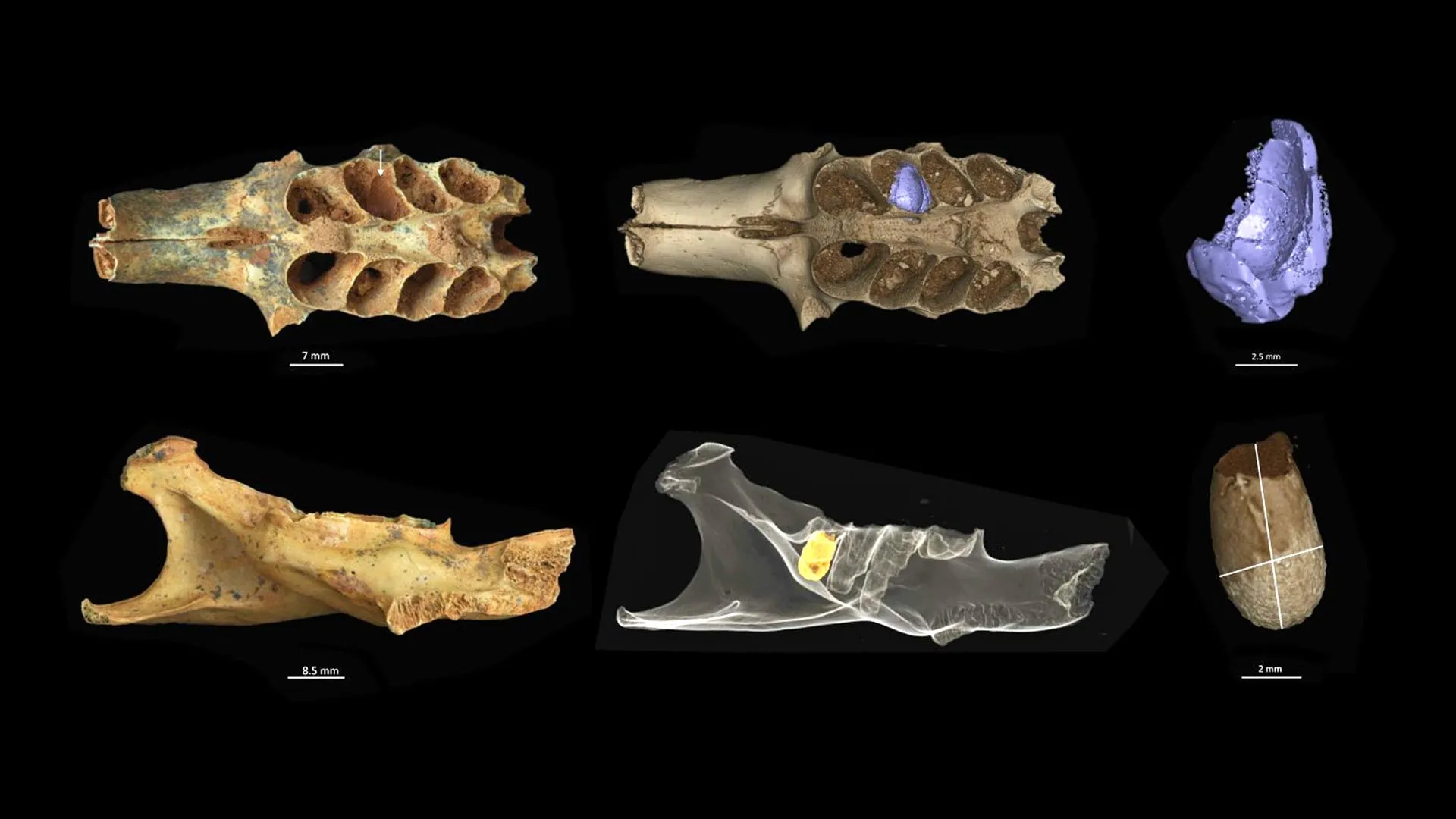
This discovery proved serendipitous. The hutia’s jaw, like that of many rodents, contained alveoli – small sockets that once held its teeth. Although the teeth themselves were long gone, the hollow cavities persisted. The size and structure of these empty alveoli were remarkably well-suited to the bee’s nesting requirements. What was once a part of a living creature’s anatomy, designed for gnawing and chewing, was repurposed by a tiny insect for the incubation of its progeny.
The initial bee’s success likely paved the way for others. Over time, successive generations of burrowing bees, encountering similar skeletal remains within the cave, began to utilize these pre-existing cavities as ready-made nesting sites. This behavior, where an insect leverages the fossilized structures of a long-extinct animal for its own life cycle, represents a rare and extraordinary instance of interspecies interaction across vast geological timescales. The cave, therefore, became a unique repository, not only of skeletal fossils but also of the traces of insect activity, a layered history preserved by the very elements that contributed to the fossilization process.
The Path to Discovery: A Paleontologist’s Keen Eye
The remarkable story encapsulated within these fossils might have remained untold had it not been for the meticulous observation of Lazaro Viñola Lopez, a doctoral student at the Florida Museum of Natural History. His excavation work in the Cueva de Mono, located in the southern Dominican Republic, led to the uncovering of thousands of hutia fossils. This particular species of hutia was of significant interest to Lopez due to its rarity in other parts of the island, suggesting the Cueva de Mono had served as a crucial, long-term feeding ground for giant barn owls, a behavior that would have persisted across many generations of both owls and their prey.
In the standard protocol for fossil collection, the process of cleaning involves meticulously removing all sediment, including from within any cavities like the alveoli. However, Lopez, driven by a deeper curiosity about the hutia species and its ecological role, adopted a more detailed approach. He meticulously inspected the fossils before proceeding with their preparation. This careful examination led him to notice an anomaly: one particular cavity within a hutia jaw exhibited an unusually smooth inner surface, contrasting sharply with the rough texture expected of bone.
From Suspected Wasps to Identified Bees: A Scientific Revision
Lopez’s initial hypothesis, based on a prior experience, was that these smooth-walled structures were the cocoons of wasps. In 2014, while excavating dinosaur fossils in Montana, he and his colleagues had discovered wasp cocoons interspersed with fossilized material. He recalled thinking that this discovery in the Dominican Republic would also be a straightforward report on wasp nests within the hutia mandibles. He even considered writing a brief paper on the subject.
He shared his initial findings and hypothesis with his colleague, Mitchell Riegler, also a doctoral student at the museum. Riegler, initially occupied with other research, was not immediately enthusiastic about what he perceived as a niche project. However, the idea was revisited when Riegler accepted a challenge from a former advisor to complete a scientific paper within a week. The collaborative effort to produce this paper involved a back-and-forth exchange, a game of scientific deduction and drafting.
During this intensive work, the team delved into the study of ichnofossils – traces of past biological activity, such as footprints, burrows, or nests. As they compared their findings with existing literature on ichnofossils, inconsistencies emerged. They learned that wasp nests are typically constructed from chewed plant material and saliva, resulting in rough interior walls. The smooth surfaces observed in the fossilized cavities did not align with this characteristic. Conversely, research indicated that certain bees often coat their nests with a waxy secretion, which dries to create a waterproof and polished interior. This crucial detail led to a pivotal re-evaluation: they were not dealing with wasp nests, but rather with the remarkable work of bees.
Unprecedented Behavior: Bees as Fossil Occupants
This correction significantly amplified the scientific importance of their discovery. The phenomenon of burrowing bees nesting within caves is exceptionally rare, with only one other known instance documented globally. However, this new finding presented an even more extraordinary behavior: bees utilizing pre-existing fossilized structures without any apparent modification. While a previous report documented bees drilling into human bones, this case involved bees passively occupying natural cavities within fossilized animal remains.
Recognizing the profound implications of their findings, the researchers adjusted their approach, slowing down their work and expanding the scope of their investigation. They consulted with contemporary bee experts and engaged in extensive reviews of scientific literature. Lopez even returned to the Cueva de Mono to conduct further geological examinations of the cave’s strata, seeking to contextualize the fossilized nests within the cave’s broader environmental history.
The research efforts faced an unexpected hurdle when a developer attempted to convert the land surrounding the cave into a septic tank system. Fortunately, this plan was ultimately thwarted, but the team recognized the urgency to salvage as many of the precious fossils as possible. This led to what Lopez described as a "rescue mission," where they worked rapidly to extract a substantial quantity of fossil material before any potential damage could occur.
A Diversity of Nests: Beyond the Hutia Jaw
The comprehensive study that emerged from this research provides a detailed chronicle of the cave’s history and the unique nesting habits of these bees. The discovery of bee nests was not confined to the hutia jaws; the bees demonstrated a remarkable adaptability, exploiting a variety of fossilized structures.
In one instance, a bee nest was found within the pulp cavity of a sloth tooth. These tree sloths, once native to the Caribbean, had long since disappeared from the region, their extinction often linked to the arrival of humans. Another nest was identified within a hutia vertebra, occupying the space that once housed the animal’s spinal cord.
Advanced imaging techniques, such as CT scans, revealed the layered nature of some of these fossilized nests. Rather than excavating new tunnels, the bees exhibited a tendency to reuse existing cavities if they were unoccupied. In a striking example, as many as six distinct bee nests were found stacked within a single hutia alveolus, arranged one inside the other in a manner reminiscent of Russian nesting dolls. This observation underscores the efficiency and opportunistic nature of these insects.
Environmental Drivers: Karst Terrain and the Need for Shelter
The research also proposed a compelling explanation for this unusual nesting behavior. The surrounding landscape of Hispaniola is characterized by karst topography, a geological formation marked by sharp, porous limestone. This type of terrain typically lacks stable, deep soil, which is crucial for burrowing insects.
"The area we were collecting in is karst, so it’s made of sharp, edgy limestone, and it’s lost all of its natural soils," Riegler explained, humorously adding, "I actually fell on it at one point, so I can tell you all about it." The limited soil that does accumulate on the surface is often subject to erosion and washes into the caves. This process creates pockets of more suitable nesting material within the cave environment, offering some of the only viable nesting conditions for burrowing bees in the region. The caves, therefore, became sanctuaries, providing the necessary substrate and protection that the exposed karst landscape could not offer.
A Cave of Unfolding Stories: Ongoing Research and Implications
The work of Viñola Lopez, Riegler, and their colleagues, published in the prestigious journal Proceedings of the Royal Society B, represents a significant contribution to our understanding of paleontology and insect behavior. Their ongoing research continues to explore the wealth of fossils recovered from the Cueva de Mono, with further discoveries anticipated in future publications.
This remarkable case study highlights the extraordinary adaptability of life. In this instance, a cave that once served as a hunting ground for giant barn owls, and a resting place for the remains of their prey, was transformed into a nursery for a different species, a testament to nature’s persistent drive to perpetuate itself in the most unexpected ways. The story of the owl, the hutia, and the bee is a vivid illustration of how the past, through the enduring power of fossilization, can continue to reveal its secrets, offering profound insights into the intricate web of life and the remarkable resilience of evolution. The Cueva de Mono, it appears, still holds many untold stories, waiting to be unearthed by the persistent curiosity of scientists.