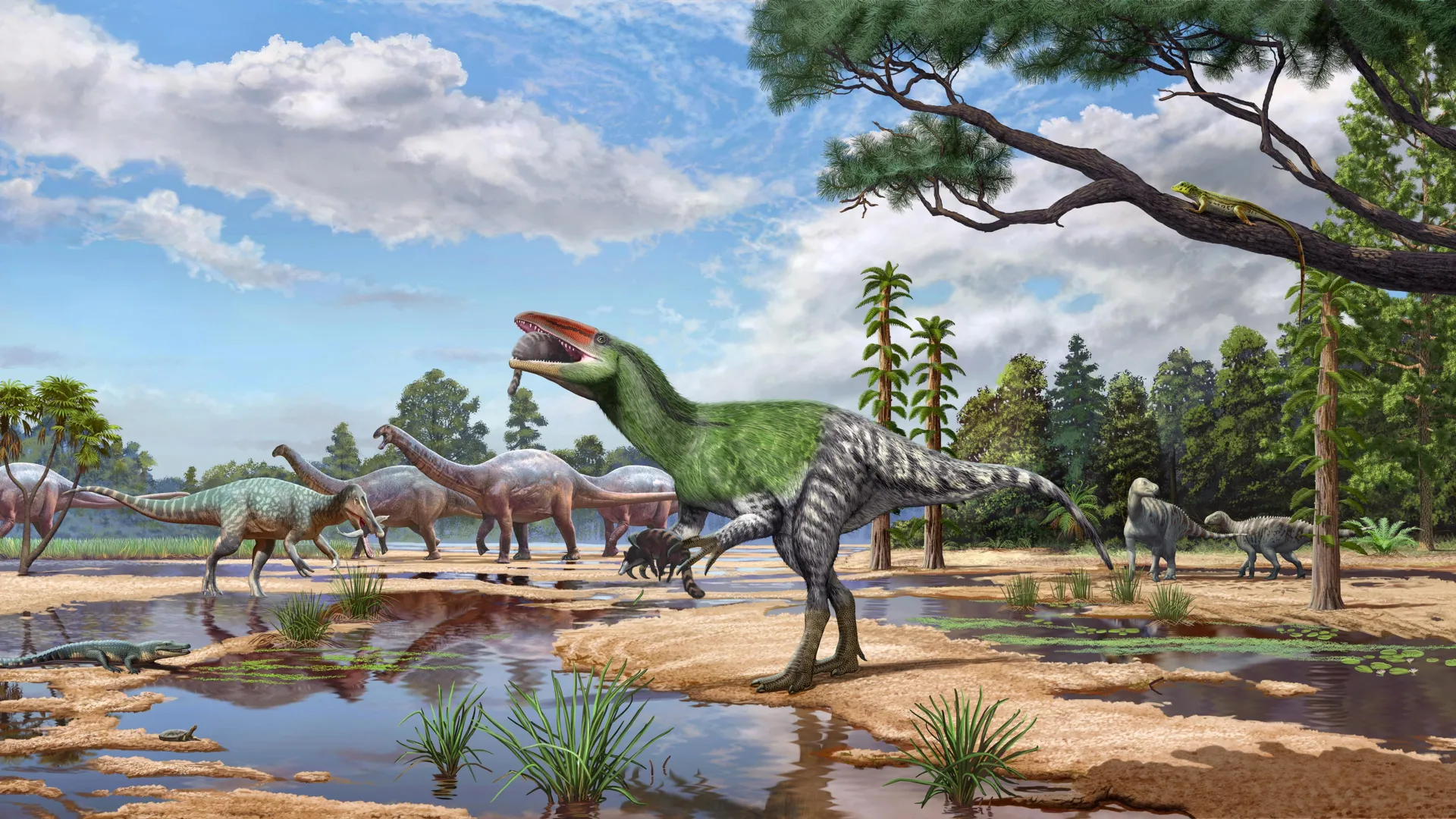
Three hundred million years ago, Earth was a planet vastly different from the one we inhabit today. Its landmasses were consolidated into a single, immense supercontinent known as Pangaea. Near the planet’s equator, this colossal landmass was dominated by sprawling, humid coal-swamp forests, a stark contrast to many modern landscapes. The atmosphere itself held a remarkable difference: oxygen levels were significantly higher than current readings, estimated to be as much as 45% greater than today’s approximately 21%. This oxygen-rich environment, coupled with abundant vegetation, fostered conditions ripe for frequent and widespread wildfires, shaping the very evolution of life on the nascent planet.
Life, in this ancient epoch, teemed across every conceivable environment. The vast oceans were alive with diverse fish species, while terrestrial realms supported a burgeoning array of amphibians, early reptiles, and a myriad of arthropods. Among these crawling creatures were some truly astonishing forms, including cockroaches of gargantuan proportions. Overhead, the skies were the domain of insects, and it is here that some of the most spectacular evolutionary divergences occurred, with certain species reaching sizes that defy modern comprehension.
The Reign of the "Griffinflies": Prehistoric Insect Wonders
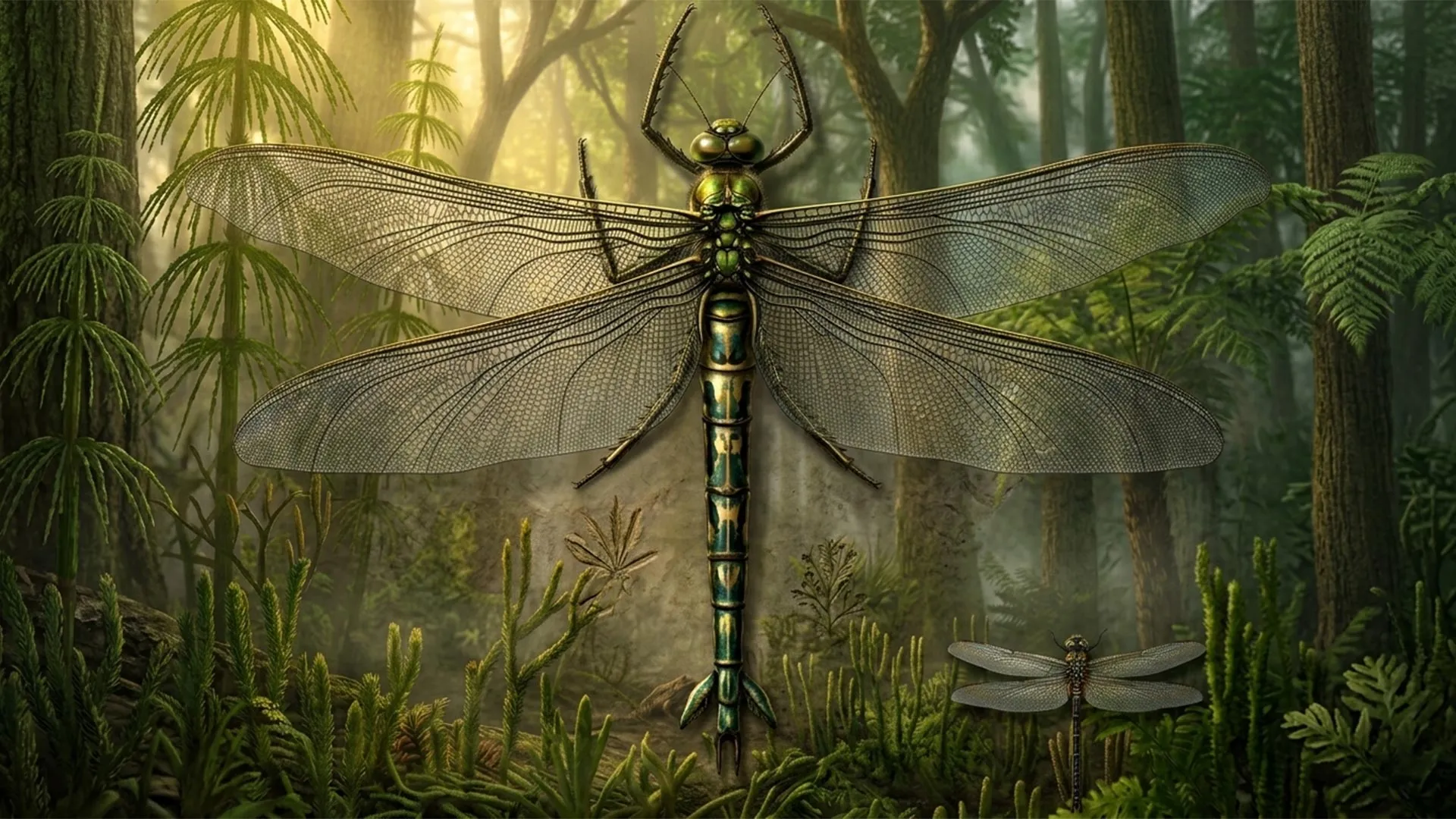
Among the most captivating of these prehistoric invertebrates were insects that dwarfed their modern descendants. Mayfly-like species, with delicate yet imposing wingspans measuring up to 17 inches (45 cm), navigated the ancient air. Even more striking were the dragonfly-like creatures, colloquially termed "griffinflies," which boasted wingspans reaching an astonishing 27 inches (70 cm). These colossal insects, first identified from remarkably preserved fossil impressions discovered in fine-grained sedimentary rock formations in Kansas nearly a century ago, have long captivated the scientific imagination.
For decades, the prevailing scientific consensus attributed the existence of these enormous insects to the exceptionally high atmospheric oxygen levels of the Carboniferous period, approximately 300 to 360 million years ago. This theory posited that the increased availability of oxygen was a prerequisite for supporting the metabolic demands of such large flying creatures.
The Long-Held Oxygen Hypothesis: A Detailed Examination
The foundation for this long-standing theory was laid in the 1980s. During this period, researchers developed sophisticated techniques that allowed for the reconstruction of ancient atmospheric compositions. These groundbreaking analyses revealed that oxygen levels indeed peaked around 300 million years ago, reaching levels that would have been profoundly different for any life forms adapted to them.
Building upon this crucial discovery, a pivotal study published in the prestigious journal Nature in 1995 solidified the link between this oxygen-rich era and the presence of giant insects. Scientists at the time proposed a direct correlation: larger insects, with their greater metabolic needs, required more oxygen. Consequently, the elevated atmospheric oxygen levels were believed to have enabled and facilitated the evolution of these colossal arthropod forms.
This explanation was intrinsically tied to the unique respiratory system of insects. Unlike vertebrates, which possess lungs for oxygen uptake, insects rely on a complex network of air-filled tubes called a tracheal system. These tubes, branching extensively throughout the insect’s body, terminate in microscopic structures known as tracheoles. Oxygen moves through these tracheoles via diffusion, a passive process driven by concentration gradients, to reach the flight muscles and other vital tissues.
The crucial aspect of diffusion is its efficiency, which diminishes significantly over longer distances. Researchers extrapolated from this principle, concluding that under modern atmospheric oxygen levels (around 21%), diffusion alone would not be sufficient to adequately supply the energy demands of extremely large flying insects. The reasoning was straightforward: a larger insect would necessitate longer diffusion pathways for oxygen to reach its most distant cells, a process that would become prohibitively slow and inefficient. Therefore, the high oxygen concentrations of the Carboniferous period were deemed essential to overcome this diffusion limitation and support the metabolic needs of griffinflies and their kin.
A New Paradigm: Challenging Decades of Scientific Understanding
However, recent research is poised to fundamentally alter this established narrative. A new study, also published in the esteemed journal Nature, presents compelling evidence that challenges the long-held assumptions about the direct role of atmospheric oxygen in limiting insect size. This research, spearheaded by Edward (Ned) Snelling, an associate professor in the Faculty of Veterinary Science at the University of Pretoria, employed advanced technological methods to re-examine the relationship between insect body size and their respiratory physiology.
The team utilized high-power electron microscopy, a technique offering unparalleled resolution, to meticulously examine the structure of insect flight muscles. Specifically, they focused on quantifying the number and distribution of tracheoles within these muscles across a range of insect species. Their findings revealed a surprising consistency: in the vast majority of insect species studied, tracheoles typically occupy a remarkably small fraction of the total flight muscle volume, often accounting for only about 1% or even less.
Crucially, when this observed proportion was applied to the hypothetical physiology of the massive griffinflies that roamed Earth 300 million years ago, the proportion of tracheoles within their flight muscles remained proportionally small. This observation suggests that the flight muscles of insects, even those of colossal size, are not inherently limited by the availability of oxygen transported via the tracheal system. The study posits that because tracheoles occupy such a minimal amount of space, insects possess significant evolutionary plasticity to increase their number and diameter without encountering insurmountable structural constraints.
Evidence from Modern Insects and Vertebrates
Professor Snelling elaborated on the implications of these findings. "If atmospheric oxygen really sets a limit on the maximum body size of insects, then there ought to be evidence of compensation at the level of the tracheoles," he stated. "There is some compensation occurring in larger insects, but it is trivial in the grand scheme of things." This implies that while larger insects may exhibit a slight increase in tracheole density, it is not of the magnitude that would be expected if oxygen diffusion was the primary limiting factor for extreme size.
Further bolstering this argument, the researchers drew comparisons between insect respiratory systems and those of vertebrates. They observed that in birds and mammals, the capillaries within their heart muscle, responsible for oxygen delivery, occupy a significantly larger proportion of the muscle tissue compared to tracheoles in insect flight muscle. Specifically, capillaries in the cardiac muscle of birds and mammals can occupy approximately ten times more relative space than tracheoles do in the flight muscle of insects.
Professor Roger Seymour of Adelaide University, a collaborator on the study, highlighted the significance of this comparative data. "By comparison, capillaries in the cardiac muscle of birds and mammals occupy about ten-times the relative space than tracheoles occupy in the flight muscle of insects, so there must be great evolutionary potential to ramp up investment of tracheoles if oxygen transport were really limiting body size," he commented. This analogy underscores the substantial untapped capacity within the insect tracheal system for oxygen transport, suggesting that it is not the bottleneck for increasing insect size.
The Enduring Mystery of Gigantism
While the new study provides a strong challenge to the oxygen diffusion limitation theory, it is important to note that the role of oxygen in limiting insect size has not been entirely dismissed by the scientific community. Some researchers caution that atmospheric oxygen might still play a role in restricting insect size through other mechanisms. These could include limitations in oxygen transport to other body parts, or perhaps during earlier, less complex developmental stages of insect evolution. The diffusion of oxygen from the spiracles (external openings of the tracheal system) into the tracheoles, rather than diffusion within the tracheoles themselves, could potentially be a limiting factor.
Nevertheless, the findings from Snelling’s team offer a clear and significant conclusion: oxygen diffusion within the flight muscle tracheoles is demonstrably not the primary limiting factor for insect size. This necessitates a re-evaluation of existing hypotheses and an exploration of alternative explanations for the remarkable gigantism observed in prehistoric insects.
Scientists are now turning their attention to other potential factors that may have contributed to the evolution of giant insects. These include increased predation pressure from newly evolving vertebrates, which might have favored larger, more robust insects as a defense mechanism. Physical limitations imposed by the insect exoskeleton, such as the structural integrity required to support a larger body mass, are also being considered. The biomechanics of flight at such immense scales, including wing loading and energy expenditure, present another avenue for investigation.
For now, the precise reasons behind the rise and eventual disappearance of these colossal insects remain an open and fascinating question in the annals of paleontology. The ongoing research promises to shed further light on the intricate evolutionary pathways that shaped life on Earth, challenging our understanding of biological limits and the dynamic interplay between environment and organism. The Carboniferous period, with its coal-swamp forests and giant arthropods, continues to be a fertile ground for scientific discovery, reminding us of the planet’s extraordinary past and the enduring mysteries it holds.