

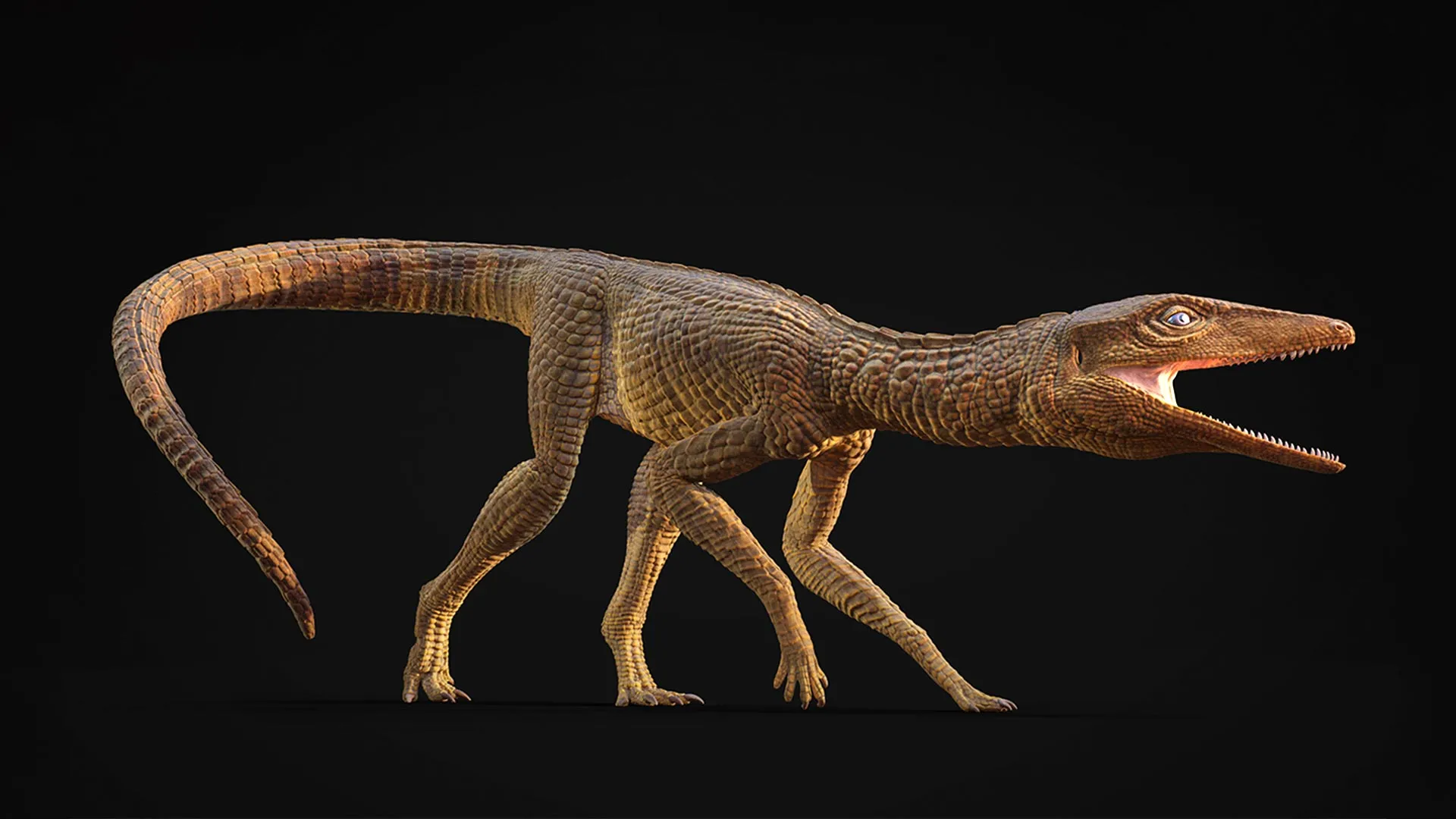
A remarkable discovery in Gloucester, United Kingdom, has unveiled a previously unknown species of crocodylomorph, a distant ancestor of modern crocodiles, that roamed the Earth approximately 215 million years ago during the Late Triassic period. This ancient predator, named Galahadodon rhysi, offers a compelling glimpse into the diversity of terrestrial ecosystems that flourished just before a significant global extinction event. Unlike its aquatic descendants, Galahadodon rhysi was a fast-moving, land-dwelling hunter, possessing a suite of adaptations that enabled it to thrive in a challenging and rapidly changing environment.
The scientific description of Galahadodon rhysi marks a significant contribution to our understanding of early crocodylomorph evolution and the intricate ecological webs of the Late Triassic. The fossil remains, recovered from fissure deposits on both sides of the Bristol Channel in what is now southern Wales and southwest England, paint a picture of a creature distinctly different from the formidable, semi-aquatic predators we associate with the term "crocodile" today.
A Predator Built for Speed and Land
Galahadodon rhysi is characterized by its long, slender legs and a comparatively lightweight skeletal structure. These anatomical features strongly suggest a life lived primarily, if not exclusively, on land, with a capacity for considerable speed. Paleontologists theorize that this agile predator would have actively pursued small prey, including early reptiles, amphibians, and nascent mammals, through the vegetated landscapes of the Triassic period. The region where the fossils were found was, at that time, an elevated plateau, an oasis of sorts surrounded by vast, arid plains. This environmental context would have dictated a different hunting strategy compared to water-bound ambush predators. The ability to move swiftly across terrestrial terrain would have been a crucial advantage for Galahadodon rhysi in securing its food supply.
The discovery adds a crucial piece to the puzzle of crocodylomorph diversification. While the popular image of crocodiles is tied to water, the early history of this lineage was far more varied. Many early crocodylomorphs, like Terrestrisuchus – another fossil found in similar deposits – were also terrestrial. Galahadodon rhysi further reinforces this understanding, showcasing a specialized terrestrial niche occupied by these ancient reptiles.
Naming Conventions: A Tribute to Legend and Mentorship
The scientific name, Galahadodon rhysi, carries a dual significance, honoring both a legendary figure and a dedicated educator. The genus name, Galahadodon, is a direct reference to Sir Galahad, the purest and most upright knight of the Arthurian legend. This choice reflects the inferred upright posture of the animal, a characteristic that distinguished it from more sprawling reptiles. The species name, rhysi, is a personal tribute to David Rhys Jones, a former physics teacher at Ysgol Uwchradd Aberteifi in Cardigan, Wales. Ewan Bodenham, a PhD student at the Natural History Museum London and UCL, and the lead author of the research paper describing the new species, explained the personal connection.
"We named it after my secondary school physics teacher," Bodenham stated, highlighting the profound impact Mr. Jones had on his academic journey. He further elaborated on his former teacher’s qualities: "Mr. Jones was just such a good teacher, not only in being able to explain things well, but you could tell that he was genuinely interested in the sciences. I think that really inspired me." Bodenham also emphasized Mr. Jones’s pedagogical approach, noting that he "didn’t let me settle. He was very good at challenging people and helping students be the best they can be. Above all, he’s a very funny, genuine, nice guy." This naming convention underscores the human element within scientific discovery and the often-unseen influences that shape the careers of researchers.
Unearthing the Past: The Significance of Fissure Deposits
The fossilized remains of Galahadodon rhysi were unearthed from fissure deposits, geological formations that offer a unique window into ancient environments. These deposits are essentially underground cavities and cracks that accumulated the remains of animals that died on the surface. Over time, carcasses would have been washed into these subterranean spaces by natural processes, such as rainfall, where they were subsequently buried by accumulating sediment. This process effectively entombed the remains, preserving them for millions of years.
The fissure deposits in the Bristol Channel region have proven to be exceptionally rich paleontological sites. They have yielded a diverse array of fossil material from the Late Triassic, providing invaluable insights into the fauna and flora of this critical period in Earth’s history. The presence of Terrestrisuchus alongside the newly identified Galahadodon rhysi within these same deposits further solidifies the understanding that this ancient landscape supported a community of terrestrial crocodylomorphs. The meticulous excavation and analysis of these sites are vital for reconstructing the ancient ecosystems.
The Rigorous Process of Species Identification
Identifying a new species from fossil fragments is a meticulous and often complex scientific endeavor. Ewan Bodenham’s PhD project focuses on deciphering the evolutionary relationships within the early crocodylomorph lineage. This involved a detailed comparative anatomical study of the newly discovered specimen. "So we conducted a detailed anatomical description of this specimen, making comparisons to other early crocodiles to determine if it was another specimen of Terrestrisuchus or if it was something new," Bodenham explained.
The research team employed advanced imaging techniques and microscopic analysis to examine the fossilized bones. By comparing the morphology, size, and specific structural features of the specimen with known crocodylomorph species, particularly Terrestrisuchus, they were able to identify distinct characteristics. The analysis revealed 13 significant anatomical differences that were deemed sufficient to classify the specimen as a distinct species, Galahadodon rhysi. This rigorous process ensures that scientific classifications are based on robust evidence and contribute meaningfully to the existing body of paleontological knowledge.
Pre-Extinction Ecosystems: A World on the Brink
The discovery of Galahadodon rhysi holds considerable importance for understanding the ecosystems that existed in the Late Triassic, a period immediately preceding the Triassic-Jurassic mass extinction event. This catastrophic extinction, one of the most severe in Earth’s history, dramatically reshaped life on the planet. It is widely believed to have been triggered by massive volcanic activity, specifically the eruption of the Central Atlantic Magmatic Province (CAMP), which led to significant climate disruption, including global warming and ocean acidification.
By cataloging and studying the species that inhabited the world just before this major upheaval, scientists can gain invaluable insights into the resilience and adaptability of life. The presence of specialized terrestrial predators like Galahadodon rhysi in the Late Triassic suggests a complex and diverse fauna that was already adapting to various environmental pressures. Studying these pre-extinction communities allows researchers to develop models of how ecosystems respond to profound environmental changes, providing potential parallels for understanding current biodiversity challenges. The diversity of crocodylomorphs, from swift land-dwellers to their future aquatic descendants, highlights the evolutionary plasticity within the group and its ability to exploit a range of ecological niches.
Publication and Future Research
The formal scientific description of Galahadodon rhysi has been published in the peer-reviewed journal The Anatomical Record. The paper, titled ‘A second species of non-crocodyliform crocodylomorph from the Late Triassic fissure deposits of southwestern UK: implications for locomotory ecological diversity in Saltoposuchidae’, provides the detailed anatomical data and phylogenetic analysis that underpin the species designation.
This discovery is likely to spur further research into the Late Triassic fissure deposits of the UK and beyond. Scientists will be keen to find more complete specimens of Galahadodon rhysi to gain a more comprehensive understanding of its anatomy and lifestyle. Furthermore, continued exploration of these fossil-rich sites promises to reveal other unknown species, further illuminating the complex evolutionary narrative of the Triassic period and the remarkable journey of the crocodylomorph lineage from swift terrestrial hunters to the apex aquatic predators of today. The ongoing study of such ancient creatures not only expands our knowledge of prehistoric life but also offers crucial perspectives on the long-term dynamics of evolution and extinction in the face of environmental change. The meticulous work of paleontologists like Ewan Bodenham and his colleagues continues to rewrite the story of life on Earth, one fossil at a time.











Leave a Reply