

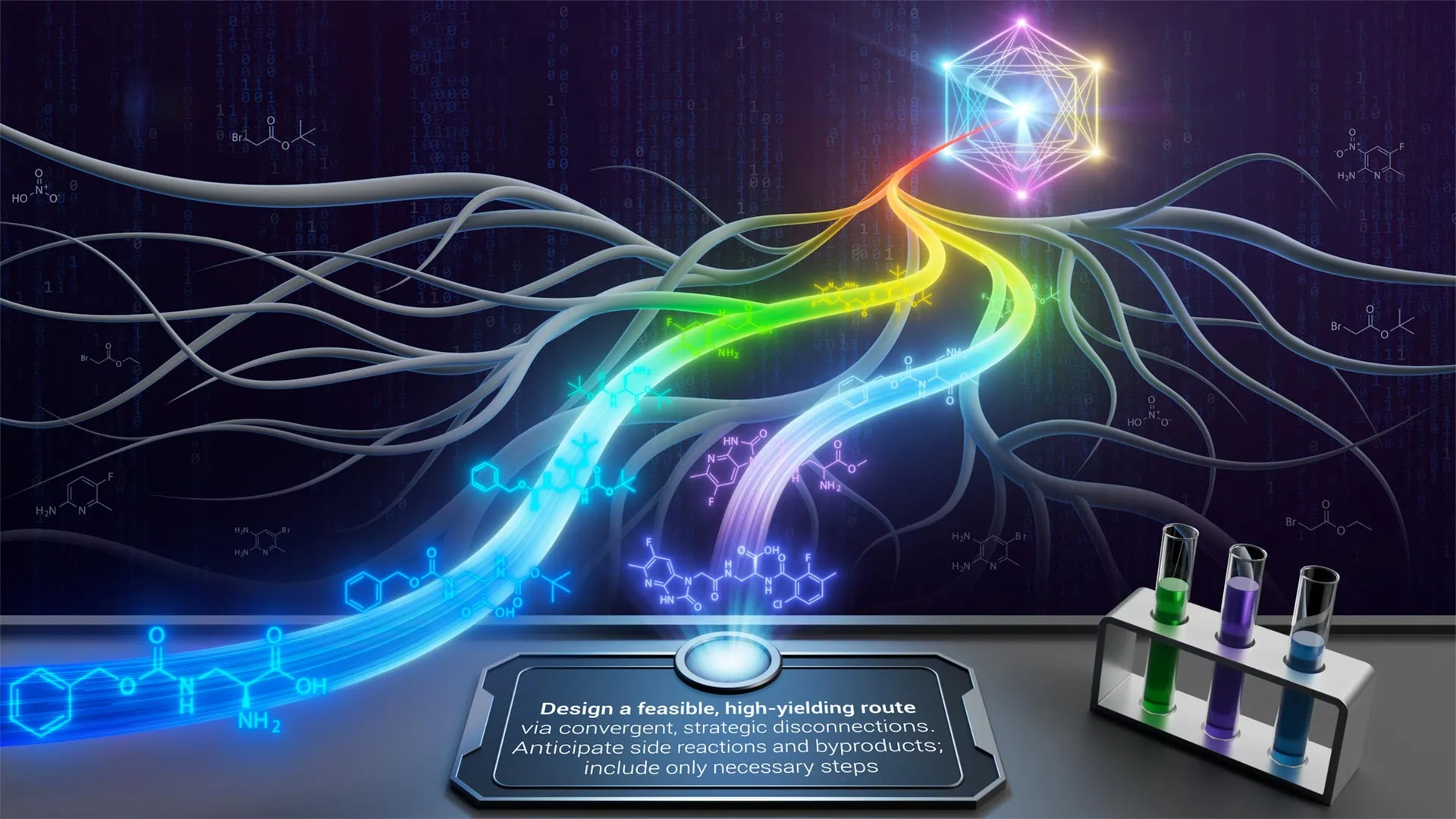
The pursuit of molecular innovation stands as one of the most formidable intellectual challenges in modern science, requiring a sophisticated synthesis of creative strategy and rigorous technical execution. Whether the objective is the development of a next-generation pharmaceutical compound to combat emerging pathogens or the engineering of sustainable materials for green energy, the path from concept to creation is paved with intricate chemical reactions. Traditionally, this process has relied on the seasoned intuition of doctoral-level chemists who spend decades mastering the art of retrosynthesis—the methodology of deconstructing a target molecule into its fundamental building blocks. However, a groundbreaking development from the Laboratory of Artificial Chemical Intelligence at the École Polytechnique Fédérale de Lausanne (EPFL) is poised to transform this landscape. Researchers led by Professor Philippe Schwaller have introduced Synthegy, a novel framework that leverages the reasoning capabilities of large language models (LLMs) to guide complex chemical synthesis and elucidate reaction mechanisms through natural language instructions.
The Evolutionary Challenge of Molecular Construction
To understand the significance of Synthegy, one must first appreciate the inherent difficulties of retrosynthetic analysis. In this "backward-thinking" approach, scientists begin with a desired end product and work toward simple, commercially available starting materials. This involves a series of high-stakes decisions: which carbon-carbon bonds to form first, when to introduce specific functional groups, and how to manage "protecting groups"—temporary modifications used to prevent sensitive parts of a molecule from reacting prematurely.
For decades, the field of computational chemistry has sought to automate this process. Early attempts in the 1960s and 70s, such as E.J. Corey’s LHASA (Logic and Heuristics Applied to Synthetic Analysis), relied on rigid, hand-coded rules. While these systems provided a foundation, they lacked the flexibility to navigate the nearly infinite "chemical space." Modern machine learning models improved upon this by scanning vast databases of known reactions, yet they often functioned as "black boxes," providing potential routes without explaining the underlying strategic logic. Furthermore, these tools frequently required users to navigate cumbersome interfaces, inputting data via complex code or restrictive filters that did not align with the way chemists actually think or communicate.
The Synthegy Framework: Bridging Language and Logic
The introduction of Synthegy marks a paradigm shift by positioning AI not as a direct generator of chemical structures, but as a strategic evaluator and reasoning partner. Published recently in the journal Matter, the research details a system where LLMs—the technology behind tools like GPT-4—act as a cognitive layer atop traditional search algorithms.
The workflow begins with a chemist providing a target molecule and a set of instructions in plain, everyday English. A researcher might specify, "Synthesize this molecule while ensuring the indole ring is formed in the final step to avoid degradation," or "Prioritize a route that avoids the use of toxic palladium catalysts." Synthegy then utilizes standard retrosynthesis software to generate hundreds of possible pathways.
The innovation lies in what happens next. Each of these potential pathways is translated into a text-based representation. The LLM then "reads" these routes, evaluating them against the chemist’s original natural language constraints. It scores each option based on feasibility, efficiency, and adherence to the specified strategy, providing a written explanation for its ranking. This transparency allows the human chemist to understand why a particular route was recommended, fostering a collaborative environment between human expertise and machine processing power.
Chronology of Development and Technological Integration
The development of Synthegy follows a clear trajectory of increasing sophistication in the application of AI to chemistry. In the early 2020s, the focus was primarily on "reaction prediction"—using AI to guess the outcome of combining two chemicals. By 2022, the emphasis shifted toward "retrosynthesis," but the tools remained difficult for non-experts to steer.
The EPFL team recognized that the missing link was a versatile user interface. In 2023, the team began experimenting with the reasoning capabilities of LLMs, discovering that while these models sometimes struggled with precise mathematical or spatial tasks, they excelled at interpreting "strategies." Throughout late 2023 and early 2024, the researchers refined the "Synthegy" framework, developing the specific prompts and scoring metrics required to turn a general-purpose language model into a specialized chemical consultant.
Andres M. Bran, the lead author of the study, emphasized the importance of this evolution. "When making tools for chemists, the user interface matters a lot," Bran noted. He explained that previous iterations of computational tools often felt like a barrier rather than a bridge. Synthegy was designed to remove that barrier, allowing for a faster, more iterative process where ideas can be tested and refined through dialogue.
Empirical Validation: Human-AI Synergy in the Lab
To test the efficacy of the Synthegy framework, the EPFL researchers conducted a rigorous, double-blind study involving 36 professional chemists. This evaluation was designed to determine if the AI’s "judgment" aligned with human expert intuition.
The results were statistically significant. Across 368 valid evaluations, the chemists agreed with Synthegy’s assessments 71.2% of the time on average. The study revealed that the system was particularly adept at:
- Identifying Strategic Errors: Synthegy successfully flagged routes that included unnecessary or redundant protecting group steps, which often plague automated synthesis tools.
- Feasibility Assessment: The model could distinguish between reactions that look good on paper but are notoriously difficult to execute in a laboratory setting.
- Instruction Adherence: When given specific constraints (e.g., "avoid high-temperature steps"), the model consistently prioritized routes that met those criteria.
Furthermore, the research highlighted a direct correlation between the size of the language model and its chemical reasoning ability. While smaller models showed limited capacity for complex strategic thinking, larger, more advanced models demonstrated a nuanced understanding of functional group compatibility and molecular stability.
Beyond Synthesis: Decoding Reaction Mechanisms
A secondary but equally vital application of Synthegy lies in the realm of reaction mechanisms. Understanding a mechanism—the step-by-step movement of electrons that transforms reactants into products—is essential for optimizing yields and discovering entirely new types of chemical transformations.
Predicting these mechanisms is a Herculean task because a single reaction can theoretically proceed through dozens of intermediate stages. Synthegy addresses this by breaking down a reaction into its most basic electron-pushing steps. The LLM then evaluates these steps to ensure they follow the laws of thermodynamics and chemical logic. By steering the search toward "chemically sensible" pathways, Synthegy prevents the computational system from wasting resources on unrealistic scenarios.
This capability also allows researchers to incorporate expert hypotheses. A chemist can input a theory—"I believe this reaction proceeds via a radical intermediate"—and Synthegy will explore pathways that validate or challenge that specific hypothesis, providing a data-driven sanity check for theoretical chemistry.
Industry Implications and the Future of Drug Discovery
The implications of the Synthegy framework extend far beyond the academic laboratory. In the pharmaceutical industry, the "hit-to-lead" phase of drug discovery—where thousands of potential compounds are synthesized and tested—is often a major bottleneck. By allowing medicinal chemists to rapidly filter synthesis routes using natural language, Synthegy could reduce the time required to bring new therapies to clinical trials.
Moreover, the tool’s accessibility could democratize advanced computational chemistry. Smaller research firms and laboratories in developing nations, which may not have access to a large staff of specialized computational chemists, could use Synthegy to bridge the expertise gap.
Industry analysts suggest that the integration of natural language interfaces into scientific software represents the "third wave" of digital chemistry. The first wave was digitalization (moving from paper to computers), the second was automation (using algorithms to scan data), and the third is "collaborative intelligence," where the machine understands the intent behind the scientist’s query.
Analysis: The Role of AI as an Interpretive Guide
The success of Synthegy highlights a critical shift in the philosophy of AI development. For several years, the narrative in the tech world has centered on AI "replacing" human workers. Synthegy offers a counter-narrative: AI as an "interpretive guide."
By acting as a layer between the raw data of chemical reactions and the high-level strategy of the human chemist, Synthegy preserves the role of human agency. It does not dictate a single path; instead, it provides a ranked list of options with justifications, leaving the final decision to the expert. This "human-in-the-loop" design is essential for scientific integrity, as it ensures that the final experimental design is vetted by both computational power and human experience.
"The connection between synthesis planning and mechanisms is very exciting," Bran stated. "We usually use mechanisms to discover new reactions that enable us to synthesize new molecules. Our work is bridging that gap computationally through a unified natural language interface."
Conclusion: A New Language for Science
As the scientific community continues to grapple with increasingly complex global challenges—from climate change to antibiotic resistance—the need for faster, more intuitive tools has never been greater. Synthegy demonstrates that the most powerful tool in the chemist’s arsenal might not be a new reagent or a faster processor, but language itself.
By translating the complexities of molecular geometry and electron density into the familiar territory of human speech, Philippe Schwaller and his team at EPFL have opened a new door in chemical research. Synthegy is not merely a piece of software; it is a translator that allows the most sophisticated machines to speak the language of the human mind, promising a future where the next life-saving molecule is only a conversation away.












Leave a Reply