The field of high-energy astrophysics has been fundamentally altered by the detection of a single subatomic particle that traversed the cosmos to reach a detector submerged deep within the Mediterranean Sea. On February 13, 2023, the KM3NeT/ARCA (Astroparticle Research with Cosmics in the Abyss) observatory recorded a neutrino with an estimated energy of approximately 220 peta-electronvolts (PeV). To place this in perspective, this single particle carried more than ten times the energy of any high-energy neutrino previously recorded, including those captured by the renowned IceCube Neutrino Observatory at the South Pole. For over a year, the scientific community has grappled with the origins of this unprecedented event. Now, a comprehensive study published in the Journal of Cosmology and Astroparticle Physics (JCAP) provides a compelling argument that the source of this "ghost particle" may lie within the relativistic jets of blazars—some of the most violent and energetic environments in the known universe.
The Detection: A Triumph of Partial Instrumentation
The detection of the 220 PeV neutrino is particularly remarkable because the instrument that captured it, KM3NeT/ARCA, was only partially functional at the time. Located 3,500 meters below the surface of the Ionian Sea, off the coast of Capo Passero in Sicily, the observatory is designed to eventually consist of two main sites comprising hundreds of detection lines. At the moment of the discovery, only 21 detection lines were operational, representing a mere 10% of the facility’s planned final configuration.
Despite this limited capacity, the detector’s Digital Optical Modules (DOMs)—spherical glass pressure vessels containing arrays of sensitive photomultiplier tubes—captured the distinct Cherenkov radiation emitted as the neutrino interacted with the seawater. This blue light, produced when a particle travels faster than the speed of light in a specific medium, allowed researchers to reconstruct the particle’s energy and trajectory with startling precision. The sheer magnitude of the energy signal immediately signaled that this was a "once-in-a-decade" event, necessitating an international collaborative effort to identify its point of origin.
Blazars: The Universe’s Most Powerful Particle Accelerators
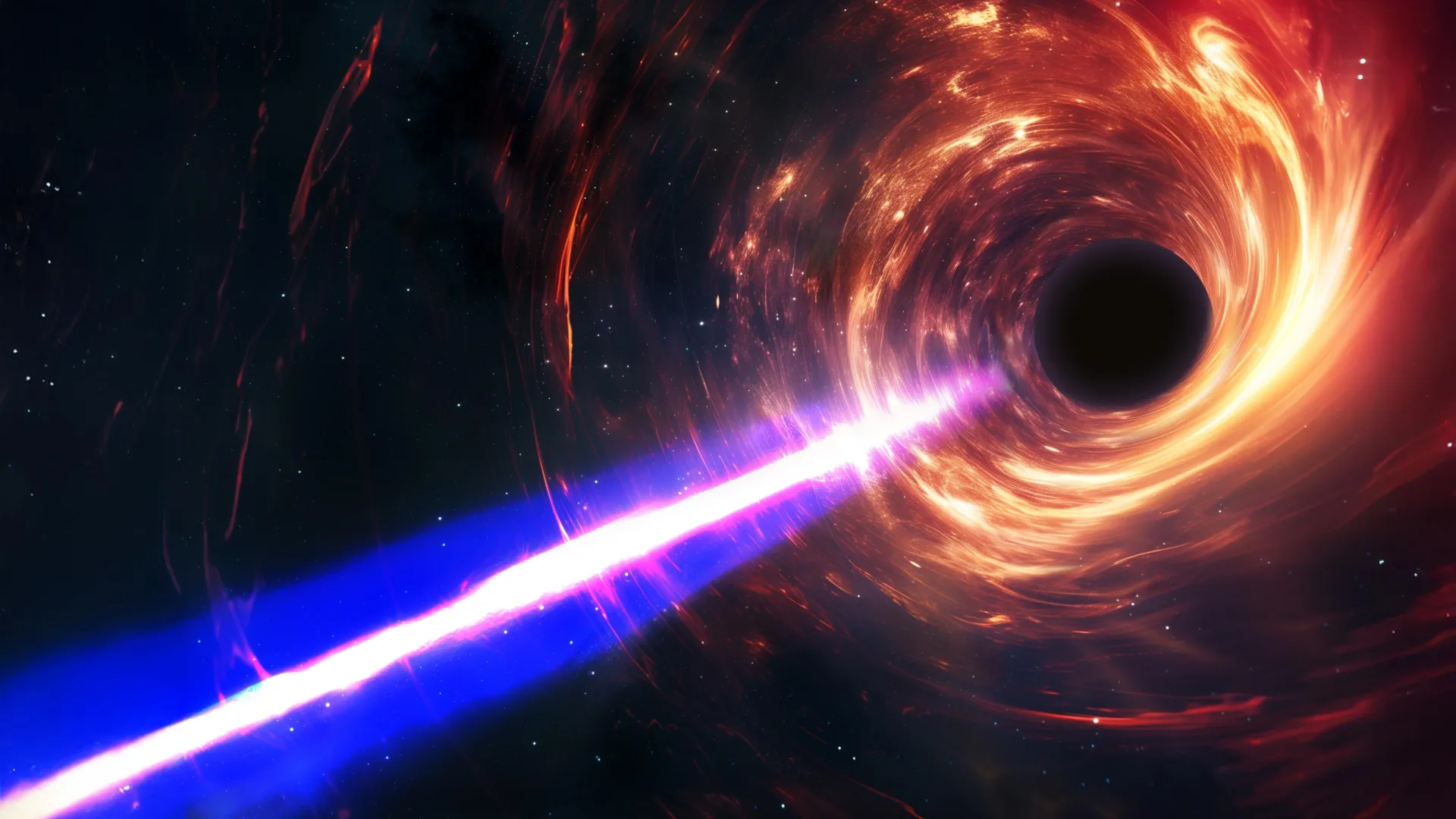
The primary suspects in this cosmic mystery are blazars, a subcategory of active galactic nuclei (AGN). At the heart of a blazar lies a supermassive black hole, millions or even billions of times the mass of our Sun. As matter falls into the black hole’s accretion disk, immense gravitational and magnetic forces eject a portion of that material outward in two colossal jets of plasma traveling at nearly the speed of light. When one of these jets is pointed directly toward Earth, the object is classified as a blazar.
The study, led by Meriem Bendahman of the National Institute for Nuclear Physics (INFN) in Naples and the KM3NeT collaboration, posits that these jets act as natural "Zevatrons"—accelerators capable of boosting protons to energies far beyond what the Large Hadron Collider (LHC) in Geneva could ever achieve. When these high-energy protons collide with photons or other matter within the jet, they produce pions, which subsequently decay into neutrinos and gamma rays. Because neutrinos have no electric charge and nearly zero mass, they travel in straight lines across the universe, unaffected by magnetic fields, making them perfect messengers for pinpointing distant cosmic engines.
Methodology: Simulating the Extreme
To test the blazar hypothesis, the research team utilized a sophisticated open-source simulation framework known as AM3 (Astrophysical Multimessenger Modeling and Simulation). The goal was to determine if a realistic population of blazars could produce a neutrino flux capable of yielding a 220 PeV event without contradicting other astronomical observations.
The researchers focused on two primary variables that govern neutrino production:
- Baryonic Loading: This refers to the ratio of energy carried by protons (baryons) compared to electrons within the blazar jet. A higher baryonic load implies a more efficient "hadronic" process, leading to a higher yield of neutrinos.
- Proton Spectral Index: This parameter describes the distribution of energy among the accelerated protons. A "harder" spectral index suggests that a larger proportion of the protons reach ultra-high energy levels.
By adjusting these parameters within the AM3 tool, the team modeled various blazar populations and compared the simulated outputs with actual data from KM3NeT, IceCube, and NASA’s Fermi Gamma-ray Space Telescope. The simulation had to satisfy a difficult "double constraint": it needed to explain the 220 PeV neutrino while also ensuring that the predicted gamma-ray emission did not exceed the total extragalactic gamma-ray background (EGB) measured by Fermi.
The "Missing" Electromagnetic Counterpart
One of the most challenging aspects of the 2023 detection was the absence of a "smoking gun" in other wavelengths. Typically, when a high-energy neutrino is detected, telescopes around the world pivot toward that region of the sky to look for a flare in radio, optical, X-ray, or gamma-ray light. In this instance, no such electromagnetic counterpart was found.
"This does not completely rule out the possibility of a point-like source," explained Meriem Bendahman. "But it leads us to consider that our neutrino may come from a diffuse background—that is, from a flux of neutrinos including contributions from many sources."
This suggests that the 220 PeV particle may not have come from a single, massive explosion, but rather was a rare "statistical outlier" from a large, steady population of extreme blazars distributed across the distant universe. This "diffuse flux" theory aligns with the fact that other observatories, like IceCube, have not detected a similar event in the same timeframe; the event was so rare that catching it was a matter of the specific orientation and sensitivity of the KM3NeT strings.
Chronology of High-Energy Neutrino Astronomy
The identification of the 220 PeV event marks a significant milestone in a timeline of discoveries that have defined modern multi-messenger astronomy:
- 2013: The IceCube Neutrino Observatory announces the first detection of high-energy "cosmic" neutrinos, nicknamed "Bert" and "Ernie," with energies around 1 PeV.
- 2017: A 290 TeV neutrino (IceCube-170922A) is traced back to a flaring blazar known as TXS 0506+056. This was the first time a specific source was identified for a high-energy neutrino.
- 2021: KM3NeT begins its initial deployment phases in the Mediterranean, aiming to complement IceCube by viewing the Northern Hemisphere sky.
- February 13, 2023: KM3NeT/ARCA detects the 220 PeV event, shattering previous energy records by an order of magnitude.
- 2024: Publication of the JCAP study providing the theoretical framework for the blazar population origin.
Implications for Particle Physics and Cosmology
The existence of a 220 PeV neutrino carries profound implications for our understanding of the "GZK Limit" (Greisen–Zatsepin–Kuzmin limit). Historically, it was believed that cosmic rays with energies above a certain threshold would interact with the Cosmic Microwave Background (CMB)—the afterglow of the Big Bang—and lose energy, preventing them from traveling long distances. However, neutrinos do not suffer from this limitation.
If blazars are indeed the source of such particles, it suggests that the processes occurring near supermassive black holes are even more efficient than previously modeled. It also suggests that the "hadronic" component of blazar jets—the part involving protons—plays a much larger role in the universe’s energy budget than the "leptonic" component (electrons). This discovery could force a re-evaluation of how energy is distributed in the early stages of galaxy formation and how black holes influence their host galaxies.
Future Outlook: The Full Potential of KM3NeT
As construction of the KM3NeT observatory continues, the scientific community anticipates a surge in similar detections. Once the facility reaches its full size of 230 detection lines, its sensitivity will increase tenfold. This will allow for more rigorous statistical analysis and the potential to move from "diffuse flux" models to identifying individual "point sources" of ultra-high-energy neutrinos.
The KM3NeT collaboration, which involves hundreds of scientists from dozens of countries, is now working on integrating their data with other global networks. The goal is to create a real-time alert system where a detection in the Mediterranean can trigger an immediate, coordinated response from orbital X-ray observatories and ground-based Cherenkov telescopes.
"We need more observational data," Bendahman concluded. "With the full detector and more data, we will be able to perform more powerful statistical analyses and open a new window on the ultra-high-energy neutrino universe."
The detection of the 220 PeV neutrino is no longer just an anomaly; it is a roadmap. It points toward a universe where the most distant and violent objects—blazars—act as cosmic laboratories, testing the very limits of physics. As KM3NeT grows, the "ghost particles" it captures will likely continue to reveal the secrets of the high-energy cosmos, one record-breaking event at a time.