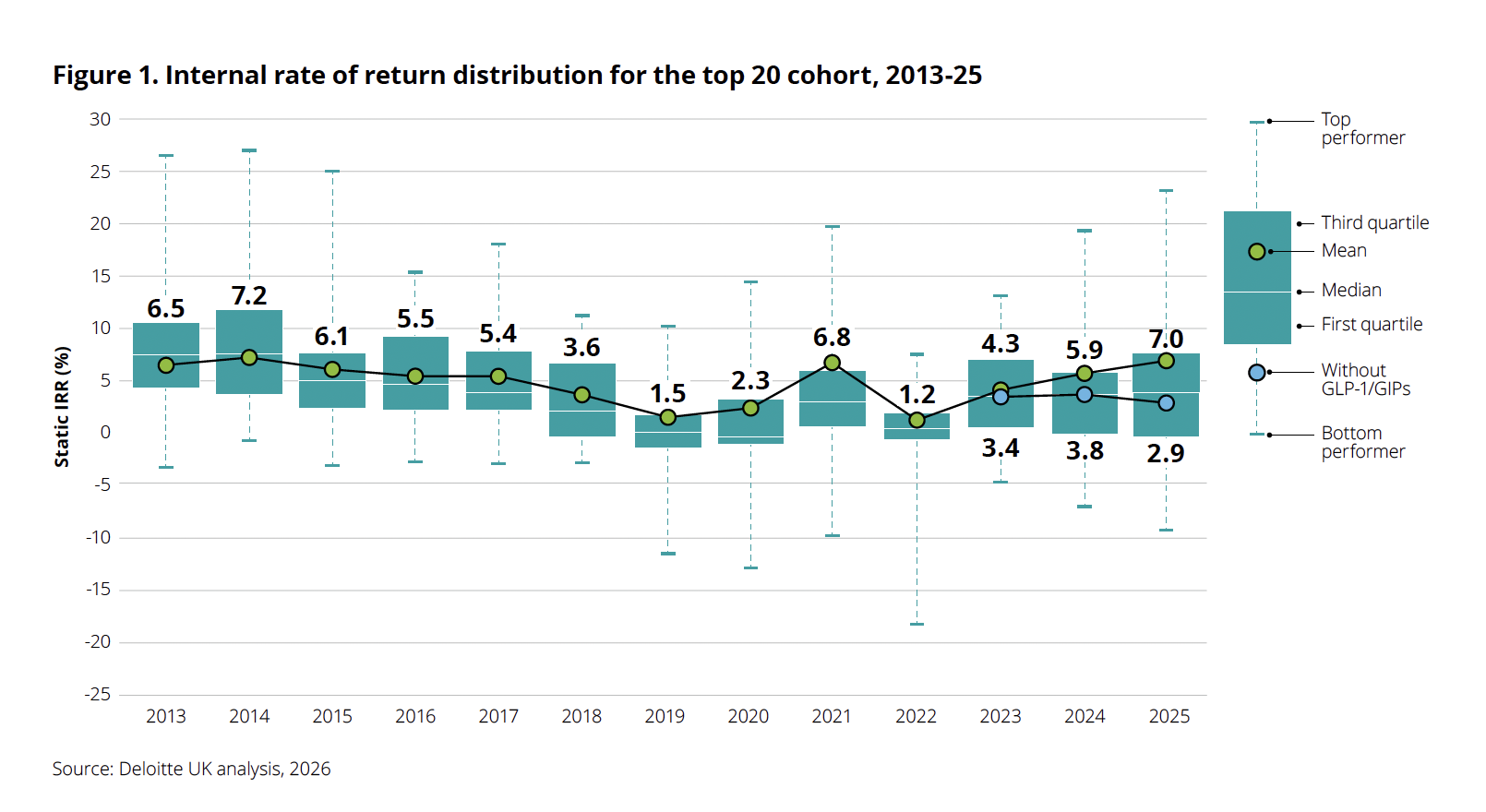
After a period characterized by uneven growth and strategic recalibrations in the wake of global health challenges, a key metric for biopharmaceutical research and development (R&D) productivity has shown a significant upturn. The 16th annual "Measuring the Return from Pharmaceutical Innovation" report by Deloitte, aptly titled "Navigating the GLP-1 Boom," reveals that the projected internal rate of return (IRR) on late-stage pipeline assets has climbed for the third consecutive year, reaching 7.0% in 2025. This marks a notable increase from 5.9% in the preceding year, signaling a potential resurgence in sector vitality. Kevin Dondarski, principal for life sciences strategy at Deloitte Consulting, underscored the significance of this trend, stating, "We went through a period of so many years where the returns kept declining, excluding the COVID impact in the middle. But the increase over the last few years is analytically unprecedented."
The GLP-1 Phenomenon: A Deeper Dive into Market Dynamics
While the headline figure of 7.0% IRR offers a promising outlook, a closer examination reveals a powerful underlying driver: the explosive growth and market valuation of GLP-1 (Glucagon-like peptide-1) and GLP-1/GIP (Glucose-dependent insulinotropic polypeptide) receptor agonist therapies. These drugs, primarily targeting obesity and related metabolic conditions such as type 2 diabetes and cardiovascular risk reduction, are estimated to account for a staggering 38% of all projected commercial inflows from the 2025 late-stage pipeline. The sheer magnitude of this contribution highlights a concentrated reliance on a single therapeutic class for the industry’s perceived recovery.
The profound impact of GLP-1s on the overall IRR becomes strikingly clear when these therapies are excluded from the analysis. Without the influence of GLP-1/GIP drugs, the projected internal rate of return for the remaining late-stage pipeline plummets from 7.0% to a mere 2.9% in 2025. For context, the IRR in 2024 stood at 5.9%, which, when stripped of GLP-1/GIP contributions, still held at a more robust 3.8%. This dramatic divergence underscores a critical duality in the current pharmaceutical landscape. As Dondarski articulated, "There are two different messages here. One, it’s certainly attractive, because the market is valuing the potential impact that those therapies can have on the public, which is great. But at the same time, it raises the question of sustainability. As those programs progress, is there going to continue to be that opportunity through the next generation and the next? It will create a responsibility for these companies to find the right assets to replace in the pipeline."
This unprecedented concentration of value is a historical first for the Deloitte report. Dondarski confirmed that in the 16-year history of the study, no single drug class has ever exerted such a dramatic influence on the headline IRR. While specific therapeutic areas often contribute disproportionately to value, the current dominance of GLP-1/GIPs is unparalleled, signifying a unique moment in pharmaceutical innovation and market valuation.
Unpacking the Return on Investment: A Closer Look at Pipeline Health
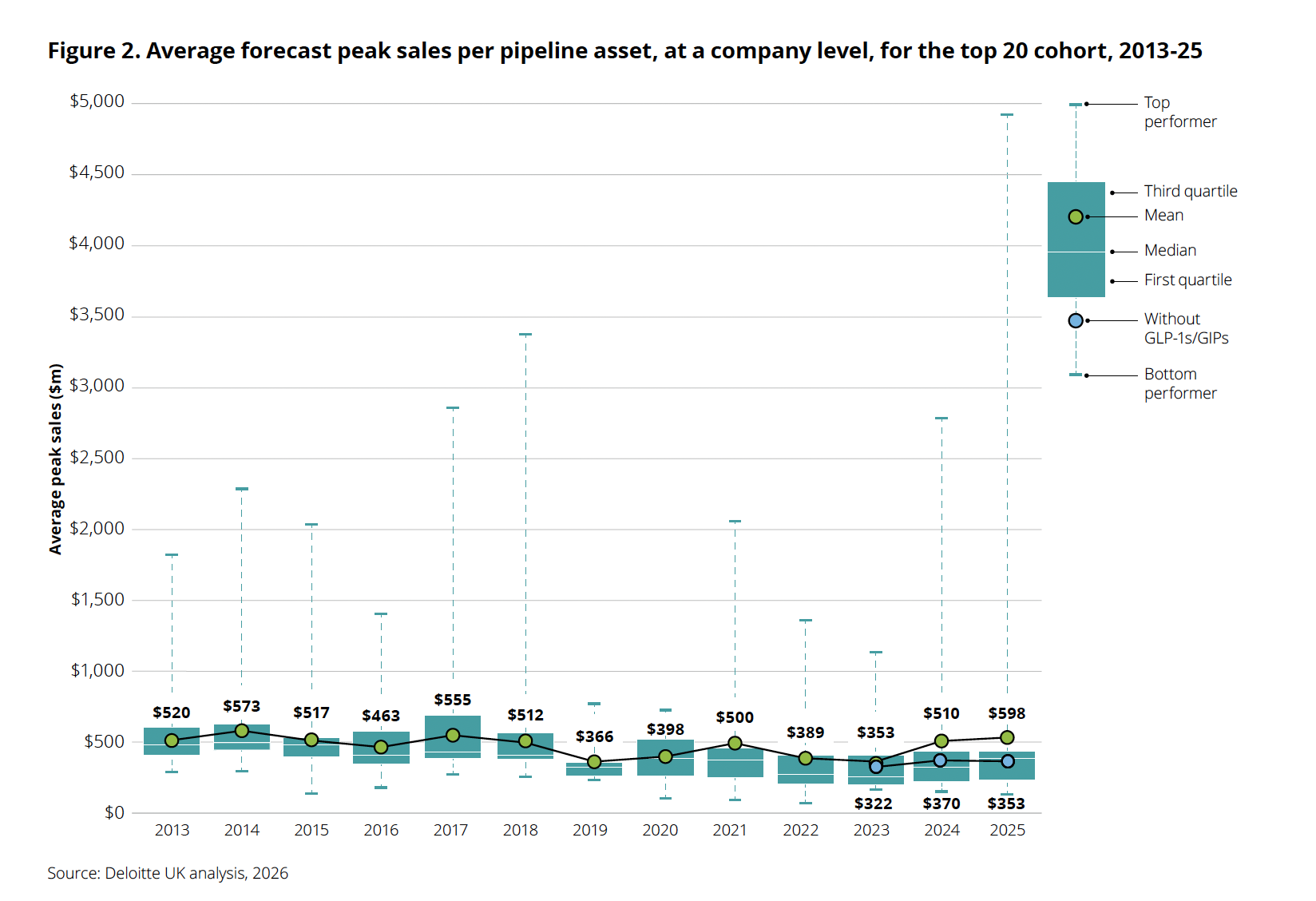
The average forecast peak sales per pipeline asset saw a considerable jump to $598 million in 2025. However, this aggregate figure masks a significant disparity. The top-performing assets, largely GLP-1 contenders, are now approaching an astounding $5 billion in projected peak sales. In stark contrast, when GLP-1/GIP drugs are removed from the calculation, the average forecast peak sales per asset drops to $353 million, a figure that is actually lower than the previous year. This data point is particularly concerning as it suggests that, beneath the dazzling performance of obesity blockbusters, the underlying productivity and commercial potential of the broader pharmaceutical pipeline might be experiencing a decline. This reinforces the "two messages" articulated by Deloitte: an exciting boom driven by a revolutionary class of drugs, juxtaposed with a potential fragility in diversified R&D output.
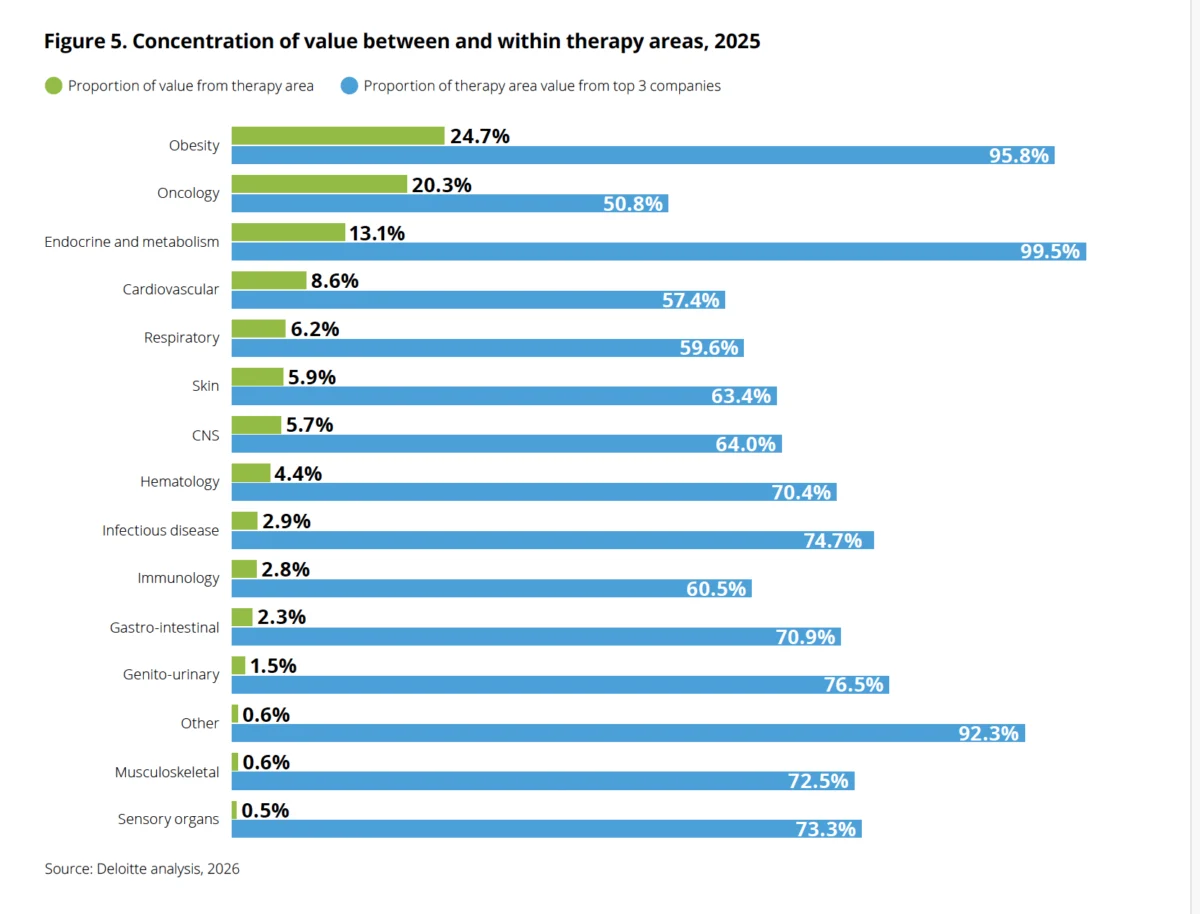
The displacement of oncology as the leading therapeutic area by value further illustrates the GLP-1 phenomenon. For the first time in the report’s history, obesity now commands the largest share of late-stage pipeline value at 24.7%, surpassing oncology, which holds 20.3%. What makes this shift even more remarkable is the extreme concentration within the obesity segment: nearly 96% of that value is attributed to just three companies, primarily Eli Lilly and Novo Nordisk, with other players like Amgen and Pfizer also making inroads, albeit with varying success. This highlights not just a therapeutic shift but also a significant power consolidation within a burgeoning market.
The Weight of Success: Market Dynamics and Competitive Pressures
Despite the undeniable market enthusiasm for GLP-1s, investors have received mixed signals regarding the long-term durability and growth trajectory of this segment. Eli Lilly, the developer of tirzepatide (marketed as Zepbound for weight loss and Mounjaro for type 2 diabetes), which also recently launched its oral GLP-1 Foundayo (orforglipron) in April 2026, has experienced stock volatility. While the company raised its full-year revenue guidance to an impressive $82-$85 billion on the strength of Mounjaro and Zepbound volume growth, its stock skidded roughly 10-13% year-to-date. This seemingly contradictory performance reflects the intense scrutiny and high expectations placed on companies leading the GLP-1 revolution.
Novo Nordisk, another dominant player with Wegovy and Ozempic (semaglutide), also faced significant turbulence. In 2025, the company underwent a leadership change, with longtime CEO Lars Fruergaard Jorgensen being replaced by Maziar Mike Doustdar amidst slowing momentum and share-price pressure. A sweeping corporate restructuring followed, including the stepping down of seven board members at an extraordinary general meeting in November 2025 and plans to cut approximately 9,000 roles from a global workforce of 78,400 by late 2026. Novo Nordisk’s Q1 2026 release indicated a workforce of approximately 67,900 employees, suggesting the reduction was even larger, around 10,500 roles.
Adding to Novo Nordisk’s challenges was the disappointing Phase 3 trial outcome for CagriSema, a combination of the amylin analogue cagrilintide and semaglutide. The drug failed to demonstrate non-inferiority against Lilly’s Zepbound in the REDEFINE 4 head-to-head trial reported in February 2026. CagriSema achieved 23.0% weight loss, falling short of tirzepatide’s 25.5%, triggering another wave of investor disappointment and highlighting the fierce competitive landscape and the high bar set by existing market leaders.
Financial Performance Amidst Volatility
Despite these headwinds, the demand for GLP-1s remains robust, fueling impressive quarterly results for both pharmaceutical giants. Eli Lilly delivered a strong Q1 beat, reporting revenue of $19.8 billion (exceeding $17.6 billion expected), a 56% year-over-year increase. This growth was primarily driven by Mounjaro, which garnered $8.7 billion (+125%), and Zepbound, which contributed $4.1 billion (+79%). Consequently, Lilly revised its full-year revenue guidance upwards by $2 billion.
Novo Nordisk also reported a complex yet strong Q1 performance. The company posted Q1 sales of DKK 96.8 billion ($15.2 billion). Its oral Wegovy pill, launched on January 5, demonstrated exceptional uptake, generating DKK 2.26 billion in its inaugural quarter, nearly doubling analysts’ expectations of DKK 1.16 billion. However, the underlying financial picture for both companies reveals inherent tensions. Lilly’s 56% revenue growth, while impressive, was powered by a 65% volume increase, partially offset by a 13% decline in realized prices. Similarly, Novo Nordisk’s adjusted sales, when a one-time $4.2 billion 340B provision reversal was excluded, actually fell 4% at constant exchange rates. These figures underscore the dynamic interplay of volume growth, pricing pressures, and market competition shaping the GLP-1 landscape.
Pricing Pressures and Access Debates
Further complicating the commercial outlook for GLP-1s are increasing pressures on pricing and market access. Both Eli Lilly and Novo Nordisk have agreed to lower U.S. prices for their GLP-1 offerings through government programs such as Medicare, Medicaid, and the newly established TrumpRx initiative. Under a November agreement, Medicare and Medicaid coverage for weight-loss indications was expected to expand for the first time, offering eligible beneficiaries monthly co-pays as low as $50. The live TrumpRx site now lists the Wegovy pill at $149 per month, the Wegovy pen at $199, Ozempic at $199, and Zepbound at $299. These price reductions, while aimed at improving patient access and affordability, will undoubtedly impact realized net prices and future revenue streams, adding another layer of complexity to the sustainability question.
The Spiraling Cost of R&D: A Persistent Challenge
Amidst the GLP-1 boom, the pharmaceutical industry continues to grapple with the escalating costs of drug development. The Deloitte report found that the average cost to bring a drug from discovery to launch surged to $2.67 billion in 2025, a significant increase from $2.23 billion the previous year. Dondarski noted that this was not an anomaly caused by a single outlier but a pervasive trend, with 17 out of the 20 companies analyzed experiencing an increase in development costs.
Three primary factors converged to drive this spike: R&D costs persistently rising above general inflation, large-scale mergers and acquisitions (M&A) deals inflating the overall R&D cost base, and attrition shrinking the total number of late-stage programs by approximately 4-5%. This means fewer programs are advancing, and those that do are becoming increasingly expensive to develop, placing greater pressure on each successful launch to recoup substantial investments.
AI: Still Waiting for Liftoff in Pharma R&D
Last year’s Deloitte report, "Be Brave, Be Bold," strongly advocated for the adoption of AI-powered drug development platforms, automation, and advanced analytics as a crucial strategy to reverse decades of declining R&D productivity. However, the 2025 data paints a picture of slow progress. Despite the urgent call to action, R&D costs continue to climb to record levels, and clinical cycle times remain stubbornly long. The report candidly concedes that AI’s much-touted promise to significantly reduce development time and costs "has not yet been realized at scale, largely due to a pilot-driven, function-by-function approach."
This does not imply a complete lack of engagement or success. As Dondarski explained, "Everybody’s actively focusing on AI, and everybody’s had some degree of success. But from our vantage point, there’s a good amount of variability in the velocity at which organizations are scaling those efforts to maximize value creation." The challenge lies in moving beyond isolated pilot projects to a more integrated, enterprise-wide adoption of AI that can truly transform the entire drug discovery and development pipeline. The pharmaceutical industry, known for its cautious and heavily regulated nature, appears to be adopting AI incrementally rather than through a revolutionary overhaul.
Broader Implications for the Pharmaceutical Landscape
The Deloitte report presents a compelling, albeit complex, narrative for the pharmaceutical industry. The remarkable success of GLP-1/GIP therapies has undeniably injected renewed vigor into R&D returns, providing a much-needed boost after a period of stagnation. This success validates substantial investments in metabolic disease research and underscores the immense public health impact and commercial potential of addressing conditions like obesity.
However, the over-reliance on a single drug class, while currently lucrative, poses significant strategic risks. It raises critical questions about portfolio diversification, the sustainability of current growth rates, and the industry’s ability to innovate across a broader spectrum of therapeutic areas. The need for companies to identify and nurture the "next big thing" beyond GLP-1s is more pressing than ever. This challenge is compounded by the persistent rise in R&D costs, which demands greater efficiency and a higher success rate from pipelines.
For healthcare systems and payers, the GLP-1 boom presents a dual challenge: managing the burgeoning demand and associated costs while ensuring equitable access to these transformative therapies. The agreements on lower U.S. prices signal a growing recognition of the need to balance innovation with affordability, a debate that will likely intensify as more GLP-1s come to market and their use expands.
The slow integration of AI at scale also remains a critical area for improvement. While the GLP-1 boom provides a temporary reprieve, the long-term health of pharmaceutical innovation depends on leveraging advanced technologies to make R&D processes more efficient, cost-effective, and ultimately, more productive. The industry’s ability to transition from isolated AI initiatives to comprehensive, data-driven platforms will be pivotal in shaping future returns and addressing the ever-present challenge of bringing novel treatments to patients.
In conclusion, the pharmaceutical industry finds itself at a fascinating crossroads. The GLP-1 phenomenon has undeniably revitalized R&D returns, but it has also cast a stark spotlight on the underlying vulnerabilities of an industry heavily reliant on blockbuster success. The journey from "winter to spring" is indeed underway, but the sustainability of this growth, the diversification of future pipelines, and the effective integration of transformative technologies like AI will determine whether this springtime blossoms into a prolonged era of robust innovation or merely a fleeting, albeit brilliant, season.