

Evosep, the Odense, Denmark-based innovator in liquid chromatography, has announced a pivotal expansion of its offerings with the launch of Evosep Proteomics, a comprehensive ecosystem meticulously engineered to standardize and scale liquid chromatography-mass spectrometry (LC-MS)-based proteomics. This strategic move aims to revolutionize proteomics workflows in both fundamental research and pharmaceutical drug development by addressing long-standing challenges related to data reproducibility, workflow variability, and scalability, thereby laying a robust foundation for AI-ready proteomic insights. The launch, effective June 1st, 2026, marks a significant milestone in the quest for industrial-scale proteomics, promising to unlock unprecedented efficiencies and reliability in the burgeoning field of protein analysis.
The Genesis of Standardization: Evosep’s Legacy and the Proteomics Imperative
Evosep’s reputation has been built on its pioneering efforts in standardizing LC separation, a critical step in proteomic analysis that often dictates the speed and consistency of results. With the introduction of Evosep Proteomics, the company now extends its standardization philosophy upstream, encompassing the often-overlooked yet critically important sample preparation phase. This holistic approach responds directly to a growing imperative within the scientific community for more reliable and scalable proteomic data, particularly as biological studies escalate in size and complexity, demanding high-throughput and robust analytical solutions.
The field of proteomics, dedicated to the large-scale study of proteins, has undergone a dramatic transformation over the past two decades. Initially focused on qualitative identification, it has evolved into a sophisticated quantitative discipline, capable of measuring thousands of proteins across diverse biological samples. However, this advancement has been hampered by a pervasive challenge: the lack of standardization across workflows and laboratories. Traditional proteomics often involves fragmented processes, manual variability, and inconsistent methodologies, which collectively limit the scale and reproducibility of experiments. This variability directly impedes the translation of proteomic insights into tangible scientific and therapeutic impact, a bottleneck that has become increasingly pronounced with the rise of data-driven biology and artificial intelligence (AI) applications.
Industry reports consistently highlight the reproducibility crisis in scientific research, with some studies estimating that a significant percentage of preclinical research findings are not reproducible, leading to substantial financial losses and delays in drug development. Proteomics, given its complexity, is particularly susceptible to these issues. The inherent variability stemming from sample collection, preparation, and LC-MS analysis can obscure genuine biological signals, making it difficult to compare results across different studies, instruments, operators, and even sites. This has created a pressing need for integrated solutions that can deliver consistent, interoperable, and high-confidence data at scale.
Addressing the Bottleneck: The Evosep Proteomics Ecosystem
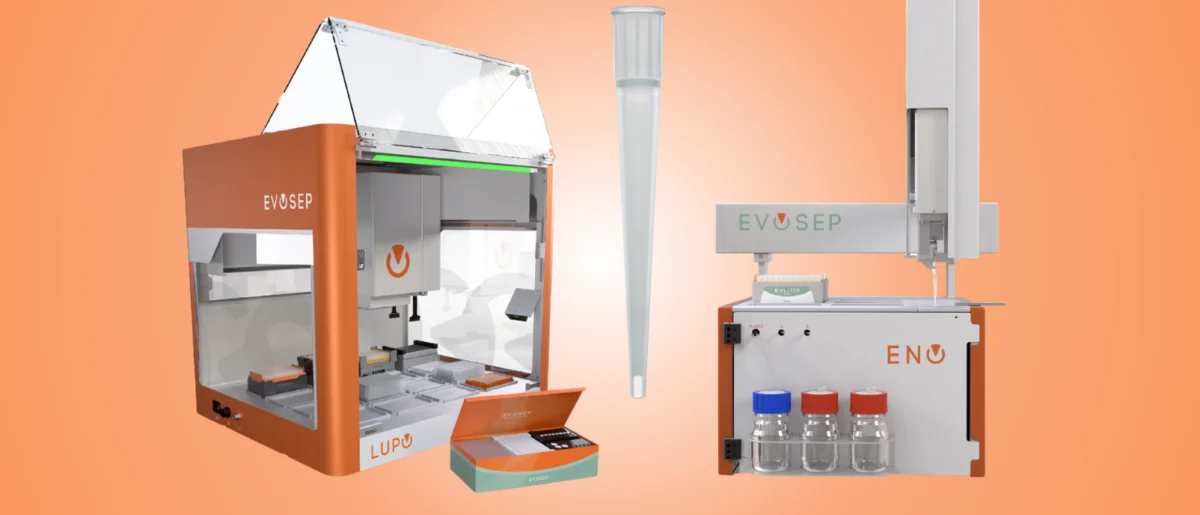
Evosep Proteomics is designed as a unified sample-to-separation platform, integrating several innovative components to achieve end-to-end standardization. At its core are the newly introduced Evokit™ sample preparation kits and the Evosep™ Lupo™ Sample Preparation System. These components work in concert with Evosep Eno™, the company’s established high-throughput LC separation system, to create a cohesive and highly reproducible workflow.
The most critical bottleneck in proteomics has long been identified in the pre-analytical phase – sample preparation. Despite remarkable advancements in mass spectrometry instrumentation, the variability introduced during sample preparation continues to limit overall data quality, comparability, and scalability. This reduction in confidence in upstream decisions inevitably impacts downstream analyses, including the burgeoning field of AI applications in biology. The Evosep Proteomics ecosystem directly confronts this challenge by standardizing these pre-analytical workflows.
The Evokit Digest and Evokit QC kits, launched as part of the initial offering, are meticulously engineered to simplify and standardize the crucial steps of protein digestion and quality control. By providing pre-validated reagents and optimized protocols, these kits minimize manual intervention and operator-dependent variability, which are common sources of error in traditional methods. Furthermore, the integration of built-in quality controls, consumable tracking, and workflow traceability within the Evosep Proteomics platform is a significant advancement. These features are essential for long-term studies, regulated environments (such as those encountered in clinical trials and pharmaceutical development), and translational research, where data integrity and audit trails are paramount.
The Evosep Lupo™ Sample Preparation System complements the Evokit range by automating key aspects of sample handling. Automation significantly reduces human error, improves throughput, and ensures consistent processing across a large number of samples. This integrated approach not only enhances data quality but also allows researchers to focus on data interpretation rather than troubleshooting inconsistent sample preparation.
The Promise of AI-Ready Data: Transforming Drug Development
The launch of Evosep Proteomics comes at a time when the pharmaceutical industry is increasingly turning to artificial intelligence and machine learning (AI/ML) to accelerate drug discovery and development. However, the efficacy of AI models is profoundly dependent on the quality, consistency, and scale of the data they are trained on. As Morten Bern, CEO of Evosep, aptly commented, "To fully realize AI-driven drug development, LC-MS-based proteomics must become standardized. Our users have been asking for scalable proteomics, not only as a reliable analytical tool, but as an AI-ready data foundation for the next generation of drug discovery and development."
Evosep Proteomics directly addresses this critical need by delivering consistent proteomic output at scale, thereby creating a robust data foundation indispensable for reliable AI deployment. This consistency is vital for several reasons: AI models thrive on clean, unbiased, and reproducible data patterns. Inconsistent proteomic data, marred by batch effects or methodological variability, can lead to faulty models, erroneous predictions, and ultimately, wasted resources and time in drug development. By standardizing the entire workflow from sample to separation, Evosep Proteomics ensures that the data fed into AI algorithms is of the highest quality, enabling faster insight generation and more confident decision-making across the entire pharmaceutical R&D pipeline.
The implications for pharmaceutical R&D are profound. In both preclinical and clinical research, teams face immense pressure to make faster, more confident decisions. Critical biological insights, often hidden within complex proteomic profiles, can be obscured by workflow variability and inconsistent data. LC-MS-based proteomics has the potential to reveal this "hidden biology," facilitating crucial processes such as biomarker discovery, target identification, mechanism of action studies, and patient stratification for clinical trials. However, this potential can only be fully realized when the proteomic data is demonstrably reliable and comparable across diverse studies, instruments, operators, and sites. Evosep Proteomics aims to provide this foundational reliability, accelerating the discovery of novel drug targets, improving the precision of drug efficacy and toxicity assessments, and optimizing patient selection for stratified medicine approaches.
Economic and Scientific Impact: Scaling High-Quality Proteomics
Beyond the technical advancements, Evosep Proteomics also offers significant economic benefits. By enabling scalable, unbiased proteomics at a target cost of approximately US$10 per sample, Evosep is making high-quality, reproducible proteomics accessible for routine use in a broader range of applications. This cost-effectiveness is crucial for large-scale studies, population proteomics, and high-throughput drug screening efforts that were previously limited by prohibitive costs and logistical complexities.
The global proteomics market, valued at approximately $25-30 billion in recent years and projected to grow substantially, underscores the increasing demand for robust proteomic solutions. Within this expanding market, the pharmaceutical sector represents a significant driver, with companies continually seeking ways to enhance efficiency and reduce the staggering costs associated with drug development, which can often exceed $1 billion per new drug. By providing a standardized, cost-effective, and reproducible platform, Evosep Proteomics is poised to democratize access to advanced proteomic capabilities, allowing more research groups and pharmaceutical companies to leverage the power of comprehensive protein analysis without the traditional barriers of high variability and cost.
The ability to generate consistent and comparable data across multiple sites and studies is also vital for collaborative research initiatives and multi-center clinical trials. Regulatory bodies are increasingly scrutinizing data quality and reproducibility, especially in the context of drug submissions. A standardized proteomic platform like Evosep Proteomics can help researchers meet these stringent requirements, accelerating the translation of basic scientific discoveries into clinical applications and approved therapies.
Future Outlook and Industry Reception
The launch of Evosep Proteomics represents a strategic evolution for Evosep and a significant step forward for the entire proteomics community. By addressing the critical need for standardization from sample preparation through separation, Evosep is not merely offering new products but an integrated solution designed to fundamentally change how proteomics is conducted. This ecosystem is expected to be widely welcomed by pharmaceutical researchers, academic institutions, and contract research organizations (CROs) grappling with the challenges of data variability and scalability.
The long-term implications are vast, extending beyond mere efficiency gains. By fostering an environment of highly reproducible and AI-ready proteomic data, Evosep Proteomics could accelerate the pace of scientific discovery, uncover novel disease mechanisms, and pave the way for a new generation of precision medicines. As biology continues its inexorable shift towards data-intensive and computationally driven approaches, platforms that ensure data quality and consistency will be indispensable. Evosep Proteomics positions itself at the forefront of this transformation, promising to empower researchers and drug developers with the reliable insights needed to tackle some of humanity’s most pressing health challenges.




















Leave a Reply