For centuries, the study of fluid dynamics has been a pursuit of understanding the inherent chaos of nature. From the swirling patterns observed by Leonardo da Vinci to the complex atmospheric models used by modern meteorologists, turbulence has remained one of the most challenging frontiers in physics. Traditionally viewed as an uncontrollable force of nature, new research from the University of Pittsburgh and the University of Turin suggests that the very direction of energy within turbulent flows can be manipulated. By utilizing sophisticated tensor geometry, scientists have demonstrated that the "cascade" of energy—the fundamental process by which motion either breaks down into smaller vortices or coalesces into larger structures—is not an immutable law, but a variable that can be engineered.
The Paradigm of the Energy Cascade
To appreciate the significance of this discovery, one must look back to 1941, when Soviet mathematician Andrey Kolmogorov revolutionized the field with his theory of turbulence, often referred to as K41. Kolmogorov proposed that in three-dimensional environments, such as the open ocean or the vast atmosphere, energy follows a "forward cascade." In this model, large-scale movements, driven by forces like wind or gravity, create large eddies. These eddies are unstable and break apart into smaller and smaller vortices until they reach the "dissipation scale," where the energy is finally converted into heat by the fluid’s viscosity.
Conversely, in two-dimensional flows—which occur in thin layers of fluid where vertical motion is restricted—the process is reversed. Known as the "inverse cascade," energy in 2D systems tends to move from smaller scales to larger ones, eventually forming massive, stable structures like Jupiter’s Great Red Spot or large-scale oceanic gyres.
For over eighty years, these directions were considered fixed properties of the environment’s dimensionality. However, the team led by Lei Fang, assistant professor of civil and environmental engineering at Pitt’s Swanson School of Engineering, has challenged this binary view. Their findings, published in Science Advances, suggest that the direction of energy flux is not merely a product of the fluid’s dimensions, but is determined by the geometric alignment of internal mechanical forces.
Recasting Turbulence as a Mechanical Process
The breakthrough began when Dr. Fang decided to view the abstract concept of energy flux through a purely mechanical lens. While turbulence is often described statistically, it is governed by the Navier-Stokes equations—a set of partial differential equations that describe the motion of fluid substances.
"To understand this abstract concept at different scales, I recast the energy flux process into a mechanical process based on Navier-Stokes equations," Fang explained. "And since this is a mechanical process, I could try to reverse it by changing the geometry between displacement and force."
The primary tool for this recasting was the use of tensors. In mathematics and physics, a tensor is a geometric object that maps in a linear manner the geometric relations between vectors, scalars, and other tensors. In the context of fluid dynamics, tensors are essential for describing quantities like stress (the internal forces neighboring particles exert on each other) and deformation (the resulting change in shape or flow).
By developing a geometric framework based on tensor alignment, the research team discovered that the direction of energy transfer depends heavily on how these tensors interact. If the forces acting on the fluid are aligned with the resulting displacement in specific ways, the energy flux can be forced to move against its natural inclination. This means a 3D flow could potentially be forced into an inverse cascade, or a 2D flow could be forced into a forward cascade.
Experimental Validation and the Electromagnetic Laboratory
To move the research from theoretical mathematics to physical proof, Fang and PhD student Xinyu Si conducted rigorous laboratory experiments. They focused on a two-dimensional flow, utilizing a thin layer of electrolyte (salty water) only a few millimeters deep.
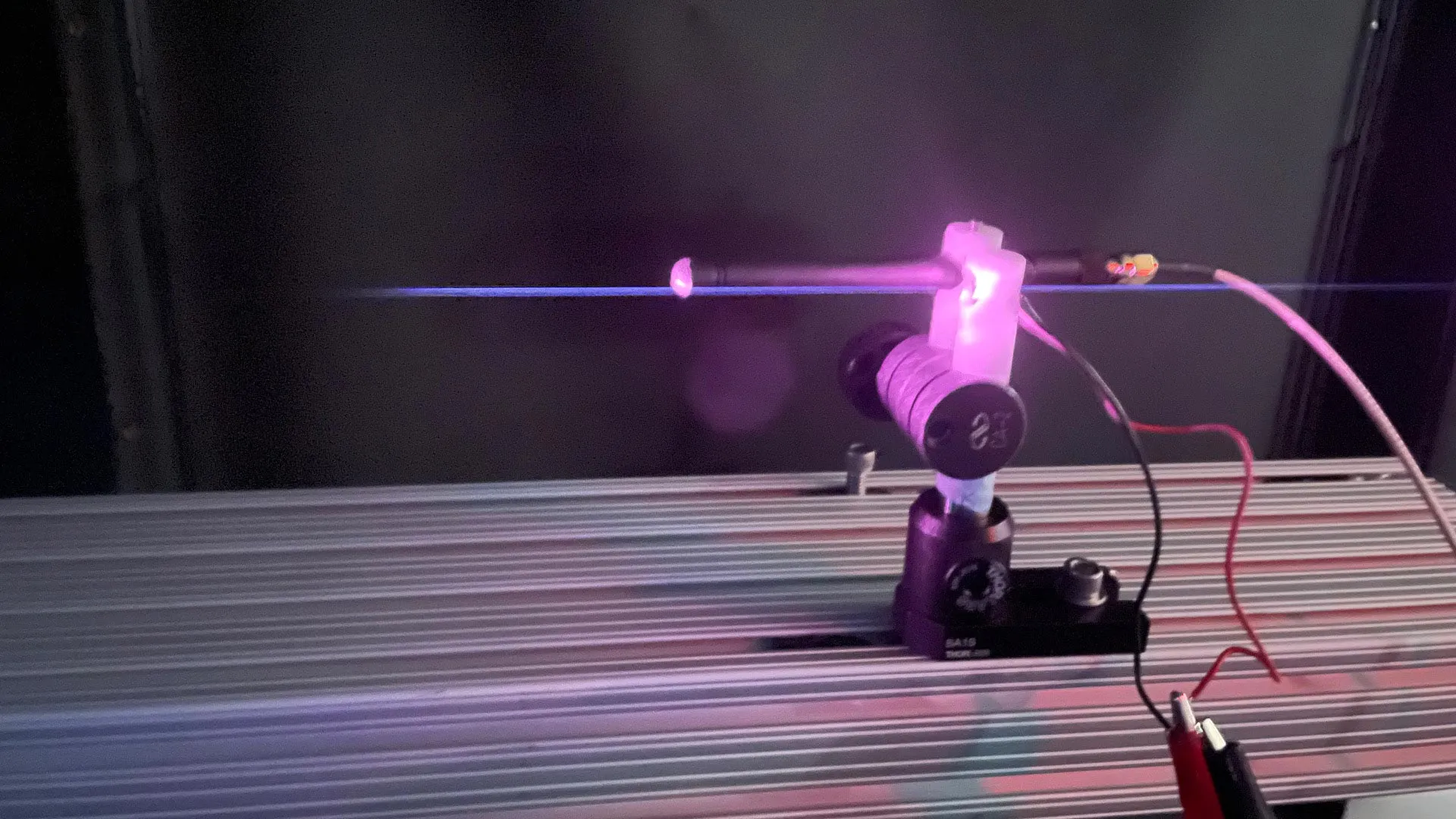
To drive the fluid without physical propellers that would disrupt the flow patterns, the team used electromagnetic forces. By placing the fluid over a grid of magnets and passing an electric current through it, they created a controlled horizontal magnetic field that generated turbulent motion. To disturb this flow and test the tensor geometry theory, they utilized an array of rods.
The movement of the fluid was captured using "tracer particles"—tiny, reflective spheres suspended in the water. High-speed cameras tracked these particles, allowing the researchers to visualize the vortices and calculate the energy flux with high precision. The results were definitive: by manipulating the physical boundaries and the alignment of forces, the team successfully redirected the flow of energy. These physical results were further validated by complex computer simulations, confirming that the framework was robust and scalable.
A Chronology of Turbulence Research
The discovery marks a significant milestone in a timeline of scientific inquiry that spans over five centuries:
- 1500s: Leonardo da Vinci coins the term "turbolenza" and sketches the "hierarchy of eddies," providing the first visual description of the energy cascade.
- 1883: Osborne Reynolds performs his famous pipe-flow experiments, identifying the "Reynolds number" as the threshold where smooth (laminar) flow becomes turbulent.
- 1922: Lewis Fry Richardson publishes a poem summarizing the cascade: "Big whorls have little whorls that feed on their velocity, and little whorls have lesser whorls and so on to viscosity."
- 1941: Andrey Kolmogorov provides the mathematical foundation for the forward cascade in 3D flows.
- 1967: Robert Kraichnan predicts the inverse energy cascade in 2D flows, explaining why 2D turbulence behaves differently.
- 2024: Lei Fang and his team demonstrate that the direction of these cascades can be manipulated via tensor geometry, breaking the rigid dependency on dimensionality.
Implications for Coastal Management and Environmental Safety
One of the most immediate practical applications of this research lies in environmental engineering, specifically in how we manage our coastlines. Coastal waters are often treated as "thin layers," behaving largely like 2D flows. In these environments, "transport barriers" can form—invisible boundaries in the water that prevent pollutants, such as wastewater or oil spills, from dispersing into the open ocean.
"Through this theoretical framework, we found that we can use small physical boundaries up to ten meters to perturb ocean transport barriers that span kilometers," said Fang.
By strategically placing small-scale structures or "perturbations" along a coastline, engineers could theoretically flip the energy flux. Instead of pollutants being trapped in large, stagnant gyres near the shore, the energy could be directed to break these structures down, allowing contaminants to disperse more effectively and reducing the ecological impact on sensitive coastal habitats.
Revolutionizing Microfluidics and Medical Diagnostics
The research also holds immense promise for the field of microfluidics—the study of fluids at the sub-millimeter scale. In medical diagnostics and chemical engineering, microfluidic chips are used to mix tiny amounts of reagents for blood tests or drug synthesis.
At this scale, fluids are highly viscous, and the Reynolds number is very low, meaning turbulence is almost entirely absent. Without turbulence, mixing becomes incredibly slow, relying on the sluggish process of molecular diffusion. This has long been a "bottleneck" in the development of rapid lab-on-a-chip technologies.
Fang suggests that by aligning forces and displacement according to their tensor framework, it is possible to generate "weak low-Reynolds-number turbulence." This artificial turbulence, even if weak, could significantly accelerate the mixing of agents in channels smaller than a millimeter, leading to faster medical results and more efficient chemical processing.
Enhancing Global Climate Models
In the broader context of climate science, the ability to accurately model turbulent energy flux is vital. The Earth’s atmosphere and oceans are massive turbulent systems that regulate global temperatures by transporting heat from the equator to the poles.
As climate change alters wind patterns and increases ocean temperatures, the traditional assumptions used in climate models may become less reliable. If changing wind stresses or current patterns begin to flip the direction of energy flux in certain regions, current models might fail to predict the resulting shifts in weather or sea levels.
"While it’s hypothetical at this point, the research could improve climate modeling," Fang noted. "As climate change alters wind patterns and ocean flows, wind stress and currents could change the direction of energy flux. Understanding the forces that create this change can lead to more accurate models."
By incorporating tensor geometry into global simulations, scientists can better account for how energy is redistributed as the planet warms, providing more precise data for policymakers and environmental agencies.
Conclusion: A New Era of Fluid Control
The study by Fang, Si, De Lillo, and Boffetta represents a fundamental shift in fluid mechanics. For decades, turbulence was something to be observed, measured, and, at best, reacted to. By proving that the direction of energy flux is a controllable variable, this research moves the scientific community toward an era where turbulence can be engineered.
Whether it is improving the dispersal of wastewater in the Mediterranean, accelerating a diagnostic blood test in a clinic, or refining our understanding of the Earth’s changing climate, the ability to guide the "chaos" of turbulence offers a powerful new tool for solving some of the most complex challenges of the 21st century. While further research is required to scale these findings to the vastness of the open ocean or the complexities of the human circulatory system, the foundation has been laid for a new understanding of how the world flows.