For the first time, researchers have demonstrated that severely bleached corals can fully recover after spending just a few days in contact with healthy, genetically identical corals. This breakthrough, documented in a study published October 14 in the journal Science Advances, offers a potentially transformative strategy for marine conservation at a time when global climate change has rendered traditional recovery models increasingly insufficient. As marine heat waves become more frequent and intense, the ability to jump-start the healing process in bleached colonies may represent the difference between the survival of entire reef ecosystems and their permanent extinction.
The Anatomy of a Bleaching Crisis
Coral bleaching is a stress response triggered by thermal anomalies. When ocean temperatures rise, the symbiotic relationship between corals and the microscopic algae known as zooxanthellae, which live within the corals’ tissues, breaks down. These algae are the primary source of the coral’s energy through photosynthesis, and they also provide the vibrant pigments that give reefs their iconic coloration.
When the water becomes too warm, corals expel these algae. The resulting "bleached" appearance is essentially a state of starvation. Without their symbiotic partners, corals are forced to rely on limited energy reserves, leaving them vulnerable to disease and opportunistic, harmful algae. While corals can recover from bleaching if temperatures return to normal within a short window, the process is notoriously sluggish—often taking months or years—and many colonies die of starvation before they can regain their vitality.
According to estimates cited by researchers, if current trends in ocean warming continue, a significant portion of the world’s coral reefs could disappear within the next few decades. The urgency of this timeline has forced marine scientists to look beyond passive conservation, such as marine protected areas, and toward active intervention strategies.
A Serendipitous Discovery
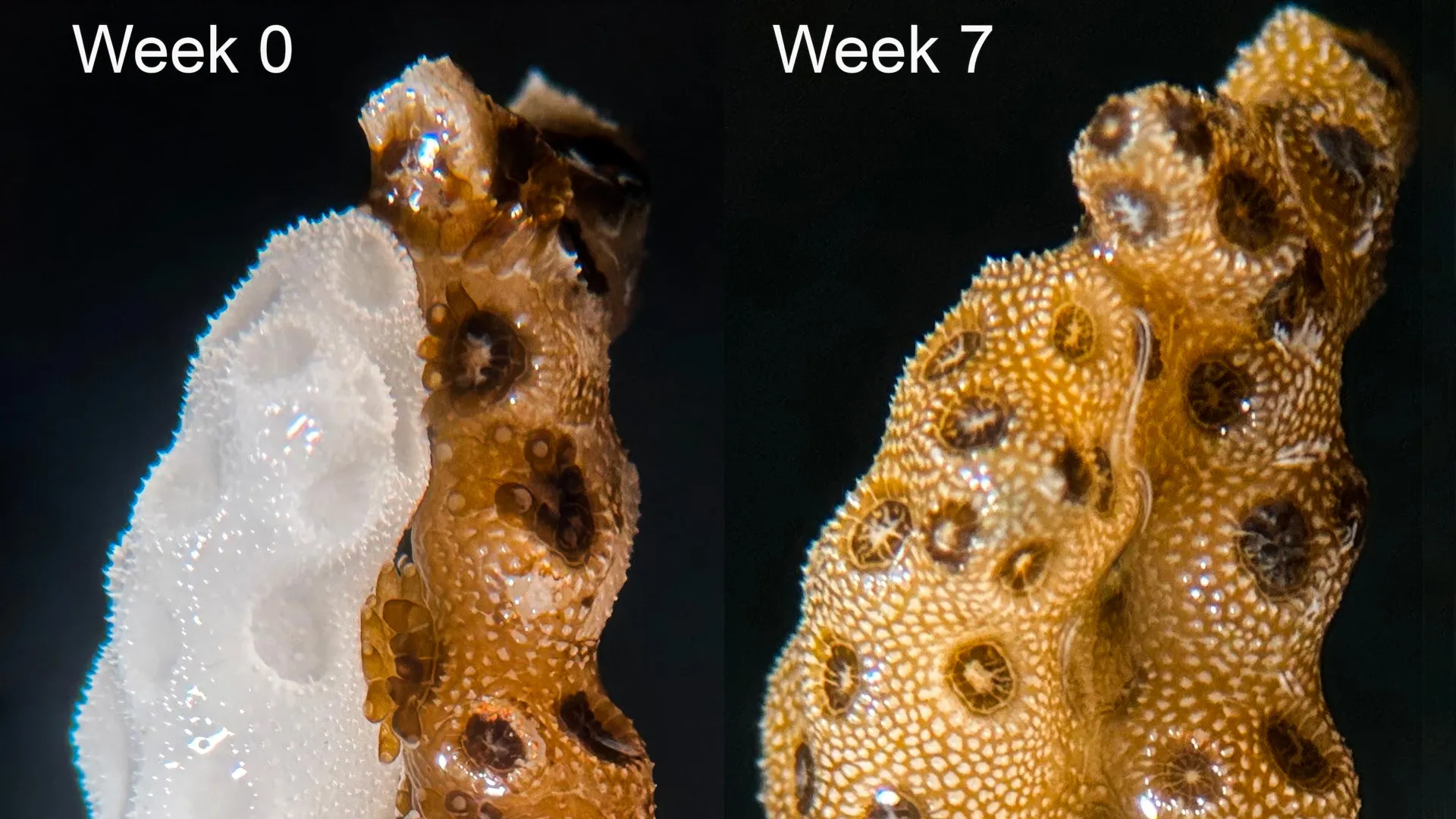
The origin of this study traces back to 2025 at the Hopkins Marine Station, where Steve Palumbi, the Jane and Marshall Steel, Jr. Professor in Marine Sciences, observed an anomaly in his aquarium. Two fragments of the same coral colony—one healthy and one bleached—had drifted into physical contact. To the surprise of the researchers, the bleached fragment began to regain its color exactly where it touched the healthy tissue.
This observation provided the impetus for a formal study led by Danny Collins, a PhD student at the Stanford Doerr School of Sustainability. Collins, who was simultaneously researching how pathogenic bacteria utilize physical contact to spread between corals, hypothesized that this same contact mechanism could be leveraged to transmit beneficial symbionts.
Experimental Methodology and Chronology
To test this hypothesis, Collins and his team structured an experiment using 10 pairs of genetically identical coral fragments. Each pair consisted of one severely bleached specimen and one healthy, vibrant specimen. The researchers divided these pairs into two groups: five pairs were placed in direct physical contact, while the other five were separated by a gap of several millimeters.
The results were stark. All five bleached fragments that maintained physical contact with their healthy counterparts achieved a full recovery within seven weeks. Conversely, the fragments that were separated by a gap succumbed to the stress of bleaching and died.
The researchers then performed a time-series analysis to determine the minimum duration required for the "rescue" effect. By separating the pairs after varying intervals, they discovered that as little as five days of contact was sufficient to initiate the recovery process. Once the healthy coral had successfully transferred enough zooxanthellae to the bleached partner, the algae began to propagate at an extraordinary rate. During the second week of the recovery phase, the algae population inside the bleached corals doubled approximately every four days—a rate ten times faster than that observed in wild, undisturbed corals.
The Biology of Fusion
The success of this intervention relies on a biological phenomenon known as "fusion." Because corals are modular animals that frequently reproduce via cloning, genetically identical fragments recognize each other when they come into contact. They possess the ability to fuse their tissues, effectively merging their internal circulatory systems. Under high-magnification microscopy, researchers observed the formation of tiny channels that allowed for the direct transfer of nutrients and beneficial algae from the healthy donor to the bleached host.
This process bears a striking resemblance to the success of organ transplantation in humans, where donor and recipient compatibility is essential. "Genetically identical corals recognize one another when they come into contact," noted Professor Palumbi. "Their tissues fuse if they are from the same clone."
Implications for Global Reef Restoration
The discovery challenges the current paradigm that bleached corals are inherently "lost causes." Fiorenza Micheli, a professor of oceans and co-director of the Stanford Center for Ocean Solutions, emphasized that this research provides a vital bridge for corals to survive the immediate aftermath of a heat wave. By artificially accelerating the recovery of the most vulnerable colonies, scientists may be able to maintain reef structural integrity long enough for natural growth and recruitment to take over.
However, the researchers remain cautious regarding the scalability of this specific technique. In a natural reef environment, identifying and pairing genetically identical corals is a logistically complex task. Scaling this to thousands of hectares of reef is currently impractical. As such, the study serves as a proof-of-concept rather than an immediate field application.
The team is already pivoting to investigate alternative delivery methods. If researchers can harvest and store beneficial algae from healthy corals before a heat wave occurs, they may be able to develop a "probiotic" delivery system. This would involve introducing the algae directly to bleached corals in the field, bypassing the need for physical fusion with a donor fragment.
Broad Scientific Response and Future Directions
The scientific community has noted the importance of the study as a pivot toward "restoration biology." By shifting the focus from simply protecting reefs to actively intervening in their physiological processes, the Stanford team has opened a new frontier in climate adaptation strategies.
The research effort was a multidisciplinary endeavor, involving experts from the Stanford Doerr School of Sustainability, the School of Humanities and Sciences, and the Hopkins Marine Station. Key contributors included Jana Sipkova, Nathaniel Mollica, Tom Rolander, Courtney Klepac, Gabriel Calistro, and Vanessa Barone. The project received financial support from the National Science Foundation and Stanford University’s Big Ideas for Oceans grant program.
Moving forward, the team plans to focus on the following key areas:
- Developing non-contact delivery methods: Testing whether concentrated algal slurries or other delivery vectors can induce the same recovery effect as physical fusion.
- Genomic analysis of donor strains: Identifying which specific strains of zooxanthellae are most resilient to high temperatures and which donor corals provide the best "rescue" efficacy.
- Field testing in controlled enclosures: Moving from aquarium settings to larger-scale, in-situ experiments on protected reef sites to observe how corals respond to varying currents, light levels, and predation.
As climate change continues to exert pressure on marine biodiversity, the window of opportunity to intervene is narrowing. The findings published in Science Advances provide more than just a biological curiosity; they offer a tangible mechanism of resilience. By proving that rapid recovery is physiologically possible, the study provides a vital ray of hope for the future of coral ecosystems, suggesting that with the right interventions, the catastrophic loss of these underwater habitats may yet be preventable.