The Architecture of Frustration: Understanding Magnetic Dipole Moments
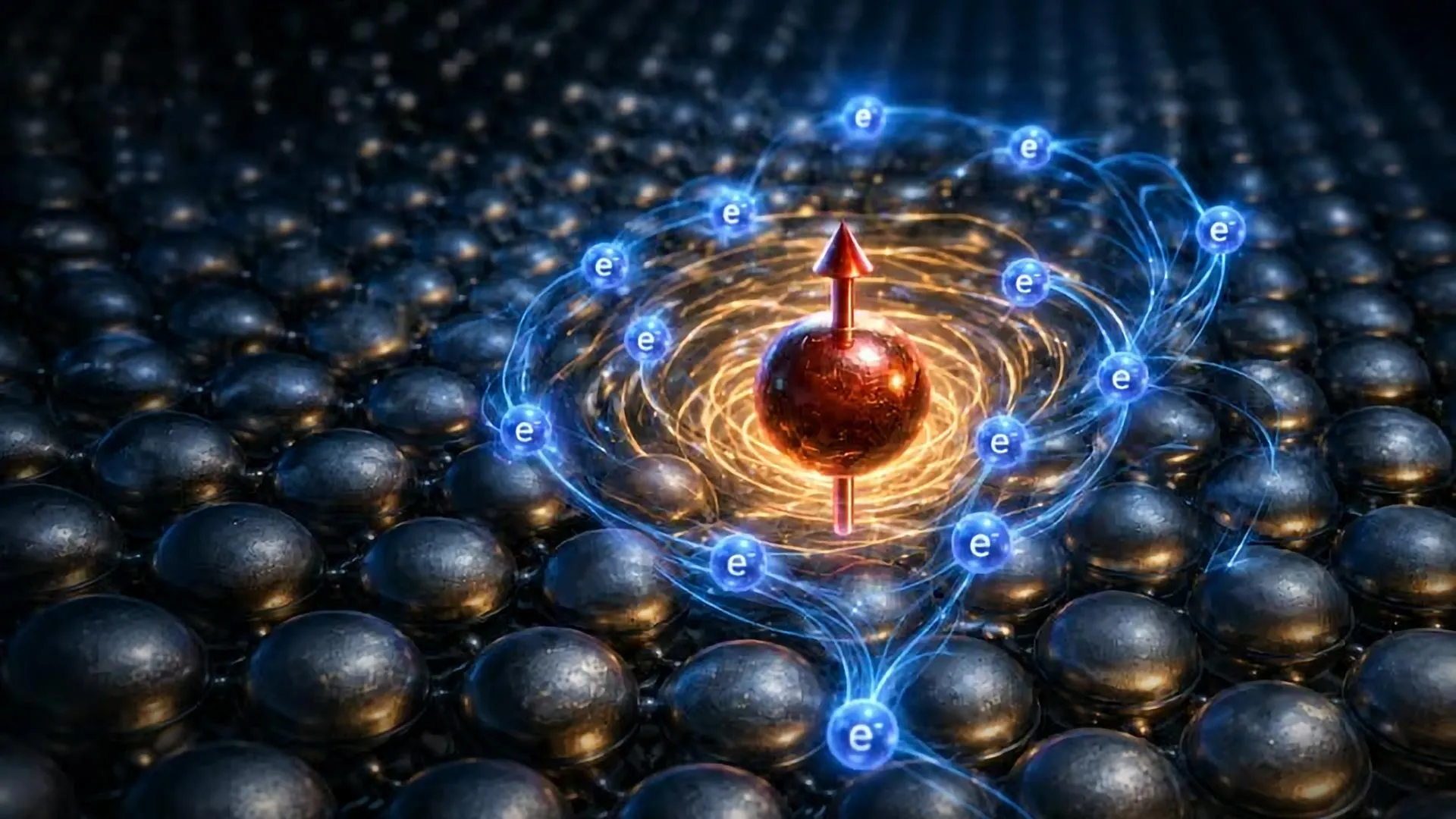
To comprehend the significance of the UCSB study, one must first examine the fundamental nature of magnetism at the atomic scale. Every atom within a crystalline solid can be viewed as hosting a tiny bar magnet, technically referred to as a magnetic dipole moment. These moments are not static; they interact with their neighbors through exchange forces, seeking a configuration that minimizes the total energy of the system. This state of minimum energy is known as the "ground state," a condition every physical system naturally gravitates toward, particularly as temperatures approach absolute zero.
In many materials, these magnets align in a simple, predictable fashion. In a ferromagnetic material, the moments all point in the same direction. In an antiferromagnet, they prefer an antiparallel arrangement, where each "north" pole is flanked by a "south" pole. In a standard square or cubic lattice, this alternating pattern is easily achieved. However, when the atoms are arranged in a triangular lattice, a geometric conflict arises. If two magnets at the base of a triangle point in opposite directions, the magnet at the third vertex cannot point in a direction that is opposite to both of its neighbors simultaneously. This inherent inability to satisfy all local interactions is what physicists term "geometric frustration."
The UCSB team’s research focuses on how this frustration prevents the material from settling into a conventional, ordered state. Instead of "freezing" into a rigid pattern, the magnetic moments remain in a state of constant fluctuation, even at extremely low temperatures. This creates a "quantum disordered" state, which serves as a fertile ground for exotic physics, including the potential for long-range quantum entanglement.
A Dual Challenge: Interleaving Bond Frustration
The primary innovation of Wilson’s team lies in the discovery of a material class that exhibits not just one, but two simultaneous forms of frustration. In addition to the geometric frustration of magnetic moments, the researchers identified a phenomenon known as "bond frustration." This occurs when the electrons responsible for chemical bonding—specifically those forming atomic dimers or shared electron pairs—are unable to find a stable, low-energy configuration due to the lattice structure.
In a triangular or honeycomb lattice, the competition between different bonding sites can lead to a "frustrated" network of bonds. These bonds are highly sensitive to external stimuli, particularly mechanical strain. Wilson explains that by interleaving these two types of frustration—magnetic and bond-related—within the same crystal structure, scientists gain a unique "handle" or control mechanism. By applying physical pressure or strain to the material, researchers can influence the bond network, which in turn dictates the behavior of the magnetic moments. This coupling of two frustrated systems allows for a level of tunability that was previously unattainable in single-frustration materials.
The Role of Lanthanides in Quantum Synthesis
The material systems under investigation at UCSB utilize lanthanides, a series of fifteen metallic elements located at the bottom of the periodic table. Lanthanides, such as ytterbium or gadolinium, are prized in materials science for their large magnetic moments and unique electronic configurations. Over the past decade, the scientific community has increasingly turned to triangular networks of lanthanide ions to search for "quantum spin liquids"—a state of matter where magnetic moments are highly entangled but never settle into a solid-like order.
The UCSB study builds upon this existing body of knowledge by "functionalizing" these exotic states. By embedding the lanthanide-based triangular lattice into a structure that also possesses bond frustration, the researchers have created a hybrid environment. In this environment, the "quantum disordered" magnetism is not just a passive observation but an active component that can be manipulated. This advancement is a critical step in the transition from merely observing quantum phenomena to engineering them for specific tasks.
Chronology of Development and Experimental Context
The journey toward this discovery is part of a broader, decades-long effort to understand frustrated magnetism.
- The 1970s and 80s: Theoretical physicists, including Nobel laureate Philip Anderson, first proposed the existence of quantum spin liquids in triangular lattices.
- The 2000s: Advances in crystal growth allowed for the synthesis of high-purity materials, such as herbertsmithite, which provided the first experimental hints of these states.
- The Mid-2010s: Research into lanthanide-based triangular lattices accelerated, with labs worldwide identifying these materials as prime candidates for hosting quantum disordered states.
- 2023-2024: The Wilson Lab at UCSB successfully synthesizes and characterizes the "interleaved" system, demonstrating the interplay between bond and magnetic frustration.
This timeline highlights the move from abstract mathematical models to the precise structural engineering of materials. The UCSB team utilized advanced characterization techniques, likely including neutron scattering and X-ray diffraction, to map the positions of atoms and the orientation of magnetic moments with sub-atomic precision.
Supporting Data and Technical Analysis
The study’s findings are underpinned by the concept of "ferroic responses." In materials science, a ferroic response refers to a change in the state of a material in response to an external field—such as a magnetic field inducing magnetization or mechanical strain inducing a structural shift.
Wilson’s data suggests that the interleaved frustration creates a "multiferroic-like" environment where the magnetic and structural properties are deeply intertwined. For instance, a small amount of mechanical strain (on the order of fractions of a percent) can trigger a transition in the magnetic layer, forcing the fluctuating moments into a specific, ordered pattern. Conversely, the application of an external magnetic field can induce changes in the bond lengths and the overall symmetry of the crystal.
This reciprocal relationship is vital for "quantum information science." In a quantum computer, information is stored in qubits, which require long-range entanglement to function. The UCSB researchers posit that if a quantum disordered ground state hosting long-range entanglement can be accessed via the bond-frustrated layer, it could provide a robust platform for quantum operations that are protected from external noise.
Implications for Future Quantum Technologies
The broader scientific community has reacted with cautious optimism to the UCSB findings. While the transition from a laboratory discovery to a commercial quantum processor is a journey of many years, the "big-picture idea" presented by Wilson is a game-changer.
- Strain-Tunable Qubits: The ability to control magnetic entanglement through mechanical strain could lead to the development of qubits that are easier to manipulate than those requiring high-frequency microwave pulses.
- New States of Matter: The discovery suggests that there may be an entire family of "interleaved" materials yet to be discovered. This could lead to the identification of new topological phases of matter.
- Advanced Sensors: Materials that are highly sensitive to both magnetic fields and physical strain are ideal candidates for next-generation sensors in aerospace, medicine, and deep-sea exploration.
Conclusion: A Foundation for Future Innovation
Stephen Wilson and his team at UC Santa Barbara have provided the materials science community with a new set of tools to explore the quantum landscape. By moving beyond simple geometric frustration and embracing the complexity of interleaved bond frustration, they have opened a door to controlling the most elusive properties of matter.
As Wilson noted, the work is fundamentally about "probing what physics may be possible." In the high-stakes race to develop quantum technologies, the ability to engineer materials from the ground up—utilizing the very "frustration" that once seemed an obstacle—may prove to be the key to unlocking the next generation of computing power. The study stands as a testament to the power of basic science, demonstrating that the most complex technological problems of the future often find their solutions in the fundamental mysteries of the atomic world.