Anthropic, a leading artificial intelligence safety and research company, has significantly enhanced the accessibility of its Claude large language models (LLMs) for Python developers through its sophisticated Python Software Development Kit (SDK). This integration empowers developers to seamlessly embed Claude’s advanced conversational AI capabilities into their applications, streamlining the process from initial setup to deploying complex, interactive systems. The SDK, designed for efficiency and developer experience, abstracts much of the underlying API interaction, providing features like typed response objects, built-in retry handling, and a simplified interface for the crucial Messages API.
The release and continuous refinement of such SDKs are pivotal in the broader adoption of LLM technologies across various industries. As the demand for AI-driven solutions escalates, tools that lower the barrier to entry for developers become increasingly vital. Python, with its widespread use in data science, machine learning, and web development, stands as the preferred language for AI implementation, making a robust Python SDK for Claude a strategic asset for Anthropic in the competitive AI landscape.
Background and the Rise of Conversational AI
The advent of highly capable large language models like Anthropic’s Claude has ushered in a new era of software development, characterized by the integration of human-like conversational interfaces and sophisticated reasoning abilities. Anthropic, founded on the principle of developing safe and beneficial AI, has positioned Claude as a powerful yet steerable alternative in the LLM space. Models within the Claude family, such as Claude Sonnet, are engineered to balance performance with efficiency and safety, making them suitable for a wide array of applications from complex data analysis to creative content generation and customer support.
The journey of integrating advanced AI into mainstream applications often hinges on the availability of well-documented, reliable development tools. Historically, interacting with powerful AI models required deep expertise in machine learning frameworks. However, the paradigm shift towards API-first AI services means that developers can now leverage state-of-the-art models without needing to train them from scratch. This democratisation of AI capabilities is largely facilitated by comprehensive SDKs that translate complex API calls into intuitive, language-specific functions. Python’s dominance in the AI/ML community, coupled with its extensive ecosystem of libraries, makes it the natural choice for such integrations, enabling a vast developer base to innovate with LLMs.
Streamlined Setup and Secure API Management
Initiating development with the Claude Python SDK is designed to be straightforward, reflecting a commitment to developer accessibility. Prerequisites are minimal: Python version 3.9 or higher and a free Claude Console account, from which developers can generate an API key. This API key serves as the authentication credential for all programmatic interactions with Claude’s services, typically accompanied by initial usage credits to facilitate experimentation.
The installation process for the SDK is standard for Python packages, executed via the pip package manager:
pip install anthropicA cornerstone of secure application development, particularly when dealing with sensitive credentials like API keys, is robust management. The Anthropic SDK adheres to industry best practices by advocating against hardcoding API keys directly into source files. Instead, it strongly recommends storing the ANTHROPIC_API_KEY as an environment variable, a common and secure method that prevents sensitive data from being accidentally committed to version control systems or exposed in public repositories.
export ANTHROPIC_API_KEY="YOUR-API-KEY-HERE"For local development environments, integrating with tools like python-dotenv allows developers to manage API keys in a .env file at the project root, providing a convenient yet secure way to load environment variables. The SDK is designed to automatically read the ANTHROPIC_API_KEY from the environment, eliminating the need to explicitly pass it within the application code, further simplifying the development workflow and enhancing security posture. This emphasis on secure configuration underscores Anthropic’s commitment not only to powerful AI but also to responsible and secure development practices.
Core Interaction: The client.messages.create() Method
The fundamental entry point for interacting with Claude through the Python SDK is the client.messages.create() method. This function is central to sending prompts to Claude and receiving generated responses. Understanding its parameters and the structure of requests is paramount for effective integration.
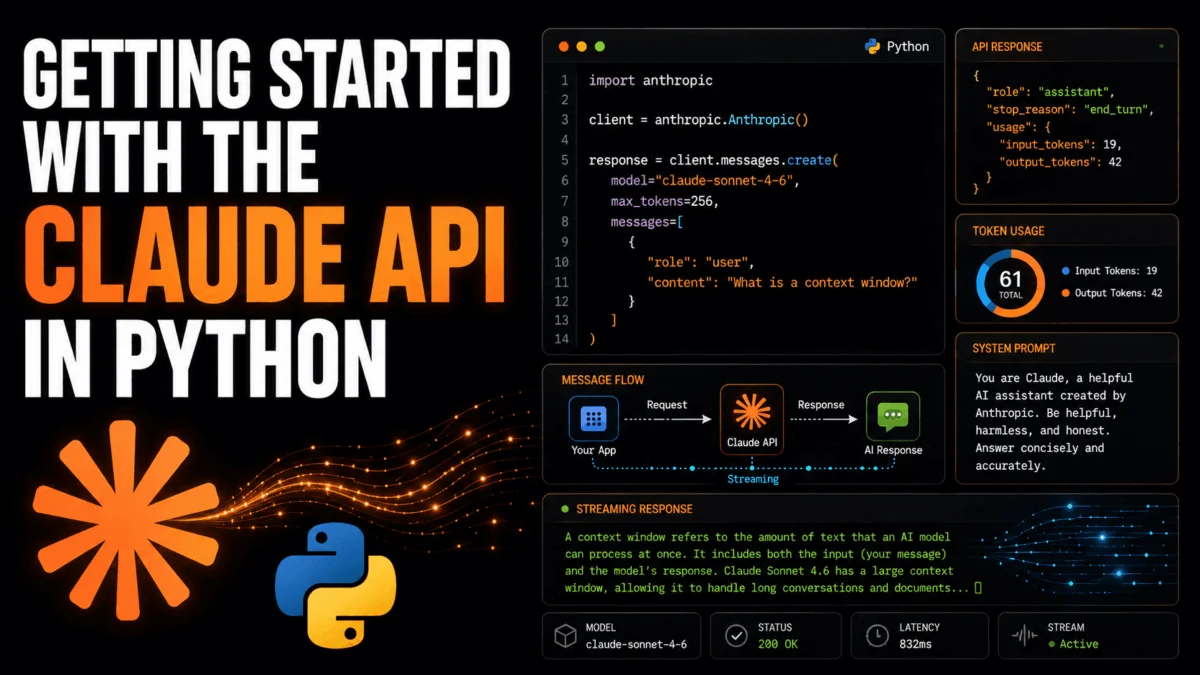
A typical invocation of client.messages.create() requires three primary parameters: the model identifier, a max_tokens limit, and a list of messages.
- Model Identifier: This string specifies which Claude model variant will process the request (e.g., "claude-sonnet-5"). Anthropic offers various models, each optimized for different use cases, cost profiles, and performance characteristics. Selecting the appropriate model is crucial for balancing application requirements with operational efficiency.
max_tokensLimit: This integer sets a hard upper bound on the number of output tokens Claude will generate. It’s a critical parameter for managing both response length and computational costs. While a higher limit allows for more comprehensive responses, setting it too low can result in truncated or incomplete outputs, particularly for open-ended queries. Developers must carefully consider the nature of their prompts to allocate an adequatemax_tokensvalue.messagesList: This parameter is a list of dictionaries, representing the conversational turns between the user and the AI. Each dictionary must contain a"role"(either "user" or "assistant") and"content"key. Crucially, the conversation history must always begin with a"user"turn, establishing the initial prompt for Claude. This structured approach to message passing is fundamental to managing conversational context and enabling multi-turn interactions.
An illustrative example demonstrating a basic API call to query Claude about a technical concept, such as a "context window," highlights the simplicity and clarity of the SDK:
import anthropic

client = anthropic.Anthropic()

response = client.messages.create(
    model="claude-sonnet-5",
    max_tokens=256,
    messages=[

            "role": "user",
            "content": "In one sentence, what is a context window?"

    ]
)

print(response.content[0].text)
This snippet demonstrates how a developer can quickly obtain a concise explanation from Claude. The model field explicitly names the desired Claude model, while max_tokens prevents excessively long responses. The messages list, containing a single user prompt, initiates the interaction. The output, such as "A context window is the maximum amount of text (measured in tokens) that a language model can process and consider at one time, encompassing both your input and its output," exemplifies Claude’s ability to provide clear and accurate information, a testament to the model’s underlying capabilities.
Deconstructing the Response Object for Deeper Insights
Upon making an API call, client.messages.create() returns a typed Message object, which encapsulates Claude’s response and crucial metadata. Understanding the structure and contents of this object is essential for robust application development, allowing developers to not only extract the generated text but also to monitor interaction specifics and manage resource consumption.
The Message object provides a comprehensive overview of the interaction:
Message(
  id='msg_01XFDUDYJgAACzvnptvVoYEL',
  type='message',
  role='assistant',
  content=[TextBlock(text='A context window is...', type='text')],
  model='claude-sonnet-5',
  stop_reason='end_turn',
  stop_sequence=None,
  usage=Usage(input_tokens=19, output_tokens=42)
)
Several fields within this object hold significant implications for developers:
idandtype: These fields provide unique identifiers and confirm the object’s nature, aiding in logging and debugging.role: Indicates that the response originates from the ‘assistant,’ affirming Claude’s role in the conversation.content: This is a list of content blocks. For standard text responses, it typically contains a singleTextBlockobject, from which the generated text can be extracted usingresponse.content[0].text. This structured content approach supports future extensibility for handling diverse output types beyond plain text.model: Confirms the specific Claude model that processed the request, valuable for auditing and performance analysis.stop_reason: This field is critical for diagnosing and optimizing API interactions. A value of'end_turn'signifies that Claude naturally completed its response. Conversely, a'max_tokens'value indicates that the response was truncated because it reached the specifiedmax_tokenslimit. Developers encounteringmax_tokensas astop_reasonmust re-evaluate theirmax_tokenssetting or refine their prompts to fit within the constraints, ensuring complete and coherent outputs.stop_sequence: Relevant when custom stop sequences are defined, allowing more granular control over response termination.usage: This nested object provides vital information about token consumption, detailing bothinput_tokensandoutput_tokens. These metrics are directly tied to Anthropic’s billing model, making them essential for cost management and for monitoring proximity to Claude’s overall context window limits. By tracking token usage, developers can proactively optimize prompt lengths and manage resource allocation, particularly in high-volume applications.
The structured nature of the Message object not only simplifies data extraction but also provides deep programmatic insight into each API interaction, empowering developers to build more resilient, cost-effective, and intelligent applications.
Elevating Control with System Prompts
Beyond individual conversational turns, the Claude API introduces the powerful concept of a "system prompt," a distinct parameter that allows developers to establish a persistent role, impose constraints, or provide overarching context that applies throughout an entire conversation or series of interactions. Unlike user or assistant messages, the system prompt sits "above" the conversation, influencing Claude’s behavior and responses from a foundational level without needing to be repeated in every message.
The system prompt is passed as a top-level system parameter to the client.messages.create() method, separate from the messages list. This architectural choice ensures that the system prompt maintains its authority and influence across all subsequent turns, effectively shaping Claude’s persona and operational guidelines.
Consider an application requiring Claude to act exclusively as a Python code reviewer, adhering to specific output formats and avoiding extraneous explanations. A system prompt can enforce these behaviors:
import anthropic

client = anthropic.Anthropic()

response = client.messages.create(
    model="claude-sonnet-5",
    max_tokens=512,
    system=(
        "You are a Python code reviewer. "
        "Respond only with corrected or improved Python code. "
        "Do not explain changes unless the user explicitly asks."
    ),
    messages=[

            "role": "user",
            "content": (
                "def get_user(id):n"
                "    db = connect()n"
                "    return db.query('SELECT * FROM users WHERE id=' + id)"
            )

    ]
)

print(response.content[0].text)
In this example, the system prompt rigidly defines Claude’s role and expected output. When presented with a snippet of potentially insecure or inefficient Python code (e.g., an SQL injection vulnerability in the get_user function), Claude would respond with a revised, safer, or more idiomatic version of the code, without offering a narrative explanation unless explicitly prompted to do so. This level of granular control is invaluable for applications requiring highly specialized or constrained AI behavior, such as automated content moderation, data transformation, or interactive learning platforms.
The strategic use of system prompts is a cornerstone of advanced prompt engineering, enabling developers to distill complex instructions and ethical guidelines into a single, authoritative directive. This not only enhances the steerability and predictability of Claude’s responses but also reduces token consumption by eliminating the need to embed behavioral instructions within individual user messages, contributing to more efficient and effective AI applications.
Enhancing User Experience with Streaming Responses
For applications requiring real-time interaction or dealing with potentially lengthy AI-generated content, displaying text as it arrives significantly enhances the user experience. The Claude Python SDK facilitates this through client.messages.stream(), which allows developers to process and present portions of Claude’s response incrementally, rather than waiting for the entire output to be generated. This feature is particularly beneficial for interactive chatbots, content generation tools, or applications where perceived responsiveness is paramount.
The stream() method is designed to be used as a context manager, ensuring proper resource management and clean closure of the underlying HTTP connection, even in the event of exceptions. Within the context block, the text_stream iterator yields individual text chunks in real time, enabling continuous output to the user.
import anthropic

client = anthropic.Anthropic()

with client.messages.stream(
    model="claude-sonnet-5",
    max_tokens=512,
    messages=[

            "role": "user",
            "content": "Walk me through what happens when a Python list grows beyond its initial capacity."

    ]
) as stream:
    for chunk in stream.text_stream:
        print(chunk, end="", flush=True)

print()  # newline after stream ends
In this example, Claude is asked to explain a technical concept. Instead of a single, delayed output, the explanation streams word by word or phrase by phrase. The print(chunk, end="", flush=True) construct is crucial here: end="" prevents automatic newlines after each chunk, while flush=True ensures that the output buffer is cleared immediately, making the text visible in real-time.
A typical streamed response for the Python list capacity query might appear as:
Python lists are dynamic arrays. When you append an element and the list has no
room, Python allocates a new, larger block of memory – typically 1.125x the current
size – copies all existing elements into it, and releases the old block. This
operation is O(n) in the worst case, but because it happens infrequently relative to
the number of appends, the amortized cost per append stays O(1). You can pre-allocate
capacity with a list comprehension or by passing an iterable to the list constructor
if you know the final size upfront.
Beyond improving perceived performance, streaming offers practical advantages. For instance, if an application needs to process or display partial results, streaming allows it to act on available data without waiting for the full response, potentially enabling more dynamic and responsive user interfaces. Furthermore, for applications that require the complete Message object after streaming, including vital token usage counts and the final stop_reason, the stream.get_final_message() method can be invoked before the context block closes, providing comprehensive post-stream analytics. This dual capability—real-time output and post-completion metadata—makes streaming a powerful feature for developing engaging and efficient AI-powered applications.
Implications for Developers and Future Directions
The Anthropic Python SDK represents a significant step forward in making advanced AI accessible and practical for a broad base of developers. By offering a robust, well-documented, and Pythonic interface to Claude’s capabilities, Anthropic is empowering the creation of a new generation of intelligent applications. The SDK’s features, from secure API key management and structured responses to sophisticated system prompts and real-time streaming, collectively reduce development complexity and accelerate the innovation cycle.
The implications for the developer community are profound. Developers can now rapidly prototype and deploy applications that leverage Claude’s nuanced understanding of language, reasoning, and content generation. This includes, but is not limited to, enhanced customer service agents, intelligent content creation platforms, sophisticated data analysis tools, and advanced educational aids. The ease of integrating such powerful AI capabilities democratizes access to cutting-edge technology, allowing smaller teams and individual developers to compete with larger enterprises in the AI space.
Looking ahead, the evolution of the Claude API and its SDK will likely focus on even greater sophistication and developer control. Areas such as advanced error handling, more granular token usage reporting, and streamlined approaches for managing multi-turn conversations are continually being refined. The stateless nature of the Messages API means that developers are responsible for sending conversation history with each request, and future SDK enhancements may offer more built-in utilities for managing this state efficiently.
Furthermore, Anthropic’s commitment to features like structured outputs and tool use—allowing Claude to interact with external systems and generate responses in specific formats (e.g., JSON)—will unlock even more complex and integrated AI applications. These capabilities transform Claude from a purely conversational agent into a powerful reasoning engine that can orchestrate workflows, automate tasks, and serve as an intelligent backend for diverse software systems. As these features mature, the Python SDK will undoubtedly continue to evolve, providing developers with the necessary tools to harness the full potential of Anthropic’s AI models, driving innovation across countless domains. The current foundation laid by the SDK offers a clear path for developers to explore these advanced functionalities, promising a future where AI is not just integrated but deeply interwoven into the fabric of everyday technology.