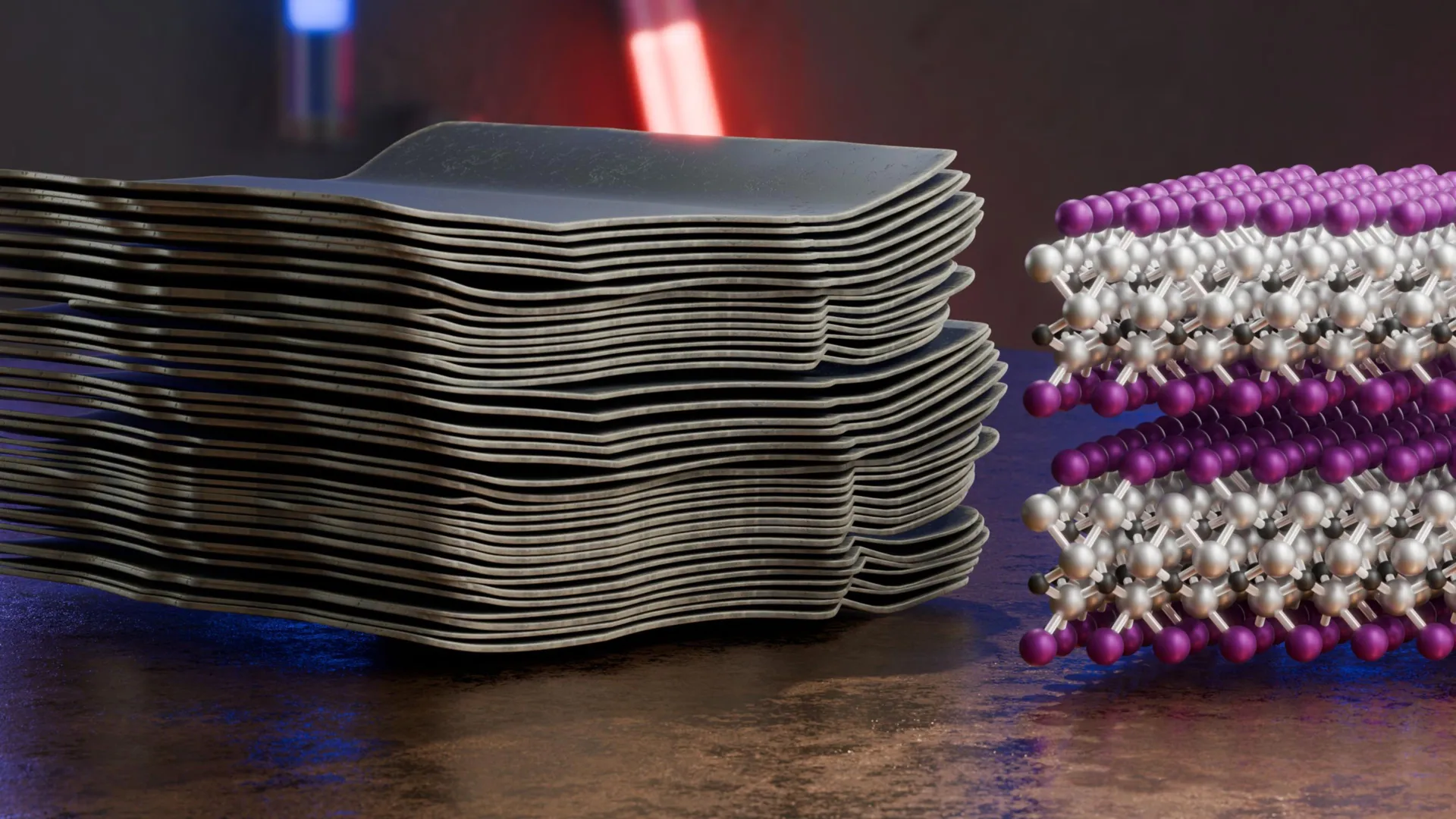
A collaborative research effort led by the Institute of Ion Beam Physics and Materials Research at the Helmholtz-Zentrum Dresden-Rossendorf (HZDR) and the Technische Universität Dresden (TU Dresden) has announced a significant breakthrough in the synthesis of MXenes, a class of two-dimensional (2D) inorganic materials. By pioneering a new synthesis method known as the Gas-Liquid-Solid (GLS) technique, researchers have successfully eliminated the atomic disorder that has long plagued these materials, resulting in a staggering 160-fold increase in macroscopic conductivity. This development marks a pivotal shift in the field of materials science, potentially unlocking the door to the next generation of high-speed electronics, advanced electromagnetic shielding, and ultra-efficient energy storage systems.
MXenes, first discovered in 2011, belong to a rapidly expanding family of ultra-thin materials composed of transition metal carbides, nitrides, or carbonitrides. Unlike graphene, which consists solely of carbon atoms, MXenes feature a complex "sandwich" structure of transition metals (such as titanium or molybdenum) combined with carbon or nitrogen. Their surfaces are populated with functional groups—atoms or molecules that attach to the outer layers—which dictate the material’s chemical, optical, and electrical properties. However, until this recent discovery, the inability to precisely control these surface atoms has been a major bottleneck in realizing the full theoretical potential of MXenes.
The Evolution of MXene Research: A Decade of Discovery
The journey of MXenes began at Drexel University in 2011 when researchers Yury Gogotsi and Michel Barsoum discovered that they could "exfoliate" certain layered bulk materials known as MAX phases. The "M" in MAX represents a transition metal, "A" represents an element from the A-group (mostly Groups 13 and 14 of the periodic table), and "X" represents carbon or nitrogen. By chemically etching away the "A" layer—usually aluminum—researchers were left with 2D sheets of $M_n+1X_n$, or MXenes.
Over the last thirteen years, the scientific community has identified and synthesized dozens of different MXene compositions. Because of their metallic conductivity and hydrophilic (water-loving) surfaces, they have been hailed as the "next graphene," with applications ranging from water purification membranes to supercapacitor electrodes. Despite this promise, the standard method of production—wet chemical etching using hydrofluoric acid (HF) or similar harsh reagents—introduced significant flaws.
The traditional etching process is notoriously messy at the atomic level. As the "A" layer is removed, various atoms from the chemical bath, such as oxygen, fluorine, and chlorine, attach themselves to the surface in a random, disorganized fashion. This "atomic disorder" acts as a series of obstacles for electrons. Dr. Dongqi Li of TU Dresden likens this phenomenon to a highway riddled with potholes: while the road exists, the traffic—representing the flow of electrons—is forced to slow down, scatter, and lose energy.
The GLS Method: Engineering Atomic Order
To address these limitations, the research team developed the GLS (Gas-Liquid-Solid) method, a synthesis strategy that moves away from aqueous acid baths in favor of high-temperature molten salts and iodine vapor. This method represents a fundamental departure from the "top-down" etching techniques used for the past decade.
In the GLS process, the researchers begin with the solid MAX phase material. Instead of using liquid acids, they introduce molten halide salts and iodine vapor. The iodine acts as a chemical transport agent, facilitating the removal of the "A" layer while providing a controlled environment for new surface atoms to bond. This environment allows the researchers to dictate exactly which halogen atoms—chlorine, bromine, or iodine—will occupy the surface sites of the MXene.
The result is a material with "surface terminations" that are perfectly ordered and uniform. By eliminating the random mix of oxygen and fluorine typical of traditional MXenes, the team produced samples that are chemically "cleaner" and structurally superior. The versatility of the GLS method was demonstrated across eight different MAX phases, proving that this is not a niche solution but a broadly applicable manufacturing advancement.
Quantitative Analysis: A Leap in Performance
The impact of this structural order on the material’s physical properties is profound. The team focused their primary testing on titanium carbide ($Ti_3C_2$), the most common and widely studied MXene. Under traditional synthesis, $Ti_3C_2$ typically exhibits a disorganized surface of chlorine and oxygen. Using the GLS method, the team produced $Ti_3C_2Cl_2$—a variant where only chlorine atoms are present in a perfectly crystalline arrangement.
When subjected to electrical testing, the GLS-produced MXene demonstrated:
- Macroscopic Conductivity: A 160-fold increase compared to traditionally etched variants.
- Terahertz Conductivity: A 13-fold enhancement, which is critical for high-frequency applications like 6G telecommunications.
- Charge Carrier Mobility: A nearly fourfold increase, indicating that electrons move through the material with significantly less resistance.
Dr. Mahdi Ghorbani-Asl of HZDR emphasized that these gains are a direct result of the reduced electron scattering. "They [surface atoms] strongly influence how electrons move through the material, how stable it is, and how it interacts with light, heat, and chemical environments," he explained. By creating a "smooth highway" for electrons, the researchers have moved MXenes closer to their theoretical limits of performance.
Theoretical Validation through Density Functional Theory
To confirm that the observed performance boosts were indeed due to surface ordering, the team employed Density Functional Theory (DFT) calculations. DFT is a quantum mechanical modeling method used to investigate the electronic structure of many-body systems.
The simulations provided a high-resolution look at the energy landscapes of the MXene surfaces. The data showed that when surface atoms are disordered, they create "trap states"—localized areas where electrons become stuck. In contrast, the ordered halogen terminations produced by the GLS method create a uniform potential energy surface. This theoretical framework not only explained the current results but also provided a roadmap for future customizations. By predicting how different atoms (like bromine or iodine) would affect the electronic band structure, the team can now "design" MXenes for specific tasks before ever entering the lab.
Expanding the Spectrum: Customization for Stealth and Shielding
One of the most exciting implications of the GLS method is the ability to tune how MXenes interact with electromagnetic radiation. The study found that by swapping chlorine for bromine or iodine on the surface, the frequency at which the material absorbs electromagnetic waves shifts.
For example, chlorine-terminated MXenes showed strong absorption in the 14–18 GHz range, which is part of the Ku band used for satellite communications and radar. By adjusting the surface chemistry, researchers can create materials that absorb or reflect specific frequencies. This has immediate applications in:
- Radar-Absorbing Coatings: Creating "stealth" surfaces for aerospace applications.
- Electromagnetic Interference (EMI) Shielding: Protecting sensitive medical or military electronics from "noise" or interference.
- Wireless Technology: Developing components for the ultra-high frequencies required by future 5G and 6G networks.
Furthermore, the team experimented with "mixed" terminations, using combinations of different halide salts to create MXenes with two or three types of surface halogens in precise ratios. This level of "chemical dial-turning" was previously impossible with traditional wet-chemistry methods.
Industry Implications and the Road to Mass Production
The transition from laboratory discovery to industrial application requires stability and scalability. Traditional MXenes produced with HF are often prone to degradation when exposed to air or water over long periods. Preliminary data from the GLS method suggests that the ordered halogen surfaces may offer improved chemical stability, as the tightly packed atoms provide a more robust shield for the transition metal core.
Industry analysts suggest that this breakthrough could accelerate the adoption of MXenes in several key sectors:
- Energy Storage: The increased conductivity and surface order could lead to batteries that charge in seconds and supercapacitors with significantly higher energy densities.
- Catalysis: Precise surface control is the "holy grail" of catalysis. These ordered MXenes could serve as highly efficient platforms for hydrogen production or carbon dioxide conversion.
- Flexible Electronics: Because MXenes are 2D and can be processed into inks, the GLS-enhanced versions could lead to high-performance wearable sensors and foldable displays that do not sacrifice speed for flexibility.
Conclusion: A New Era for 2D Materials
The work of Dr. Ghorbani-Asl, Dr. Dongqi Li, and their colleagues represents a major step forward for MXene chemistry. By moving from the "brute force" approach of acid etching to the precision of the GLS molten salt method, they have transformed MXenes from a promising but flawed material into a high-precision tool for modern engineering.
"By combining theory with our experimental ability to precisely control surface terminations, we open a new path toward MXenes with improved stability and tailored functional properties," concluded Ghorbani-Asl. As the scientific community continues to explore the "alphabet" of MXene compositions, the ability to write that alphabet with perfect atomic handwriting ensures that the future of 2D materials will be as conductive as it is versatile.
The findings, recently published in a leading scientific journal, are expected to spark a new wave of research into "clean" 2D material synthesis, moving the industry away from hazardous acids toward more controlled, gas-phase and molten-salt reactions. This shift not only promises better performance but also a more sustainable and precise future for nanotechnology.