In a landmark development for the field of renewable energy, an international team of researchers has announced a significant breakthrough in solar energy conversion, effectively bypassing a long-standing physical barrier that has limited the efficiency of solar cells for decades. In a study published in the Journal of the American Chemical Society on March 25, scientists from Kyushu University in Japan, in collaboration with the Johannes Gutenberg University (JGU) Mainz in Germany, detailed a method to achieve energy conversion efficiencies of approximately 130%. By utilizing a specialized molybdenum-based "spin-flip" emitter to harness a process known as singlet fission, the team has demonstrated that it is possible to generate more than one energy carrier from a single photon of light, a feat previously considered a "dream technology" in the photovoltaic industry.
The Physical Ceiling: Understanding the Shockley-Queisser Limit
To appreciate the magnitude of this breakthrough, one must first understand the fundamental limitations of current solar technology. Most modern solar cells are based on the semiconductor silicon. When photons—particles of light—strike the surface of a solar cell, they transfer their energy to electrons within the material. This energy allows the electrons to break free and move, creating an electric current. This process, however, is governed by the Shockley-Queisser limit, a theoretical maximum efficiency for single-junction solar cells.
The Shockley-Queisser limit dictates that a standard solar cell can only convert about 33.7% of incoming sunlight into electricity. This loss occurs because the solar spectrum is broad, and solar cells are tuned to a specific bandgap. Low-energy infrared photons often lack the energy required to dislodge an electron and pass through the cell unused. Conversely, high-energy photons, such as those in the blue and ultraviolet spectrum, possess more energy than is needed to excite an electron. This "extra" energy is not captured; instead, it is rapidly dissipated as heat through a process called thermalization. Consequently, roughly two-thirds of the energy provided by the Sun is lost before it can be converted into usable power.
Singlet Fission: The Quest for Energy Multiplication
For years, researchers have sought ways to circumvent the Shockley-Queisser limit. One of the most promising avenues is singlet fission (SF). In a standard photovoltaic process, one photon generates one "exciton"—a pair consisting of an excited electron and the "hole" it left behind. In singlet fission, a high-energy "singlet" exciton produced by a single photon can split into two lower-energy "triplet" excitons.
If these two triplet excitons can be successfully harvested, a single photon could theoretically produce two units of electricity, potentially doubling the current output of high-energy light. Materials like tetracene have long been known to support singlet fission, but the practical application of this technology has been hindered by a phenomenon known as Förster Resonance Energy Transfer (FRET).
Associate Professor Yoichi Sasaki of Kyushu University’s Faculty of Engineering, a lead researcher on the project, explains that energy is often "stolen" by the FRET mechanism before the multiplication process can be completed. In many experimental setups, the energy from the initial singlet exciton is transferred to an acceptor molecule too quickly, preventing the split into two triplets. To solve this, the team needed a way to selectively capture only the triplet excitons while ignoring the initial singlet energy.
The Innovation: Molybdenum-Based Spin-Flip Emitters
The solution arrived through a sophisticated application of coordination chemistry. The research team identified a molybdenum-based metal complex that functions as a "spin-flip" emitter. Unlike traditional energy acceptors, this molybdenum complex is specifically engineered to change its electron spin during the absorption or emission of near-infrared light.
This unique property allows the complex to act as a highly selective "catcher" for the triplet excitons generated through singlet fission. By precisely tuning the energy levels of the molybdenum complex to match the energy of the triplet excitons in tetracene, the researchers were able to ensure that the energy transfer occurred only after the fission process was complete. This effectively minimized the losses associated with FRET and allowed for the efficient extraction of the multiplied energy carriers.
The technical success of this approach relied on the "spin-forbidden" nature of certain transitions within the molybdenum complex. Because the complex favors transitions that involve a change in spin state, it is naturally predisposed to interact with triplet excitons—which also possess a specific spin orientation—while remaining relatively "blind" to the initial singlet excitons.
A Chronology of International Collaboration
The development of this technology is the result of a multi-year collaborative effort between Japanese and German institutions. The partnership was galvanized by Adrian Sauer, a graduate student from the Heinze group at JGU Mainz, who visited Kyushu University as part of an academic exchange program.
The Heinze group at Mainz has spent years studying the properties of molybdenum complexes and their unique photophysical behaviors. Sauer brought this expertise to Kyushu, where Associate Professor Sasaki and his team were already exploring singlet fission in organic materials.
"We could not have reached this point without the Heinze group," Sasaki noted, highlighting the importance of cross-disciplinary and international cooperation. The chronology of the project involved several phases:
- Material Synthesis: The JGU Mainz team synthesized and characterized the molybdenum-based spin-flip emitters.
- System Integration: The Kyushu University team integrated these emitters with tetracene-based organic molecules in a liquid solution.
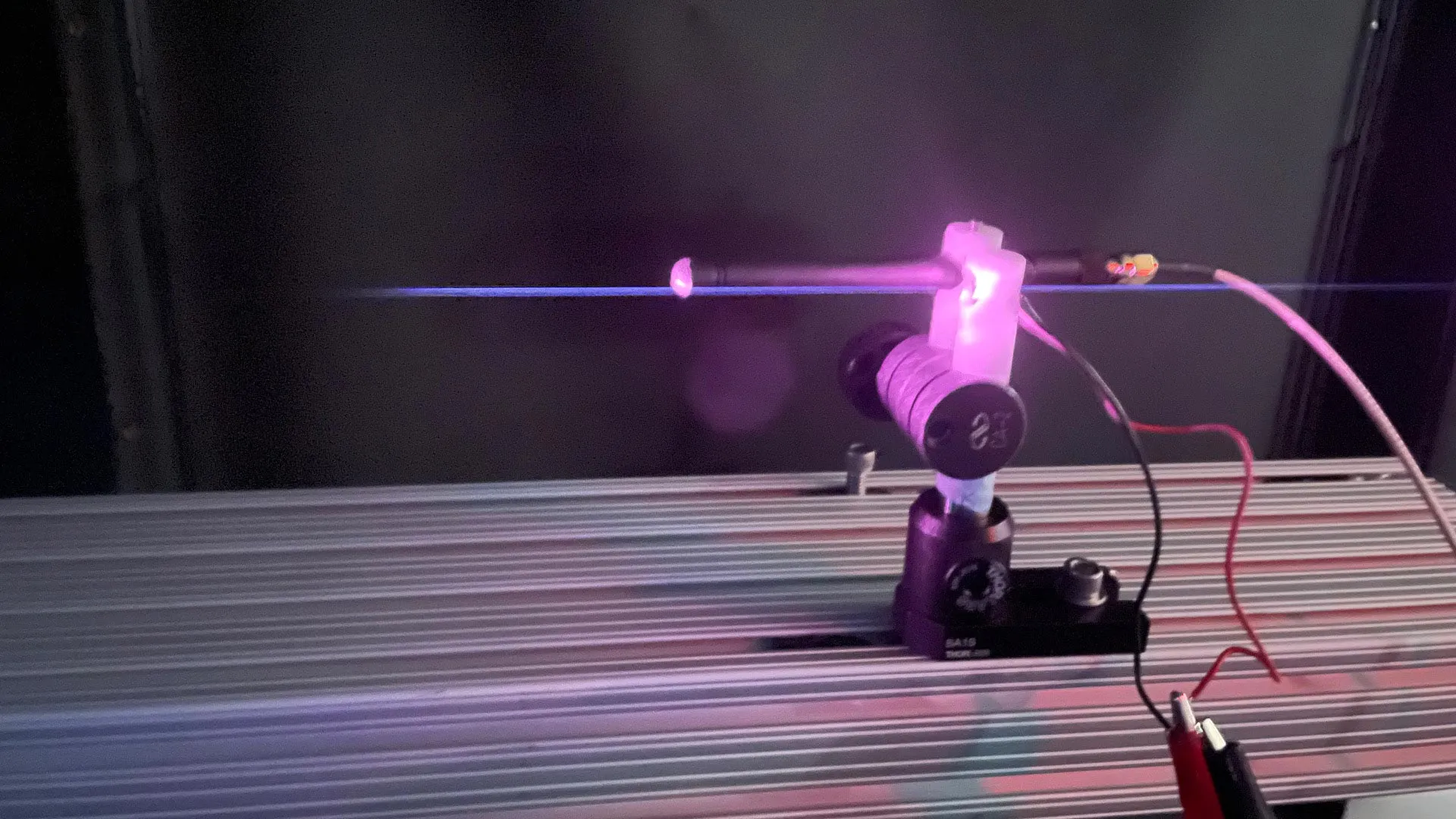
- Spectroscopic Analysis: Using advanced laser spectroscopy, the team tracked the movement of energy from the moment a photon hit the solution to the activation of the metal complexes.
- Verification: The team measured the quantum yield—the ratio of activated complexes to absorbed photons—to confirm the energy multiplication.
The culmination of this work was the successful demonstration of a 130% quantum yield, a figure that represents a significant milestone in photochemistry.
Analyzing the Data: What 130% Efficiency Means
In the context of this study, "130% efficiency" refers to the external quantum yield. In a standard system, the maximum possible yield is 100% (one photon in, one exciton out). A yield of 130% means that for every 100 photons absorbed by the system, 130 energy-carrying molybdenum complexes were activated.
This data provides empirical proof that the singlet fission process successfully multiplied the energy carriers. Specifically:
- Photon Absorption: High-energy light is absorbed by the tetracene.
- Fission Event: The resulting singlet exciton splits into two triplet excitons.
- Selective Capture: The molybdenum complexes capture these triplets with high efficiency.
- Result: The production of more energy carriers than the number of photons that entered the system.
While this does not mean the entire solar panel is 130% efficient (which would violate the laws of thermodynamics regarding total energy conservation), it means that the conversion process for high-energy light is over 100% efficient relative to the photon count. This surplus helps offset the losses usually seen in the blue and UV spectrums, potentially raising the overall ceiling of solar panel productivity far beyond the 33.7% Shockley-Queisser limit.
Broader Implications for Industry and Technology
The implications of this research extend far beyond theoretical physics. As the world transitions toward a decarbonized economy, the demand for more efficient and cost-effective solar energy is at an all-time high.
Advancing Solar Photovoltaics
If this proof-of-concept can be transitioned from a liquid solution to a solid-state material, it could be integrated into the next generation of commercial solar panels. By adding a layer of singlet fission material and molybdenum emitters on top of a standard silicon cell—a configuration known as a "tandem" or "hybrid" cell—manufacturers could significantly boost the wattage of solar modules without increasing their physical footprint. This would be particularly beneficial in urban environments or regions with limited space for large-scale solar farms.
Quantum Technology and LEDs
Beyond solar energy, the ability to control exciton spin and multiplication has profound implications for quantum technologies. The precise manipulation of triplet states is a cornerstone of quantum sensing and information processing. Furthermore, the "spin-flip" mechanism used in the molybdenum complexes could lead to the development of more efficient Light Emitting Diodes (LEDs). Current organic LEDs (OLEDs) often struggle with "efficiency roll-off" at high brightness; the selective energy management demonstrated by the Kyushu-Mainz team could provide a solution to this problem.
Future Outlook: From Laboratory to Rooftop
Despite the excitement surrounding the 130% yield, the researchers emphasize that the technology is currently in the proof-of-concept stage. The primary challenge moving forward is "solidification."
"Our next goal is to move these materials into solid-state systems," says Associate Professor Sasaki. In a liquid solution, molecules move freely, making it easier for them to interact and transfer energy. In a solid-state solar panel, the molecules are fixed in a matrix. The team must now engineer a solid material that maintains the same level of energy transfer efficiency and selectivity.
Additionally, the long-term stability of molybdenum-based complexes under constant exposure to sunlight must be rigorously tested. Commercial solar panels are expected to last 25 to 30 years; ensuring that these advanced chemical systems can withstand decades of environmental stress is a vital step toward commercialization.
Conclusion
The collaboration between Kyushu University and JGU Mainz represents a pivotal shift in how scientists approach the "physical ceiling" of solar energy. By moving away from traditional semiconductor limitations and embracing the complex world of molecular photochemistry and spin dynamics, the team has opened a new door for energy harvesting.
The 130% conversion efficiency achieved in this study serves as a powerful reminder that the limits of technology are often just milestones waiting to be surpassed. As research continues into solid-state integration and material durability, the "dream technology" of singlet fission appears closer to reality than ever before, promising a future where the Sun’s immense energy is captured with unprecedented precision and minimal waste.