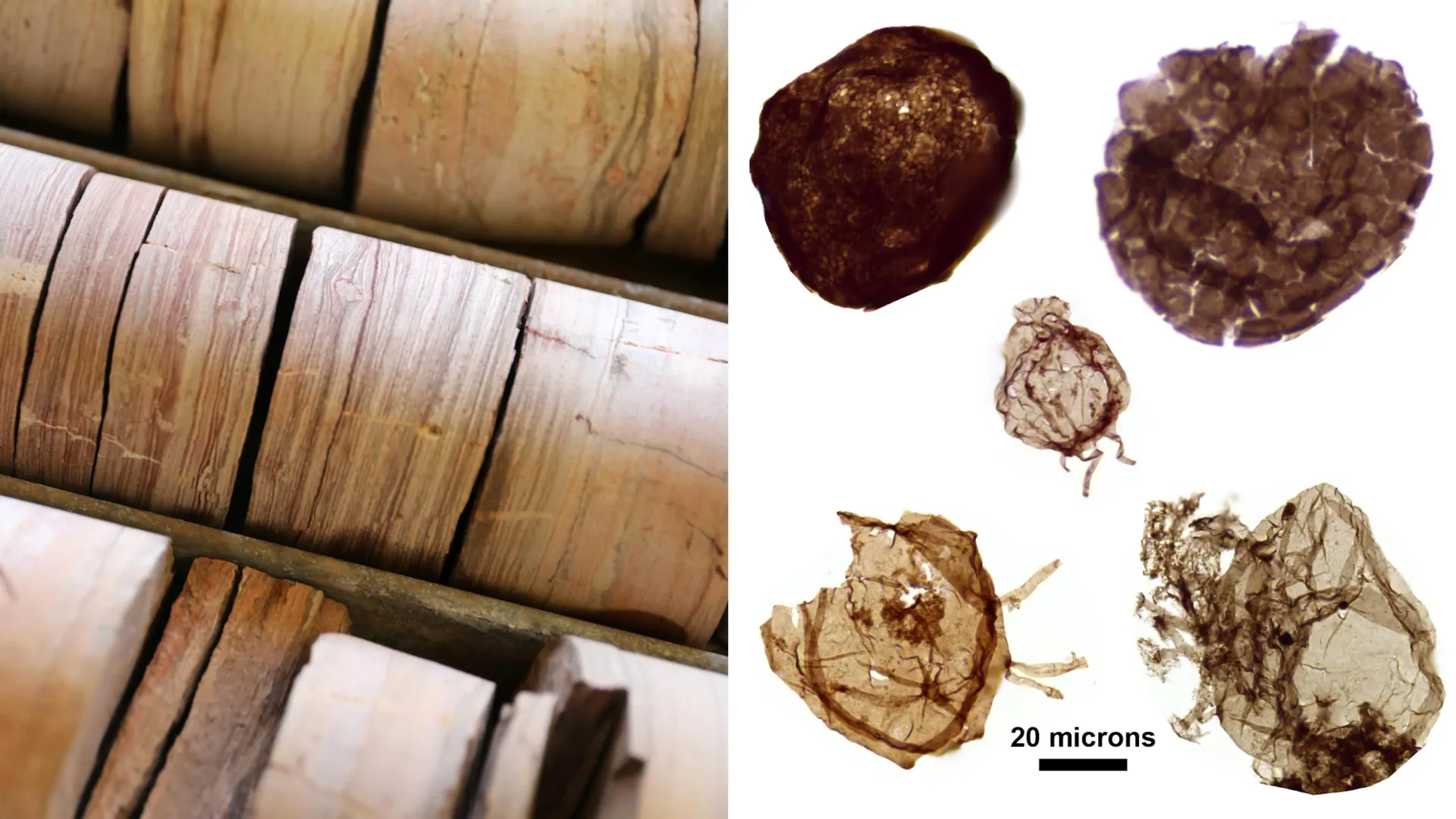
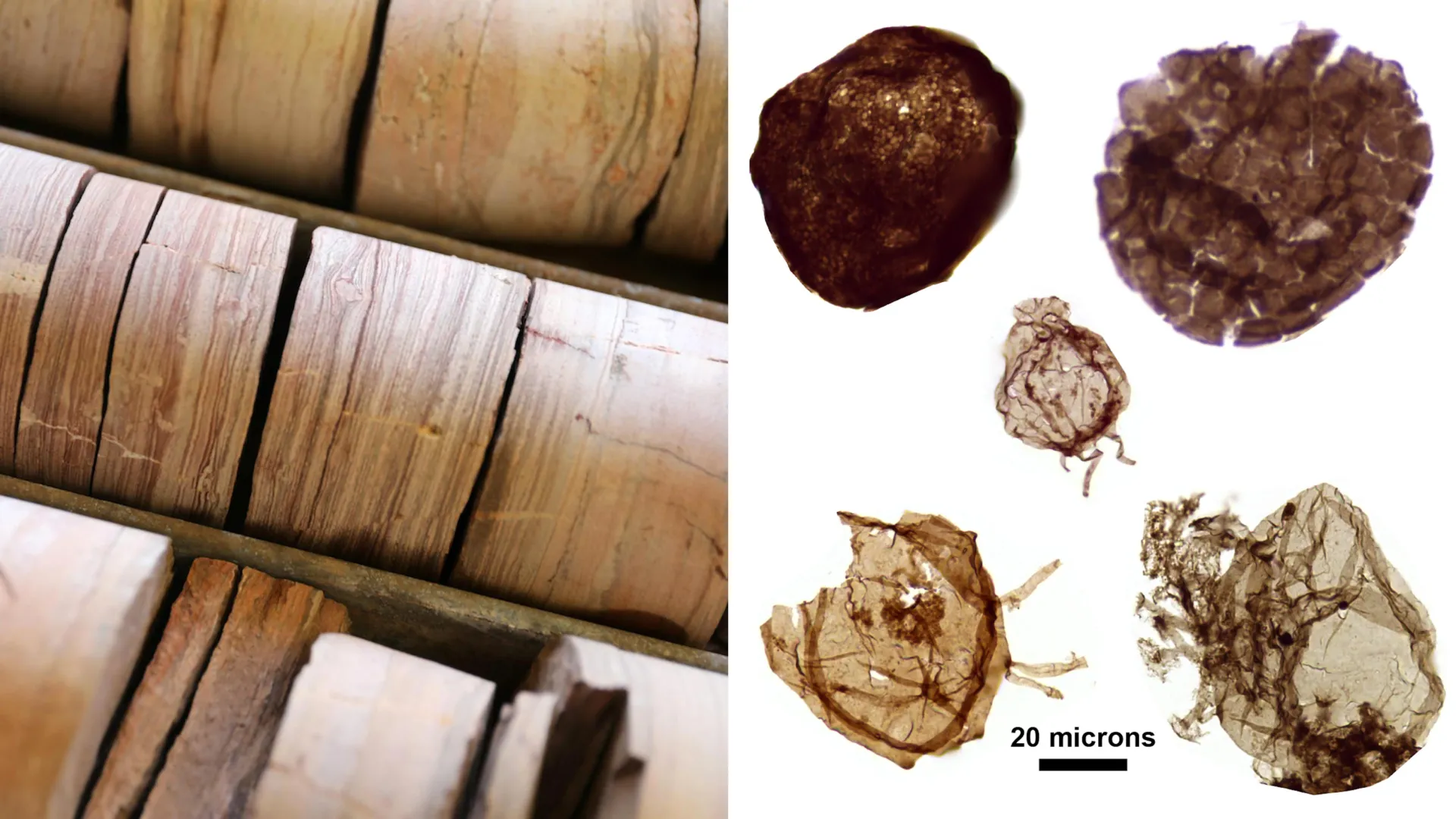
Stored in an open-air warehouse in the humid, tropical climate of Darwin, Australia, lies a collection that initially appears mundane to the untrained eye. Thousands of trays contain cylindrical cores of rock, extracted from hundreds of metres below the surface by mineral exploration companies decades ago. These geological relics, managed by the Northern Territory Geological Survey (NTGS), were originally intended to map potential mineral wealth. However, modern scientific analysis has revealed that these mudstones—sedimentary rocks formed from ancient, hardened seafloor silt—hold a far more profound treasure: the fossilized remains of the earliest complex organisms to ever inhabit our planet.
A recent study published in the journal Nature utilizes these ancient samples to address one of the most significant enigmas in evolutionary biology: the origin of eukaryotes. By scrutinizing these microscopic fossils, which date back between 1.4 and 1.75 billion years, researchers are reconstructing the environmental conditions that facilitated the leap from simple, single-celled life to the complex cellular architecture that eventually gave rise to all animals, plants, and fungi.
The Great Cellular Divide
To understand the significance of these fossils, one must recognize the fundamental division in life on Earth. All organisms fall into one of two categories: prokaryotes and eukaryotes. Prokaryotes, which include bacteria and archaea, possess a relatively simple cellular structure, lacking a defined nucleus or complex organelles. They are the workhorses of the biosphere, capable of surviving in extreme conditions, yet they rarely exhibit the intricate, multi-compartment internal organization required for complex life.
Eukaryotes, by contrast, are defined by their structural sophistication. They contain a nucleus—the command center housing genetic material—and specialized organelles such as mitochondria and chloroplasts, which perform essential tasks like energy production and photosynthesis. The "eukaryotic revolution," as biologists often call it, was the catalyst for the development of multicellular life. Genetic evidence strongly suggests that this transition occurred through endosymbiosis, a process in which an ancestral archaeon and a bacterium merged, creating a symbiotic relationship that eventually evolved into the first eukaryotic cell.
A Chronology of Early Life
The timeline of this transition remains a subject of intense academic debate. While prokaryotic life has existed for nearly 3.5 to 4 billion years, the emergence of eukaryotes is typically traced back to the Proterozoic Eon. The fossils recovered from the Northern Territory are of particular global importance because they represent the oldest known eukaryotic specimens, with some dating back approximately 1.75 billion years.
- 3.5–4 Billion Years Ago: The emergence of the first prokaryotic life forms.
- 1.75 Billion Years Ago: The earliest evidence of eukaryotic life appears in the geological record, as seen in the Northern Territory samples.
- 1.4–1.7 Billion Years Ago: A period of diversification where eukaryotes began to inhabit a wider range of marine environments.
- Present Day: Eukaryotes dominate the biosphere, having branched into the diverse kingdoms of life we recognize today.
The Oxygen Paradox
For decades, the scientific consensus held that the rise of eukaryotes was inextricably linked to the "Great Oxidation Event" (GOE), a period roughly 2.4 billion years ago when atmospheric oxygen levels began to rise significantly. The logic was straightforward: eukaryotes, particularly those that utilize aerobic respiration, require oxygen to generate the high energy levels necessary for maintaining complex cellular machinery.
However, recent discoveries have complicated this narrative. Scientists have identified "enigmatic" eukaryotes capable of thriving in anaerobic, or oxygen-free, environments. Furthermore, geochemical evidence from the Proterozoic era suggests that while oxygen levels were rising, they remained volatile and, in many marine settings, quite scarce. This discrepancy led researchers to question whether oxygen was the primary driver of eukaryotic evolution or if early complex life was more resilient to anoxic conditions than previously hypothesized.
Methodology: Unlocking the Mudstone Archive
In the recent study, researchers adopted a rigorous, multi-faceted approach to analyze the Darwin-based samples. By crushing and chemically dissolving the mudstone cores, the team isolated more than 12,000 microscopic fossils. The process of extracting these fossils requires extreme precision to ensure that the fragile organic residue remains intact for microscopic examination.
Beyond identifying the morphology of these organisms, the research team analyzed the chemical signature of the surrounding sediment. This provided a "paleo-environmental reconstruction," essentially a snapshot of the chemical composition of the ancient ocean floor. By mapping the presence of these fossils against the chemical markers of oxygen availability in the mudstones, the researchers sought to establish a direct correlation between habitat and organism complexity.
Findings and Official Implications
The results of the study provide compelling evidence that oxygen was indeed a limiting factor for early eukaryotic life. The researchers found that eukaryotic fossils were exclusively present in rock samples deposited in oxygenated marine settings. Conversely, samples derived from oxygen-free, or anoxic, environments contained only simple, prokaryotic forms.
"These findings suggest that even the earliest eukaryotes were highly dependent on oxygen," noted the study authors. "While some modern eukaryotes have adapted to live without it, the evolutionary pressure that allowed the first complex cells to flourish was likely dictated by the presence of oxygen in the ancient oceans."
This conclusion lends significant weight to the long-standing hypothesis that oxygen acted as a "metabolic spark" for evolution. Without sufficient oxygen, the energetic costs of building and maintaining a nucleus and complex organelles may have been insurmountable for early microbes.
Broader Impact and Scientific Consensus
The implications of this research extend far beyond the Northern Territory. By clarifying the environmental requirements of early eukaryotes, scientists are better equipped to model how life might have developed on other planets or within other extreme environments. The study serves as a bridge between the fields of paleontology, geochemistry, and molecular biology, demonstrating the necessity of interdisciplinary work in understanding the history of the biosphere.
The Northern Territory Geological Survey (NTGS) has been praised by the international scientific community for its stewardship of these cores. By preserving these samples for decades, the survey has inadvertently curated a library of evolutionary history that has only recently become readable through advanced analytical techniques. Experts in the field of astrobiology have noted that such archives are vital for understanding not just our past, but the potential for life elsewhere in the cosmos.
As research continues, the focus will likely shift toward mapping the exact concentrations of oxygen required to trigger specific evolutionary milestones. By examining different layers of rock from various time periods, scientists hope to create a high-resolution timeline that links specific oxygen levels to the diversification of eukaryotic lineages.
Conclusion
The fossils resting in the Darwin warehouse are more than just geological artifacts; they are the earliest records of our own ancestors. They serve as a reminder that the path from a simple, single-celled entity to a complex organism was not guaranteed, but rather a response to the shifting chemistry of a developing planet. As we continue to probe these ancient mudstones, we move closer to solving the mystery of how life on Earth crossed the threshold into complexity, providing a clearer picture of our origins in the vast timeline of the universe. The study confirms that while the journey of life is resilient, it remains governed by the fundamental constraints of the environment—a lesson that continues to inform our understanding of biological survival and evolutionary potential.