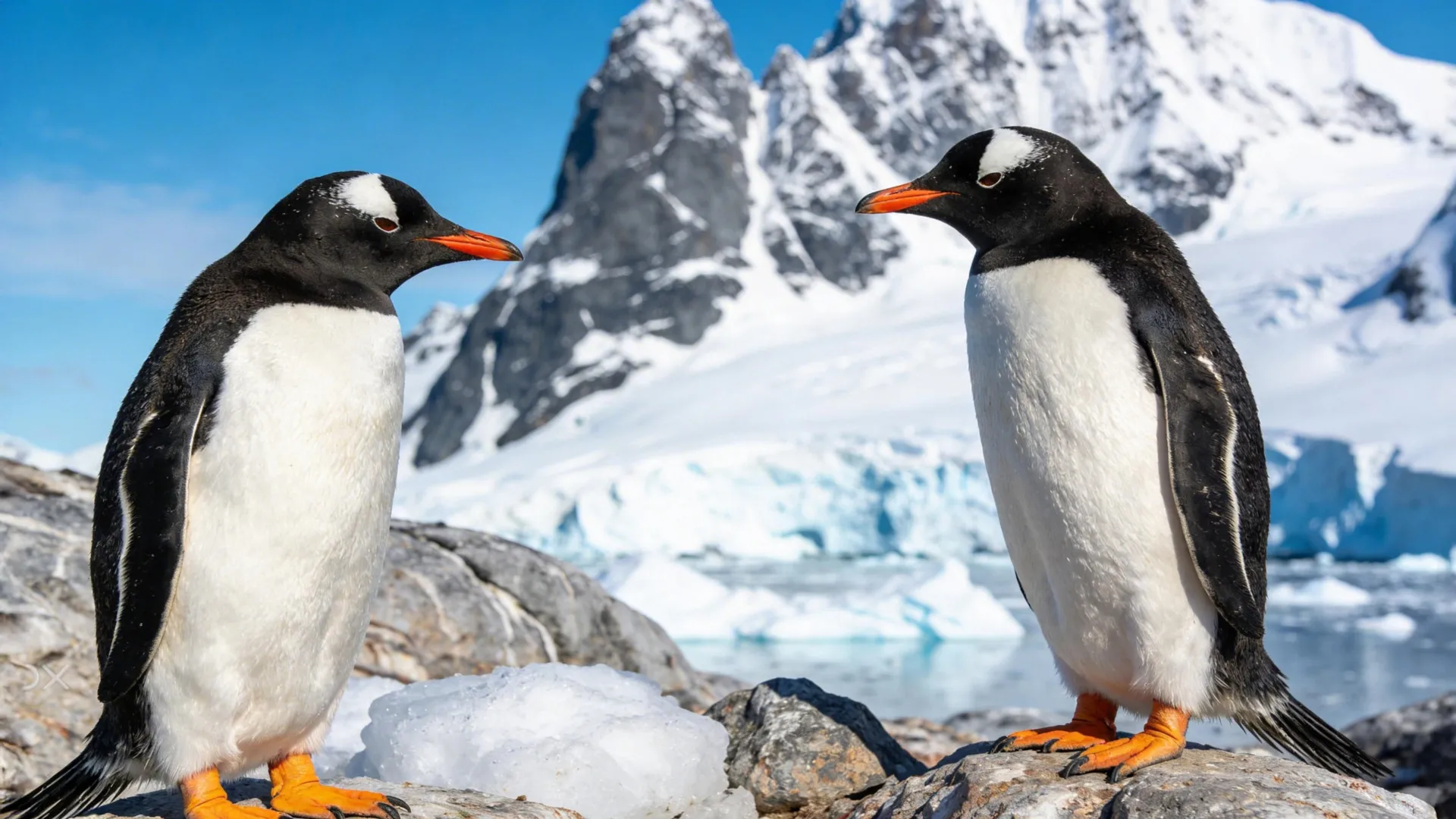
For over a century, the scientific community operated under the assumption that the gentoo penguin, recognized by its signature white bonnet-like stripe and bright orange-red bill, represented a single, cohesive species. However, a landmark international study published in the journal Communications Biology has dismantled this long-standing taxonomic consensus. By utilizing comprehensive whole-genome sequencing of 64 penguins collected across 10 distinct breeding colonies, researchers have determined that what was once viewed as one species is, in fact, four separate, genetically distinct lineages. This discovery marks the first time a new penguin species has been formally identified in more than 100 years, shedding light on the cryptic evolutionary processes occurring in the remote reaches of the Southern Hemisphere.
The study, led by an international consortium including the University of Chile, the University of California, Berkeley, and institutions across nine other countries, provides a definitive resolution to a debate that has simmered in ornithological circles for generations. The research team, spearheaded by authors Juliana Vianna, Rauri Bowie, and Elie Poulin, combined genomic data with detailed observations of vocalizations, physical morphology, and behavioral patterns to reach their conclusion.
A Chronology of Taxonomic Confusion
The gentoo penguin (Pygoscelis papua) has long been a subject of intense scientific scrutiny. Since its initial description, researchers have proposed as many as six different subspecies, yet a universal agreement remained elusive due to the geographic isolation of the birds. Gentoos inhabit islands scattered across the Southern Ocean, often thousands of miles from the nearest permanently inhabited landmass. The Kerguelen Islands, often referred to as the "Desolation Islands" due to their extreme remoteness, serve as a primary example of these fragmented habitats.
For decades, the physical similarity between these populations—a phenomenon known as "cryptic speciation"—masked significant internal genetic divergences. While the birds share the same basic white-and-black plumage designed for counter-shading against aquatic predators, the genomic data reveals that their internal biological architectures have adapted to their unique local environments over the last 300,000 to 500,000 years. This timeline of divergence suggests that the Antarctic Polar Front—a massive, high-energy oceanic boundary—acted as a significant barrier, restricting the movement of marine animals and facilitating independent evolutionary trajectories.
The Four Distinct Lineages
The newly formalized classification recognizes four species, each with unique genetic adaptations:
- Pygoscelis ellsworthi (Southern Gentoo): Inhabiting the Antarctic Peninsula and South Georgia Island, this is the most populous of the four. Genetic markers indicate specialized adaptations for extreme polar survival, including enhanced fat storage and light-perception genes that allow the birds to navigate the intense glare of Antarctic ice and extreme seasonal daylight shifts.
- Pygoscelis papua (Northern Gentoo): Restricted to the Falkland (Malvinas) and Martillo Islands, this lineage displays genomic enrichment related to muscle excitation and heart contraction, suggesting physiological support for the intense, sustained physical activity required for foraging in South American waters.
- Pygoscelis taeniata (Eastern Gentoo): Found on the Crozet, Marion, and Macquarie Islands, this species has evolved for deeper, longer dives in nutrient-poor waters. Their genome shows evidence of efficient carbohydrate metabolism and specialized oxygen transport mechanisms, which are critical for remaining submerged for extended durations.
- Pygoscelis kerguelensis (Southeastern Gentoo): The newly identified species living near the Kerguelen and Heard Islands. This population represents the crux of the new discovery, as it had previously escaped formal recognition despite its distinct genetic profile.
The Role of Dietary Flexibility
A primary driver of this rapid speciation, according to the research, is the gentoo’s dietary versatility. Unlike the Emperor or Adélie penguins, which rely heavily on specific krill populations—a resource currently threatened by the decline of sea ice—gentoo penguins are generalist predators. They consume a diverse menu of fish, squid, and crustaceans.
Because they do not need to migrate thousands of miles to follow specific prey, gentoo populations have remained relatively sedentary, returning to the same nesting sites for successive breeding seasons. This behavioral fidelity to nesting sites, coupled with the lack of necessity to travel vast distances, reinforced the genetic isolation of island populations. Over hundreds of thousands of years, natural selection favored those traits that best suited the local ecological niches, cementing the genetic differences between the groups.
Climate Change and Conservation Implications
The classification of these birds as four distinct species carries profound conservation implications. The researchers utilized climate modeling to project the survival of these species through 2050, and the outlook is disparate.
The Southern Gentoo (P. ellsworthi) is projected to be the most resilient; as the Antarctic Peninsula warms, its suitable range may actually expand. Conversely, the island-dwelling sub-Antarctic species face an existential crisis. The models indicate that these populations could lose significant portions of their suitable habitat as the climate shifts, and because they are endemic to isolated, remote islands, they lack the ability to simply relocate to more favorable environments.
"In terms of climate change, island species that have low population sizes are the most vulnerable," noted Dr. Juliana Vianna. "These penguins cannot adapt easily to colonize any other region because they are geographically trapped. It is imperative that conservation institutions in the countries governing these sub-Antarctic territories—including Chile, France, Australia, and New Zealand—recognize these as four separate species and adjust their management strategies accordingly."
Technological Advancements in Genomic Conservation
The study represents a shift in how biologists approach species classification. By moving beyond traditional visual taxonomy and employing high-throughput genomic sequencing, the team identified thousands of single nucleotide polymorphisms (SNPs) that provide a clearer picture of how these birds relate to one another and their environment.
This genomic dataset has already become a valuable resource for other areas of ornithology. Dr. Rauri Bowie, a curator at UC Berkeley’s Museum of Vertebrate Zoology, emphasized that the application of whole-genome sequencing is transforming conservation efforts. Researchers are currently using this data to scan for genetic markers associated with resistance to avian influenza, which is currently sweeping through global wildlife populations. By identifying which penguin populations possess natural genetic defenses, conservationists can better prioritize intervention efforts.
A Shifting Perspective on Evolutionary History
The recognition of these four species also provides a more nuanced view of penguin evolution. Research led by Vianna and Bowie in 2019 previously established that the ancestor of all modern penguins likely originated near Australia and New Zealand approximately 22 million years ago. The development of the circumpolar current 12 million years ago was the catalyst that allowed these birds to colonize the Southern Hemisphere.
The story of the gentoo penguin is a microcosm of this broader history. It demonstrates how, even in the vast and seemingly homogenous Southern Ocean, geography and biology can interact to create unique, localized evolutionary lineages. As the global climate continues to shift, the ability to distinguish between these species will be the difference between proactive management and reactive loss.
For the international scientific community, the formal naming of Pygoscelis kerguelensis is not just a footnote in a taxonomy journal; it is a call to action. With three of the four species facing precarious futures, the data collected by this study provides the baseline necessary for the protection of these birds. The gentoo penguin, once thought to be a single, uniform entity, has revealed itself to be a complex, diverse, and fragile group of species, each requiring unique conservation considerations as they navigate an increasingly unstable environment. The century of debate has concluded, and in its place is a roadmap for the survival of the gentoo lineage in the modern era.