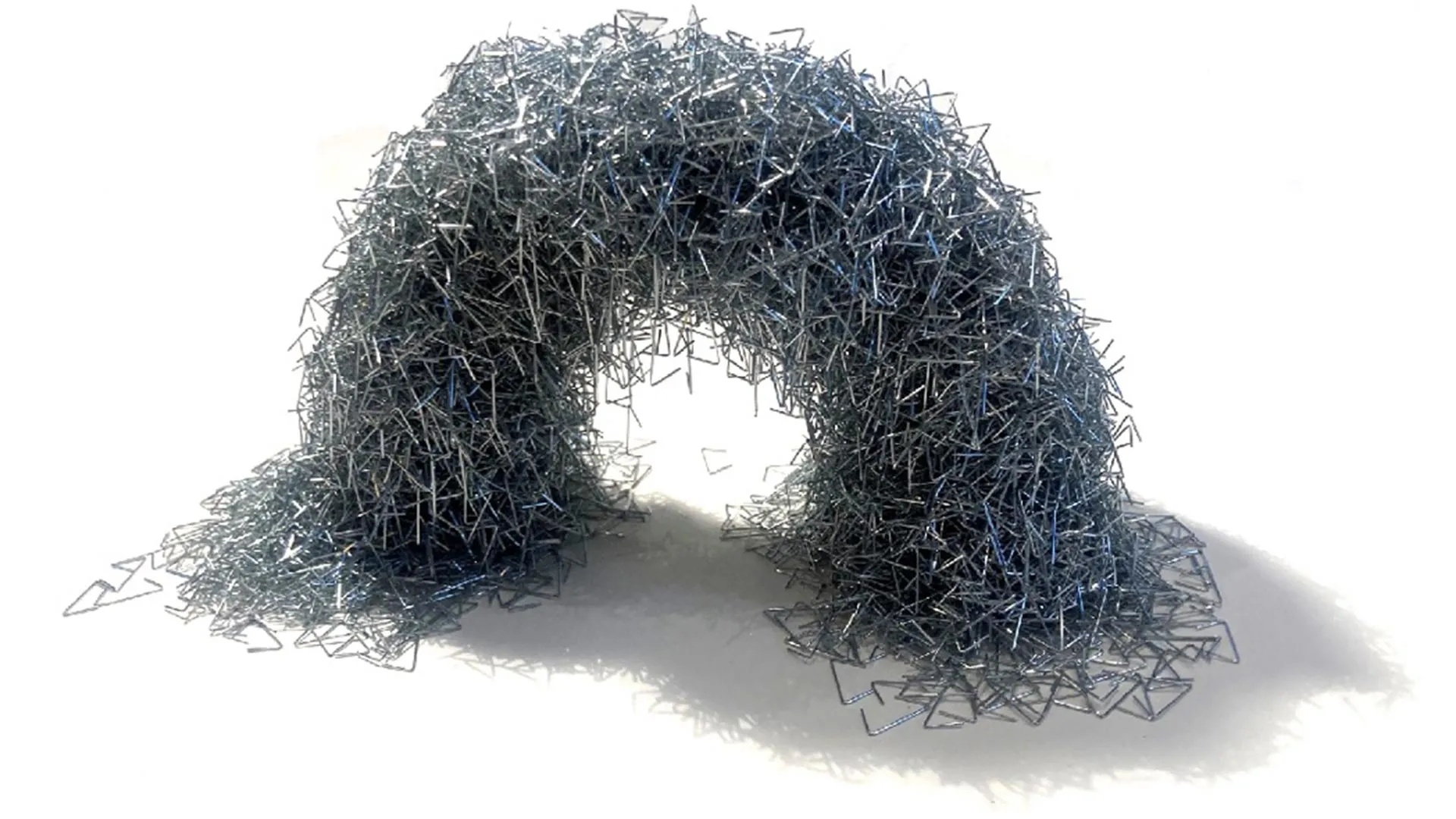
Researchers at the University of Colorado Boulder have uncovered a mechanical phenomenon that allows loose collections of U-shaped particles to transform from a fluid-like state into a rigid, high-strength solid. By studying the behavior of everyday office staples in high-compression environments, a team at the Paul M. Rady Department of Mechanical Engineering has identified a specific geometric blueprint for a new class of "entangled granular materials." These materials possess the rare ability to be exceptionally strong and tough while remaining entirely reversible, offering a potential paradigm shift for sustainable construction, aerospace engineering, and autonomous robotics.
The study, recently published in the Journal of Applied Physics, highlights how the simple geometry of a "two-legged" particle—resembling a standard staple—creates a complex network of physical hooks. Unlike traditional building materials like concrete or mortar, which rely on chemical adhesives to bond, these entangled materials derive their integrity from the mechanical interlocking of their constituent parts. This discovery marks a significant milestone in the field of soft matter physics and structural mechanics, suggesting that the shape of individual grains is just as important as the material they are made of.
The Science of Mechanical Entanglement
At the heart of this research is the concept of entanglement, a physical state where individual units become so intertwined that they cannot be separated without significant force. While entanglement is a well-known concept in polymer science and biology, applying it to macroscopic, manufactured particles is a relatively new frontier. Professor Francois Barthelat, lead researcher and head of the Laboratory for Advanced Materials & Bioinspiration, notes that the team has spent years exploring the geometry of building blocks, but only recently pivoted to the specific mechanics of interlocking granular systems.
In nature, entanglement is a fundamental survival strategy. Bird nests are perhaps the most visible example; they are constructed from hundreds of disparate twigs that, when woven together, form a resilient, load-bearing cradle. On a microscopic level, human bone structure utilizes a similar principle, where mineralized collagen fibers interweave to provide both rigidity and the ability to absorb impact. The CU Boulder team sought to replicate these natural efficiencies by moving away from "convex" particles, such as sand or gravel, which have smooth, rounded surfaces that slide past one another. Instead, they focused on "non-convex" shapes—geometries with indentations or protrusions that allow grains to hook into their neighbors.
Methodology: From Monte Carlo Simulations to Physical Testing
The research followed a rigorous chronological progression, beginning with computational modeling before moving to laboratory validation. To determine which shape would provide the optimal balance of strength and reversibility, the team utilized Monte Carlo simulations. This computational technique allowed the researchers to simulate the interactions of thousands of particles with varying geometries, testing how different "leg lengths" and "crossbar widths" affected the overall stability of a compressed mass.
The simulations revealed a clear winner: the "two-legged" staple shape. While more complex shapes were tested, the staple provided the most efficient ratio of interlocking capability to ease of assembly. Following the theoretical phase, PhD students Youhan Sohn and Saeed Pezeshki transitioned to physical "pickup tests." In these experiments, the researchers compressed bundles of 3D-printed staple-like particles and then measured the force required to pull the mass apart or lift it as a single unit.
The data indicated that the staple-shaped particles outperformed other geometries in two critical metrics: tensile strength (the ability to resist being pulled apart) and toughness (the ability to absorb energy before failing). In conventional materials science, strength and toughness are often mutually exclusive; a diamond is strong but brittle, while rubber is tough but weak. The entangled staple mass, however, demonstrated a unique synergy of both properties.
Reversibility and the Role of Vibration
One of the most transformative findings of the CU Boulder study is the role of vibration in controlling the material’s state. The researchers discovered that the entanglement of these particles is not a permanent condition but a tunable one. By applying specific frequencies of vibration, the team could dictate whether the material behaved like a solid or a liquid.
Low-amplitude, gentle vibrations acted as a catalyst for entanglement. These movements encouraged the particles to settle into one another, maximizing the number of contact points and "locking" the structure. Conversely, high-amplitude, vigorous vibrations provided enough kinetic energy to break the mechanical hooks, causing the "solid" mass to instantly dissolve into a pile of individual, pourable pieces.
This "switchable" nature addresses one of the primary challenges in modern engineering: the trade-off between permanence and recyclability. "It’s a strange material because it’s obviously not a liquid, yet it’s also not quite a solid," Professor Barthelat explained. This duality allows for the creation of structures that are incredibly stable during their service life but can be "de-constructed" on demand without the need for heavy machinery or chemical solvents.
Implications for Sustainable Construction and the Circular Economy
The construction industry is currently one of the world’s largest contributors to carbon emissions and landfill waste, largely due to the permanence of concrete. Once a concrete structure reaches the end of its life, it must be demolished, a process that is energy-intensive and results in material that is difficult to recycle into high-grade applications.
The CU Boulder research offers a blueprint for a "circular" approach to infrastructure. Future bridges, temporary housing, or industrial supports could be built using large-scale entangled particles. When the structure is no longer needed, a specific vibrational frequency could be applied, allowing the building blocks to be harvested, sorted, and reused in a new project with zero loss in material quality.
Furthermore, because the strength of the material is derived from geometry rather than chemical bonds, these particles could be manufactured from a wide range of recycled materials, including plastics, metals, or composite fibers. This would reduce the reliance on virgin resources and lower the overall carbon footprint of large-scale engineering projects.
Applications in Swarm Robotics and Shape-Shifting Technology
Beyond the world of civil engineering, the research has sparked significant interest in the field of robotics. PhD student Saeed Pezeshki noted that the technology aligns with the goals of "swarm robotics," where groups of small, independent robots work together to perform complex tasks.
In this scenario, individual robotic units could be designed with staple-like "limbs." When a task requires a solid tool—such as a bridge to cross a gap or a lever to move an object—the robots could entangle themselves into a rigid structure. Once the task is complete, they could disentangle and return to their individual states.
Professor Barthelat likened the concept to the "T-1000" liquid metal robot from the film Terminator 2, which could transition from a fluid state to a solid form to pass through obstacles. While the current research uses passive 3D-printed particles, the underlying physics provide the mathematical framework for active robotic systems that can change their mechanical properties in real-time.
Future Research: The "Burr" Design and Scaling Challenges
As the CU Boulder team moves into the next phase of their work, they are looking toward even more complex geometries. Their latest experiments involve particles with multiple protruding "legs," modeled after the "burrs" found on plants like the Burdock. These natural hooks are famously difficult to remove from fabric and fur because they utilize hundreds of tiny points of entanglement.
Early data suggests that these burr-like designs could create materials with exponential increases in tensile strength. However, the team also faces the challenge of scalability. While 3D printing is ideal for laboratory-scale experiments, mass-producing billions of precision-engineered staple particles for a bridge or a skyscraper would require new manufacturing techniques.
"It’s expensive, and scaling up is a challenge, but it’s something that’s on everybody’s mind," Barthelat admitted. The team is currently exploring injection molding and high-speed stamping as potential methods for industrial-scale production.
Conclusion: A New Frontier in Material Science
The research conducted at the Paul M. Rady Department of Mechanical Engineering represents a fundamental shift in how we perceive structural integrity. By proving that "entanglement" can be engineered and controlled through simple geometric changes, the CU Boulder team has opened the door to a future where materials are as adaptable as they are strong.
The ability to create reversible, high-performance structures has the potential to impact everything from disaster relief—where temporary shelters could be deployed and retracted rapidly—to space exploration, where deployable antennas and habitats must be packed tightly and then expanded into rigid forms. As the team continues to refine their designs and explore the limits of non-convex particle physics, the humble office staple may eventually be seen as the progenitor of a new era in sustainable and intelligent engineering.