From the humble garden fence framing a suburban backyard to monumental global landmarks like the Eiffel Tower in Paris and the Golden Gate Bridge in San Francisco, the relentless battle against weathering is a defining challenge of structural engineering and material science. Protective paint and specialized coatings are engineered to serve as the frontline defense against the elements, shielding underlying metals, woods, and masonry from premature decay. Yet, exposed surfaces inevitably succumb to the passage of time. For generations, scientists, architects, and industrial manufacturers have operated under the assumption that this degradation was driven by a well-understood duo of environmental culprits: mechanical stress and chemical erosion.
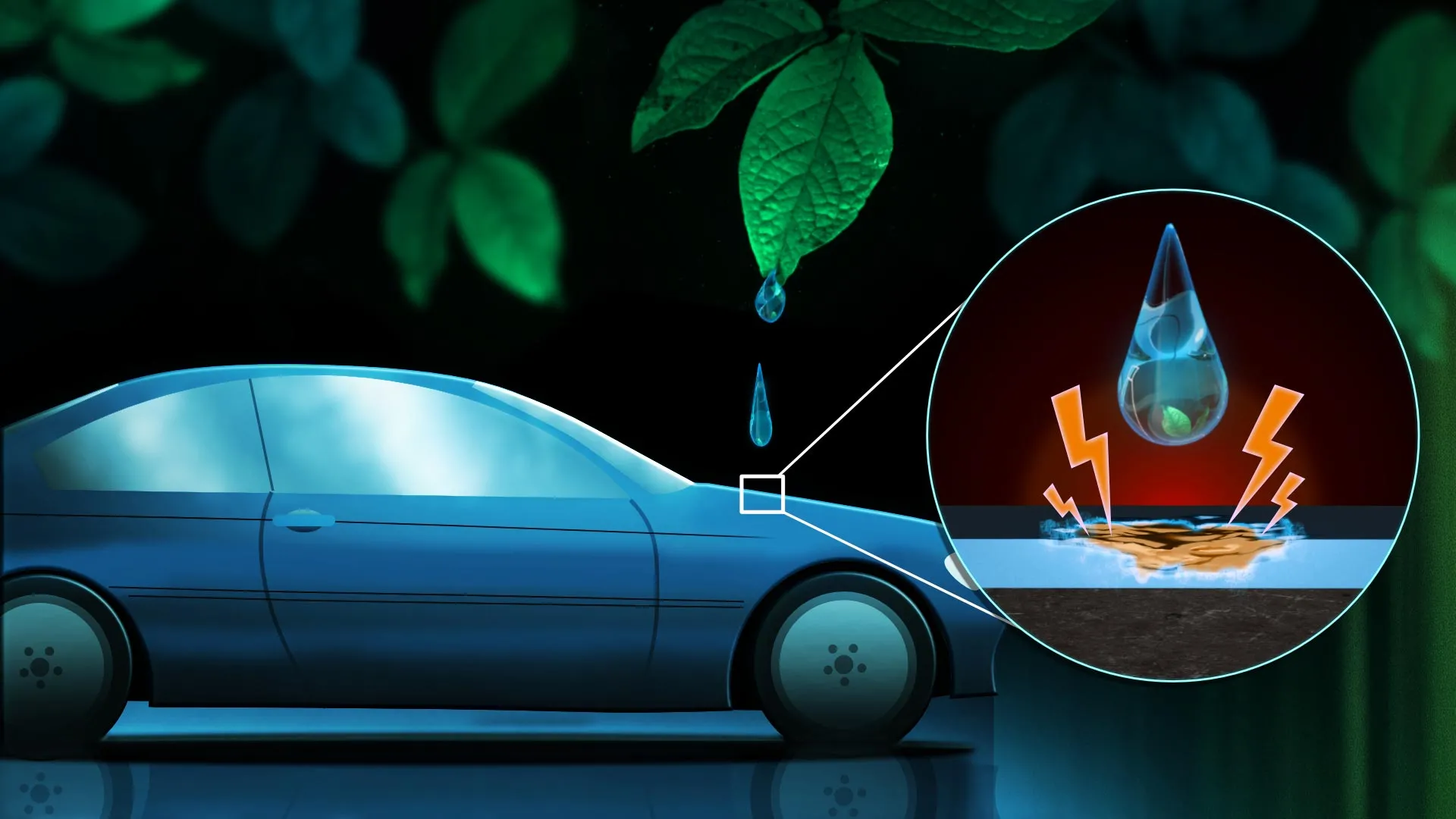
However, groundbreaking research published in the prestigious scientific journal Nature has upended decades of conventional wisdom. An international team of physicists and materials scientists has identified a previously unrecognized, highly destructive mechanism at play: the electrical charge carried by falling and sliding water droplets. Acting much like microscopic bolts of lightning, these charged droplets discharge upon impact, puncturing and systematically compromising protective layers at the molecular level. This revelation not only sheds light on a fundamental blind spot in surface physics but also paves the way for the next generation of weather-resistant materials.
Traditional Paradigms of Surface Erosion
To understand the significance of this new discovery, one must examine how science has historically categorized the wear and tear of protective coatings. For centuries, the deterioration of outdoor surfaces has been attributed primarily to two major processes: mechanical friction and chemical attack.
Mechanical stress occurs through the relentless bombardment of rain, hail, and wind-driven moisture. As water droplets repeatedly strike a coated surface, the kinetic energy and hydraulic pressures involved create micro-friction. Over millions of impacts, this continuous physical interaction gradually erodes the outer layers, causing microscopic pitting, micro-cracking, and eventual peeling.
Concurrently, chemical damage accelerates the process. Rainwater is rarely pure; atmospheric pollutants, industrial emissions, coastal sea salt, and organic acids from decaying vegetation turn moisture into a mild chemical corrosive. When these solutions settle into microscopic fissures in a coating, they react with the binding agents and pigments, breaking down chemical bonds and weakening the structural integrity of the protective barrier.
While these two forces account for a vast majority of observed surface weathering, they fail to fully explain anomalies where coatings degraded at rates or in patterns that defied mechanical and chemical models alone. The missing link, as researchers have now demonstrated, is electrostatic.
The Genesis of the Discovery: Friction Electricity in Liquids
The breakthrough was spearheaded by Hans-Jürgen Butt, director at the Max Planck Institute for Polymer Research in Mainz, Germany, in close collaboration with academic heavyweights including the University of Bonn, the South China University of Technology, the Massachusetts Institute of Technology (MIT), and Johannes Gutenberg University Mainz.
The research trajectory began several years prior, when the Max Planck team set out to investigate the fundamental physics governing how water droplets acquire electrical charges as they slide across various solid surfaces. In the field of physics, this phenomenon relates to triboelectrification—colloquially known as "friction electricity"—which is vastly more complex in liquids than it is between two solid objects.
"A few years ago, we investigated the physics behind how water droplets become charged as they slide surfaces," explains Rüdiger Berger, a group leader within the Physics at Interfaces department at the Max Planck Institute. "This is a kind of ‘friction electricity’ in droplets and is physically much more complex than previously assumed."
As a droplet moves across a surface—whether it is a leaf, a pane of glass, or an automobile hood—it interacts with microscopic surface charges, capturing ions and developing a net electrostatic charge. The Max Planck team realized that when these charged droplets subsequently detach and strike another surface, the sudden neutralization of that charge does not happen passively. Instead, it discharges locally and instantaneously, creating an electrostatic arc that acts on a micro-scale like a flash of lightning. This localized electrical discharge delivers a thermal and electrical shock to the coating, compromising its molecular structure at the exact point of impact.
Methodology and Empirical Testing: Simulating Rain
To rigorously test whether these minute electrical events could cause measurable physical harm, the researchers designed a controlled laboratory experiment capable of isolating electrostatic discharge from mechanical and chemical variables.
The team began with a pristine, uniformly applied surface of Teflon, a synthetic fluoropolymer universally recognized for its non-stick properties and resilience, commonly found on cookware and specialized industrial coatings. In the initial phase of the experiment, uncharged water droplets were systematically dropped onto the Teflon target. Even after 3,000 continuous impacts, advanced microscopic examinations revealed no discernible changes, scratches, or structural modifications to the Teflon coating.
Having established a baseline, the researchers altered the experimental setup. Before allowing the water droplets to strike the Teflon target, they directed them to roll across various common everyday materials, including natural houseplant leaves, polyvinyl chloride (PVC)—a common plastic used in construction—and polystyrene, the rigid polymer material frequently utilized in plastic window frames and insulation.
As the water droplets traversed these intermediate materials, they triboelectrically accumulated significant electrical charges. Once charged, the droplets were dropped onto the Teflon surface under identical physical conditions as the first trial.
The results were striking. After 3,000 impacts with the charged droplets, subsequent microscopic analysis revealed clear, quantifiable alterations not only in the protective Teflon surface itself but also in the underlying metal substrate. The electrical discharges had systematically weakened the protective barrier, allowing microscopic degradation to take root.
Material Variability and Charge Generation
A critical finding of the study was that the magnitude of the electrical charge acquired by a water droplet is heavily dependent on the chemical composition and micro-texture of the surface it traverses before impact.
"The charge a droplet acquires as it slides depends heavily on the specific surface—we measured differences of up to a factor of ten," notes Zhongyuan Ni, the study’s lead author.
Different materials donate or accept electrons at varying efficiencies based on their position in the triboelectric series. For instance, water sliding across a hydrophobic plant leaf accumulated a vastly different electrical profile compared to water sliding across rigid PVC or polystyrene. However, despite these wide variances in charge magnitude, a sobering commonality emerged across all trials: every single experiment involving charged droplets produced detectable, cumulative damage to the protective coating.
This universality suggests that virtually any surface exposed to rain will generate some degree of electrostatic charging, meaning that electrostatic micro-discharges are an omnipresent, albeit previously hidden, factor in global weathering processes.
Implications for Industrial and Cultural Infrastructure
The publication of these findings in Nature marks a paradigm shift in how material scientists view environmental degradation. By identifying electrostatic discharge as a third pillar of weathering alongside mechanical stress and chemical corrosion, the scientific community can now approach the design of protective coatings from a more holistic perspective.
The implications span a vast economic and infrastructural landscape. Industrial sectors that rely heavily on durable coatings stand to benefit immensely. For the automotive industry, where vehicle finishes must endure years of highway driving, rain, and automated car washes, understanding droplet-induced electrostatic wear could lead to paints that resist micro-pitting and maintain their gloss for decades.
Similarly, monumental architectural structures—such as suspension bridges, offshore wind turbines, skyscrapers, and historical maritime vessels—require multi-million-dollar maintenance programs centered entirely around repainting. If engineers can formulate coatings that dissipate electrical charges or insulate against micro-arcs, the frequency and cost of these massive maintenance undertakings could be substantially reduced.
Beyond modern industrial applications, the discovery holds profound value for the preservation of cultural heritage sites. Ancient stone monuments, outdoor sculptures, and historic wooden structures are exceptionally vulnerable to environmental weathering. Because traditional restorative treatments often focus solely on sealing out moisture chemically, they may have inadvertently left surfaces exposed to electrostatic damage. Armed with this new data, conservators can develop specialized anti-static sealants to safeguard priceless artifacts against the invisible threat of electrified rain.
Future Directions in Materials Science
In the wake of this discovery, research laboratories worldwide are already pivoting toward the development of advanced anti-static and charge-dissipating coatings. The primary goal is to engineer surfaces that either prevent water droplets from accumulating a charge during contact or possess dielectric properties capable of neutralizing micro-discharges before they can puncture the material boundary.
As climate patterns shift and extreme weather events become more frequent globally, the demand for resilient infrastructure has never been higher. By decoding the hidden physics of a falling raindrop, researchers at the Max Planck Institute and their international partners have unlocked a vital piece of the weathering puzzle, opening the door to a future where our most valued structures, vehicles, and homes remain protected against the elements for generations to come.