Researchers at the University of Basel and ETH Zurich have achieved a significant milestone in condensed matter physics by demonstrating a method to reverse the polarity of a specialized ferromagnet using a focused laser beam. This breakthrough, recently published in the journal Nature, marks a transition from traditional thermal-based magnetic manipulation to a sophisticated optical approach. By utilizing the unique properties of twisted quantum materials, the research team has opened the door to a future where electronic circuits can be designed, written, and reconfigured directly on a chip using light. The discovery bridges the gap between strong electronic interactions, topological states, and dynamical control, offering a new toolkit for the development of next-generation semiconductor technology and precision sensing.
The Mechanics of Ferromagnetism and the Thermal Barrier
To understand the significance of the Basel and Zurich discovery, one must first consider the fundamental principles of magnetism. Ferromagnetism arises from the collective behavior of electron spins within a material. Every electron possesses an intrinsic property known as "spin," which generates a microscopic magnetic field. In most materials, these spins point in random directions, effectively canceling each other out. However, in a ferromagnet, a substantial number of these spins align in a single direction. This coordinated alignment creates a macroscopic magnetic field strong enough to be used in applications ranging from simple refrigerator magnets to complex data storage drives.
The stability of this alignment is governed by the interaction energy between the spins. These interactions must be powerful enough to resist the disruptive influence of random thermal motion. Every ferromagnetic material has a specific threshold known as the Curie temperature. Below this temperature, the spins remain locked in alignment. Once the material is heated above this critical point, the thermal energy overcomes the magnetic interactions, causing the orderly arrangement to collapse into a state of disorder. Traditionally, to reverse the polarity of such a magnet, engineers must heat the material beyond its Curie temperature, allow the spins to become susceptible to external influence, and then cool the material in the presence of a new magnetic field to set a different orientation. This thermal requirement imposes significant limitations on the speed, energy efficiency, and miniaturization of magnetic devices.
The Breakthrough: Non-Thermal Laser Switching
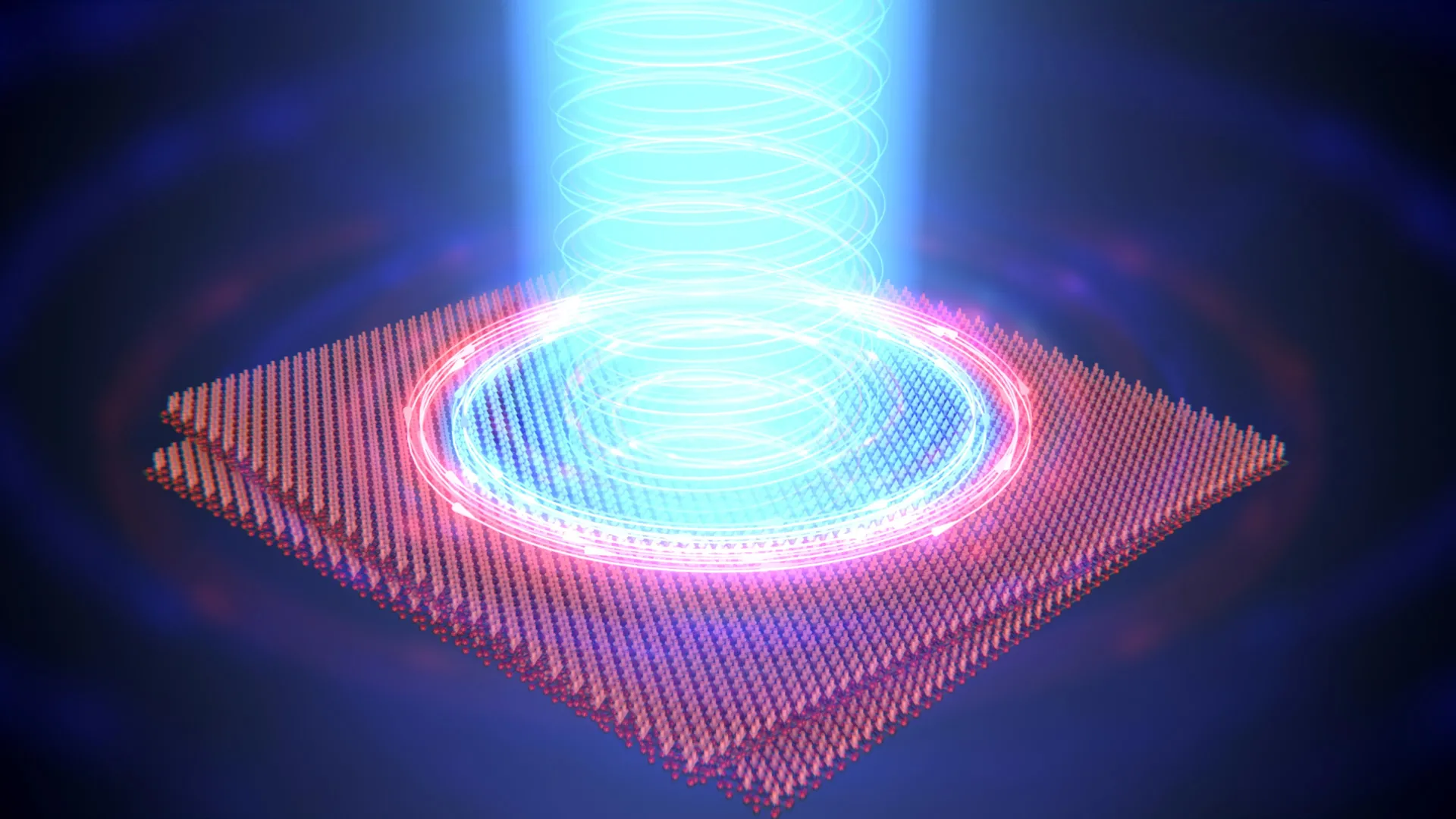
The collaborative effort led by Professor Dr. Tomasz Smoleński of the University of Basel and Professor Dr. Ataç İmamoğlu at ETH Zurich has successfully bypassed the thermal requirement. Their experiment demonstrates that a laser pulse can induce a collective reorientation of spins without necessitating a rise in the material’s temperature. This "cold" switching mechanism is inherently faster and potentially more energy-efficient than traditional methods.
The experiment utilized a specialized class of materials known as Transition Metal Dichalcogenides (TMDs), specifically molybdenum ditelluride (MoTe2). By stacking two atomically thin layers of this organic semiconductor and introducing a slight rotational misalignment—a "twist"—the researchers created a moiré superlattice. This twisted structure alters the electronic environment, allowing for the emergence of complex quantum states that are not found in naturally occurring crystals.
"What’s exciting about our work is that we combine the three big topics in modern condensed matter physics in a single experiment: strong interactions between the electrons, topology and dynamical control," Professor İmamoğlu stated. This synthesis of concepts represents a culmination of years of theoretical and experimental groundwork in the field of "twistronics."
Chronology of Development in Twisted Quantum Materials
The path to this discovery began in the early 2010s with the rise of two-dimensional materials research. While graphene was the first to gain prominence, the scientific community soon realized that TMDs like molybdenum ditelluride offered unique advantages, such as an inherent bandgap suitable for electronics.
- 2018: The Twistronics Revolution: The discovery of "magic-angle" twisted bilayer graphene demonstrated that rotating two layers of a 2D material could induce superconductivity and correlated insulating states. This launched the field of twistronics.
- 2020-2022: Exploring TMD Moiré Lattices: Researchers began applying the twistronics concept to TMDs. These materials were found to host "flat bands," where electron velocity slows down, making the interactions between electrons (Coulomb repulsion) much more influential than their kinetic energy.
- 2023: Identification of Topological States: Studies began to confirm that these twisted TMDs could host topological insulators, specifically Chern insulators, which exhibit the Quantum Anomalous Hall effect.
- 2024: The Basel-ETH Zurich Achievement: The current study successfully demonstrated the ability to use light to switch the magnetic polarity within these topological states, moving the field from observation to active dynamical control.
Topological States and the MoTe2 Architecture
The material at the heart of the experiment, molybdenum ditelluride, is engineered to exploit "topology." In physics, topology refers to properties of a system that remain unchanged even if the system is deformed. The researchers use the classic analogy of a ball and a doughnut: a ball can be squeezed into a pancake or stretched into a cigar, but it can never become a doughnut unless a hole is physically cut into it. Similarly, the electronic states in the MoTe2 moiré lattice are topologically distinct.
In the experiments overseen by Smoleński and İmamoğlu, the researchers were able to tune the system between different topological phases. By adjusting the electron density, they could transition the material from a topological insulator (which conducts electricity only along its edges) to a metallic state (where the entire bulk conducts). Crucially, in both of these phases, the interactions between electrons were strong enough to force their spins into a parallel, ferromagnetic alignment.
The researchers observed that the topology of the state directly influenced how the spins responded to light. "This switching was permanent and, moreover, the topology influences the switching dynamics," Smoleński explained. This indicates that the "hole in the doughnut" (the topological invariant) provides a level of stability and a specific pathway for the magnetic reversal that is absent in conventional materials.
Experimental Data and Verification
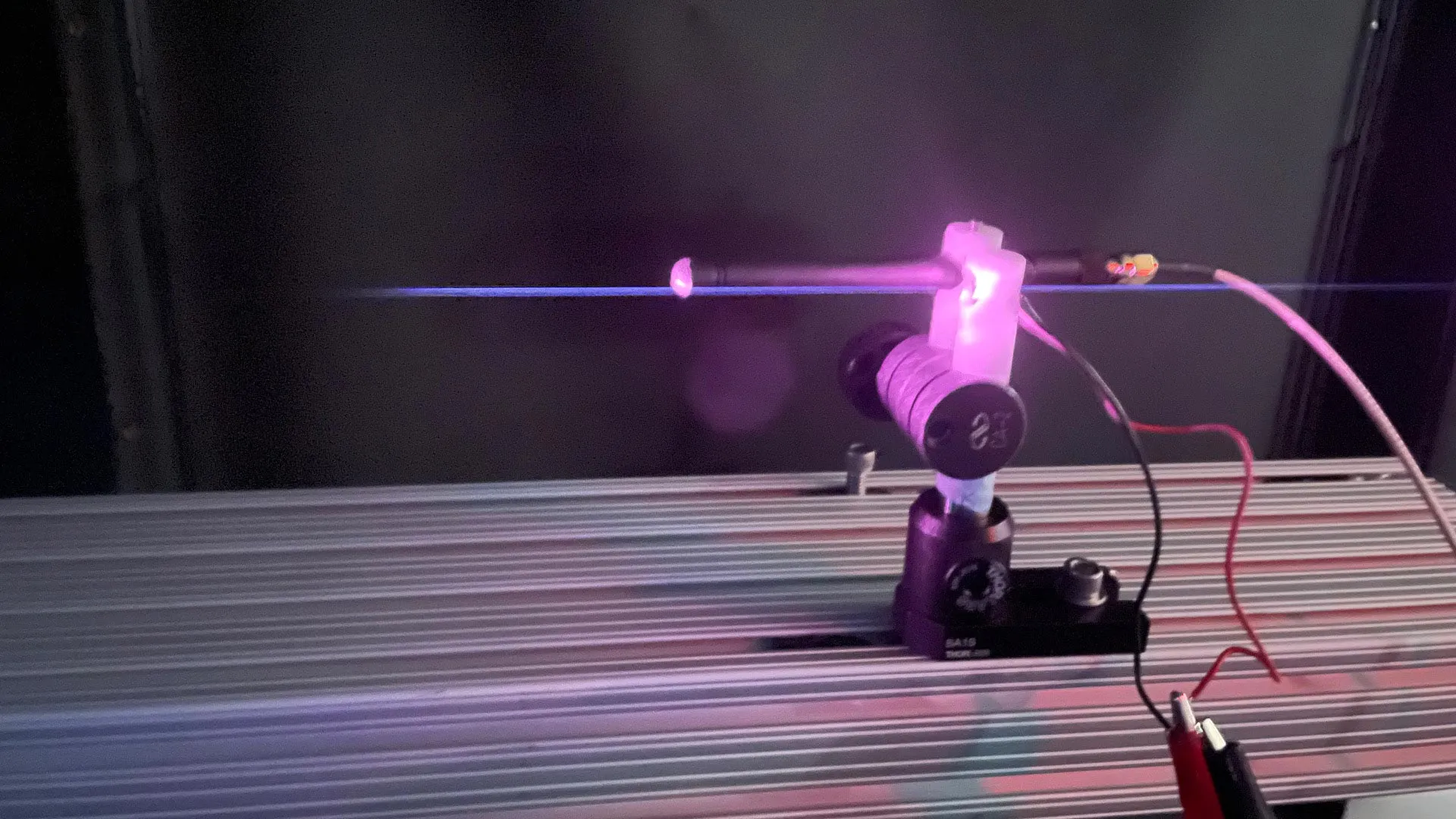
To verify the successful reversal of polarity, the team employed a sophisticated optical detection method. The primary "pump" laser was used to initiate the switching of the ferromagnet, which measured only a few micrometers in diameter. To confirm the result, a second, much weaker "probe" laser was directed at the material.
By analyzing the polarization of the reflected light from the probe laser—a technique based on the Magneto-Optical Kerr Effect (MOKE)—the team could determine the precise orientation of the electron spins. The data showed a clear, permanent flip in the magnetic signature following the pump laser pulse. This confirmed that the laser had not just temporarily disturbed the spins, but had successfully driven them into a new, stable collective orientation.
Key data points from the research include:
- Material Scale: The ferromagnets were microscopic, on the scale of several micrometers, suitable for integration into microchips.
- Persistence: The magnetic reversal remained stable after the laser was turned off, fulfilling the requirement for non-volatile memory or logic.
- Selectivity: The laser could be focused to specific areas, allowing for the creation of magnetic "domains" or boundaries within a single flake of material.
Official Responses and Scientific Impact
The scientific community has reacted with high interest to the findings. While earlier research had demonstrated that light could manipulate the spin of individual electrons or small clusters, the Basel-ETH Zurich study is among the first to show such control over a collective, macroscopic ferromagnetic state in a topological system.
Olivier Huber, a PhD student at ETH who conducted the measurements alongside Kilian Kuhlbrodt, emphasized the novelty of the achievement: "Our main result is that we can use a laser pulse to change the collective orientation of the spins." This shift from individual particle control to collective state control is a prerequisite for any practical application in computing.
Independent analysts suggest that this research validates the potential of "optical spintronics." By using light instead of electricity to move information, devices could theoretically operate at terahertz speeds with minimal heat dissipation. The fact that this occurs within a topological framework adds a layer of "fault tolerance," as topological states are notoriously resistant to local defects and impurities that usually plague semiconductor manufacturing.
Broader Implications: Reconfigurable Circuits and Precision Sensing
The long-term implications of this discovery extend far beyond basic physics. The ability to "write" magnetic and topological states onto a chip using light suggests a paradigm shift in how integrated circuits are manufactured and used.
1. Optically Programmable Hardware
Currently, the architecture of a computer chip is fixed at the factory. With the method developed by Smoleński and İmamoğlu, a "blank" chip of twisted MoTe2 could be reconfigured on the fly. A laser could define the pathways for electricity (the circuits) by creating boundaries between different topological regions. If a different circuit design is needed, the laser can simply "rewrite" the chip.
2. Advanced Quantum Sensing
The researchers pointed toward the development of miniature interferometers. These devices, which measure the interference of quantum waves, could be optically written onto MoTe2 chips to detect incredibly small electromagnetic fields. This has profound implications for medical imaging, materials science, and even fundamental physics research.
3. Spintronic Logic and Memory
By replacing traditional transistors with topological magnetic switches, the industry could move toward "spintronic" logic. This would allow for chips that do not lose information when power is removed and that require significantly less energy to operate, addressing the growing energy crisis in global data centers.
"In the future, we will be able to use our method to optically write arbitrary and adaptable topological circuits on a chip," Smoleński concluded. This vision of adaptable, light-driven hardware marks a significant step toward the next era of solid-state electronics, where the boundaries between light, magnetism, and electricity become increasingly fluid.