

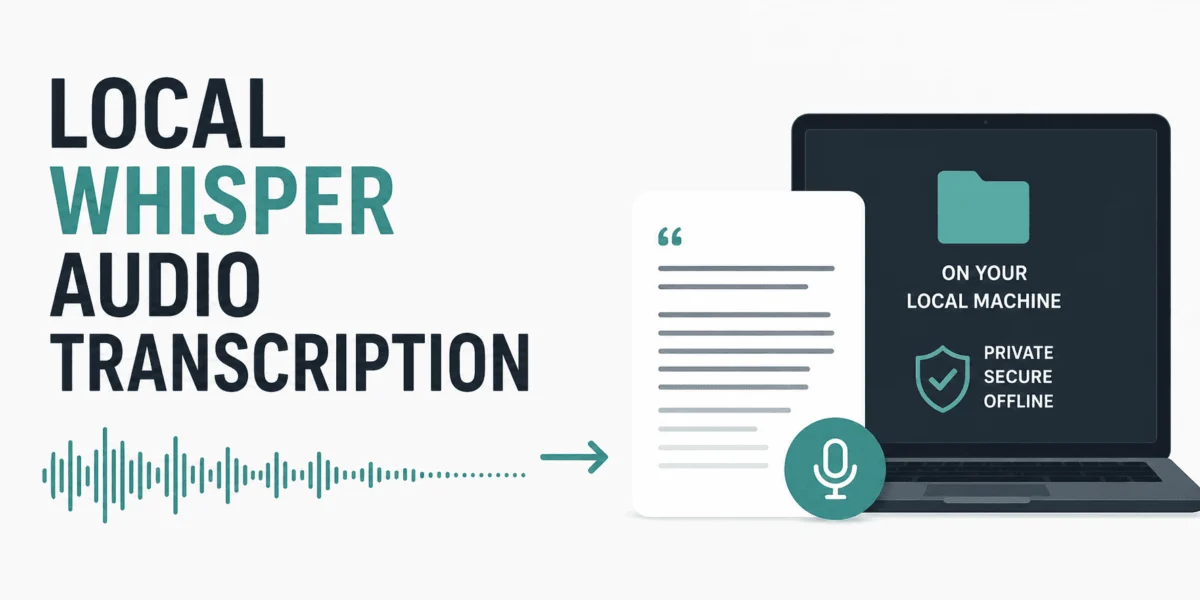
In a significant advancement for data privacy and operational efficiency, the development of robust, local audio transcription systems leveraging technologies like OpenAI’s Whisper and its optimized variant, Faster-Whisper, is democratizing access to high-accuracy speech-to-text capabilities. This paradigm shift allows individuals and organizations to process sensitive audio data directly on their own hardware, mitigating concerns over cloud-based data handling, reducing recurring costs, and offering unparalleled control over the transcription pipeline. The capability to convert spoken word into text—whether for meeting analyses, content captioning, or voice-controlled applications—has become a critical demand in the digital age, and the move towards local processing represents a pivotal evolution in meeting this need securely and economically.
The Evolution of Speech-to-Text Technology and the Advent of Whisper
Automatic Speech Recognition (ASR) has long been a cornerstone of human-computer interaction, evolving from rudimentary dictation software to sophisticated cloud-based APIs. Historically, achieving high accuracy in ASR required massive computational resources, often necessitating reliance on centralized cloud providers. These services, while powerful, inherently involve transmitting audio data to external servers, raising legitimate privacy concerns for sensitive information, such as medical consultations, legal depositions, or proprietary business meetings. Furthermore, the recurring costs associated with per-minute usage of cloud-based ASR can accumulate rapidly, posing a significant financial burden for high-volume users or smaller enterprises.
The landscape began to shift dramatically with the introduction of OpenAI’s Whisper model. Released as an open-source project, Whisper quickly garnered attention for its exceptional performance. Trained on an unprecedented dataset of diverse audio and text from across the internet, Whisper demonstrated remarkable accuracy across multiple languages, even contending with challenging conditions like background noise, varied accents, and complex terminology. Its multilingual capabilities and robust performance made it a benchmark for ASR models. However, the initial implementation of Whisper, while groundbreaking, presented practical challenges for local deployment. Running the full-scale model on standard consumer-grade CPUs could be computationally intensive and slow, often consuming significant memory and processing time, making real-time or high-volume local transcription impractical for many users. For instance, transcribing a 10-minute audio file using the original Whisper on a typical CPU might take upwards of 10-15 minutes, depending on the model size and hardware specifications.
Faster-Whisper: A Leap in Local Processing Efficiency
Recognizing the immense potential of Whisper but also its performance bottlenecks for local applications, the open-source community, particularly SYSTRAN, developed Faster-Whisper. This optimized variant addresses the core performance limitations by leveraging the CTranslate2 project, a fast inference engine for Transformer models. Faster-Whisper significantly improves processing speed and reduces memory footprint without compromising the transcription accuracy inherent to Whisper’s architecture. Benchmarks indicate that Faster-Whisper can be anywhere from 3 to 5 times faster than the original Whisper implementation on a CPU, and even more so when optimized for GPU acceleration. For example, the same 10-minute audio file that might take 10-15 minutes with original Whisper on a CPU can be transcribed in approximately 2 minutes with Faster-Whisper using a base model on a modern CPU, or even in mere seconds on a capable NVIDIA GPU. This substantial speedup transforms local transcription from a theoretical possibility into a practical reality for a wide range of applications.
This optimization is not merely about speed; it’s about accessibility and resource management. By reducing the computational demands, Faster-Whisper enables a broader array of devices—from standard laptops to modest servers—to perform high-quality transcription locally. This efficiency is crucial for developers building voice-to-text applications, researchers analyzing large audio datasets, or content creators needing quick, secure captions. The underlying technology behind Faster-Whisper ensures that the neural network operations are executed with maximum efficiency, making it a powerful tool for on-device AI inference.
Empowering Users: Unrivaled Privacy and Significant Cost Savings
One of the most compelling advantages of local transcription using Faster-Whisper is the inherent privacy it affords. In an era marked by heightened data security concerns and stringent regulations like GDPR and CCPA, processing sensitive audio data locally ensures that no information leaves the user’s controlled environment. This "on-premise" processing eliminates the risk of data breaches associated with third-party cloud services, providing a crucial layer of confidentiality for highly sensitive content. For sectors such as healthcare, legal services, finance, and government, where data sovereignty and patient/client confidentiality are paramount, this capability is not just a convenience but a necessity.
Beyond privacy, the economic implications are substantial. Cloud-based ASR services typically operate on a pay-as-you-go model, with costs often accumulating per minute of audio transcribed. For businesses or individuals with high transcription volumes, these costs can quickly escalate into hundreds or thousands of dollars monthly. By contrast, a local setup, after the initial investment in hardware (if upgrading is necessary) and electricity, incurs virtually no recurring transcription fees. This represents a significant cost reduction, democratizing access to advanced ASR technology for startups, small businesses, and independent developers who might otherwise be priced out of enterprise-grade cloud solutions. Analysts suggest that for organizations processing over 1,000 hours of audio annually, the transition to a local Faster-Whisper setup could lead to savings exceeding 80% compared to typical cloud API costs, with the initial setup investment often recouped within months.
Technical Implementation and Broad Accessibility
Setting up a local transcription system with Faster-Whisper is remarkably accessible, primarily requiring Python 3.8 or higher, making it cross-platform compatible with Windows, macOS, and Linux environments. The process typically involves installing the faster-whisper Python library and a foundational audio processing tool like FFmpeg, alongside the pydub library for Python. FFmpeg is essential for preprocessing audio files, as Whisper models are optimized for 16 kHz mono WAV format. Most real-world audio files (MP3, M4A, OGG) require conversion, a task pydub seamlessly handles by leveraging FFmpeg in the background. This ensures that diverse audio inputs can be uniformly prepared for transcription.
For enhanced performance, especially when dealing with longer audio files or batch processing, Faster-Whisper supports NVIDIA GPUs through CUDA. This optional but highly recommended setup for performance-critical applications requires installing relevant NVIDIA drivers, cuBLAS, and cuDNN. However, the system is designed to gracefully fall back to CPU processing if a compatible GPU setup is not detected, ensuring broad accessibility regardless of advanced hardware availability. This flexibility allows users to scale their transcription capabilities based on their specific needs and available resources, from casual users on laptops to professionals with dedicated workstations.
Industry Reactions and Broader Implications
The emergence of efficient local ASR solutions like Faster-Whisper has been met with considerable enthusiasm across various sectors. Developers are leveraging its capabilities to build innovative applications, from offline voice assistants and personal transcription tools to secure internal communication analysis platforms. Privacy advocates commend the technology for empowering users with greater control over their data, aligning with a broader movement towards ethical AI and decentralized data processing. Small and medium-sized businesses, previously constrained by cloud costs, are now exploring in-house transcription solutions, which can significantly streamline workflows in areas like customer service, content creation, and internal documentation.
The broader implications extend to democratizing access to advanced AI. By making high-quality ASR readily available on standard hardware, these tools lower the barrier to entry for innovation. Educational institutions can use it for lecture transcription, media outlets for rapid content indexing, and legal firms for secure, in-house deposition processing. The ability to customize models, fine-tune them with specific terminology, and integrate them directly into existing software ecosystems without external API calls opens up a new frontier for bespoke AI solutions. This trend signifies a move towards more distributed, resilient, and user-centric AI systems, shifting power from centralized cloud providers to individual users and local enterprises.
Challenges and Future Outlook
While the advancements are significant, some challenges remain. The initial setup, particularly for GPU acceleration, can still pose a learning curve for less technically inclined users. Furthermore, while CPU performance is vastly improved, transcribing extremely long audio files (e.g., multi-hour recordings) in near real-time still often benefits significantly from dedicated GPU hardware. The memory footprint, though optimized, can still be substantial for the largest Whisper models, especially when handling multiple simultaneous transcription tasks.
Looking ahead, the trajectory for local ASR is bright. Ongoing research focuses on further model quantization and optimization techniques to reduce both size and computational demands, making these powerful AI models even more accessible to edge devices. Integration with other local AI capabilities, such as speaker diarization (identifying different speakers in an audio file) using tools like pyannote.audio or building user-friendly interfaces with Gradio or Streamlit, will further enhance the utility and ease of use of these local transcription systems. The continuous drive towards more efficient, privacy-preserving, and cost-effective AI solutions underscores a future where sophisticated machine learning capabilities are not just for large corporations but are a standard tool available to everyone.
In conclusion, the advent of efficient local audio transcription through OpenAI’s Whisper and its optimized Faster-Whisper variant marks a pivotal moment in the evolution of AI. By prioritizing privacy, dramatically reducing costs, and offering robust performance on local hardware, these technologies are transforming how individuals and businesses interact with and leverage speech-to-text capabilities, paving the way for a more secure, accessible, and democratized AI landscape.













Leave a Reply