In a milestone achievement for both quantum computing and high-energy physics, an international research collective led by the Duke Quantum Center (DQC) has successfully utilized a programmable quantum simulator to observe the complex dynamics of string breaking. Published on September 23 in the prestigious journal Nature Physics, this experiment provides a pioneering window into the birth of matter from pure energy, bridging the gap between theoretical subatomic physics and tangible laboratory observation. By manipulating a chain of trapped ions, the scientists were able to recreate conditions traditionally reserved for particle accelerators like the Large Hadron Collider or the violent, high-energy epochs immediately following the Big Bang.
The Main Facts and Experimental Breakthrough
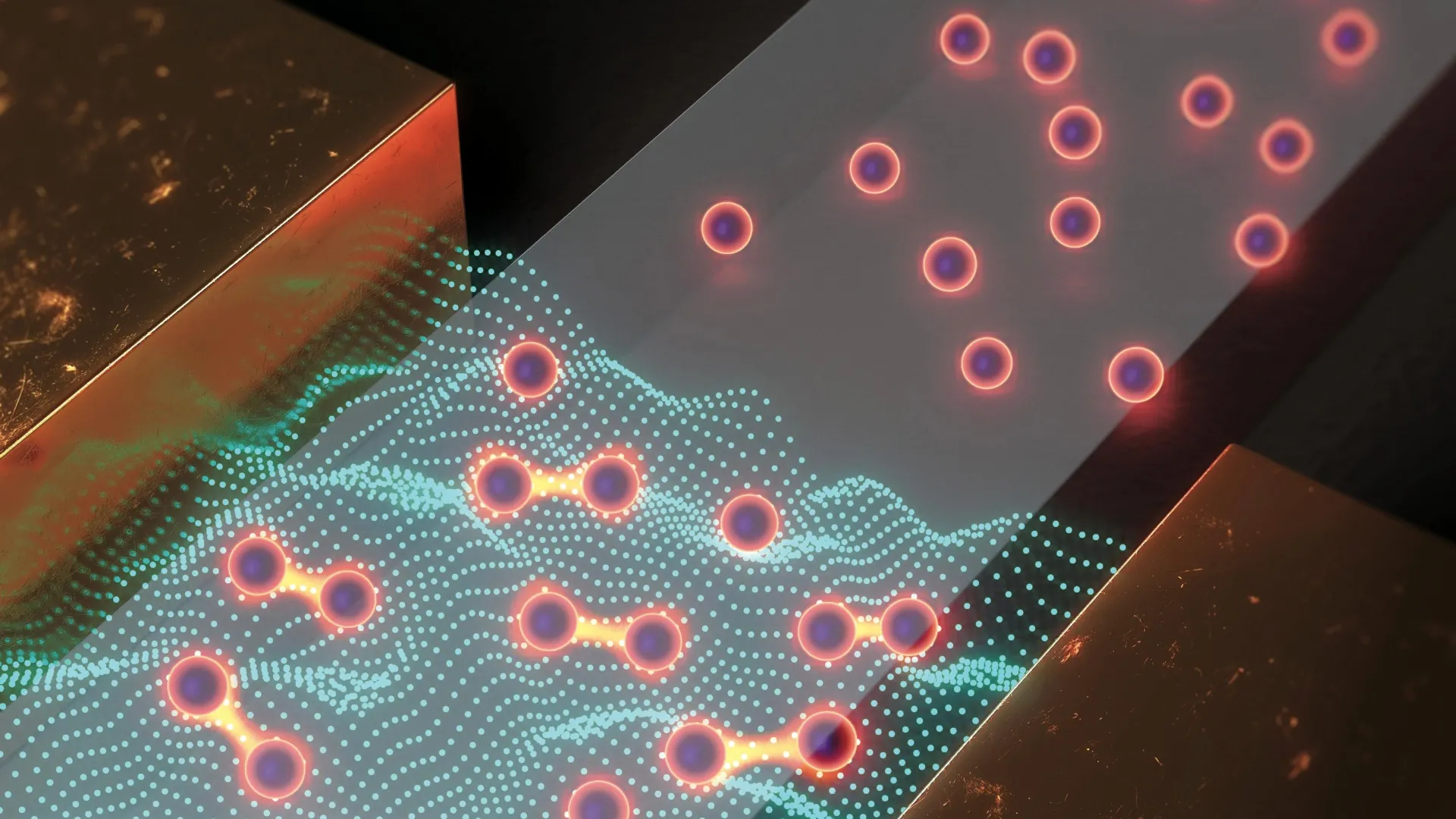
At the heart of the research is the phenomenon known as string breaking, a fundamental process linked to quark confinement. Quarks, which are the elementary constituents of protons, neutrons, and other hadrons, are roughly a billion times smaller than a single atom and possess the unique property of never being found in isolation. Under standard terrestrial conditions, the strong force binding quarks together behaves like an elastic string; as two quarks are pulled apart, the potential energy stored within the connecting flux tube increases proportionally with distance.
According to Albert Einstein’s mass-energy equivalence principle, encapsulated in the equation $E=mc^2$, this escalating accumulation of energy eventually reaches a critical threshold. Rather than stretching infinitely, the energy concentrated in the string spontaneously converts into mass, causing the original connection to snap and new particle-antiparticle pairs to materialize out of the vacuum.
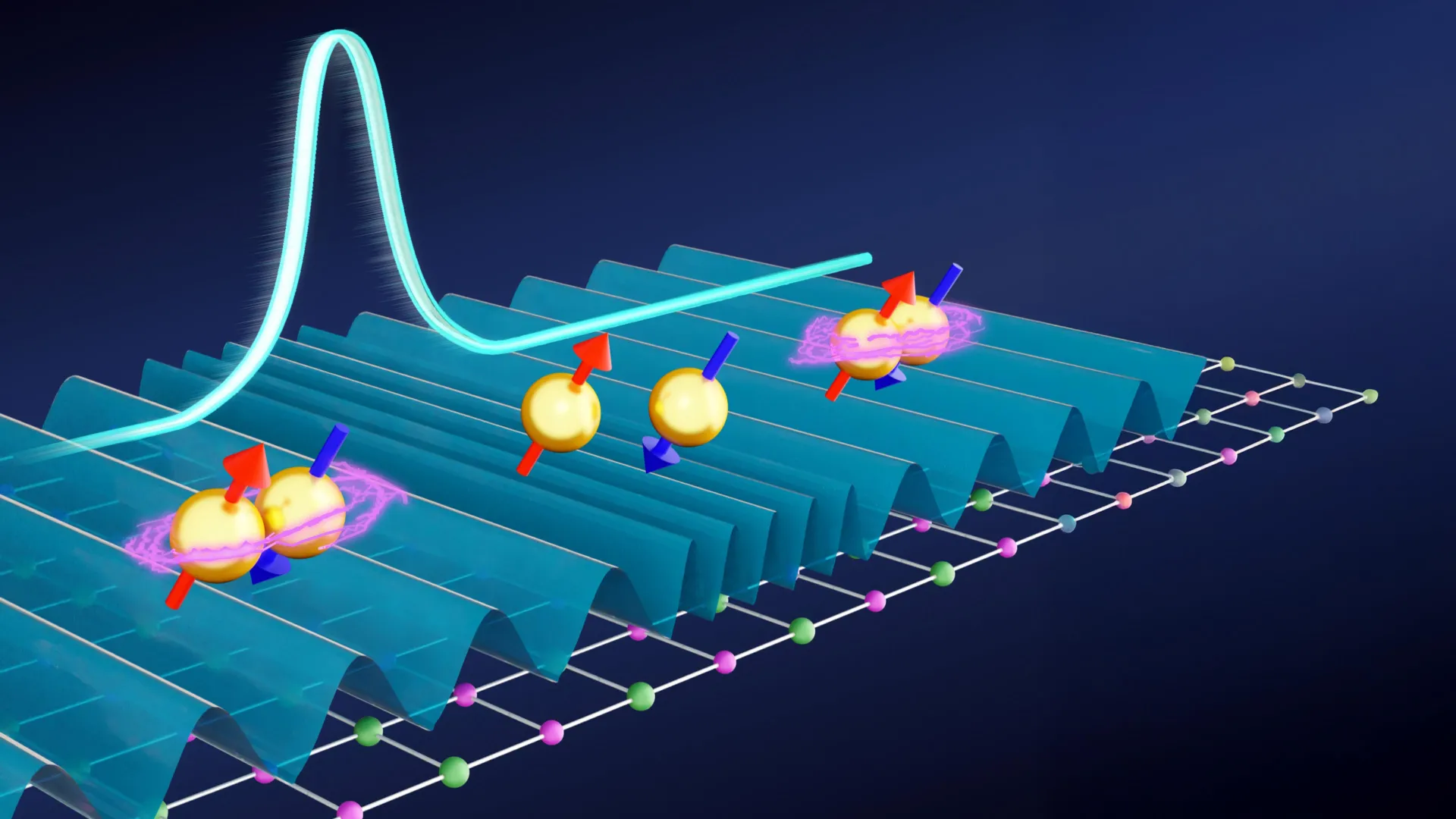
To model this elusive mechanism, the research team—comprising physicists from Duke University, the University of Maryland (UMD), Oxford University, the California Institute of Technology, Cornell University, and KU Leuven—encoded a theoretical string-breaking model onto a quantum hardware architecture. Using precisely calibrated laser beams directed at a linear chain of 13 trapped ions, the researchers dynamically tuned the interactions between individual quantum bits. This fine-grained control allowed them to replicate the precise energetic tipping point where a confining string snaps, giving birth to effective charges and yielding direct empirical data on out-of-equilibrium subatomic mechanics.
Chronology and Collaborative Development
The publication of these findings represents the culmination of years of collaborative theoretical development and hardware refinement. The foundational concepts underpinning quantum simulation of high-energy physics began to take serious shape in the academic sector during the late 2010s, as trapped-ion and neutral-atom platforms transitioned from rudimentary logical gates to scalable processors.
By 2021 and 2022, theoretical frameworks linking lattice gauge theories to atomic physics enabled researchers to map complex quantum chromodynamics (QCD) problems onto hardware-friendly spin models. The experimental phase at the Duke Quantum Center intensified over the subsequent years, culminating in the data collection and verification protocols finalized in mid-2024.
Significantly, the Duke-led release coincided with parallel breakthroughs from competing research groups utilizing entirely different quantum computing paradigms. Teams spearheaded by Google and QuEra Computing independently reproduced related string-breaking and confinement models using superconducting circuits and neutral-atom arrays, respectively. The near-simultaneous publication of these three distinct hardware demonstrations marks a watershed moment for the quantum computing community, providing an immediate cross-platform benchmark that validates the fidelity and reliability of modern noisy intermediate-scale quantum (NISQ) devices.
Supporting Data and Technical Validation
To ensure the physical validity of their quantum simulation, the Duke-led team implemented rigorous verification protocols. Because the scale of the current simulation involved 13 trapped ions, the researchers were able to compute the identical theoretical models using classical high-performance supercomputers. A direct comparison between the quantum simulator’s trajectory and the classical computational output revealed a high degree of concordance, confirming that the trapped-ion platform accurately tracked the system’s out-of-equilibrium evolution without succumbing to systematic hardware errors.
Funding and institutional backing played a critical role in realizing the technical complexity of the experiment. The research received substantial financial grants from the United States Department of Energy—specifically under awards DE-SC0020312, DE-SC0025341, DESC0019040, DE-SC0024220, and DE-SC0020271—alongside contributions from the National Science Foundation (OMA-2120757), the Air Force Office of Scientific Research, the Defense Advanced Research Projects Agency (DARPA), and Amazon Web Services (AWS). These resources enabled the acquisition and maintenance of ultra-stable laser systems and vacuum chambers required to maintain the fragile quantum states of the trapped ions over extended experimental runs.
Official Responses and Perspectives from the Research Team
The implications of the study have drawn enthusiastic commentary from the principal architects of the collaboration, who emphasize the dual utility of quantum devices as both computational engines and physical laboratories.
"Quantum computer simulations provide the best platform to investigate complex questions like matter formation, short of having witnessed the Big Bang itself," said Christopher Monroe, the Gilhuly Family Presidential Distinguished Professor of Electrical and Computer Engineering and Physics at Duke University, who led the research initiative. Monroe highlighted the competitive yet collaborative nature of the recent breakthroughs across the industry, noting that the converging results from trapped ions, superconducting circuits, and neutral atoms establish a robust foundation for the field.
Arinjoy De, the first author of the Nature Physics study, former doctoral candidate in Monroe’s laboratory, and current production machine lead at QuEra Computing, underscored the conceptual leap of bringing high-energy physics down to the atomic scale. "Working at the intersection of quantum simulation and high-energy physics is incredibly exciting," De remarked. "By simulating quark confinement and string-breaking phenomena in a controlled lab environment, we’re opening up new pathways for experimental investigations into the behavior of matter at its most fundamental level."
Echoing these sentiments, theoretical physicist Zohreh Davoudi, an associate professor of physics at the University of Maryland and a key member of the collaborative team, pointed toward the broader cosmological horizons unlocked by the research. "As a physicist, it is incredibly exciting to investigate the conditions of the early universe in an atomic-level computing machine," Davoudi stated. "Even the slightest insights from an out-of-equilibrium physics model will guide us in the future."
Broader Impact and Implications for Future Physics
The successful simulation of string breaking by the Duke Quantum Center and its international partners signals a paradigm shift in how physicists approach problems that are experimentally inaccessible via conventional instrumentation. While particle accelerators such as the Large Hadron Collider at CERN remain indispensable for high-energy collisions, they are inherently limited when it comes to observing continuous out-of-equilibrium field dynamics in real time.
Quantum simulators offer a controllable, highly tunable alternative where parameters can be adjusted at will, allowing scientists to probe regimes of nature that exist outside standard laboratory bounds. As quantum hardware scales upward in qubit count, gate fidelity, and coherence time, classical supercomputers will eventually be rendered obsolete for these specific lattice gauge calculations.
Looking forward, the roadmap outlined by this research points directly toward simulations of nuclear matter under extreme densities, the internal dynamics of neutron stars, and the subtle quantum fluctuations that dictated the asymmetry of matter and antimatter in the primordial universe. By transforming abstract theoretical equations into observable quantum motion, researchers have taken a decisive step toward unlocking the deepest structural secrets of the cosmos.