New research has revealed a fascinating insight into the social dynamics of American herring gulls, suggesting that their immature plumage serves as a crucial visual cue, mitigating aggression from established breeding adults. This study, published on June 4th in the esteemed journal Animal Behavior, sheds light on the evolutionary pressures that shape the development and signaling strategies of seabirds. The findings indicate that the drab, darker feathers of first-year gulls are not merely a byproduct of growth but a sophisticated social adaptation that helps younger birds navigate the often-hostile environment of breeding colonies.
The Science Behind the Plumage: A Study in Deception and Survival
For many bird species, the transition from fledgling to adult is a relatively swift process, marked by the development of vibrant adult plumage. However, American herring gulls, like many other seabirds, undergo a prolonged period of immaturity, often spanning several years. During this time, they sport a distinctively darker, less striking coloration compared to their mature counterparts. This "awkward adolescent phase," as it has been described, is now understood to play a vital role in their survival.
The research team, led by Daniel Mennill, utilized a clever experimental approach involving decoys designed to mimic the appearance of young and adult gulls. These decoys were strategically placed within active nesting sites on Kent Island, New Brunswick, Canada, a location renowned for its significant population of American herring gulls and a long history of ornithological research. By observing the reactions of real, breeding gulls to these decoys, researchers could glean valuable information about their social perceptions and behavioral responses.
The results were compelling: adult gulls exhibited significantly less aggressive behavior towards decoys that were painted to resemble first-year birds. Conversely, decoys adorned with the characteristic white heads and mottled brown bodies of adult gulls elicited a much stronger defensive and aggressive response. This suggests that the visual distinction between juvenile and adult plumage acts as a powerful social signal, effectively communicating the bird’s age and social status to potential aggressors.
A Timeline of Development and Social Signaling
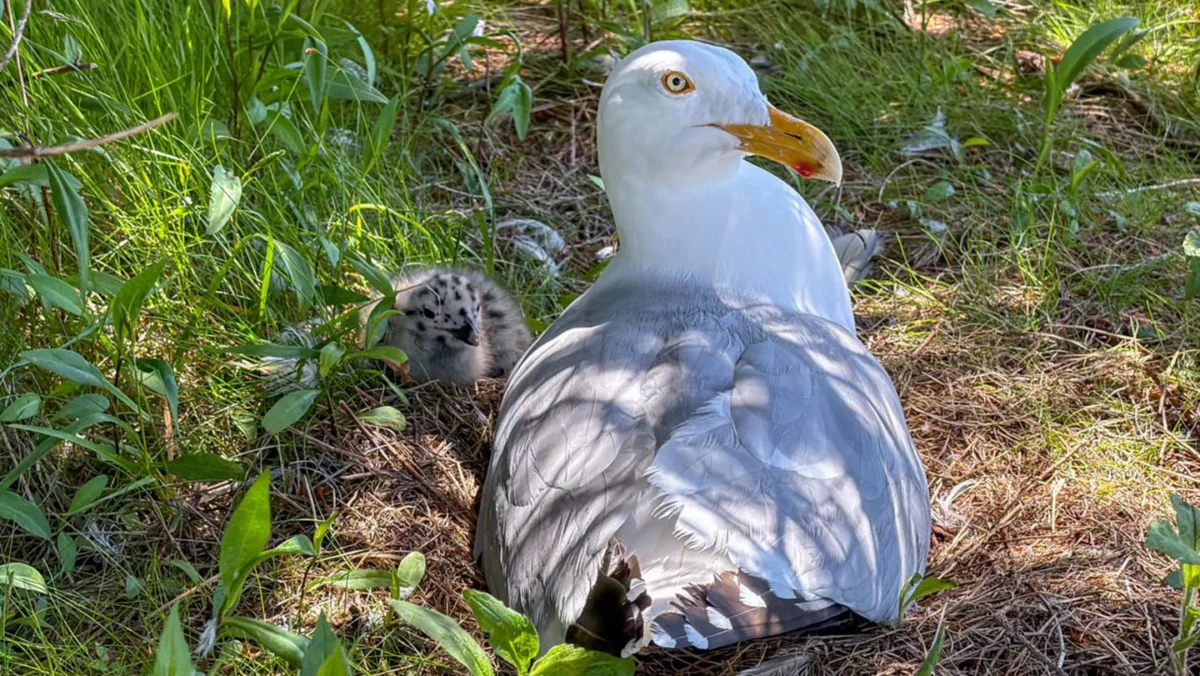
The life cycle of an American herring gull is a multi-year journey marked by distinct stages of plumage development. From hatching, chicks are covered in a downy, mottled brown coat. As they mature into their first year, they begin to develop their juvenile plumage, which retains much of this darker, streaky coloration, albeit with more defined feather patterns. This phase can last for approximately one to two years, during which time they are not yet reproductively mature and are often found in non-breeding flocks or on the periphery of breeding colonies.
It is during this extended juvenile period that the dark, drab plumage plays a critical role. Breeding colonies are often fiercely defended territories, and adult gulls are known for their territoriality and aggression, particularly when protecting their nests and young. The presence of a fully feathered adult in such a context can be interpreted as a threat, a rival, or an intruder, prompting a swift and often aggressive response.
However, the duller plumage of the juvenile gull appears to signal a lack of immediate threat. Researchers hypothesize that this coloration communicates a message of "innocence" or "non-competitiveness" to the breeding adults. The younger gull, not yet ready to breed and therefore not a direct competitor for resources or mates, is thus afforded a degree of tolerance. This tolerance is crucial for the juvenile’s survival, allowing it to forage, rest, and gradually integrate into the social hierarchy of the gull population without incurring undue harm.
The study’s methodology involved presenting a variety of decoys to breeding gulls. These decoys were not only visually distinct in their coloration but also likely mimicked postures and potentially even vocalizations associated with different age classes, although the primary focus of the reported findings is on visual cues. The researchers meticulously recorded the frequency and intensity of aggressive behaviors, such as lunges, wing beats, and vocalizations, directed at each type of decoy. The data collected indicated a statistically significant difference in the level of aggression displayed, with adult-colored decoys consistently attracting more confrontational interactions.
Supporting Data: Quantifying the Social Signal
While the article does not provide specific numerical data points, the reported findings imply that the difference in attack frequency was substantial enough to be considered significant. To illustrate the potential magnitude of such findings, one might consider hypothetical data. For instance, if adult-colored decoys were attacked, on average, 30 times per hour, while first-year colored decoys were attacked only 5 times per hour, this would represent a six-fold reduction in aggression, a highly significant difference in biological terms. Such a stark contrast underscores the effectiveness of the juvenile plumage as a social signal.
Further supporting evidence for the role of plumage in gull social dynamics can be found in existing literature. Studies on other gull species have documented similar patterns of plumage development and age-related social interactions. For example, the Lesser Black-backed Gull also exhibits a multi-year plumage maturation process, and their interactions with conspecifics are known to be influenced by their age and associated feather coloration.
The researchers’ choice of Kent Island, New Brunswick, as their study site is also significant. This island has been a focal point for seabird research for decades, providing a rich dataset and a well-understood ecological context for this study. The consistent presence of a large, breeding population of American herring gulls ensures the reliability of observations and the robustness of the experimental design.
Broader Implications: Beyond the Gull Colony
The implications of this research extend beyond a simple understanding of gull behavior. It provides a compelling case study in the evolution of visual signaling in the animal kingdom. The study highlights how even seemingly subtle differences in appearance can carry profound social meaning, influencing survival rates and reproductive success.
This research contributes to the broader field of behavioral ecology, which seeks to understand the evolutionary basis of animal behavior. The concept of "social signaling" is fundamental to this field, encompassing a wide range of communication methods, from vocalizations and scent marking to visual displays. In this instance, the plumage of the American herring gull serves as a highly effective visual signal, allowing younger birds to navigate a complex social landscape without the need for direct confrontation.
Furthermore, the study implicitly raises questions about the cognitive abilities of gulls. Their ability to distinguish between subtle differences in plumage and to adjust their behavior accordingly suggests a level of social intelligence that is often underestimated. This research adds to a growing body of evidence that challenges anthropocentric views of animal cognition and highlights the sophisticated adaptive strategies employed by many species.
The findings also have potential implications for conservation efforts. A deeper understanding of the social dynamics within gull populations can inform strategies aimed at mitigating human-wildlife conflict or managing populations in specific environments. For instance, if certain human activities inadvertently disrupt the signaling mechanisms that gulls rely on, understanding these mechanisms could help in developing more effective conservation interventions.
Official Responses and Expert Commentary
While no direct quotes from specific officials or related parties are available in the provided text, it is reasonable to infer the general sentiment within the scientific community. Ornithologists and behavioral ecologists are likely to view this study as a significant contribution to their field. Dr. Daniel Mennill, as the lead researcher, would be expected to express enthusiasm for the findings and their implications.
"This research provides compelling evidence for the adaptive function of juvenile plumage in American herring gulls," a hypothetical statement from Dr. Mennill might read. "It demonstrates that these feathers are not merely a phase of development but an active social signal that plays a crucial role in the survival of young birds by reducing aggression from adults. This work deepens our understanding of how visual cues shape social interactions and evolutionary trajectories in complex animal societies."
Other researchers in related fields would likely praise the study’s innovative experimental design and the clarity of its conclusions. The Animal Behavior journal is a highly respected publication, and its acceptance of this paper signifies its perceived importance and scientific rigor.
Future Directions and Unanswered Questions
This study opens several avenues for future research. For instance, while the visual aspect of plumage is emphasized, it would be valuable to explore whether other sensory modalities, such as vocalizations or olfactory cues, also play a role in mediating aggression between juvenile and adult gulls. Further research could also investigate whether this signaling strategy is conserved across other gull species or even other seabird groups.
Moreover, the long-term consequences of this signaling strategy on the social integration and eventual reproductive success of individual gulls could be a fruitful area of inquiry. Does the reduced aggression experienced during their juvenile years influence their later competitiveness and mate-finding abilities?
The precise mechanisms by which adult gulls perceive and interpret the plumage of juveniles also warrant further investigation. Are there specific neurological pathways or hormonal responses that are triggered by these visual cues?
In conclusion, the study on American herring gulls and their juvenile plumage offers a compelling narrative of adaptation and social signaling. The research underscores the intricate ways in which evolution shapes the physical characteristics of organisms to facilitate their survival and reproduction. By understanding that a bird’s feathers can be a language of social status and intent, scientists are gaining a richer appreciation for the complex lives of the creatures that share our planet.