The global effort to mitigate climate change has reached a critical juncture as atmospheric carbon dioxide (CO2) levels continue to hover at record highs, necessitating more efficient Carbon Capture and Storage (CCS) technologies. While the scientific community has long identified CCS as a cornerstone of the transition to a net-zero economy, the practical implementation of these systems has been historically hampered by high energy requirements and prohibitive operational costs. Current industrial standards rely heavily on liquid-based absorption methods that, while effective at trapping gases, require immense amounts of energy to release the captured carbon for storage or utilization. A breakthrough from a research team at Chiba University in Japan may provide the solution to this thermodynamic bottleneck. By developing a new class of "designer" carbon materials known as viciazites, researchers have demonstrated a method to capture and release CO2 at significantly lower temperatures, potentially unlocking the use of industrial waste heat to power the process.
The Thermodynamic Challenge of Modern Carbon Capture
To understand the significance of the Chiba University study, one must first examine the limitations of existing Carbon Capture and Storage (CCS) infrastructure. For decades, the gold standard for industrial carbon removal has been aqueous amine scrubbing. This process involves passing flue gas—the exhaust from power plants and factories—through a liquid solution containing amines, which are organic compounds derived from ammonia. The amines react chemically with the CO2, effectively "scrubbing" it from the emission stream.
However, the "regeneration" phase of this process is where the efficiency drops. To detach the CO2 from the liquid so the amine solution can be reused, the entire volume of liquid must be heated to temperatures exceeding 100 degrees Celsius, and often as high as 120 to 150 degrees Celsius. This phase, known as desorption, consumes a massive portion of a power plant’s total energy output—sometimes as much as 30%. This energy penalty not only increases the cost of electricity but also limits the scalability of carbon capture in regions where energy resources are already strained.
Furthermore, liquid amine systems face logistical hurdles. The solutions are often corrosive to the metal piping and tanks used in industrial plants, leading to high maintenance costs. They also tend to degrade over time, losing their efficacy and producing volatile byproducts that require careful disposal. These factors have led researchers to explore solid-state adsorbents, particularly carbon-based materials, which are cheaper, more durable, and have a high surface area for gas interaction.
The Limitations of Traditional Solid Adsorbents
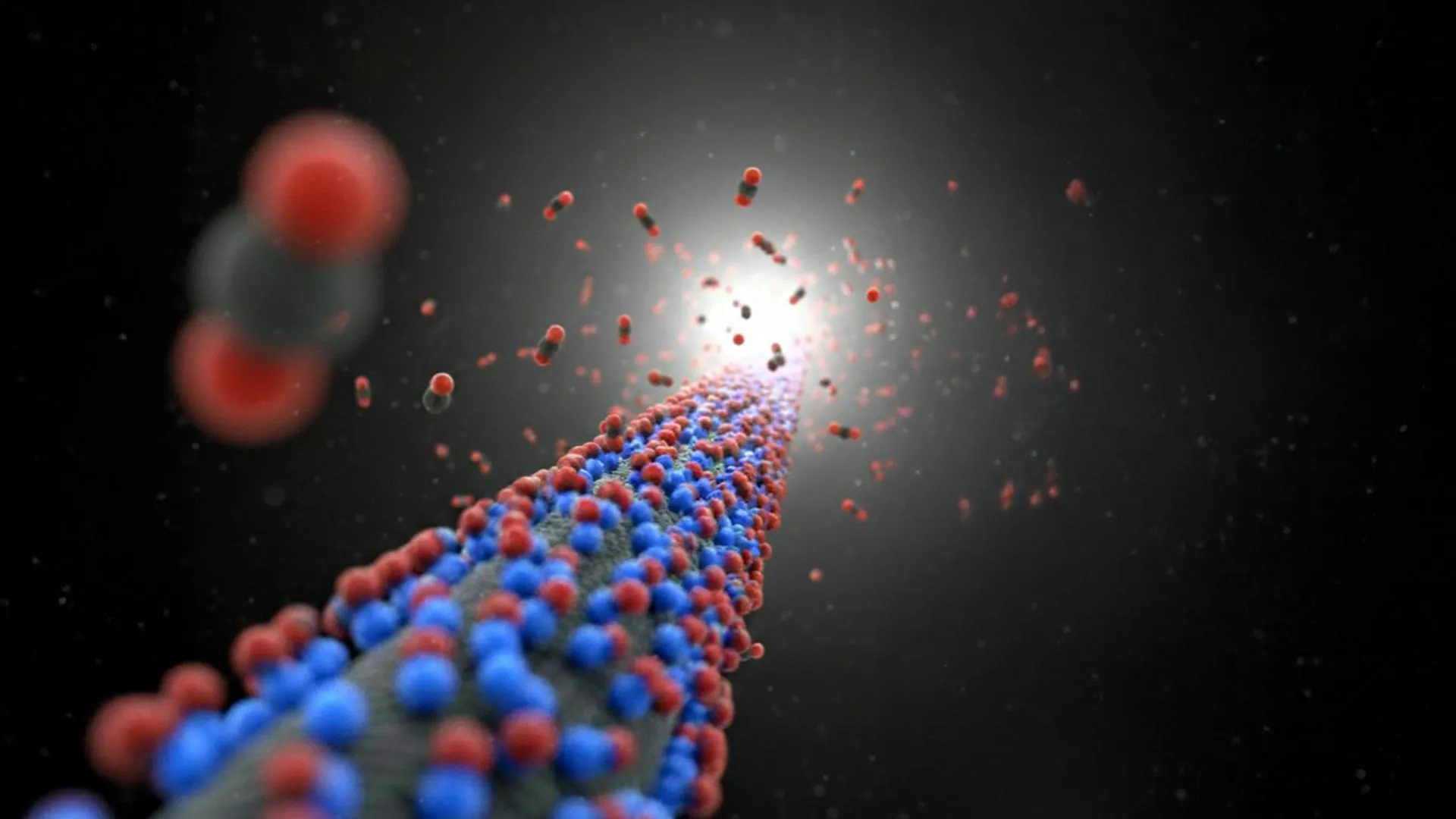
Solid carbon materials, such as activated carbon and biochar, have emerged as a promising alternative to liquid amines. These materials are porous, meaning they possess a vast internal network of microscopic tunnels that can trap CO2 molecules through a process called adsorption. To enhance the "stickiness" of these carbon surfaces for CO2, scientists often "dope" the carbon with nitrogen-based functional groups. Nitrogen atoms create localized areas of chemical attraction that pull CO2 molecules out of the air.
Despite their potential, traditional nitrogen-doped carbons have suffered from a lack of structural precision. In standard manufacturing processes, such as pyrolysis (heating organic matter in the absence of oxygen), nitrogen groups are distributed randomly across the carbon framework. This "shotgun" approach creates a heterogeneous surface where some areas capture CO2 too weakly, while others bind it so tightly that high temperatures are still required to release it. Without the ability to control the exact molecular arrangement of these nitrogen groups, researchers have struggled to optimize the balance between capture efficiency and energy-efficient release.
Introducing Viciazites: A Breakthrough in Molecular Engineering
To overcome the hurdles of structural randomness, a research team led by Associate Professor Yasuhiro Yamada from the Graduate School of Engineering and Associate Professor Tomonori Ohba from the Graduate School of Science at Chiba University developed a novel class of materials they named "viciazites." The study, co-authored by Mr. Kota Kondo and published in the prestigious journal Carbon, introduces a method for precisely positioning nitrogen groups in adjacent pairs on a carbon framework.
The term "viciazite" refers to these specialized carbon structures where nitrogen atoms are not isolated or scattered, but are specifically engineered to sit side-by-side. This proximity changes the chemical environment of the material, creating synergistic effects that enhance the material’s affinity for CO2 while simultaneously lowering the energy barrier required for its release.
The research team focused on three specific configurations of nitrogen: primary amines (-NH2), pyrrolic nitrogen, and pyridinic nitrogen. By controlling the placement of these groups, the team sought to identify the "sweet spot" for carbon capture performance—a material that grabs CO2 firmly at room temperature but lets it go with minimal heating.
The Synthesis Chronology: A Three-Step Precision Method
The development of viciazites followed a rigorous and innovative chemical synthesis timeline. Unlike traditional methods that rely on high-heat carbonization of bulk biomass, the Chiba team utilized a more controlled "bottom-up" approach.
- Selection of the Precursor: The process began with coronene, a polycyclic aromatic hydrocarbon consisting of seven peripheral benzene rings. Coronene was chosen because its rigid, flat structure provides a stable template for adding functional groups in specific locations.
- Thermal Pre-treatment and Bromination: The researchers first heated the coronene to prepare the molecular edges. They then subjected the material to bromination. By adding bromine atoms to the coronene framework, they created "placeholder" sites. Because bromine atoms are relatively large, they tend to attach to specific adjacent positions on the rings due to the molecular geometry of the coronene.
- Ammonia Gas Treatment: In the final critical step, the brominated coronene was treated with ammonia gas (NH3). Through a substitution reaction, the nitrogen from the ammonia replaced the bromine atoms. Because the bromine atoms were already positioned in adjacent pairs, the resulting nitrogen groups remained in those same adjacent positions.
This methodology yielded remarkable results in terms of chemical "selectivity." The team achieved 76% selectivity for adjacent primary amine groups, 82% for adjacent pyrrolic nitrogen, and 60% for adjacent pyridinic nitrogen. In the world of materials science, such high levels of selectivity for specific molecular architectures are rare and represent a significant advancement in carbon engineering.
Empirical Verification and Performance Data
To confirm that the nitrogen groups were indeed adjacent and not randomly dispersed, the Chiba University team employed a suite of sophisticated analytical techniques. They used Nuclear Magnetic Resonance (NMR) spectroscopy and X-ray Photoelectron Spectroscopy (XPS) to map the electronic environment of the nitrogen atoms. Computational modeling further supported these findings, showing that the "viciazite" arrangement was energetically stable and structurally distinct from traditional doped carbons.
Once the structures were verified, the materials were applied to activated carbon fibers to create samples for performance testing. The results highlighted a clear hierarchy of effectiveness based on the nitrogen configuration:
- Primary Amine Viciazites (-NH2): This material showed the most promising results. The adjacent -NH2 groups created a highly reactive surface that captured significantly more CO2 than untreated carbon fibers. Most importantly, the team found that the captured CO2 could be released (desorbed) at temperatures below 60 degrees Celsius.
- Pyrrolic Nitrogen Viciazites: These samples also outperformed standard carbon fibers in capture capacity. While they required slightly higher temperatures for desorption compared to the primary amines, the researchers noted that the pyrrolic structure is chemically more robust, suggesting it might have a longer operational lifespan in harsh industrial environments.
- Pyridinic Nitrogen Viciazites: This configuration showed the least improvement, suggesting that the specific geometry of pyridinic nitrogen is less conducive to forming the necessary bonds with CO2 molecules in a carbon capture context.
Strategic Implications: Leveraging Industrial Waste Heat
The discovery that primary amine viciazites can release CO2 at temperatures below 60 degrees Celsius is perhaps the most significant finding for the energy industry. In modern manufacturing and power generation, "waste heat" is a byproduct of almost every process. Steel mills, chemical plants, and power stations produce vast amounts of low-grade heat—usually in the form of steam or hot water—that is typically vented into the atmosphere because it is not hot enough (under 100 degrees Celsius) to drive turbines or power traditional amine scrubbing systems.
"Performance evaluation revealed that in carbon materials where NH2 groups are introduced adjacently, most of the adsorbed CO2 desorbs at temperatures below 60 °C," explained Dr. Yamada. "By combining this property with industrial waste heat, it may be possible to achieve efficient CO2 capture processes with substantially reduced operating costs."
If the desorption process can be powered by heat that would otherwise be wasted, the "energy penalty" of carbon capture could be virtually eliminated. This would transform CCS from a costly regulatory burden into a viable, integrated component of industrial production.
Broader Impact and Future Pathways
While the primary focus of the Chiba University research is carbon capture, the implications of viciazite technology extend into several other fields of green chemistry and environmental engineering. The ability to place nitrogen groups with molecular precision allows for the customization of a material’s surface properties for various tasks.
One potential application is in the removal of heavy metal ions from industrial wastewater. The adjacent nitrogen pairs in viciazites can act as "chelating agents," essentially grabbing onto metal ions like lead, mercury, or copper and removing them from the water. Additionally, these materials could serve as advanced catalysts for the production of hydrogen or the conversion of captured CO2 into useful fuels and chemicals, contributing to a circular carbon economy.
Dr. Yamada emphasized that the goal of the research is to provide a roadmap for the next generation of environmental technologies. "Our motivation is to contribute to the future society and to utilize our recently developed carbon materials with controlled structures," he stated. "This work provides validated pathways to synthesize designer nitrogen-doped carbon materials, offering the molecular-level control essential for developing next-generation, cost-effective, and advanced CO2 capture technologies."
Conclusion and Funding Acknowledgments
The development of viciazites represents a shift from "discovery by accident" to "design by intent" in the field of carbon materials. By demonstrating that the spatial arrangement of nitrogen atoms is just as important as their presence, the Chiba University team has opened a new frontier in materials science. As the world seeks to scale up carbon removal to gigaton levels, the transition from high-energy liquid systems to low-energy, "designer" solid adsorbents like viciazites could be the catalyst needed for global adoption.
The research was made possible through the support of several prominent Japanese scientific institutions, including the Mukai Science and Technology Foundation and the Japan Society for the Promotion of Science (JSPS KAKENHI Grant Number JP24K01251). Technical support was also provided by the "Advanced Research Infrastructure for Materials and Nanotechnology in Japan (ARIM)" of the Ministry of Education, Culture, Sports, Science and Technology (MEXT). As the team moves toward scaling this synthesis process, the industrial sector will be watching closely to see if viciazites can deliver on the promise of affordable, efficient carbon capture.