

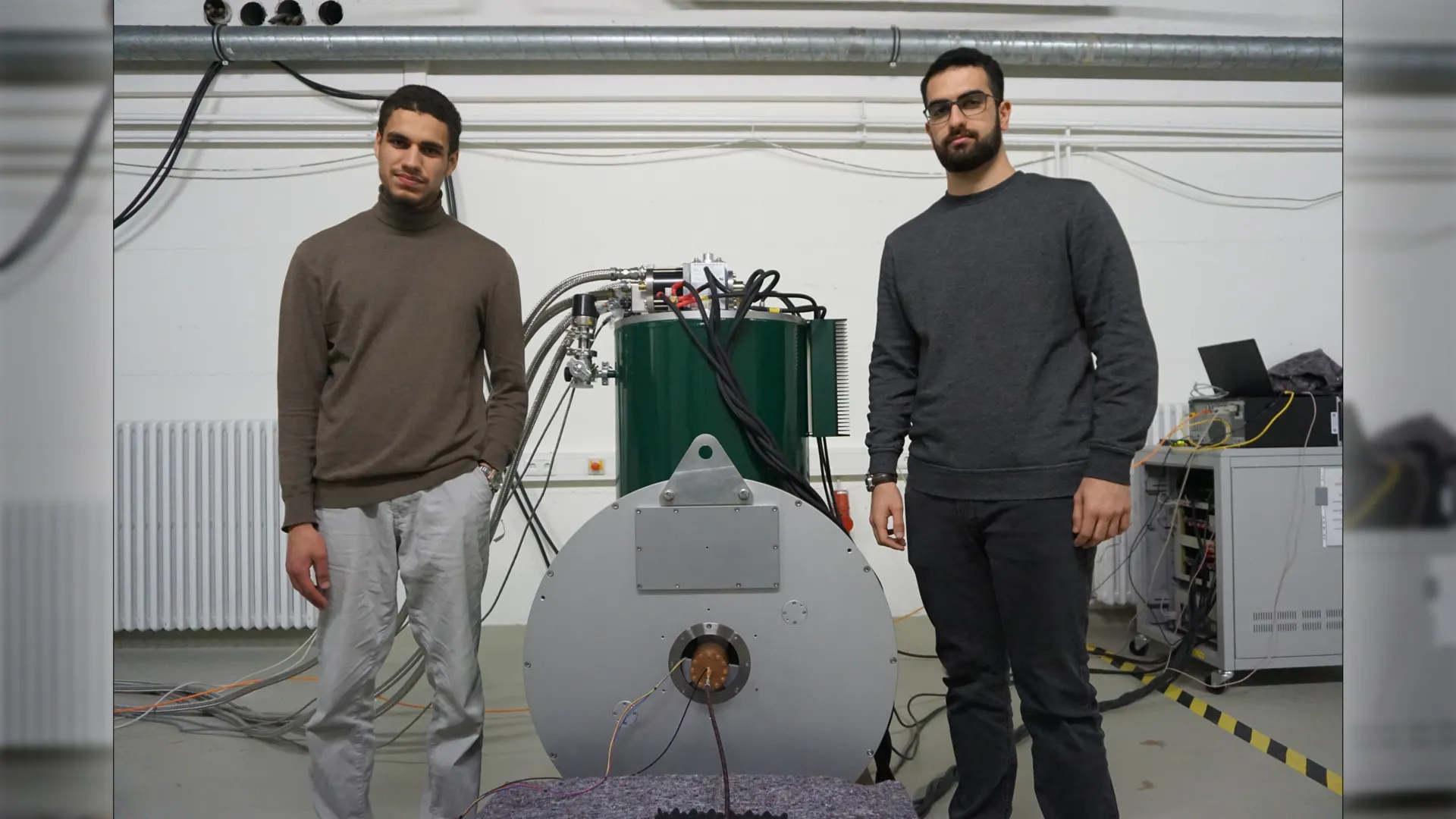
The pursuit of understanding the fundamental constituents of the universe has long been characterized by the presence of colossal infrastructure, ranging from the multi-billion-dollar Large Hadron Collider at CERN to the sprawling deep-underground facilities of the Gran Sasso National Laboratory. However, a recent breakthrough led by a team of undergraduate students at the University of Hamburg, published in the Journal of Cosmology and Astroparticle Physics (JCAP), has demonstrated that significant contributions to the field of dark matter detection can emerge from smaller, more agile research initiatives. By designing, constructing, and operating a compact resonant cavity detector, these students have successfully established new experimental limits on the properties of axions, one of the most promising candidates for dark matter. This achievement underscores a pivotal shift in the landscape of modern physics, where institutional support and creative engineering allow small-scale experiments to provide critical data in the search for the "missing" mass of the cosmos.
The Search for the Invisible: Contextualizing Axion Dark Matter
To understand the significance of the Hamburg study, it is necessary to examine the broader context of modern cosmology. Current astrophysical observations, including galactic rotation curves and the cosmic microwave background, suggest that approximately 85% of the matter in the universe is "dark"—meaning it does not emit, absorb, or reflect electromagnetic radiation. While its gravitational effects are undeniable, its particle nature remains one of the greatest mysteries in science.
Among the various theoretical candidates for dark matter, the axion holds a position of prominence. Originally proposed in the late 1970s by physicists Roberto Peccei and Helen Quinn to solve the "strong CP problem" in quantum chromodynamics, axions are theorized to be extremely light, neutral particles that interact very weakly with ordinary matter and light. Because of their predicted abundance and stability, they are ideal candidates for the dark matter that permeates the Milky Way.
Detecting axions requires specialized equipment known as haloscopes. These devices typically utilize a strong magnetic field to induce the "Primakoff effect," a process in which an axion converts into a detectable photon when passing through a magnetic field. Because the axion mass is unknown, researchers must "tune" their detectors to various frequencies, searching for a signal that matches the axion’s mass-energy. The University of Hamburg project focused on this haloscope principle, simplifying the complex engineering of large-scale experiments into a functional, compact setup.
Chronology of the Hamburg Axion Project
The project’s trajectory began with a grant from the University of Hamburg’s Hub for Crossdisciplinary Learning. This initiative was designed to foster independent student research, providing undergraduates with the financial and institutional resources typically reserved for doctoral or post-doctoral researchers.
In the initial phase, the student team, led by Agit Akgümüş and Nabil Salama, conducted a feasibility study to determine if a simplified cavity detector could produce scientifically valid results. By late 2022 and early 2023, the team began the physical assembly of the detector. Unlike the massive installations of the MADMAX (Magnetized Disk and Mirror Axion eXperiment) collaboration, with which the students were affiliated, this project focused on a "minimalist" design.
The construction phase involved sourcing highly conductive materials for the resonant cavity to minimize energy loss and integrating sensitive microwave electronics to capture potential signals. Throughout mid-2023, the team conducted calibration tests, ensuring the detector could accurately distinguish between background thermal noise and the theoretical signal of an axion-photon conversion. By the time the data collection phase concluded, the team had moved into the analysis and peer-review stage, culminating in their recent publication in JCAP.
Technical Architecture and Experimental Methodology
The detector designed by the Hamburg undergraduates is a "resonant cavity haloscope." At its core, the experiment relies on a copper or gold-plated cylinder placed within a high-intensity magnetic field. When the resonant frequency of the cavity matches the mass of a passing axion, the probability of the axion converting into a microwave photon increases significantly.
Nabil Salama, now a Master of Science student in Physics at the University of Hamburg, noted that the detector was essentially a stripped-down version of the massive instruments used in global collaborations. "We reduced very complex experiments to their essential components," Salama stated. This reductionist approach allowed the team to bypass the immense costs associated with large-scale cryogenics and massive magnets while still maintaining the precision necessary for scientific inquiry.
The team utilized the facilities provided by the Quantum Universe Cluster of Excellence, a major research initiative in Germany. This gave them access to a powerful magnet and specialized cabling and structural supports. The resulting setup, though limited in its search window—the specific range of axion masses it could probe—was highly efficient within that narrow band. By focusing on a specific frequency range, the students were able to achieve a level of sensitivity that, while lower than "Big Science" projects, was sufficient to rule out certain theoretical models of axion-photon coupling.
Institutional Synergy and the Role of MADMAX
A critical factor in the project’s success was the integration of the student team into the existing infrastructure of the MADMAX experiment. MADMAX is an international collaboration aiming to detect axions in a higher mass range using a "dielectric haloscope" approach. By being "embedded" within this group, the undergraduates had access to mentorship from world-class physicists and technical experts.
This synergy highlights a model for modern scientific education where the boundaries between teaching and high-level research are blurred. The University of Hamburg and the Hub for Crossdisciplinary Learning provided the administrative framework, but the MADMAX group provided the "tribal knowledge" of experimental physics—how to shield against electromagnetic interference, how to calibrate sensitive amplifiers, and how to interpret complex data sets.
The funding from the Quantum Universe Cluster of Excellence further stabilized the project, ensuring that the students had the necessary hardware to translate their mathematical models into a physical experiment. This multi-tiered support system—combining student-led curiosity with institutional expertise—serves as a blueprint for other universities looking to advance their research output.
Analyzing the Results: New Limits and Scientific Value
While the Hamburg experiment did not result in the "smoking gun" discovery of the axion, its scientific value is significant. In experimental physics, a "null result" is not a failure; rather, it is a crucial step in the process of elimination. The data collected by Akgümüş, Salama, and their colleagues allowed them to establish new "exclusion limits."
An exclusion limit is a boundary in the parameter space of a theoretical particle. By demonstrating that no axion signal was found within a specific mass range and at a certain coupling strength, the students have effectively told the scientific community: "The axion does not exist with these specific properties." This helps theorists refine their models and allows future, larger experiments to focus their resources on unexplored regions of the parameter space.
"The search for axions involves exploring a wide range of possible parameters," explained Agit Akgümüş, the study’s first author. "Our experiment covers only a small region, with limited sensitivity, but it still helps narrow down the possibilities." By excluding axions that interact more strongly with photons in their tested range, the study provides a valuable data point in the global effort to map the dark matter landscape.
Broader Impact and the Future of Experimental Pedagogy
Beyond the immediate scientific data, the Hamburg project has profound implications for the way physics is taught and practiced. One of the most striking outcomes of the peer-review process for the JCAP paper was a comment from a referee suggesting that such setups could eventually become standard in student laboratories.
Historically, undergraduate physics labs involve recreating experiments that are decades or even centuries old—such as measuring the charge of an electron or observing the photoelectric effect. The Hamburg project demonstrates that undergraduates are capable of engaging with the "frontier" of physics. As the technology for axion detection matures and the properties of the particle (such as its mass) are eventually narrowed down, these compact detectors could be mass-produced for educational purposes.
"We were told that setups like ours could one day become standard student lab experiments," Salama recalled. "In a way, we may have anticipated that future." This shift would democratize dark matter research, allowing hundreds of universities worldwide to contribute to a global network of detectors, creating a "crowdsourced" search for cosmic particles.
Conclusion: Small Science in a Big Science Era
The success of the University of Hamburg’s undergraduate team serves as a reminder that the "Big Science" era of massive observatories does not render small-scale experimentation obsolete. While large collaborations like MADMAX, ADMX, and HAYSTACK are essential for broad-spectrum searches, the ability of a small student team to produce peer-reviewed data in a major journal indicates that there is still room for "tabletop" physics.
The project highlights the importance of institutional agility. By providing undergraduates with the funding and freedom to lead their own research, the University of Hamburg has not only contributed to the global search for dark matter but has also trained a new generation of physicists in the rigors of experimental design and data analysis. As the hunt for the axion continues, the contributions of these students will remain a testament to the power of creative, resource-efficient science in tackling the universe’s most profound mysteries. The path to discovering dark matter may be long, but as this study proves, it is a path that can be paved by researchers at every level of their academic careers.












Leave a Reply