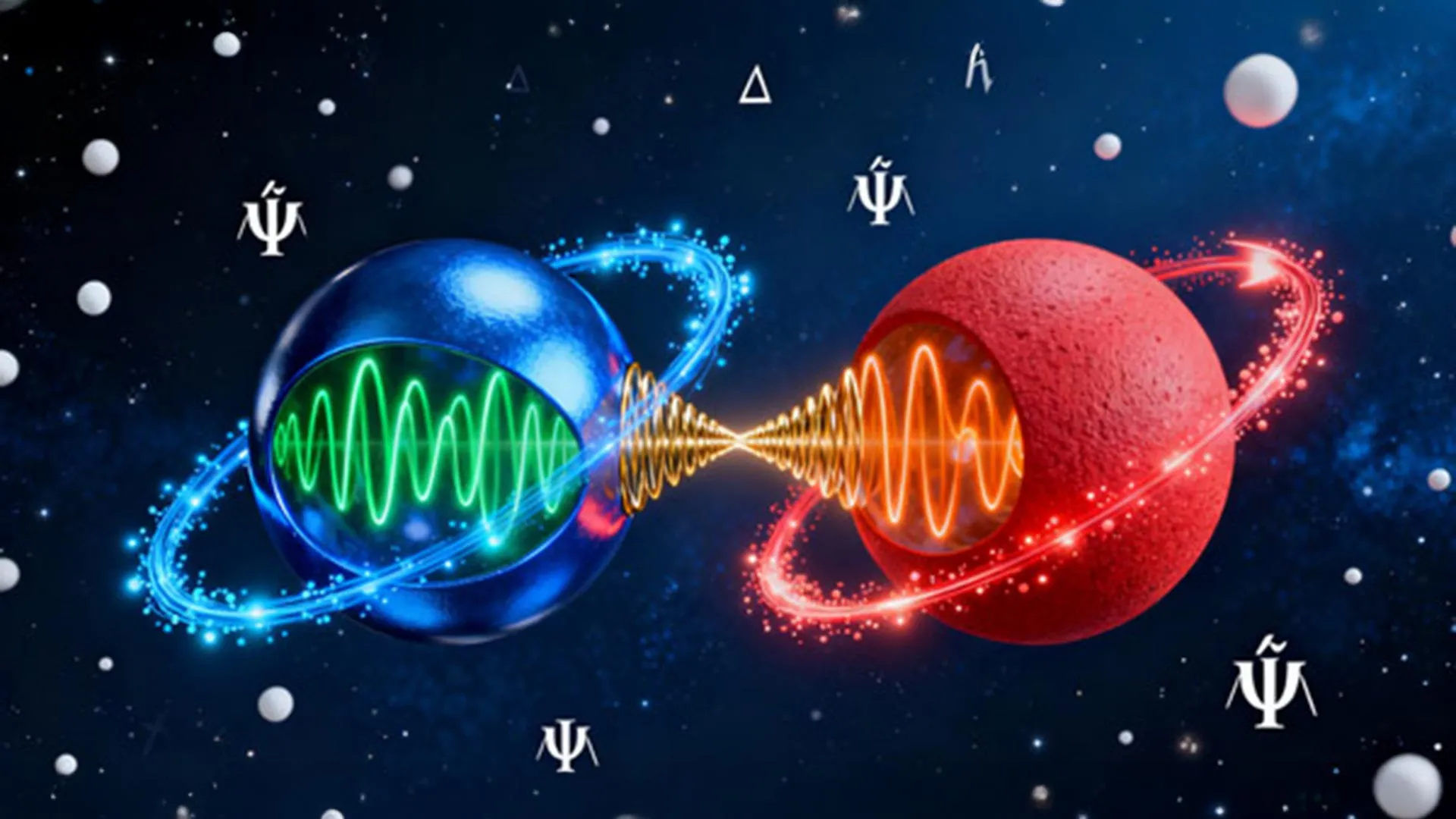
In a landmark theoretical study that addresses one of the most persistent hurdles in quantum information science, a team of researchers at the RIKEN Center for Quantum Computing (RQC) has proposed a novel method for achieving one-way quantum synchronization of phonons. This breakthrough, led by theoretical physicists Franco Nori, Adam Miranowicz, and Deng-Gao Lai, introduces a framework where synchronization occurs between two quantum systems in a nonreciprocal manner—meaning information and phase alignment flow in one direction but are strictly inhibited in the reverse. Unlike previous theoretical models that often collapsed under the pressure of real-world environmental conditions, this new approach demonstrates an unprecedented level of resilience against manufacturing imperfections and external noise, marking a significant step toward the realization of scalable and stable quantum technologies.
Phonons, the quantized units of vibrational energy or "particles" associated with sound, have increasingly become a focal point for researchers seeking alternatives to photon-based quantum systems. While photons (light) are the traditional carriers of quantum information, phonons offer unique advantages in terms of their ability to interact with a wide variety of physical systems, including superconducting circuits and solid-state defects. However, controlling phonons at the quantum level is notoriously difficult due to their sensitivity to thermal fluctuations and the inherent symmetry of mechanical vibrations. The RIKEN team’s proposal effectively breaks this symmetry, creating a "one-way street" for quantum synchronization that could serve as the backbone for future quantum signal processors and nonreciprocal acoustic devices.
The Evolution of Nonreciprocal Quantum Systems
The concept of nonreciprocity—where a signal travels freely in one direction but is blocked or attenuated in the opposite direction—is a cornerstone of modern electronics and optics. In classical systems, components such as diodes and circulators allow engineers to direct the flow of electricity or light, preventing unwanted reflections that could damage sensitive equipment or degrade signal integrity. As the global scientific community shifts its focus toward quantum computing, the need for "quantum nonreciprocity" has become urgent. In a quantum context, this involves directing the flow of quantum states or entanglement without allowing back-action to disturb the source.
Historically, achieving this in quantum systems has been a delicate balancing act. Early attempts to create nonreciprocal quantum devices often relied on complex experimental setups that were highly sensitive to any deviation from perfection. In the realm of quantum synchronization, the challenge was even greater. Synchronization is a collective phenomenon where two oscillating systems, such as two mechanical resonators, adjust their frequencies and phases to match one another. Nonreciprocal synchronization implies that System A can force System B into its rhythm, but System B has no influence over System A.
Until now, the theoretical blueprints for such systems were largely considered "fragile." They required near-perfect vacuum conditions, absolute zero temperatures, and flawless fabrication of nanostructures. Even minor "noise"—the random fluctuations caused by the environment—or tiny variations in the size and shape of components during manufacturing would typically decouple the systems and destroy the quantum synchronization. The RIKEN team’s research, however, suggests that these obstacles are not insurmountable.
Chronology of Research and Theoretical Development
The path to this discovery began with the team’s investigation into how light and magnetic fields interact with mechanical vibrations at the nanoscale. For several years, researchers at the RIKEN Center for Quantum Computing have been exploring the intersection of optomechanics and quantum control. The current study is the culmination of a multi-year effort to find a "robustness" factor that would allow quantum effects to survive outside of highly controlled laboratory "goldilocks" zones.
In early 2023, the team began modeling systems where phonons could be manipulated via external drives, such as lasers or magnetic fields. The primary goal was to find a way to induce nonreciprocity without the need for the massive, power-hungry equipment typically required to break time-reversal symmetry. By late 2023, the researchers had developed a mathematical framework that combined two distinct quantum effects—one related to how energy dissipates into the environment and another related to how particles are driven by external forces.
When these two effects were integrated into a single theoretical framework, the researchers observed a surprising result: the resulting one-way synchronization was not only possible but was also "self-protecting." By the time the study was finalized in 2024, the team had confirmed that this "fragile-to-robust" transition represented a new category of quantum resource generation.
Technical Analysis of the RIKEN Framework
The core of the RIKEN proposal lies in its unique handling of dissipation and external influence. In traditional quantum mechanics, dissipation—the loss of energy to the environment—is usually seen as the enemy of quantum coherence. It is the process that leads to decoherence, the "leaking" of quantum information that causes quantum computers to make errors.
However, Nori and his colleagues utilized a concept often referred to as "reservoir engineering." Instead of trying to eliminate dissipation, they shaped it. By carefully controlling how the system interacts with its environment, they created a scenario where the environment itself helps to enforce the one-way flow of information. The team’s strategy involves applying light or a magnetic field from a specific direction to a pair of mechanical resonators. When the influence comes from Direction X, the phonons in both resonators synchronize their quantum phases. If the same influence is applied from Direction Y, the coupling vanishes, and the systems remain independent.
Supporting data from their simulations indicates that this synchronization remains stable even when the frequencies of the two resonators are slightly mismatched—a common occurrence in manufacturing where no two nanomechanical beams are identical. Furthermore, the synchronization persisted in simulations involving significant thermal noise, which typically shakes quantum systems out of their synchronized states. This "robustness" is the defining feature of the RIKEN model, distinguishing it from the "fragile" nonreciprocal systems of the past.
Reactions from the Scientific Community and Lead Researchers
The announcement has sparked significant interest among theoretical and experimental physicists alike. Dr. Franco Nori, a leading figure at the RIKEN Center for Quantum Computing, emphasized the practical shift this research represents. "Nonreciprocal components enable signals to travel along desired paths, whereas they are strongly attenuated in the opposite direction," Nori explained. "This ability finds applications ranging from signal processing to invisible cloaking. Our development establishes a new foundation for generating fragile-to-robust nonreciprocal quantum resources with future practical applicability."
The sentiment was echoed by Adam Miranowicz, who highlighted the struggle against environmental interference. "Practical quantum technologies face critical challenges from random fabrication imperfections and environmental noise," Miranowicz noted. "These factors profoundly suppress—or even completely destroy—quantum resources in conventional approaches." The fact that their model thrives where others fail suggests a paradigm shift in how quantum engineers might approach device design.
Deng-Gao Lai, who was instrumental in the discovery of the system’s resilience, recalled the team’s reaction to the data. "We were thrilled to discover that quantum synchronization persists even in the presence of substantial imperfections and noise," Lai said. "Previously, this was thought to be impossible without employing complex protection schemes."
While independent peer reviews from experimentalists are still forthcoming, the theoretical community suggests that this could simplify the architecture of quantum repeaters—devices necessary for a "quantum internet"—by reducing the need for active error correction and complex shielding.
Broader Implications for Quantum Computing and Networking
The implications of robust one-way phonon synchronization extend far beyond the laboratory. As the world moves toward a quantum-based information economy, the ability to manage signal flow is paramount.
-
Quantum Networking: In a future quantum internet, information must be sent over long distances via fiber optics or satellite links. Nonreciprocal phonon devices could act as "quantum diodes," ensuring that signals move from a sender to a receiver without bouncing back and causing interference. Because the RIKEN method is robust against noise, these devices could theoretically operate in less-than-ideal conditions, such as in urban environments or across variable temperatures.
-
Error-Resilient Processors: One of the greatest challenges in building a useful quantum computer is "crosstalk," where one qubit unintentionally influences another. One-way synchronization could be used to isolate different parts of a quantum processor, allowing for more precise control and fewer errors.
-
Advanced Sensing and Cloaking: The ability to control sound waves (phonons) in one direction opens the door to "acoustic cloaking," where objects could be made "invisible" to sonar or other sound-based detection systems. While this remains a more distant application, the underlying physics of nonreciprocity is the key to such technologies.
-
Phononic Circuitry: Just as electronic circuits use electrons and photonic circuits use light, phononic circuits use mechanical vibrations. Phononic systems can be much smaller than photonic ones, allowing for greater miniaturization of quantum components. The RIKEN team’s work provides a blueprint for making these tiny circuits reliable.
Conclusion and Future Directions
The research conducted by Nori, Miranowicz, and Lai represents a vital bridge between theoretical quantum mechanics and practical engineering. By proving that one-way quantum synchronization can be made resilient to the "messiness" of the real world, the RIKEN team has removed a significant roadblock on the path to commercial quantum technology.
The team is now planning to move from theoretical modeling to the design of experimental prototypes. "By enabling robust nonreciprocal quantum synchronization, our research paves the way for realizing more reliable quantum processors and protected quantum resources," Lai concluded. "We’re now planning to explore applications in quantum networking and error-resilient quantum information processing."
As the global race for quantum supremacy intensifies, the focus is shifting from simply creating quantum effects to making them "robust." The RIKEN proposal for phonon synchronization stands as a testament to this shift, offering a glimpse into a future where quantum devices are as reliable and ubiquitous as the silicon chips that power the world today. The scientific community will be watching closely as these theoretical foundations are tested in laboratories, potentially ushering in a new era of noise-tolerant quantum communication.