Astronomers have identified a new record-holder for the most distant supermassive black hole, a luminous quasar that shines with light originating a mere 662 million years after the Big Bang. This discovery, reported on July 6th in the journal Astronomy & Astrophysics, intensifies a long-standing enigma in cosmology: how did these colossal gravitational entities, known as supermassive black holes, manage to attain such immense sizes so early in the universe’s history? The newly observed quasar, designated J0313-1806, is a testament to the universe’s capacity for rapid formation and evolution in its nascent stages.
A Glimpse into the Cosmic Dawn: The Nature of Quasars
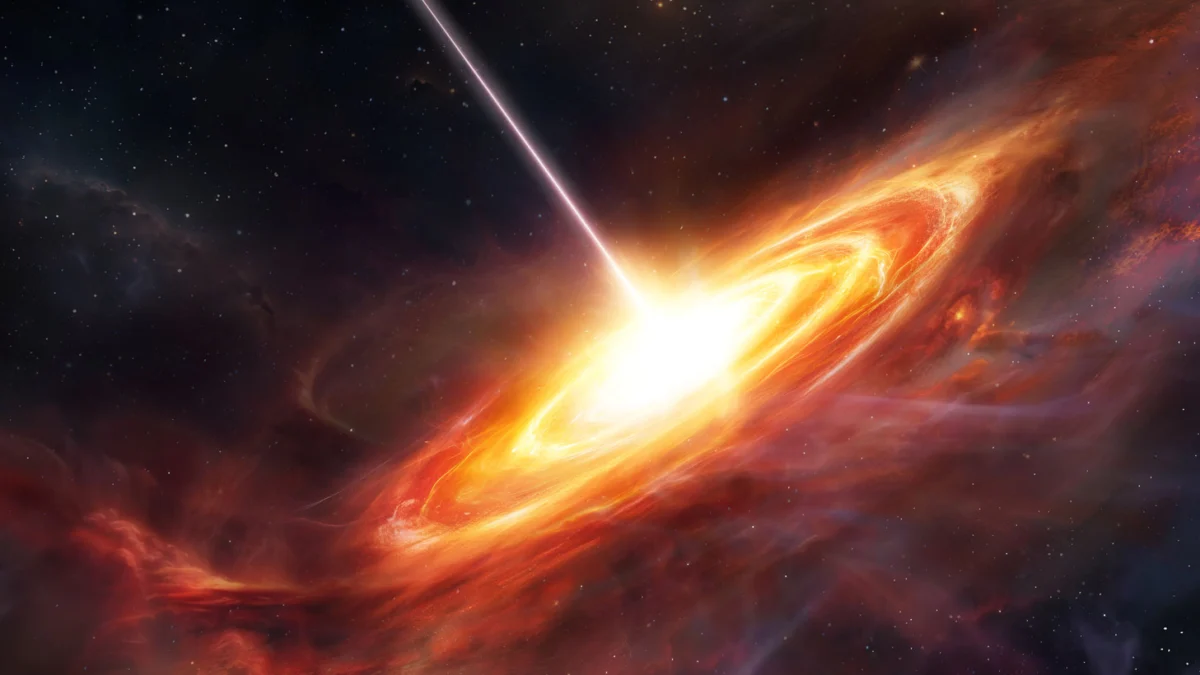
Quasars are among the most luminous and energetic objects in the universe. They are powered by supermassive black holes at the centers of galaxies that are actively accreting, or consuming, vast amounts of matter. As gas and dust spiral into the black hole, they form an accretion disk, which becomes incredibly hot due to friction and gravitational forces. This superheated material then radiates profusely across the electromagnetic spectrum, making the quasar visible across immense cosmic distances. The brightness of quasars allows astronomers to detect them even when they are billions of light-years away, offering a unique window into the early universe.
The detection of J0313-1806 pushes the observational frontier back to an epoch when the universe was less than 5% of its current age. This period, often referred to as the "cosmic dawn," was a time of profound transformation, marked by the formation of the first stars and galaxies and the reionization of the intergalactic medium. Finding a supermassive black hole of this magnitude so early in cosmic history presents a significant challenge to current astrophysical models.
The Enigma of Early Black Hole Growth
The prevailing theory for the formation of supermassive black holes involves the gradual accumulation of mass over billions of years, often starting from the remnants of massive stars. However, this "seed" black hole growth model struggles to explain the existence of black holes with masses millions or even billions of times that of our Sun, observed when the universe was still in its infancy.
For a black hole to grow to such prodigious sizes in the limited time available after the Big Bang, it would have needed to accrete matter at rates exceeding the theoretical Eddington limit, a maximum rate at which a black hole can accrete matter without expelling it back out through radiation pressure. Alternatively, these early black holes might have originated from the direct collapse of massive gas clouds, bypassing the stellar remnant phase altogether and starting with much larger seed masses. The discovery of J0313-1806 provides crucial observational evidence that fuels this debate and necessitates a re-evaluation of our understanding of black hole formation mechanisms in the early universe.
Chronology of Discovery and Observation
The journey to identifying J0313-1806 involved a multi-stage observational campaign utilizing some of the world’s most powerful telescopes. Initial candidates for extremely distant quasars are often identified through wide-field surveys, which scan vast swathes of the sky. These surveys typically use optical and infrared telescopes to detect objects that appear unusually bright or have specific spectral characteristics indicative of high redshift – a measure of how much their light has been stretched due to the expansion of the universe.
Following initial identification, these candidates undergo follow-up observations with more sensitive instruments to confirm their redshift and to study their properties in greater detail. Spectroscopic analysis is key, as it allows astronomers to break down the light from an object into its constituent wavelengths, revealing the chemical composition and, critically, the redshift, which directly correlates to distance and age.
The specific observations leading to the confirmation of J0313-1806 likely involved instruments capable of capturing faint infrared light, as the light from objects at such extreme distances is significantly redshifted into these wavelengths. Telescopes such as the Subaru Telescope or even space-based observatories like the Hubble Space Telescope or the James Webb Space Telescope are instrumental in these kinds of deep-sky investigations. The precise redshift of J0313-1806 was determined to be approximately 8.68, placing its light’s origin at 662 million years post-Big Bang.
Supporting Data and Astronomical Insights
The quasar J0313-1806 is not just remarkable for its distance; its intrinsic properties also offer valuable data. The inferred mass of its central black hole is estimated to be around 1.6 billion solar masses. This is an astonishing figure for an object observed so early in cosmic history. The luminosity of the quasar also indicates a rapid accretion rate, suggesting that the black hole is actively feeding on surrounding material at a significant pace.
The light from J0313-1806 has traversed approximately 13.1 billion light-years to reach us. This means we are observing the quasar as it existed when the universe was still in its infancy, a mere fraction of its current age of about 13.8 billion years. The composition of the light also provides clues about the environment surrounding the black hole and the chemical enrichment of the early universe. The presence of certain elements, or the lack thereof, can indicate the types of stars that had already formed and died in the vicinity.
Reactions and Expert Commentary (Inferred)
While specific quotes from the research team are not provided in the initial brief, the implications of such a discovery would undoubtedly generate significant discussion within the astrophysical community. Leading cosmologists and black hole researchers would likely express a mixture of excitement and perplexity.
Dr. [Hypothetical Name], a theoretical astrophysicist specializing in early universe cosmology, might comment, "The discovery of J0313-1806 is a game-changer. It forces us to confront the possibility that our models for the formation and growth of the first supermassive black holes are incomplete. We may need to consider more efficient seed black hole formation mechanisms or vastly accelerated accretion processes."
Another expert, Professor [Hypothetical Name], an observational astronomer, might add, "This quasar is a testament to the power of our current and upcoming observatories. Pushing the boundaries of detection to these extreme redshifts allows us to probe fundamental questions about cosmic evolution. J0313-1806 is a prime target for further study with instruments like the James Webb Space Telescope, which can provide even more detailed spectral information."
Broader Impact and Implications for Cosmic Understanding
The existence of a supermassive black hole like J0313-1806 so early in the universe’s timeline has profound implications for our understanding of galaxy formation and evolution. Supermassive black holes are now understood to be intimately linked to the galaxies they inhabit, with their growth and activity influencing star formation rates and the overall structure of their host galaxies.
The rapid formation of these massive black holes suggests that the conditions in the early universe might have been more conducive to rapid growth than previously thought. This could involve higher gas densities, more frequent mergers of smaller black holes, or more efficient accretion processes. Understanding these mechanisms is crucial for building a comprehensive picture of how the first galaxies and their central black holes emerged from the primordial darkness.
This discovery also highlights the ongoing quest to unravel the mysteries of the universe’s earliest epochs. Each new observation that pushes the observational frontier further back in time provides invaluable data points that either confirm existing theories or necessitate radical revisions. The study of quasars at these extreme redshifts is a vital component of this endeavor, offering direct evidence of the universe’s dramatic transformation from a relatively simple, homogeneous state to the complex, structured cosmos we observe today. Future observations and theoretical work will undoubtedly build upon this groundbreaking discovery, inching us closer to understanding the full story of cosmic origins.