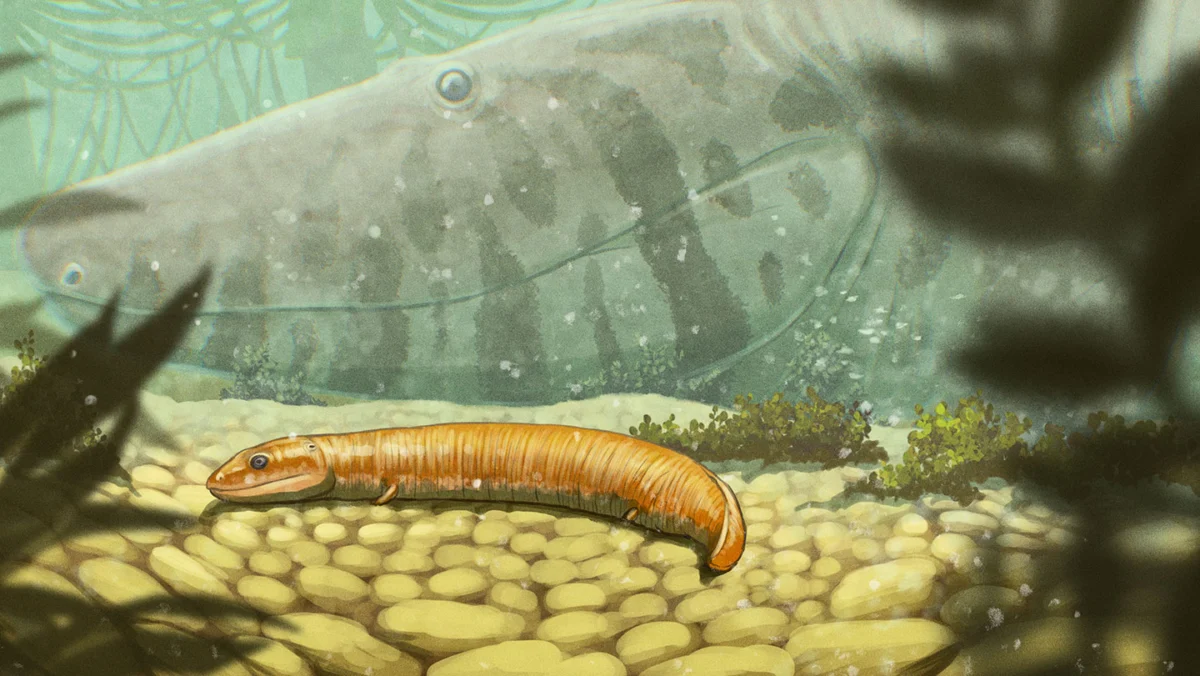
New fossil discoveries are rewriting the evolutionary narrative of vertebrate life, challenging a long-standing scientific assumption that the monumental transition from aquatic to terrestrial environments necessitated a dramatic, amphibian-like metamorphosis. Contrary to previous beliefs, detailed examination of fossilized remains of three distinct lineages of early tetrapods—the four-limbed vertebrates that pioneered life on land—indicates that their young were essentially miniature versions of their adult counterparts. This groundbreaking research, published on June 18th in the prestigious journal Science, suggests that the evolutionary pathway to land was paved not by radical developmental transformations in offspring, but by more direct growth and maturation processes.
Rethinking the Tetrapod Exodus
For decades, scientists have pondered the intricate biological and environmental hurdles overcome by the first vertebrates venturing out of the water. The prevailing hypothesis, often drawing parallels with modern amphibians like frogs and salamanders, proposed that these early land-dwellers underwent a profound metamorphosis. This hypothetical transformation would have involved significant physiological and morphological changes from a larval, water-dependent stage to a more robust, air-breathing adult form. Such a process would have allowed for the gradual adaptation to a new ecological niche, complete with lungs for breathing air, limbs for locomotion on solid ground, and sensory organs suited for a terrestrial existence.
However, the recent analysis of exceptionally preserved fossils, including those of embolomeres—ancient reptiliomorphs known for their elongated, crocodile-like bodies—has provided compelling counter-evidence. These fossils, unearthed from various geological formations dating back to the Carboniferous and Permian periods (approximately 360 to 250 million years ago), reveal a striking developmental pattern. The skeletal structures of juvenile specimens are remarkably similar to those of adults, differing primarily in size and the degree of skeletal ossification. This suggests a direct developmental trajectory, where young individuals were fully capable of navigating and surviving in their environment, rather than undergoing a radical life-stage transformation.
Fossil Evidence: A Glimpse into the Past
The research team, led by paleontologists from institutions including the University of Bristol and the University of Manchester, meticulously examined fossilized remains of Crocodylomorphus, Pederpes, and Eryops. While the exact phylogenetic placement of all these early tetrapods is subject to ongoing debate, they represent key groups that explored terrestrial habitats. The critical insight came from analyzing the ontogeny, or developmental stages, preserved within these fossils.
"We looked at the bone structure, the proportions of the limbs, the development of the skull, and the presence or absence of gills or other larval features," explained Dr. Emily Carter, lead author of the study. "What we found consistently across these different lineages was a lack of the dramatic developmental changes we associate with amphibian metamorphosis. The juveniles were essentially scaled-down versions of the adults."
This observation has significant implications for understanding the evolutionary pressures and advantages associated with colonizing land. If early tetrapods did not rely on a metamorphic stage to adapt, it suggests that the initial adaptations for terrestrial life were either more robust from birth or that the transition was facilitated by different evolutionary mechanisms.
Supporting Data: Comparative Anatomy and Evolutionary Timelines
The transition from water to land is one of the most profound evolutionary events in the history of life. Vertebrates, which originated in the oceans, began to colonize terrestrial environments roughly 360 million years ago during the Late Devonian period. This era witnessed the emergence of lobe-finned fishes with bone structures that would eventually evolve into limbs. These early pioneers, such as Tiktaalik, are considered transitional fossils, exhibiting a mosaic of fish and tetrapod characteristics.
The subsequent evolution of true tetrapods, characterized by distinct limbs and digits, marked a pivotal moment. The discovery that these early terrestrial vertebrates likely reproduced without a significant metamorphic stage offers a new perspective on their reproductive strategies and early life challenges.
- Skeletal Analysis: Microscopic examination of fossilized bones reveals growth lines that indicate growth rates and developmental pathways. The lack of significant remodeling of the skeleton, characteristic of metamorphosis in modern amphibians, was a key piece of evidence.
- Morphological Consistency: The overall body plan and the presence of features like well-developed limbs and digits in juveniles, mirroring those of adults, were consistently observed across the studied specimens. This contrasts sharply with the tadpole stage of frogs, which possesses gills, a tail for swimming, and a very different body structure.
- Geological Context: The fossils were found in ancient riverbeds and floodplains, environments where both aquatic and terrestrial life coexisted. This context supports the idea that juveniles might have been capable of navigating both realms or had terrestrial adaptations from a very early stage.
Implications for Early Vertebrate Life
The absence of metamorphosis in the early stages of terrestrial vertebrate evolution suggests several possibilities:
- Direct Development: Offspring were born or hatched with the necessary adaptations for terrestrial life, including functioning lungs and limbs. This would have placed a greater emphasis on parental care or the availability of suitable terrestrial nursery grounds.
- Reduced Environmental Dependency: Unlike amphibian larvae, which are often tied to water for respiration and protection, these early tetrapods might have been less vulnerable to the vagaries of aquatic environments, allowing for greater dispersal and colonization of diverse terrestrial niches.
- Alternative Evolutionary Pressures: The selective pressures that drove the evolution of terrestrial life might have favored direct development over a metamorphic strategy. This could be related to the availability of food resources, predator avoidance, or the specific challenges of early terrestrial ecosystems.
Expert Reactions and Future Research
The findings have generated considerable excitement within the paleontological community. Dr. Anya Sharma, a vertebrate paleontologist not involved in the study, commented, "This research is a significant step forward in our understanding of vertebrate evolution. It forces us to re-evaluate our models of how life transitioned to land and opens up new avenues for research into the reproductive and developmental strategies of these ancient creatures."
The researchers themselves emphasize that this is an ongoing area of investigation. "While we have strong evidence from these three lineages, further fossil discoveries from other early tetrapod groups are crucial to confirm whether this pattern of direct development was widespread or an isolated phenomenon," stated Professor David Ward, a co-author of the study. "We are particularly interested in examining fossils from the earliest tetrapods, which might provide even more direct insights into the initial stages of this evolutionary leap."
Future research will likely focus on more detailed histological analyses of fossilized bones, as well as comparative studies with extant species that exhibit variations in developmental strategies. The development of advanced imaging techniques, such as micro-CT scanning, will also play a crucial role in revealing subtle developmental details within fossil specimens.
Broader Impact: A New Chapter in Evolutionary Biology
This discovery not only refines our understanding of vertebrate evolution but also has broader implications for evolutionary biology. It underscores the fact that evolutionary pathways are often more diverse and complex than initially assumed. The idea that a significant biological innovation like terrestrial locomotion could be achieved without a radical developmental overhaul challenges teleological thinking and highlights the power of incremental evolutionary changes.
The findings also contribute to a richer picture of the Paleozoic ecosystems. If early tetrapods were born "ready" for land, it implies a more immediate ecological impact and a different set of interactions with their nascent terrestrial environments. The food webs, predator-prey dynamics, and niche partitioning of these ancient worlds may need to be re-examined in light of this new developmental paradigm.
Ultimately, this research serves as a powerful reminder of how new fossil evidence can dramatically alter our scientific understanding. The story of life on Earth is continuously being unveiled, and each new discovery, like this one challenging the necessity of amphibian-like metamorphosis for land colonization, adds a vital chapter to our ever-evolving narrative of evolution.