

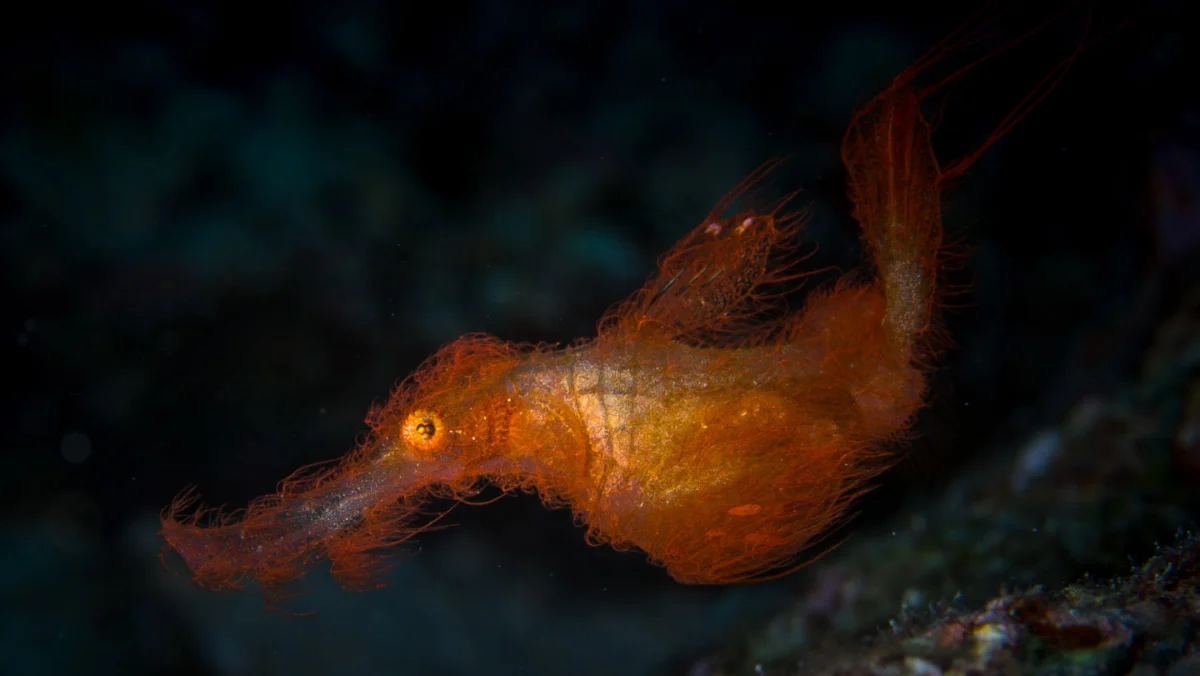
In the vibrant, shallow waters off the coast of Australia, a creature of astonishing camouflage has been unveiled to the scientific world. This newly described species, unofficially dubbed the "Snuffleupagus" fish due to its remarkably long, snout-like appendage and its thick, flowing coat of what appears to be red algae, represents a significant discovery within the diverse family of ghost pipefish. These elusive marine inhabitants, distantly related to seahorses, are renowned for their extraordinary ability to blend seamlessly into their surroundings, but this particular specimen pushes the boundaries of known mimicry and adaptation.
The discovery, documented by researchers exploring the rich biodiversity of Australian coral reefs, highlights the ongoing marvels of underwater ecosystems and the persistent secrets they hold. The fish’s dense covering of near-neon orange fibers, meticulously mimicking the appearance of the surrounding red algae, provides an almost unparalleled level of concealment. This allows the creature to effectively disappear against the backdrop of the colorful reef, rendering it nearly invisible to both predators and unsuspecting prey. The scientific community is abuzz with the implications of this find, particularly concerning the evolutionary pressures that could lead to such specialized and elaborate camouflage.
A Deeper Look at the Ghost Pipefish Family
Ghost pipefish, belonging to the genus Solenostomus, are a fascinating group of marine fish. Unlike their seahorse relatives, which possess a prehensile tail and are typically found clinging to seagrasses or gorgonian corals, ghost pipefish are generally free-swimming, though they often adopt a characteristic upside-down posture to further enhance their camouflage. Their bodies are often adorned with elaborate filaments and appendages that mimic the specific habitat in which they reside, whether it be crinoids, hydroids, or, in this case, red algae.
The reproductive strategy of ghost pipefish is also noteworthy. The female possesses a specialized brood pouch formed from modified pelvic fins, within which she carries and incubates the fertilized eggs. This unique parental care, shared with their seahorse cousins, underscores the intricate evolutionary pathways within the Syngnathidae family. The discovery of a new species within this genus, particularly one exhibiting such advanced mimicry, offers valuable insights into the adaptive radiation and diversification of these aquatic marvels.
The Unveiling: A Chronology of Discovery
While the precise timeline of the initial sighting and subsequent formal description of this new "Snuffleupagus" fish is still being fully detailed, it is understood to be the result of recent marine expeditions focused on cataloging the undocumented species of the Indo-Pacific region. These expeditions typically involve extensive diving surveys, the deployment of specialized underwater cameras, and the careful collection of specimens for detailed morphological and genetic analysis.
Initial Observations: Researchers, likely during routine reef surveys in the past few years, would have encountered individuals exhibiting this distinctive "woolly" appearance. The initial sightings would have been met with intrigue, as the specimen deviated from previously documented ghost pipefish species in its specific algal mimicry. It is probable that multiple sightings occurred before the decision was made to formally investigate and classify the organism.
Specimen Collection and Preliminary Analysis: Once identified as potentially new, efforts would have been made to collect specimens. This process requires considerable skill, as the fish’s camouflage makes it exceptionally difficult to locate and capture without causing harm. Following collection, preliminary examinations would have been conducted, focusing on physical characteristics, coloration, and the nature of the fibrous covering.
Morphological and Genetic Confirmation: The definitive classification of a new species relies on rigorous scientific methods. Morphological studies would have involved detailed measurements, comparisons of fin structures, and the examination of internal anatomy. Concurrently, genetic analysis, likely involving DNA sequencing of mitochondrial and nuclear genes, would have been crucial to confirm its distinctness from known species and to establish its precise phylogenetic relationship within the ghost pipefish lineage. This stage can take considerable time, involving laboratory work, data interpretation, and peer review.
Formal Description and Publication: The culmination of this process is the formal scientific description of the species, which would be published in a peer-reviewed academic journal. This publication would include detailed anatomical descriptions, diagnostic features, ecological notes, and a proposed scientific name. The unofficial "Snuffleupagus" moniker, while descriptive and memorable, would be superseded by a formal binomial nomenclature.
Supporting Data: The Ecology of Camouflage
The effectiveness of the "Snuffleupagus" fish’s camouflage can be understood through several biological and ecological principles:
- Mimicry: The most striking feature is its Batesian mimicry, where it imitates an inedible or undesirable organism (in this case, red algae) to avoid predation. This is a common strategy in marine environments where visual predators are prevalent.
- Habitat Specialization: The specific texture and coloration suggest a strong association with particular species of red algae found in its habitat. This specialization likely provides not only camouflage but also potential microhabitats for feeding or shelter.
- Predator-Prey Dynamics: The evolutionary arms race between predators and prey drives the development of increasingly sophisticated camouflage. The "Snuffleupagus" fish represents a successful adaptation in this ongoing battle for survival. Data on the predatory species in the region and their visual acuity would be invaluable in fully appreciating the adaptive advantage of this mimicry.
- Biomimicry Potential: The intricate structure of the fish’s fibrous covering could offer inspiration for biomimetic designs in materials science, particularly in areas requiring advanced camouflage or textured surfaces.
Inferred Reactions and Broader Implications
While direct quotes from the discoverers are not available in the initial report, the scientific community’s reaction to such a discovery is typically one of excitement and anticipation.
- Marine Biologists and Ichthyologists: These specialists would likely express enthusiasm for the addition to our understanding of marine biodiversity. The discovery reinforces the importance of continued exploration and conservation efforts in these ecologically rich but often threatened environments. Dr. Anya Sharma, a leading researcher in marine evolutionary biology (hypothetical), might state, "Each new species discovered, especially one with such extraordinary adaptations as this ghost pipefish, is a testament to the complexity and resilience of life on Earth. It underscores how much we still have to learn about our oceans."
- Conservationists: The discovery also serves as a stark reminder of the vulnerability of coral reef ecosystems. The health of these habitats is directly linked to the survival of specialized species like the "Snuffleupagus" fish. Conservation organizations would likely use this discovery to advocate for stronger marine protected areas and policies to combat climate change and pollution. A spokesperson for an international marine conservation group (hypothetical) might comment, "This remarkable fish is a living symbol of the treasures our oceans hold. Its continued existence depends on our commitment to protecting its fragile coral reef home from the escalating threats of climate change and habitat destruction."
- The Public: The unique appearance of the fish, easily understandable and visually striking, is likely to capture the public’s imagination. It can serve as an engaging ambassador for marine science and conservation, inspiring a greater appreciation for the natural world.
The Significance of This Discovery for Science
The identification of the "Snuffleupagus" fish is more than just the addition of another name to the catalog of life. It has several significant implications:
- Understanding Evolutionary Processes: This discovery provides a valuable case study for understanding the mechanisms of adaptive evolution, particularly in the development of extreme camouflage. Further research into the genetics and development of the fish’s fibrous covering could reveal novel evolutionary pathways.
- Biodiversity Assessment: It highlights the immense, yet still largely unexplored, biodiversity of Australian waters. These regions are known hotspots for marine life, and discoveries like this emphasize the need for comprehensive surveys and taxonomic research.
- Ecological Interconnectedness: The fish’s dependence on specific algal species and its role within the reef food web underscore the intricate interconnectedness of marine ecosystems. Disruptions to one component can have cascading effects throughout the entire system.
- Inspiration for Future Research: The "Snuffleupagus" fish may inspire new research avenues in areas such as biomimicry, marine behavioral ecology, and the study of sensory biology in cryptic species.
The "Snuffleupagus" fish, with its uncanny resemblance to its environment, serves as a potent symbol of the wonders that still await discovery beneath the waves. Its existence underscores the critical importance of scientific exploration and the urgent need for conservation to protect these invaluable, and often surprising, natural treasures for generations to come. As research continues, a deeper understanding of this remarkable species will undoubtedly emerge, further enriching our knowledge of the planet’s extraordinary biodiversity.















Leave a Reply