

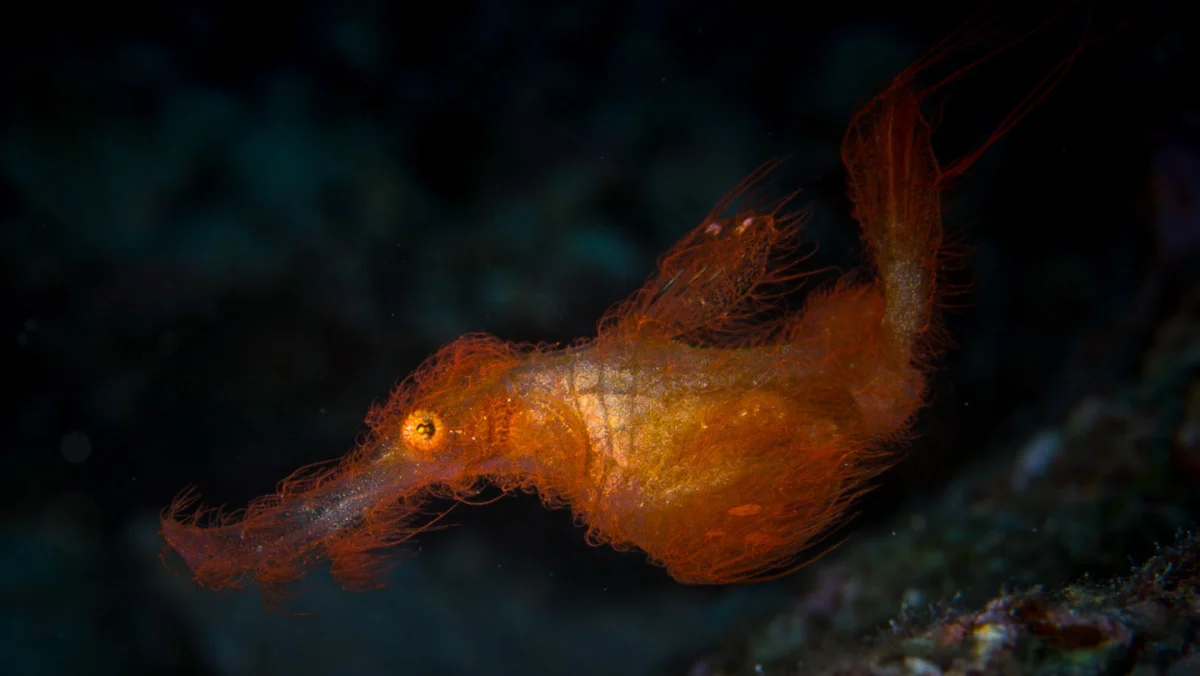
In the vibrant, kaleidoscopic world of Australia’s shallow marine ecosystems, a remarkable discovery has surfaced: a new species of ghost pipefish, colloquially dubbed the "Snuffleupagus" fish due to its distinctive, trunk-like snout and an extraordinary ability to blend seamlessly with its surroundings. This elusive creature, adorned with a thick coat of near-neon orange fibers that mimic the appearance of colorful coral and algae, represents a significant addition to our understanding of marine biodiversity and the intricate strategies employed by ocean dwellers for survival. The discovery, made in the waters near Australia, highlights the ongoing marvels hidden within the planet’s oceans and the critical importance of their preservation.
A Master of Disguise: The "Snuffleupagus" Fish Unveiled
The newly identified species belongs to the family Solenostomidae, commonly known as ghost pipefish. These fish, distantly related to the more widely recognized seahorses, are renowned for their exceptional camouflage abilities. However, the "Snuffleupagus" fish, as documented in recent scientific observations, pushes the boundaries of this natural artistry. Its most striking feature is its dense covering of filamentous appendages, which are not merely decorative but serve as a sophisticated form of mimicry. These fibers, ranging in hue from bright orange to a reddish-orange, closely resemble the delicate structures of certain types of coral and the frilly textures of red algae, allowing the fish to become virtually indistinguishable from its reef habitat.
The image accompanying the initial report vividly captures this phenomenon. A small fish, characterized by a prominent, elongated snout reminiscent of the beloved fictional character, is enveloped in these vibrant, fur-like growths. The visual effect is astonishing, creating an illusion of a living, breathing part of the coral structure itself. This level of adaptation is crucial for survival in environments teeming with both predators and prey. For a small, slow-moving fish, effective camouflage is not just an advantage; it is a prerequisite for existence.
The Discovery: A Chronicle of Observation and Identification
The journey from initial sighting to formal scientific description is often a meticulous process. While specific timelines for this particular discovery are not yet fully detailed in the preliminary reports, such findings typically emerge from extensive fieldwork and subsequent laboratory analysis. Marine biologists and ichthyologists often spend years surveying specific marine environments, documenting species, and collecting specimens.
It is plausible that the "Snuffleupagus" fish was observed on multiple occasions by divers and researchers exploring the coral reefs of Australia. These initial sightings, likely marked by a sense of wonder at the creature’s unusual appearance, would have triggered further investigation. The process would have involved careful observation of its behavior, habitat, and physical characteristics. Subsequently, specimens would have been collected, often through non-invasive methods or by careful netting, for detailed morphological and genetic analysis.
The genetic sequencing would have been particularly crucial in confirming its status as a new species, differentiating it from known ghost pipefish varieties. This process involves comparing its DNA to existing databases, identifying unique genetic markers that signify evolutionary divergence. The morphological examination would focus on its physical traits, including the structure of its snout, fins, and the unique fibrous appendages, comparing them to established taxonomic keys.
Background Context: The Rich Biodiversity of Australian Coral Reefs
Australia is home to some of the most diverse and extensive coral reef systems in the world, most notably the Great Barrier Reef. These ecosystems are biological hotspots, supporting an astonishing array of marine life, from microscopic plankton to large pelagic fish. The complexity and richness of these environments provide countless niches for specialized organisms, leading to evolutionary adaptations that are often breathtaking in their ingenuity.
Ghost pipefish, as a family, are found throughout the Indo-Pacific region, with various species inhabiting different reef structures. They are typically found in close association with specific host organisms, such as crinoids, gorgonian corals, and sponges, on which they rely for both shelter and camouflage. The "Snuffleupagus" fish’s ability to mimic a broader range of reef elements, including both coral and algae, suggests a particularly advanced form of mimicry, potentially allowing it to thrive in a wider variety of reef microhabitats.
The environmental conditions of these shallow seas, characterized by complex topography, fluctuating currents, and a dazzling interplay of light and shadow, create an ideal stage for the evolution of such sophisticated camouflage strategies. The presence of abundant algae and a variety of coral species would have provided the selective pressures necessary for the development of the "Snuffleupagus" fish’s unique fibrous covering.
Supporting Data and Scientific Significance
The scientific description of a new species involves rigorous documentation, including detailed measurements, anatomical descriptions, and ecological observations. While the initial announcement provides a captivating visual and a general description, a formal scientific paper would include precise data on:
- Morphological Characteristics: Detailed measurements of body length, snout length, fin ray counts, and the structure and distribution of the filamentous appendages. The texture, color variations, and potential for changing these fibers to match different backgrounds would also be noted.
- Genetic Data: Analysis of mitochondrial and nuclear DNA to establish its phylogenetic relationship with other Solenostomidae species and to confirm its distinct evolutionary lineage.
- Ecological Niche: Observations on its habitat preference, diet, reproductive strategies (if observed), and interactions with other species. The specific types of coral and algae it mimics would be meticulously documented.
- Geographic Distribution: Precise locations where specimens were collected or observed, contributing to mapping its known range.
The significance of this discovery extends beyond simply adding a name to the list of known species. It offers valuable insights into:
- Evolutionary Adaptation: The "Snuffleupagus" fish provides a case study in convergent evolution or extreme specialization within camouflage strategies. Understanding the genetic and developmental pathways behind its fibrous coat could reveal novel biological mechanisms.
- Reef Health Indicators: The presence and abundance of specialized species like this ghost pipefish can serve as indicators of the health of the coral reef ecosystem. Changes in their population or their ability to camouflage could signal environmental disturbances.
- Marine Conservation: The discovery underscores the vastness of undiscovered life in our oceans and the urgent need for conservation efforts to protect these fragile environments from threats like climate change, pollution, and overfishing.
Potential Implications and Future Research
The revelation of the "Snuffleupagus" fish prompts several avenues for future research and raises important questions about its ecological role and conservation status.
Implications for Understanding Camouflage: The complex, hair-like structures that grant this fish its remarkable camouflage are a subject of intense scientific interest. Researchers will likely investigate the cellular and molecular mechanisms behind the growth and maintenance of these fibers. Understanding how they are produced, their structural properties, and whether they can be actively manipulated by the fish to alter their appearance could lead to breakthroughs in biomimicry and material science. For instance, could these structures inspire new types of adaptive camouflage for technological applications?
Ecological Role and Interactions: Further studies are needed to understand the "Snuffleupagus" fish’s position in the food web. What does it eat, and what preys upon it? Its specialized camouflage suggests it may be a sit-and-wait predator, relying on its disguise to ambush small invertebrates. Understanding its interactions with its environment and other species will paint a more complete picture of the reef ecosystem’s intricate balance.
Conservation Status and Threats: As a newly described species, its population size, distribution, and any potential threats are likely unknown. Establishing its conservation status will be a priority. Given its reliance on specific coral reef habitats, it is inherently vulnerable to the impacts of coral bleaching, ocean acidification, and habitat destruction. The discovery serves as a stark reminder that many species may be disappearing before they are even known to science.
Broader Impact on Marine Science: The "Snuffleupagus" fish is more than just a scientific curiosity; it is a testament to the ongoing exploration and discovery within our planet’s oceans. It fuels the passion of marine biologists and encourages further investment in oceanographic research. Each new species discovered enriches our understanding of life’s diversity and the complex processes that have shaped it over millennia.
Conclusion: A Call for Continued Exploration and Protection
The emergence of the "Snuffleupagus" fish from the vibrant reefs of Australia is a captivating event in the world of marine biology. Its extraordinary camouflage, mimicking the very fabric of its coral reef home, showcases the boundless ingenuity of evolution. This discovery not only expands our knowledge of marine biodiversity but also serves as a powerful reminder of the vast, unexplored frontiers that still exist beneath the ocean’s surface. As scientists delve deeper into the secrets of this uncanny creature, its existence underscores the critical importance of protecting these invaluable marine ecosystems for generations to come. The "Snuffleupagus" fish, a living marvel of disguise, is a compelling call to action for continued exploration and robust conservation efforts worldwide.















Leave a Reply