A team of researchers at the University of Hong Kong (HKU) has successfully demonstrated that ultrathin, highly flexible diamond membranes can produce a measurable piezoelectric response, upending a foundational scientific assumption that has remained unchallenged for more than a century. This breakthrough bridges materials science, solid-state physics, and micro-electromechanical engineering, opening transformative pathways for advanced micro-energy harvesting, next-generation sensors, and biocompatible medical implants.
The groundbreaking research was spearheaded by Professor Zhiqin Chu from the Department of Electrical and Computer Engineering and Professor Yuan Lin from the Department of Mechanical Engineering, both stationed within the Faculty of Engineering at HKU. By combining advanced mechanical engineering techniques with rigorous quantum-mechanical modeling, the HKU research group has rewritten the textbook definition of diamond’s electrical capabilities under extreme physical deformation.
Challenging a Century-Old Materials Science Rule
Since the early decades of the twentieth century, diamond has been universally classified within solid-state physics and materials science as a strictly non-piezoelectric substance. Piezoelectricity—the ability of a material to generate an internal electrical charge in response to applied mechanical stress—was thought to be fundamentally absent in pure diamond due to its highly symmetrical crystal lattice structure.
This long-held classification heavily restricted how engineers utilized diamond in industrial and technological applications. While diamond boasts a formidable array of exceptional physical characteristics—including unmatched hardness, extreme tensile strength, chemical inertness, high acoustic wave velocity, phenomenal thermal conductivity, high dielectric breakdown strength, and an ultrawide electronic bandgap—its role in microelectromechanical systems (MEMS) was largely passive. Engineers routinely relied on diamond exclusively as a robust structural substrate or heat-dissipating support layer for other, genuinely piezoelectric materials such as quartz, lead zirconate titanate (PZT), or aluminum nitride.
Consequently, the concept of harvesting electrical energy directly from a diamond through mechanical flexing was widely dismissed by the academic and industrial engineering communities as practically impossible. The HKU team’s recent findings dismantle this historical boundary, demonstrating that altering a material’s physical dimensions can fundamentally awaken latent electromechanical properties.
From Bulk Rigidity to Nanoscale Flexibility: The Chronology of Experimentation
The pathway to this discovery required overcoming a profound physical limitation: bulk diamond is notoriously rigid and shatters rather than bends under significant mechanical stress. To test whether diamond could exhibit unconventional electromechanical behavior under extreme conditions, the HKU research team leveraged a recently developed advanced edge exfoliation technique.
Through this precision manufacturing process, the scientists successfully produced freestanding, ultrathin, highly flexible polycrystalline diamond membranes. Reducing the material to a nanometer-scale thickness fundamentally altered its mechanical profile, enabling the normally brittle carbon lattice to undergo substantial elastic bending without fracturing.
When the researchers deliberately subjected these flexible diamond membranes to controlled mechanical bending, highly stable voltage signals were recorded. To ensure absolute scientific rigor, the team designed and executed a comprehensive regime of mechanical cycling experiments. These rigorous testing protocols were specifically engineered to eliminate false positives, systematically ruling out environmental electromagnetic interference and triboelectric effects—unwanted surface charges generated by mechanical friction between contacting materials.
The experimental data confirmed that the voltage output appeared consistently, repeatedly, and proportionally in direct response to the mechanical flexing of the diamond membrane itself. This definitive evidence established that ultrathin diamond is indeed capable of direct piezoelectric transduction.
Deciphering the Quantum Mechanism: The Role of Grain Boundaries
To uncover the underlying physical mechanisms driving this unexpected piezoelectric phenomenon, the HKU researchers conducted advanced first-principles theoretical calculations based on density functional theory.
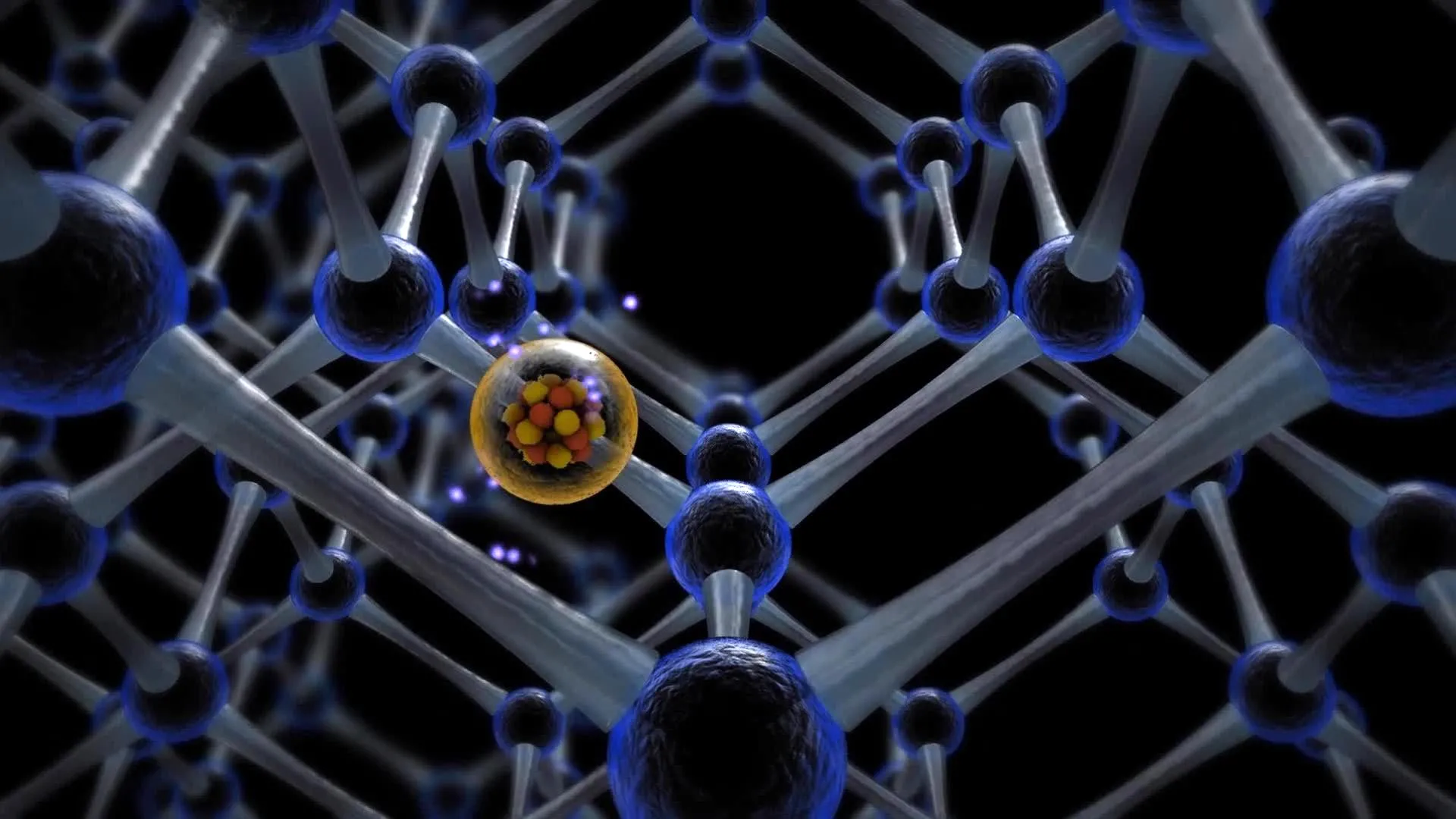
Their atomic-level analysis revealed that the electrical activity originates primarily from structural asymmetries located at the grain boundaries within the polycrystalline diamond structure. Unlike single-crystal diamond, which features a uniform, highly symmetric lattice, polycrystalline diamond is composed of countless microscopic diamond grains tightly joined together.
As the researchers applied mechanical force to bend the ultrathin membrane, differential stress concentrations caused electrical charge polarization to accumulate selectively around these intricate grain boundaries. This localized redistribution of charge generated a measurable electrical potential difference between the upper and lower surfaces of the membrane, successfully converting mechanical strain into electrical voltage.
This theoretical insight demonstrates that localized structural disorder and interfacial boundaries can be deliberately engineered to induce macroscopic functional properties in materials traditionally deemed inert or passive.
Industry Implications and Future Technological Applications
The confirmation of piezoelectricity in diamond membranes carries profound implications across multiple high-technology sectors, particularly where extreme durability, chemical inertness, and biological compatibility are paramount.
Diamond is exceptionally biocompatible, chemically stable in corrosive environments, and entirely non-toxic to living biological tissues. These traits render piezoelectric diamond membranes extraordinarily attractive for advanced biomedical engineering. Future applications could include implantable medical devices—such as pacemakers, neurostimulators, and internal health monitors—that operate autonomously by harvesting mechanical energy directly from the natural movements of the human body, including heartbeats, respiration, and muscle flexion. Additionally, these membranes could serve as highly sensitive biological sensors capable of detecting minute physical deformations in real time.
Beyond healthcare, the discovery paves the way for the development of rugged, high-reliability micro-energy systems capable of functioning reliably in hostile environments, such as high-temperature industrial machinery, aerospace propulsion systems, and deep-well subterranean monitoring equipment. By transforming diamond from a purely passive structural support into an active, energy-transducing component, this HKU-led breakthrough establishes a versatile new paradigm for nanomaterials engineering and self-powered electronic systems worldwide.