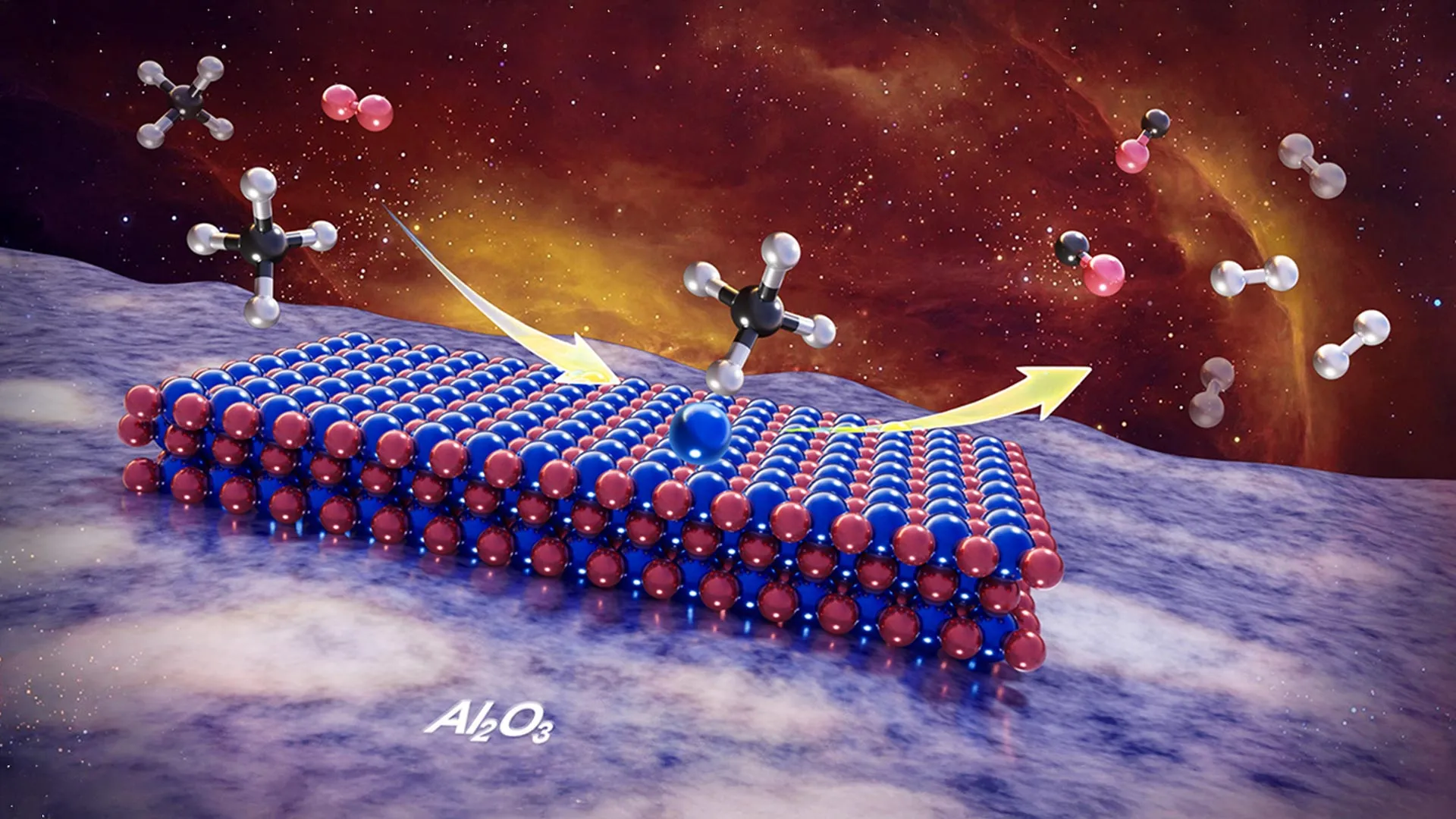
For decades, the petrochemical industry has relied on the partial oxidation of methane (POM) as a cornerstone technology for producing syngas—a vital industrial mixture of carbon monoxide and hydrogen used to manufacture synthetic fuels, methanol, and a wide array of valuable chemicals. Yet, a fundamental paradox has long frustrated heterogeneous catalysis researchers: while scientists widely assumed that metallic nickel nanoparticles served as the primary active centers driving the reaction, compelling evidence suggested that these metallic species might merely be artifacts. Specifically, analysts debated whether the metallic nickel observed post-reaction was merely a byproduct of nickel oxide being reduced by syngas at elevated operating temperatures, rather than the true catalyst performing the critical bond-activation steps. Resolving this long-standing ambiguity required a paradigm shift in how researchers observe catalysts under operating conditions, setting the stage for a breakthrough that promises to reshape industrial catalyst design.
A multi-institutional research consortium has finally resolved this decades-old controversy. In a landmark study published in the prestigious journal Nature Catalysis, scientists revealed that highly active, transient structures are formed in situ when nickel oxide surfaces undergo precise atomic reconstruction during the partial oxidation of methane. Led by an elite team of researchers from the Dalian Institute of Chemical Physics (DICP) of the Chinese Academy of Sciences (CAS)—including Profs. Tao Zhang, Aiqin Wang, and Xiaoyan Liu—alongside Prof. Wei Liu from DICP, Prof. Tao Yang from Xi’an Jiaotong University, and Prof. Graham J. Hutchings from Cardiff University, the study bridges the gap between static post-mortem analysis and real-time operational reality. By proving that catalytic activity stems from a dynamically formed atomic motif rather than bulk metallic nickel or static nickel oxide, the team has provided a blueprint for engineering high-efficiency, low-cost industrial catalysts.
The Chronology of a Scientific Breakthrough: From Post-Mortem Guesswork to Real-Time Observation
The journey toward this discovery spans years of frustration in the field of catalysis, where researchers struggled to reconcile macroscopic reaction rates with microscopic observations. Historically, surface science relied heavily on ex situ characterization—analyzing catalysts in vacuum chambers before and after exposure to reaction environments. However, under the harsh, high-temperature redox conditions characteristic of industrial POM, nickel catalysts undergo severe structural transformations. Nickel readily shifts its oxidation states and atomic coordination numbers, rendering traditional snapshot imaging inadequate for identifying true active sites.
Recognizing that catalysts are dynamic entities that adapt to their chemical environments, the DICP-led research team pivoted toward advanced in situ and operando characterization techniques. By combining real-time spectroscopic observations with high-resolution electron microscopy and rigorous density functional theory (DFT) calculations, the researchers traced the evolution of nickel-based catalysts from the moment reactants were introduced. They discovered that initial metallic nickel nanoparticles present at the start of the reaction were rapidly oxidized into a nickel oxide phase under POM conditions. However, standard nickel oxide alone was incapable of driving the reaction efficiently; pre-formed, pure-phase NiO catalysts bypassed partial oxidation entirely, catalyzing only the complete, undesirable combustion of methane into carbon dioxide and water.
The critical turning point came when the team utilized a specialized microemulsion synthesis method to fabricate a highly dispersed nickel-on-alumina (Ni/Al2O3) catalyst containing a mere 0.8 weight percent of nickel. Operating this ultra-low-loading material under realistic POM conditions allowed the scientists to capture the exact moment a unique surface motif—identified as a reconstructed [Ni1O4Ni4] structural unit—formed on the NiO(100) crystal facet. This dynamic restructuring proved that the true active site is neither a permanent metallic cluster nor a static metal oxide, but a transient, stress-induced atomic configuration born from the interplay between the catalyst surface and the reacting gas stream.
Decoding the Data: High Performance with a Fraction of the Metal
To validate the efficacy of the newly discovered active site, the research team subjected their ultra-low-loading 0.8 wt% Ni/Al2O3 catalyst to rigorous performance evaluations and benchmarked it against traditional formulations. The results exceeded expectations, demonstrating that catalytic efficiency does not scale linearly with metal content when active structures are engineered at the atomic level.
Under steady-state POM conditions, the 0.8 wt% Ni/Al2O3 catalyst achieved an exceptional methane conversion rate of 92 percent. Furthermore, the selectivities for the desired syngas components—carbon monoxide (CO) and hydrogen (H2)—reached an impressive 87.0 percent, while maintaining a remarkably stable H2-to-CO molar ratio of approximately 2.0. This specific ratio is considered the gold standard for downstream industrial applications, such as Fischer-Tropsch synthesis and methanol production, as it eliminates the need for expensive and energy-intensive gas-adjustment steps.
Most astonishingly, post-reaction analyses revealed almost no detectable metallic nickel nanoparticles in the catalyst. Despite utilizing only one-tenth of the active metal content typically required, this lean catalyst performed comparably to a conventional 8.0 wt% Ni/Al2O3 catalyst prepared via standard wet impregnation methods.
To prove that the synthesis method—and not just the low nickel content—was responsible for this extraordinary performance, the researchers synthesized a comparative 0.8 wt% Ni/Al2O3 material using traditional impregnation. Tested under identical operating conditions, the conventionally prepared low-loading catalyst failed to promote partial oxidation, defaulting instead to complete methane combustion. This stark performance contrast underscored the importance of nickel dispersion and precursor interaction in facilitating the necessary surface reconstruction.
Theoretical Insights: Unlocking the Kinetics of C-H Bond Activation
To understand why the reconstructed [Ni1O4Ni4] motif exhibits such remarkable catalytic prowess, the research team turned to advanced quantum-chemical modeling using density functional theory (DFT) calculations. Activating methane is notoriously difficult due to the exceptional strength of its nonpolar carbon-hydrogen (C-H) bonds, which typically require high activation energies to break.
The theoretical models provided a compelling kinetic explanation for the experimental findings. Calculations revealed that the activation barrier for C-H bond dissociation on the newly discovered, reconstructed [Ni1O4Ni4] structural unit on the NiO(100) surface was a mere 12.5 kilocalories per mole (kcal·mol⁻¹).
This energy barrier is radically lower than the activation energy calculated for an intact, unreconstructed NiO(100) surface, which stands at a prohibitive 38.5 kcal·mol⁻¹. Furthermore, the kinetic barrier of the dynamic [Ni1O4Ni4] motif undercuts even the traditional benchmark: the metallic Ni(111) surface, which exhibits an activation barrier of 15.7 kcal·mol⁻¹.
This substantial kinetic advantage explains the experimental success of the catalyst. By lowering the energetic threshold required to cleave the initial C-H bond, the dynamically formed surface motif accelerates the reaction pathway toward syngas production while suppressing runaway combustion pathways. The convergence of experimental observation and theoretical calculation definitively establishes that catalytic activity emerges from dynamic structural adaptation under reaction conditions.
Expert Perspectives and Industry Implications
The implications of this discovery extend far beyond academic curiosity, offering a new paradigm for industrial catalysis. Platinum-group metals have historically dominated high-efficiency catalytic processes, while base metals like nickel have often required high loadings to compensate for lower intrinsic activity and rapid deactivation via coking or sintering. By demonstrating that trace amounts of base metals can be coaxed into forming highly active, highly dispersed surface motifs, this study points the way toward a more sustainable chemical manufacturing sector.
Reflecting on the broader significance of the work, Prof. Xiaoyan Liu emphasized the necessity of modern analytical methodologies in modern materials science. "Our study highlights the critical role of in situ characterization in identifying dynamic active structures under reaction conditions," Prof. Liu noted. "Dynamic reconstruction enables low-loading catalysts to achieve high performance, offering new opportunities for the rational design of efficient catalysts while reducing reliance on high metal loadings."
Industry analysts and chemical engineers suggest that the ability to engineer catalysts capable of undergoing controlled surface reconstruction could revolutionize how syngas is produced worldwide. Methane is the primary component of natural gas and an increasingly abundant resource derived from shale formations and biogas initiatives. Efficiently converting methane into syngas without requiring excessive precious-metal or high-loading base-metal catalysts translates directly into reduced capital expenditures, lower environmental footprints, and enhanced process economics.
Furthermore, the methodological framework established by the DICP, Xi’an Jiaotong, and Cardiff University collaboration serves as a roadmap for studying other challenging catalytic reactions. By treating catalysts as living systems that adapt to their chemical environments—rather than static substrates—researchers can begin to re-evaluate established catalysts across energy storage, carbon capture, and green fuel generation.
As the global energy landscape transitions toward greater efficiency and sustainability, innovations at the sub-nanoscale will continue to drive industrial progress. By decoding the hidden life of nickel during methane conversion, this international research team has not only resolved a decades-old scientific debate but has also laid the foundational science for the next generation of industrial chemical technologies.