In a significant milestone for theoretical condensed matter physics, a research team at the Helmholtz-Zentrum Berlin (HZB) has demonstrated that fractons—exotic quasiparticles historically confined to highly idealized theoretical frameworks—can emerge within realistic quantum solid-state models. This breakthrough, spearheaded by Professor Johannes Reuther and Dr. Nils Niggemann, bridges a critical chasm between abstract gauge field theories and physical realizations, potentially unlocking new pathways toward fault-tolerant quantum computing and ultra-stable data storage.
Quasiparticles are foundational concepts in modern physics. They represent collective excitations or emergent phenomena arising from the complex, many-body interactions of countless particles inside a solid medium. Familiar examples include phonons, which describe the propagation of lattice vibrations through a crystal, and plasmons, representing plasma oscillations. However, fractons represent a vastly different tier of complexity and strangeness.
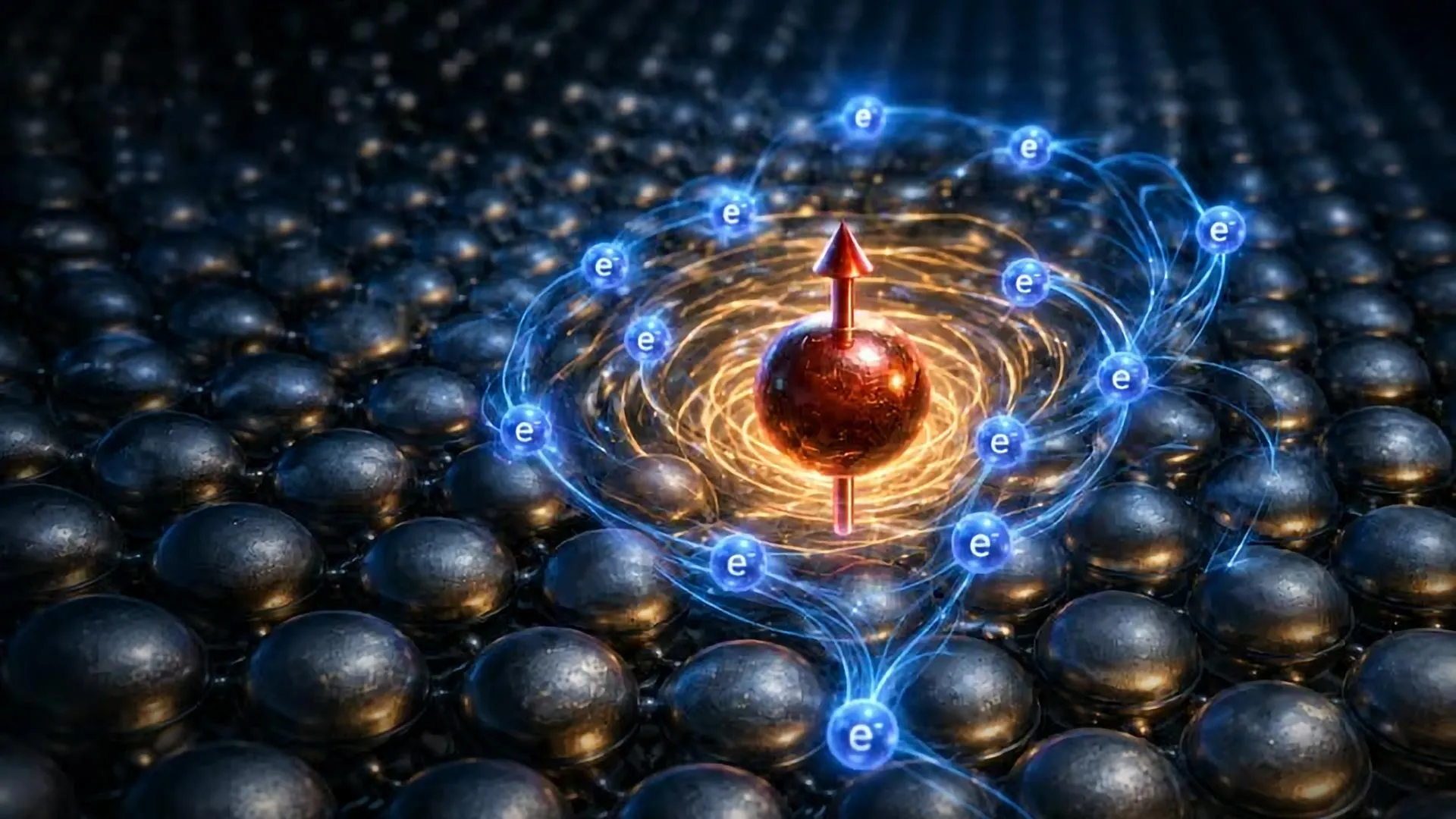
Unlike conventional quasiparticles that propagate freely across a crystalline lattice, fractons are characterized by severely restricted mobility. Confined strictly to the boundaries and corners of magnetic domain walls—regions separating distinct microscopic spin arrangements—a single fracton is fundamentally immobile on its own. It cannot translate through the lattice independently; instead, it can only be displaced through cooperative, highly constrained interactions with neighboring fractons.
This extreme kinematic restriction is more than a mere academic curiosity. In the realm of quantum information science, mobility translates to vulnerability. Standard quantum bits, or qubits, are notoriously fragile, suffering from decoherence caused by environmental noise and thermal fluctuations. Because fractons are spatially trapped and topologically constrained, physicists have long theorized that they could serve as robust information carriers. Constructing a quantum memory architecture utilizing fractons could theoretically shield stored data from localized errors, offering a pathway to intrinsically protected quantum hardware.
The Theoretical Evolution of Fractonic States
Until recently, predicting the existence of fractons required sweeping theoretical assumptions. Historically, theoretical physicists identified these quasiparticles within quantum spin liquids—exotic states of matter where the magnetic moments of electrons refuse to freeze into an orderly, static crystalline lattice, even when cooled to absolute zero (0 Kelvin). Instead, electron spins remain in a state of perpetual quantum fluctuation, mimicking the chaotic, dynamic movement of molecules in a liquid.
While quantum spin liquids provide a fertile theoretical playground, confirming the presence of fractons within them has remained an elusive experimental goal. Previous theoretical models relied almost exclusively on generalized rank-2 U(1) gauge field theories. While mathematically elegant, these frameworks employ high-level abstractions that are notoriously difficult to map onto tangible, laboratory-bound materials. They treat interactions as broad, idealized symmetries, leaving a vast canyon between pencil-and-paper equations and physical verification.
The HZB research team sought to dismantle this limitation. By shifting the investigative focus from idealized gauge theories to a grounded, realistic quantum solid-state model, Reuther and Niggemann embarked on a rigorous numerical simulation campaign to determine whether fractons could survive the harsh realities of competing quantum fluctuations.
Navigating the Quantum-Classical Paradox
Simulating quantum matter is computationally intensive and fraught with paradoxes. Classical models of magnetism fail to capture the subatomic weirdness of quantum mechanics, yet pure quantum treatments often collapse under their own mathematical weight when scaled to realistic systems.
In earlier exploratory phases, the HZB research group encountered a fundamental roadblock that threatened to halt the project. The simulations revealed a delicate, highly unstable balancing act regarding quantum effects. When the simulated quantum fluctuations were dialed up to accurately reflect true quantum dynamics, the hypothesized fractons destabilized and completely vanished from the system. Conversely, when the quantum parameters were weakened to allow the fractons to manifest stably, the particles shed their genuine quantum properties, degrading into mundane, classical defects governed by standard thermodynamics. The window for viable fractonic behavior appeared mathematically closed.
The turning point came through a refined mathematical formulation of spin interactions within the numerical algorithms. By improving how the model calculated the nuanced interplay between neighboring atomic spins, the researchers successfully stabilized the elusive phase of matter. The updated numerical simulations provided robust, statistically significant evidence that fractons can indeed endure under realistic quantum mechanical conditions, proving that the phenomenon is not merely an artifact of overly simplistic gauge theories.
Chronology of the Discovery
The journey toward simulating fractons in realistic solids spans years of incremental theoretical developments and computational advancements within the international physics community.
The conceptual foundation of fractonic phases originated roughly a decade ago, driven by theorists attempting to classify novel states of quantum matter. Early papers utilized toy models and generalized gauge theories to demonstrate that subdimensional particles could exist.
By the late 2010s and early 2020s, the HZB research group began investigating magnetic frustration in complex lattices, recognizing that traditional models failed to account for localized constraints on spin textures. Over the past twenty-four months, Dr. Nils Niggemann and Professor Johannes Reuther focused intensively on refining numerical algorithms capable of handling competing quantum and classical interactions without succumbing to the "sign problem" or computational divergence.
The culmination of these efforts materialized in the recent breakthrough: a set of advanced tensor-network and Monte Carlo simulations demonstrating that realistic spin Hamiltonians can host fractonic excitations. The findings have laid the groundwork for the next major phase of research: experimental realization.
Collaborative Synergy and Experimental Horizons
A critical catalyst for the HZB team’s success has been the close proximity and continuous dialogue between theoretical physicists and experimental condensed-matter researchers at Helmholtz-Zentrum Berlin. Bridging the gap between a computer simulation and a physical laboratory requires an intimate understanding of material science, crystal growth, and spectroscopy.
"When modeling this complex spin interaction, we benefit from personal exchanges with HZB colleagues in experimental solid-state physics," noted Professor Johannes Reuther, highlighting the institution’s interdisciplinary environment. This collaborative feedback loop ensures that theoretical models do not drift into mathematical fantasy, but instead retain parameters that experimentalists can eventually target.
With the theoretical feasibility of fractons in realistic solids now established, the global physics community faces a formidable operational challenge: identifying or synthesizing actual physical materials that replicate the precise conditions assumed in the HZB model.
Because naturally occurring minerals rarely exhibit the exact microscopic parameters required to isolate fractons, researchers are increasingly looking toward synthetic quantum simulation platforms. Among the most promising avenues are Rydberg atom arrays—systems where ultra-cold atoms are manipulated individually using optical tweezers and excited into high-energy Rydberg states. These programmable quantum simulators allow scientists to dial in specific interaction strengths and lattice geometries, offering a controlled laboratory playground to recreate complex quantum solid-state Hamiltonians.
Broader Implications for Quantum Technologies
The successful simulation of fractons in realistic models carries profound implications for the trajectory of modern physics and technology. If experimental physicists can successfully engineer platforms that host these quasiparticles, the impact will reverberate across multiple high-tech sectors.
Foremost among these is quantum information science. The pursuit of fault-tolerant quantum computing remains the holy grail of contemporary physics. Present-day noisy intermediate-scale quantum (NISQ) computers struggle with environmental decoherence, requiring massive overhead in error-correction codes. By leveraging the restricted mobility of fractons, theorists envision memory storage units where quantum states are topologically protected against local disturbances. Because a single fracton cannot move independently, random thermal noise cannot easily flip or destroy encoded information without imparting a coordinated, highly improbable multi-particle interaction.
Furthermore, the research deepens fundamental understandings of quantum many-body physics. Fractonic phases represent a departure from traditional Landau paradigm classifications of matter, pointing toward entirely new classes of emergent phenomena where space and degrees of freedom are fundamentally fractionalized.
As the HZB team transitions from computational discovery to experimental collaboration, the physics community stands on the precipice of a new experimental frontier. What began as an abstract mathematical prediction in generalized gauge theories is now a concrete target within the crosshairs of experimental quantum science. Whether through synthetic Rydberg lattices or novel magnetic crystal compounds, the quest to capture, contain, and utilize the elusive fracton has officially entered its most tangible era.