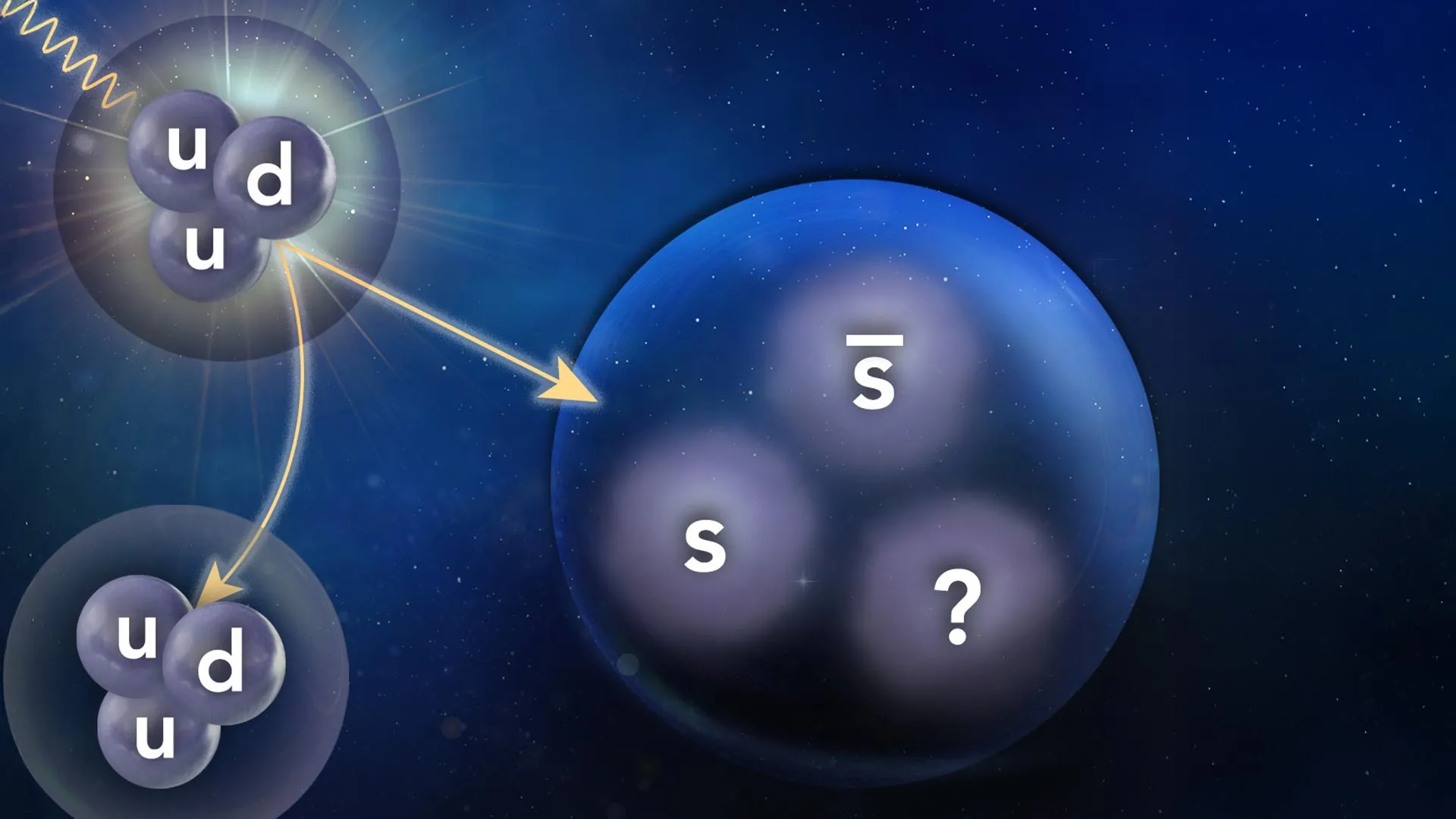
For decades, modern physics has wrestled with the formidable challenge of cataloging the subatomic realm, establishing an elaborate taxonomy of matter that standard models frequently struggle to fully contain. Now, cutting-edge research conducted at the U.S. Department of Energy’s Thomas Jefferson National Accelerator Facility has introduced a compelling new chapter to this ongoing scientific quest. Physicists working with the Gluonic Excitations Collaboration, commonly known as GlueX, have officially identified concrete evidence for two previously undetected subatomic structures. These signals emerge from a notoriously enigmatic category of particles known as XYZ states, entities that defy traditional quark configurations and continue to test the limits of our understanding of the strong nuclear force.
Published recently in the prestigious academic journal Physical Review Letters, these new findings provide theorists with fresh data points to decode how nature binds elementary particles together. Rather than observing a previously theorized particle through an alternate method, the research team stumbled upon two distinct, unexpected resonances. This breakthrough not only expands the expanding frontier of hadron spectroscopy but also signals a transformative shift in how high-energy physicists utilize photon beams to probe the fundamental architecture of the universe.
The Historical Evolution of the Particle Zoo
To understand the weight of the recent Jefferson Lab discovery, one must look back at the historical milestones that shaped modern particle physics. Beginning in the 1950s, a flood of new particle discoveries emerged from high-energy collision experiments. These composite entities, collectively termed hadrons, are bound together by the strong nuclear force—one of the four fundamental forces of nature. Within this broad classification, physicists identified mesons, typically characterized as bound pairs of a quark and its antimatter equivalent, an antiquark.
In 1964, Murray Gell-Mann and George Zweig independently introduced the revolutionary quark model to bring order to this chaotic particle landscape. The initial iterations of this model relied on just three lighter quark flavors: up, down, and strange. These ingredients proved sufficient to explain everyday matter, such as the protons and neutrons making up atomic nuclei, as well as a variety of short-lived mesons.
The theoretical framework experienced another seismic shift in 1974 with the discovery of the charm quark, a significantly heavier constituent that confirmed the theoretical framework soon to be codified as the Standard Model of particle physics. As accelerators grew more powerful and detectors achieved unprecedented precision, physicists expanded the quark model to six flavors. Yet, as the turn of the 21st century approached, experiments began uncovering a new generation of hadrons that refused to conform to traditional expectations. These anomalies possessed strange quantum properties that could not be easily reconciled with standard quark-antiquark pairings, prompting the scientific community to adopt the catch-all designation of XYZ states.
Probing the Strange Quark Sector and the Search for Y(2175)
The newly discovered signals reside within a complex neighborhood of the subatomic spectrum associated with strange quarks. Particles containing a charm quark and an anti-charm quark occupy the charmonium region, whereas their strange and anti-strange counterparts populate the strangeonium spectrum. A significant proportion of identified XYZ states have been isolated within these specific sectors, drawing intense global scrutiny.
A major milestone in this subfield occurred in 2006, when researchers on the BaBar experiment at the DOE’s SLAC National Accelerator Laboratory detected a potential strangeonium state carrying a mass of roughly 2.16 billion electron volts, or 2.16 GeV. Designated as the Y(2175), this particle was generated via electron-positron ($e^+e^-$) annihilation, a process wherein electrons and positrons collide and annihilate into pure energy before materializing into new particles.
The quantum behavior exhibited by the Y(2175) immediately puzzled theorists. Conventional quark-antiquark models struggled to account for its properties, leaving open several radical possibilities. Some physicists hypothesized that Y(2175) represents a hybrid state—an exotic meson where excited gluons, the force-carrying particles of the strong interaction, actively participate in the internal binding. Other theories suggested a tetraquark configuration consisting of four quarks, or alternatively, a tightly bound molecular composite of traditional mesons.
Over the subsequent years, major international facilities—including the Beijing Spectrometer in China and the Belle experiment in Japan—successfully corroborated the existence of Y(2175). However, every single observation of this elusive state relied exclusively on electron-positron annihilation. Validating its existence through an entirely independent physical process remained a critical objective for the global particle physics community, setting the stage for the GlueX Collaboration’s novel approach.
The GlueX Experiment: Harnessing High-Energy Photons
Determined to test whether Y(2175) could be produced through alternative mechanisms, the GlueX Collaboration set out to utilize photoproduction in Experimental Hall D at Jefferson Lab. The collaboration leveraged the Continuous Electron Beam Accelerator Facility, a premier DOE Office of Science user facility that annually supports more than 1,700 researchers worldwide.
The experimental setup is uniquely engineered for precision spectroscopy. CEBAF delivers an intense stream of high-energy electrons, which are directed through an ultrathin diamond wafer. This process converts the electron beam into a highly coherent stream of polarized, high-energy photons. Millions of these photons then collide with protons housed inside a liquid hydrogen target every single second. A massive, high-acceptance spectrometer subsequently records the resulting cascade of secondary particles produced in the collisions.
"No other experiment has a facility with a photon beam of this intensity at the energy we have available," noted Malte Albrecht, a staff scientist at Jefferson Lab. "This truly is a unique setup."
The sheer volume of data generated by this apparatus is staggering, capable of saturating an average consumer laptop hard drive within minutes. Sifting through this immense dataset requires sophisticated computational algorithms and meticulous calibration. The primary objective of the search was clear: to find evidence of the elusive Y(2175) particle via photoproduction. Instead, the data revealed something entirely unanticipated.
Unexpected Discoveries: Y(2240) and X(1830)
When the research team analyzed the photoproduction data, the expected signal for Y(2175) failed to materialize. Rather than validating the known particle at its established mass, the analysis uncovered two distinct, unexpected structures residing at nearby mass scales.
The first and more prominent of the two structures appeared at a mass of approximately 2.24 GeV and was designated as Y(2240). Statistical analysis of the data confirmed this signal with extraordinary precision, achieving a confidence level of 99.9994%. In the formal language of particle physics, this corresponds to a five-sigma ($5sigma$) significance level, indicating that the probability of the signal being a random statistical fluctuation is less than one in a million—the gold standard required to claim the discovery of a new particle resonance.
The second structure, designated as X(1830), emerged at a mass of approximately 1.82 GeV. While the statistical significance for this secondary signal was more modest at three sigma ($3sigma$), representing a confidence level of roughly 99.7%, it remains an intensely intriguing anomaly that demands further investigation.
"One of the interesting things about this result is that we didn’t observe Y(2175) at the place we were searching," remarked Albrecht. "We found something new using a completely different physics process, and that’s really intriguing. But now that these have been observed, that doesn’t mean we’re done."
Theoretical Implications and the Role of Quantum Chromodynamics
The identification of Y(2240) and X(1830) provides vital empirical constraints for theorists attempting to solve the equations of Quantum Chromodynamics (QCD), the foundational theory describing the strong nuclear force. QCD permits the existence of exotic configurations where gluons—normally confined to mediating forces between quarks—can play an active structural role, forming hybrid mesons and other complex hadronic states.
"Excited gluonic fields are what could be in these mesons where you have more than just the quark-antiquark pair," explained Justin Stevens, a physics professor at the College of William & Mary and the spokesperson for the GlueX Collaboration. "That’s one of the investigations, to try to understand whether there is a gluonic contribution to the structure we see."
By successfully observing these unexpected resonances through photoproduction rather than electron-positron annihilation, the Jefferson Lab team has demonstrated that the production mechanism plays a decisive role in which exotic states are accessible. Furthermore, the analysis established definitive upper limits on the probability of producing Y(2175) via photon beams, furnishing theoretical modelers with critical boundaries that will refine future predictions and experimental designs.
Official Responses and Perspectives from the Collaboration
The international team behind the GlueX experiment views these findings not as an isolated endpoint, but as the opening salvo in a much broader exploratory campaign. As researchers continue to parse through massive archives of experimental data, the implications of Hall D’s unique capabilities are becoming increasingly clear.
"We are in a new era here, similar to 70-odd years ago," observed Frank Nerling, a collaborator from Germany’s GSI Helmholtz Centre for Heavy Ion Research and Goethe University Frankfurt. "First, a zoo of hadrons was discovered. Now, we’re facing a zoo of so-called exotic states."
Emphasizing the collaborative nature of global particle physics, Klaus Goetzen, another GSI physicist working at Jefferson Lab, underscored the complexities of harmonizing data from disparate facilities. "The challenge is that you have many measurements around the world in very different experiments that have to find consensus about what they are seeing. It’s more complicated than it sounds, because there are states that are close by in mass and might or might not be the same thing."
With the empirical foundation now firmly established, the theoretical physics community faces the task of interpreting these signals. "The next step is to figure out which exotic quark configurations nature might have realized here," Nerling added. "Theorists may come to further conclusions and identify measurements that could help pin down the real nature of these particular states."
Broader Impact and Future Outlook for Hadron Spectroscopy
The successful identification of Y(2240) and X(1830) marks a turning point for experimental hadron spectroscopy. By proving that high-energy photon beams can effectively probe and reveal complex, unexpected subatomic structures, the Jefferson Lab facility has validated a powerful new methodology for exploring the subatomic landscape.
As computational capabilities advance and accelerator technologies continue to mature, physicists are better equipped than ever to navigate the intricacies of the subatomic zoo. The GlueX Collaboration currently possesses substantial reservoirs of unanalyzed data, suggesting that the recent publications in Physical Review Letters represent merely the tip of the iceberg.
"It really opens the door for a whole new set of hadron spectroscopy measurements we can make with GlueX," concluded Stevens. "We’ve got much more data to sort through, so this is just the beginning of the story."