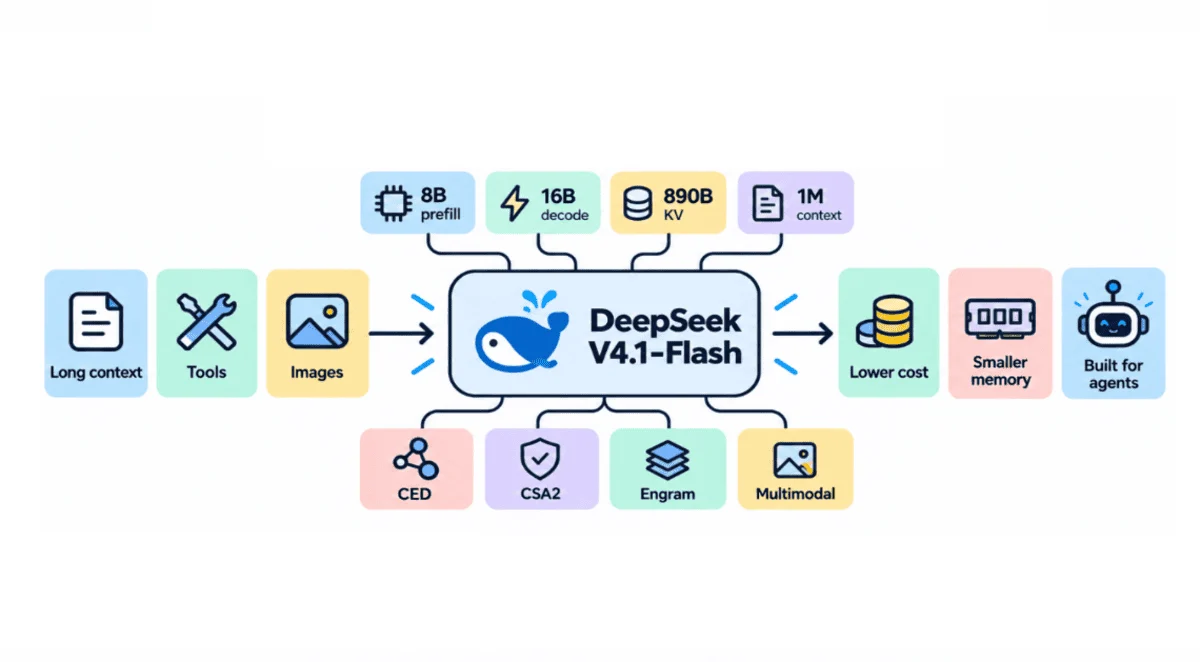
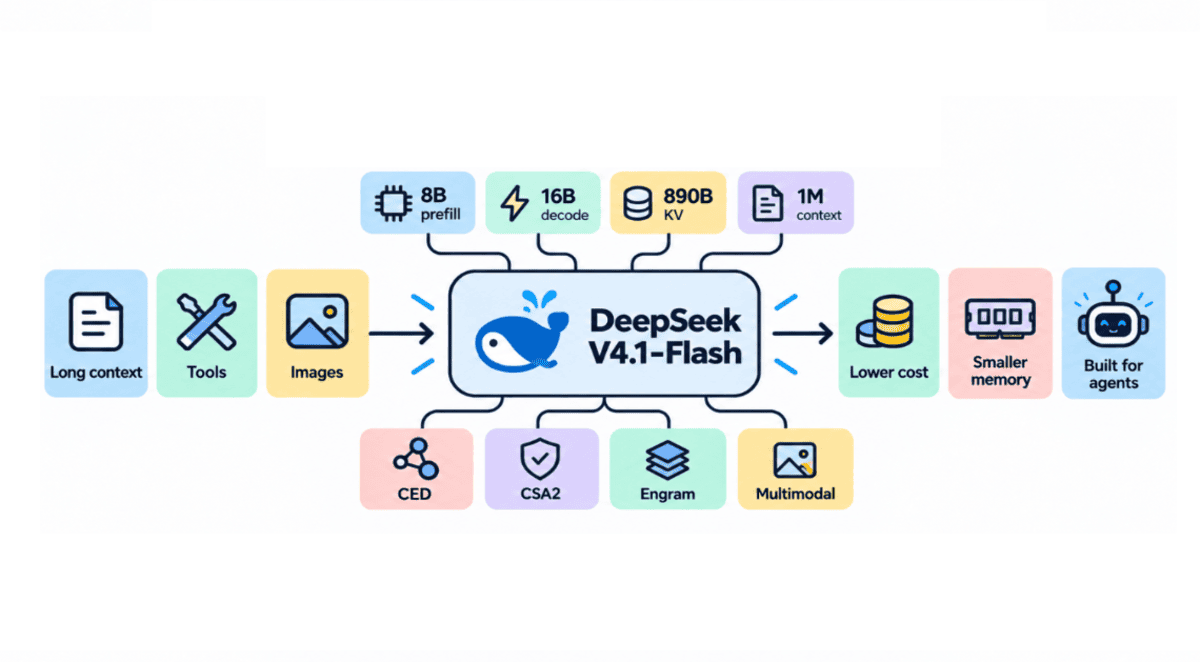
The landscape of artificial intelligence infrastructure experienced a significant shift with the official release of DeepSeek-V4.1-Flash by artificial intelligence research lab DeepSeek. While mainstream media attention routinely fixates on benchmark scores and raw parametric scale, this particular iteration introduces fundamental architectural departures from standard transformer designs. As the industry transitions from simple conversational interfaces to complex, long-running autonomous agents, the economic and computational hurdles of inference have grown exponentially. DeepSeek-V4.1-Flash is engineered specifically to address these mounting challenges, targeting the hidden bottlenecks of modern machine learning deployment: expensive input prefill phases, bloated key-value (KV) memory caches, massive context windows, and the high cost of maintaining multi-turn operational state across extended interactions.
Rather than relying solely on brute-force scaling—a strategy that inflates hardware requirements and operational expenditures—DeepSeek has systematically re-engineered the model architecture and its underlying inference stack. By decoupling the computational intensity of reading massive prompts from the generation of token outputs, the laboratory has demonstrated a pathway toward high-efficiency, long-context language modeling. Released under the permissive MIT license along with comprehensive reference code, the model represents both a practical tool for developers and a blueprint for the future design of open-source architectures.
Background Context and the Evolution of Agentic Workflows
To understand the engineering significance of DeepSeek-V4.1-Flash, one must examine the operational demands of contemporary AI systems. The paradigm of artificial intelligence has evolved rapidly from static question-and-answering chatbots to autonomous agents capable of executing multi-step coding tasks, navigating terminal environments, conducting security audits, and performing browser automation. These agentic workflows inherently alter the consumption pattern of computational resources.
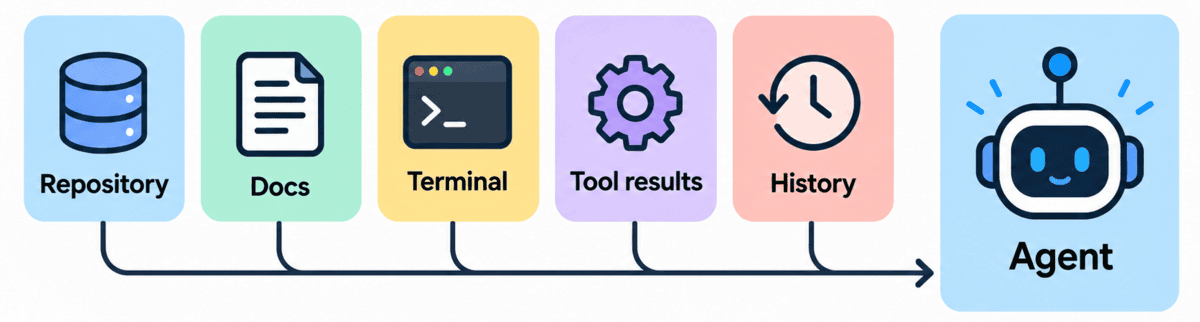
In a traditional chat setting, input prompts are relatively concise, followed by moderately lengthy model responses. Autonomous agents invert this ratio entirely. A software-engineering agent, for instance, frequently evaluates hundreds of thousands of lines of code, system logs, and documentation histories—totaling hundreds of thousands of input tokens—before generating a targeted patch consisting of only a few dozen tokens. Under standard decoder-only architectures, the computational cost of ingesting this massive input stream scales linearly and heavily burdens the infrastructure, as reading and writing incur near-equal resource demands.
Over the preceding development cycles, DeepSeek established a reputation for disruptive efficiency, most notably through its Mixture-of-Experts (MoE) implementations and optimized inference routing. The V4.1-Flash release builds upon this institutional knowledge, directly confronting the architectural friction that limits the viability of long-running autonomous operations. By optimizing memory access patterns and reducing the physical memory footprint required to maintain extended contexts, the laboratory aims to make enterprise-grade agentic deployment economically sustainable.
Architectural Breakthroughs: Redefining Prefill and Decode Dynamics
The core innovation of DeepSeek-V4.1-Flash lies in its asymmetric handling of computational phases. Inference in large language models fundamentally consists of two distinct stages: prefill, where the model parses and encodes the input prompt, and decoding, where tokens are generated sequentially.
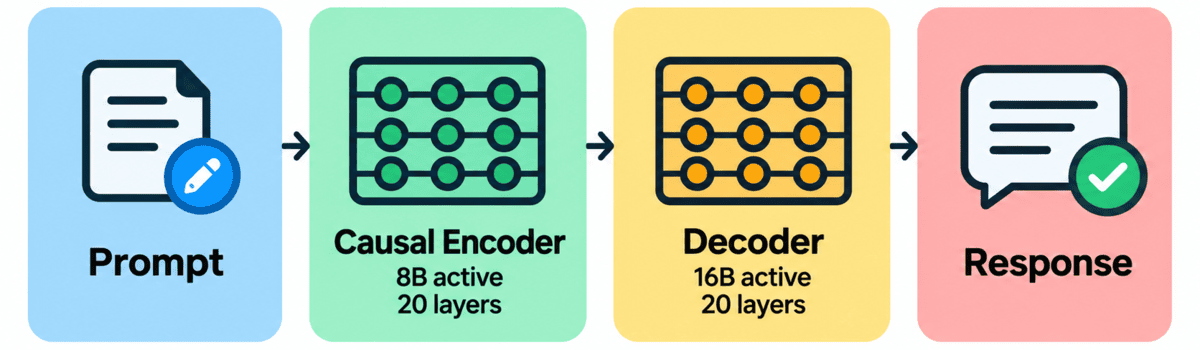
DeepSeek-V4.1-Flash operates as a 552-billion-parameter Mixture-of-Experts model, yet it strategically activates only 8 billion parameters per token during the prefill phase, scaling up to 16 billion active parameters per token during the decoding phase. This asymmetrical profile is achieved primarily through the implementation of a novel Causal Encoder-Decoder (CED) architecture. Comprising a 20-layer causal encoder coupled with a 20-layer decoder, the system fundamentally changes how global key-value representations are managed. Instead of forcing every independent decoder layer to generate a complete global KV representation during prompt ingestion, the decoder efficiently derives its global KV data directly from the encoder’s final representation.
This structural split ensures that the model expends minimal computational energy during the ingestion of large informational payloads, reserving its higher active parameter capacity for the critical reasoning and generation phases. For developers deploying automated agents that process vast amounts of background data before rendering a decision, this inversion of traditional compute profiles aligns precisely with operational needs.
Mitigating Memory Bloat via Compressed Sparse Attention 2 (CSA2)

Beyond computational efficiency during prefill, long-context models face an acute infrastructure crisis regarding the key-value cache. As context windows expand toward the one-million-token mark, storing historical token representations consumes vast amounts of high-bandwidth memory (HBM), often becoming the primary bottleneck that dictates hardware cluster sizing.
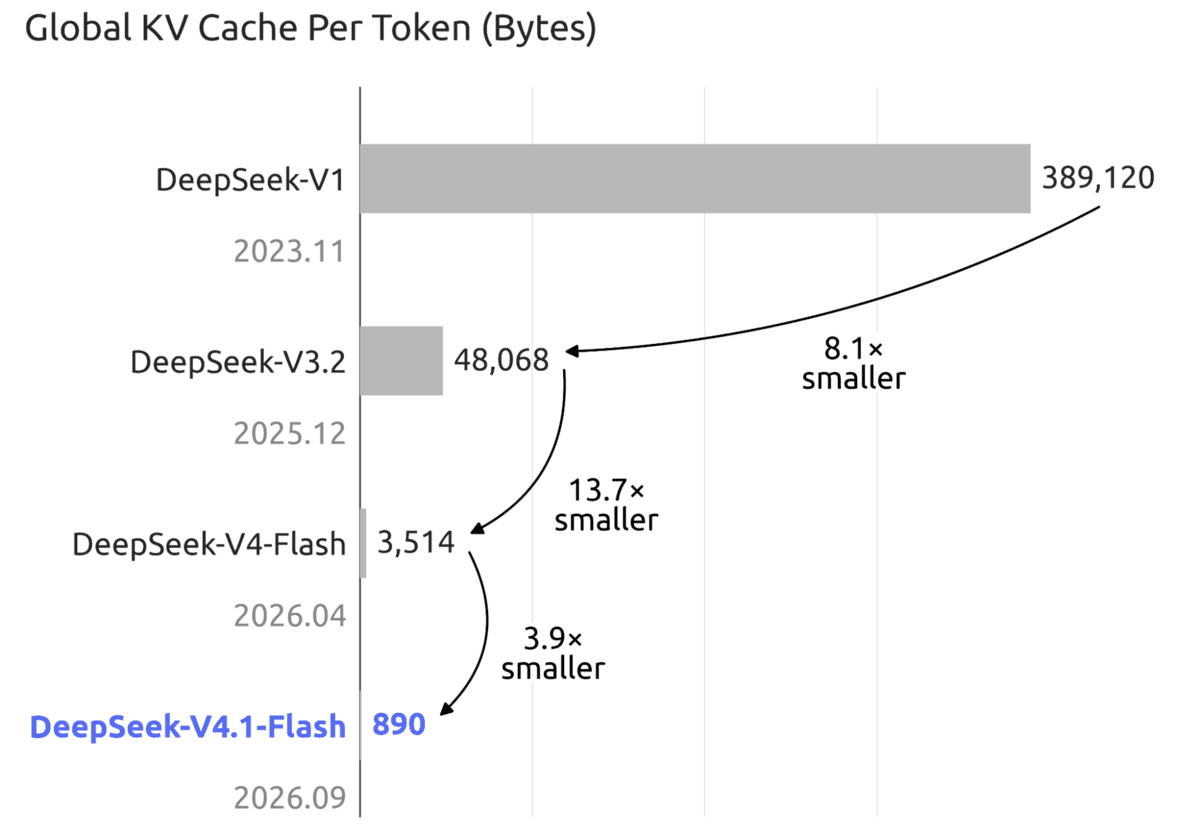
DeepSeek-V4.1-Flash addresses this limitation by shrinking its global KV cache to an exceptionally lean 890 bytes per token. For a full one-million-token context window, the global KV data footprint is restricted to approximately 890 megabytes, requiring roughly one-quarter of the HBM demanded by its predecessor, V4-Flash.
This dramatic reduction is facilitated by Compressed Sparse Attention 2 (CSA2). Traditional transformer architectures frequently suffer from redundancy, where multiple attention layers independently generate, store, and repetitively search identical historical KV information. CSA2 eliminates this duplication by introducing a multi-mode sharing framework encompassing Full, Reindex, and Reuse operations.
- Full Mode: The model creates new KV information and conducts a comprehensive search to isolate the most relevant contextual tokens.
- Reindex Mode: The system reuses existing KV information generated by preceding layers but performs a fresh, targeted search over it.
- Reuse Mode: The architecture bypasses redundant computation entirely, utilizing both the pre-existing KV information and previous search results.
Complementing CSA2 is a Hierarchical Sparse Indexer. When navigating a context containing one million tokens, the model avoids brute-force scanning across every layer. Instead, an early-stage indexer narrows down the massive token pool into a refined subset of high-relevance candidates. Subsequent layers then restrict their search parameters to this curated subset. Combined with FP4 KV caching—which compresses numerical representations into ultra-low-precision formats—these mechanisms collectively achieve unprecedented memory economy without sacrificing contextual recall.
Additional Engineering Innovations: SWA, Engram Memory, and mHC
The architectural enhancements of DeepSeek-V4.1-Flash extend far beyond its attention mechanisms, incorporating a suite of complementary optimizations designed to streamline data movement and memory allocation:

- SWA Bounded Replay: This feature minimizes the necessity of retaining continuous, uninterrupted attention states in memory. By intelligently discarding non-essential intermediate states and selectively rebuilding a compact sliding window when required, the model reduces persistent KV storage requirements to approximately one-eighth of previous generation levels.
- Engram Conditional Memory: Operating as a sparse, external conditional-memory component housing 196 billion parameters, Engram functions as an associative lookup mechanism rather than an active computational backbone. Instead of executing the entirety of these parameters for every processed token, the network selectively retrieves specific informational snippets on demand, significantly enhancing storage capacity without imposing a proportional compute tax.
- Single-Pass mHC: Data movement within traditional neural network layers often involves repetitive reading and mixing of activation states. Single-Pass mHC reorganizes internal data pipelines to execute these operations within a single pass, slashing internal memory traffic by roughly 50 percent and directly accelerating inference speeds.
- DSpark Speculative Decoding: To maximize output generation velocity, DSpark employs a draft-and-verify paradigm. The system rapidly generates multiple candidate draft tokens, which are subsequently validated in parallel by the primary model. Correctly predicted sequences are accepted simultaneously, yielding substantial throughput improvements.
Empirical Performance on Agentic Benchmarks
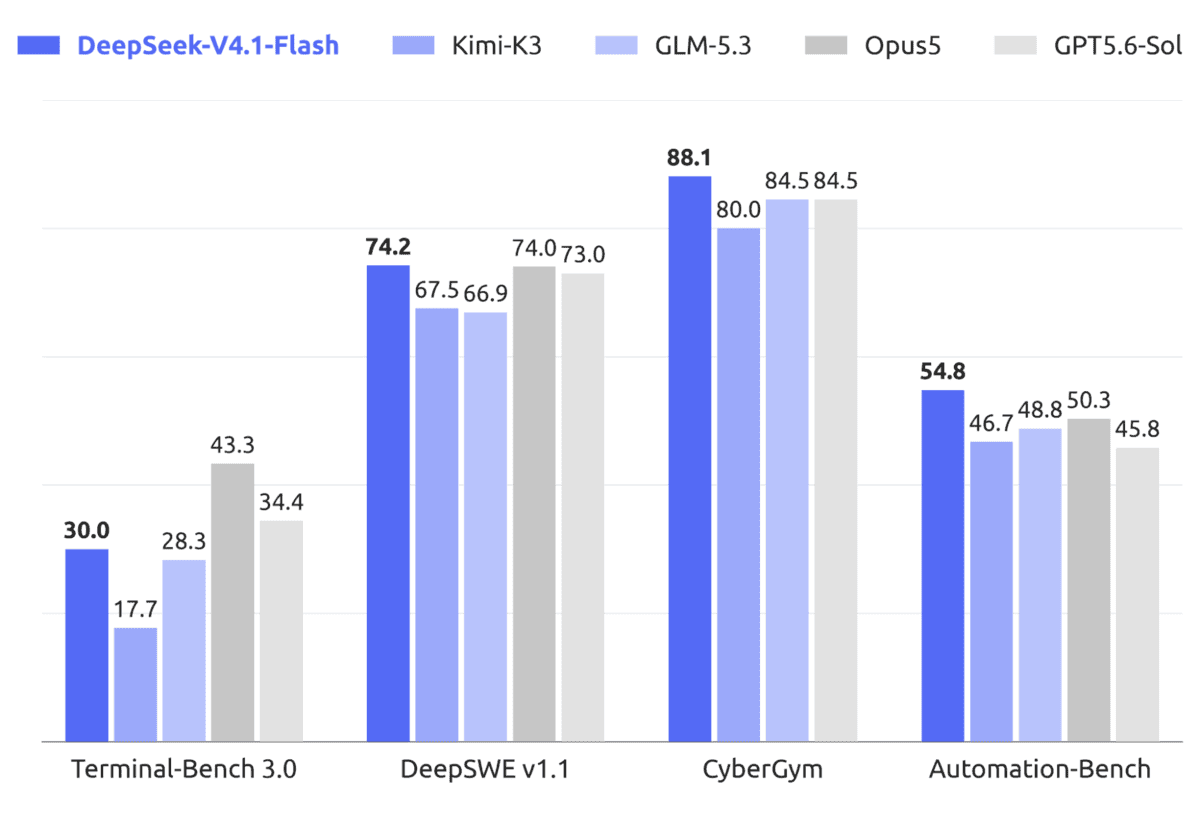
Theoretical architectural improvements must ultimately validate their utility through measurable performance gains. According to benchmark data released by DeepSeek, V4.1-Flash not only achieves unprecedented operational efficiency but also records dominant scores across rigorous, agent-centric evaluation suites that measure real-world utility in coding, automation, cybersecurity, and terminal navigation.
In empirical evaluations, DeepSeek-V4.1-Flash secured a score of 74.2 on the DeepSWE v1.1 software engineering benchmark, substantially outperforming its predecessor V4-Flash (54.4) and the V4-Pro variant (62.7). Similar upward trajectories are visible across specialized operational domains:

- Terminal-Bench 2.1: Reached 90.6, surpassing V4-Pro (87.9) and V4-Flash (82.7).
- CyberGym (Cybersecurity): Scored 88.1, outperforming V4-Pro (83.3) and V4-Flash (76.7).
- AutomationBench: Achieved 54.8, improving significantly over V4-Pro (43.2) and V4-Flash (37.7).
- Agent’s Last Exam: Recorded 31.8, leading the internal baseline series.
These metrics indicate that DeepSeek’s engineering choices did not compromise cognitive capability. Instead, the model successfully synthesizes operational economy with superior problem-solving proficiency in complex digital environments.
Broader Industry Implications and Open-Source Impact
The release of DeepSeek-V4.1-Flash under the MIT license carries significant structural implications for the broader artificial intelligence ecosystem. By providing open access to both the model weights and detailed reference implementations of asymmetric prefill-decode computation, sparse attention compression, and ultra-compact KV caching, DeepSeek has provided a valuable public resource for the AI research community.
Independent technical analyses suggest that while V4.1-Flash may face competition from specialized proprietary engines or alternative open releases regarding raw cost-to-performance ratios in standard chat tasks, its unique strength lies in output velocity and memory footprint minimization. As inference hardware costs remain a primary fiscal constraint for enterprise adopters, the techniques pioneered in this release—such as cross-layer KV sharing, FP4 caching, and conditional memory lookups—are expected to be rapidly integrated into mainstream inference frameworks like vLLM and TensorRT-LLM.
Ultimately, DeepSeek-V4.1-Flash serves as a clear proof-of-concept that the scaling laws governing large language models can be fundamentally reshaped. By designing architectures that explicitly respect the operational bottlenecks of long-context autonomous agents, the open-source community now possesses a robust foundation to build faster, leaner, and drastically more efficient artificial intelligence systems.