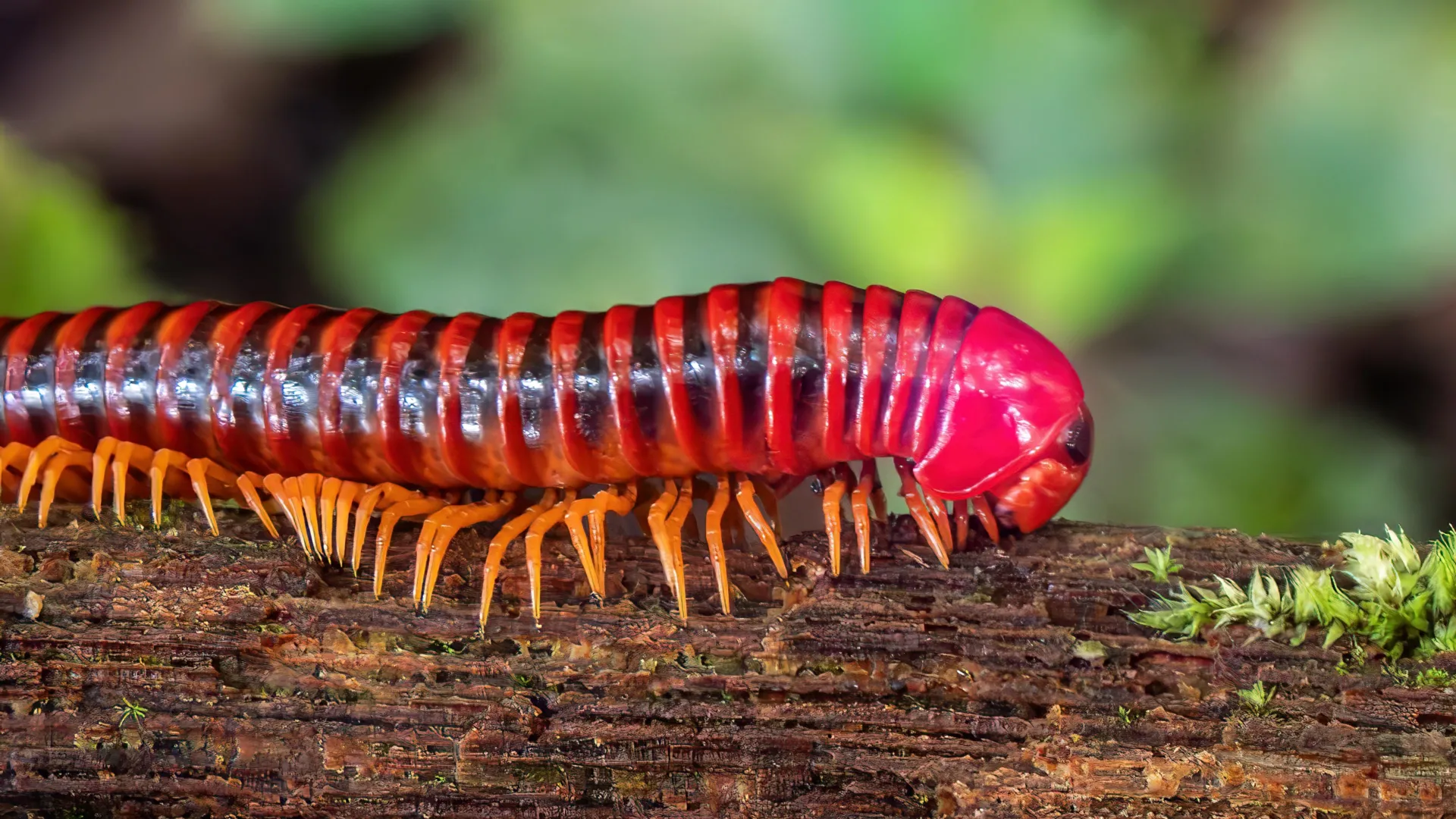
For hundreds of millions of years before dinosaurs roamed the Earth and long before vertebrates dared to venture onto land, millipedes were already a dominant force, silently shaping the planet’s nascent terrestrial ecosystems. These unassuming decomposers, often overlooked in favor of more charismatic megafauna, have now been the subject of groundbreaking research that has illuminated their remarkable evolutionary journey, pushing back their origins and solidifying their pivotal role in preparing Earth for complex life. An international consortium, spearheaded by researchers at Virginia Tech, has meticulously reconstructed the complete evolutionary history of all living millipede orders, a feat that fills a significant void in our understanding of these ancient arthropods.
The study, published in the esteemed journal Current Biology, represents a monumental leap in millipede phylogeny. By integrating vast amounts of DNA data from contemporary species with meticulously analyzed fossil evidence, the scientists have traced the lineage of millipedes back an astonishing 460 million years. This revised timeline suggests that millipedes were not only present but thriving on land a staggering 80 million years before the earliest known vertebrate fossils, and significantly predates the oldest physical millipede fossils discovered to date.
"Millipedes beat vertebrates onto land by more than 80 million years," stated Dr. Paul Marek, the lead investigator of the study and an associate professor in Virginia Tech’s Department of Entomology within the College of Agriculture and Life Sciences. "They really set the stage for later life on land, including humans and vertebrates." This pioneering arrival on the terrestrial stage highlights a profound ecological shift, where arthropods, rather than vertebrates, were the initial architects of land-based food webs and nutrient cycling.
Solving a Century-Old Millipede Mystery
The research tackled a long-standing enigma within millipede taxonomy: the placement of two rare and elusive groups, Siphoniulida and Siphonocryptida. For over a century, scientists acknowledged their existence but lacked the crucial genetic material to definitively position them within the broader millipede family tree. The scarcity of fresh specimens for DNA analysis had rendered these groups akin to biological "white whales" for entomologists, hindering a comprehensive understanding of millipede evolution.
One of these enigmatic groups comprises millipedes measuring less than a centimeter in length, characterized by their subterranean lifestyle. The other group is known to inhabit a very limited number of geographical locations worldwide, making them exceptionally difficult to find and study.
"These last two were kind of like our white whales," Dr. Marek acknowledged, underscoring the significant challenge and dedication involved in their discovery. To finally capture these elusive creatures, the research team embarked on expeditions to remote locations. Their persistent efforts led them to the lush region of Los Tuxtlas in Mexico and the volcanic landscapes of the Canary Islands in Spain. It was here that they successfully collected specimens of Siphoniulida neotropicus and Hirudicryptus canariensis, species whose genetic makeup had never before been incorporated into an evolutionary study.
The fieldwork was arduous and required immense patience. Luisa "Fernanda" Vasquez-Valverde, M.S. ’21, Ph.D. ’24, the paper’s first author and a doctoral candidate in Dr. Marek’s lab, recounted the difficulty of locating these tiny organisms. "It took 10 people over a week just to find this one tiny 10-millimeter adult," she explained. "Finding them in the field was hard because we were just seeing this little white nematode. We didn’t know for sure it was a millipede until we looked under the microscope." This anecdote vividly illustrates the dedication and meticulous observation required for such foundational scientific discoveries.
A Data-Driven Reconstruction of Millipede Ancestry
With the elusive specimens in hand, the team proceeded to sequence their DNA. This genetic data was then integrated with that of 82 other millipede species, creating a comprehensive dataset of hundreds of genes. To further anchor their evolutionary timeline, the researchers incorporated data from 29 well-preserved fossils, representing a crucial bridge between ancient lineages and modern diversity. This multi-faceted approach, combining molecular and morphological evidence, provided the robust framework necessary to reconstruct evolutionary relationships stretching back hundreds of millions of years.
The sheer scale of the genomic data generated was substantial, requiring the significant computational power of Virginia Tech’s Advanced Research Computing resources. These powerful systems were essential for processing terabytes of genetic information and performing complex phylogenetic analyses to reconstruct the intricate web of evolutionary connections.
The results of this extensive analysis provided definitive answers to long-standing questions. The study revealed that Siphonocryptida, previously considered a distinct millipede order, is in fact integrated within an existing lineage, demonstrating a closer evolutionary relationship than previously understood. Siphoniulida, meanwhile, was finally placed alongside its closest evolutionary kin, resolving its ambiguous position in the millipede family tree.
Millipedes on an Ancient, Alien Earth
The revised evolutionary timeline has profound implications for our understanding of early terrestrial life. The analysis strongly suggests that millipedes originated approximately 460 million years ago. This date is about 35 million years earlier than the oldest definitive millipede fossils currently known and significantly predates previous estimations.
"The biggest surprise was just how ancient some of these lineages turned out to be," Dr. Marek remarked, emphasizing the unexpected depth of millipede history.
During the Silurian and Devonian periods, when millipedes are now understood to have first emerged, Earth bore little resemblance to its present form. The land was largely barren, devoid of the complex vegetation that characterizes modern ecosystems. Dr. Marek painted a vivid picture of this primordial world, stating, "There were no vertebrates, no trees, no leaves, no flowering plants, no plants with seeds."
In this nascent terrestrial environment, millipedes emerged as vital pioneers. They were among the first organisms to colonize the land, playing a critical role in nutrient cycling. By consuming decaying organic matter—primarily decomposed mosses, primitive fungi, and other organic detritus—they facilitated the breakdown of dead plant material, a fundamental process that paved the way for the development of more complex terrestrial ecosystems. Their role as decomposers was indispensable, transforming a relatively sterile land surface into a substrate capable of supporting further life.
The Dawn of Millipede Chemical Warfare
Beyond establishing their ancient origins and ecological importance, the newly completed evolutionary tree has also provided unprecedented insights into the development of one of the millipede group’s most remarkable adaptations: their sophisticated chemical defense mechanisms.
"They made the first chemical weapons," Dr. Marek observed, likening these arthropods to "little chemical factories." The study’s phylogenetic analysis pinpoints the emergence of these chemical defenses to approximately 260 million years ago, during the Carboniferous period. This period, known for its vast coal forests, would have presented new predatory pressures, likely driving the evolution of effective deterrents. This finding offers the most compelling evidence to date regarding the timing of when millipedes first evolved the ability to produce and deploy chemical compounds for protection against predators.
These chemical defenses can range from mild irritants to potent toxins, varying significantly among different millipede species. They are produced in specialized glands and can be secreted or sprayed, effectively deterring a wide array of potential threats. The evolution of these sophisticated chemical weapons underscores the intense selective pressures faced by early terrestrial invertebrates and highlights the diverse strategies employed to survive and thrive in evolving environments.
Unsung Architects of Ecosystems
Even today, millipedes continue to fulfill their crucial ecological role as detritivores, playing an indispensable part in nutrient cycling and maintaining the health of ecosystems worldwide. By breaking down dead plant material, they prevent the accumulation of organic debris and return vital nutrients to the soil, supporting plant growth and the entire food web.
"It’s really kind of puzzling that they have such an important function in the ecosystem, and yet they’re so poorly known," Dr. Marek expressed, highlighting the disconnect between their ecological significance and public or even scientific awareness.
Despite the existence of over 14,000 described species globally, researchers estimate that tens of thousands of millipede species remain undiscovered. The ongoing exploration by scientists like Dr. Marek and his students, who have identified new species in diverse locations from the campus of Virginia Tech to urban environments like Los Angeles, underscores the vastness of this unexplored biodiversity.
For researchers like Luisa Vasquez-Valverde, the thrill of discovery is a powerful motivator. "There is all this potential for discovery," she shared. "It keeps me wondering what else we’re going to find." This sense of wonder and the pursuit of uncovering Earth’s hidden biodiversity fuels the ongoing scientific endeavor.
The research was generously funded by the National Science Foundation, a key supporter of fundamental scientific inquiry. The collaborative effort involved a wide array of institutions, demonstrating the global nature of scientific investigation. Participating organizations included the Field Museum of Natural History, Hampden-Sydney College, Universidad de La Laguna, Virginia Tech’s School of Plant and Environmental Sciences, the Australian National Insect Collection, West Virginia University, and Universidad Autonoma del Estado de Hidalgo. This broad collaboration underscores the interdisciplinary and international nature of tackling complex scientific challenges. The implications of this research extend beyond millipede taxonomy, offering a deeper appreciation for the ancient history of life on Earth and the often-unseen contributions of its earliest inhabitants to the planet’s habitability.