For several years, the pursuit of success for American biotechnology firms has grown increasingly arduous. Even in the more robust investment climates preceding 2022, the development and growth of a biotech enterprise inherently demanded a unique confluence of significant risk appetite and exceptionally patient capital. This fundamental requirement often stood in stark contrast to the rapid exit strategies commonly observed in other sectors of technology investing, where quick returns on investment were more typical. However, the prevailing investment climate has undergone a profound transformation. A palpable increase in caution now permeates both U.S. regulatory bodies and investor communities, a trend that has paradoxically coincided with a surplus of capital and increased regulatory streamlining within China. This convergence of factors has created an even more challenging and intricate operating environment for innovative biotech firms in the United States, compelling them to re-evaluate traditional paradigms and forge novel strategic pathways.
The core imperative for U.S. biotech, therefore, lies in meticulously crafting new strategies designed to navigate the multifaceted challenges of intellectual property (IP) appropriation by lower-cost Chinese competitors. This necessitates either maximizing investment in drug development areas perceived as popular and inherently lower risk, or, more ambitiously, pioneering innovative operational models that can simultaneously unlock new markets and generate substantial cost efficiencies. Each of these strategic approaches carries its own distinct set of risks, yet each also presents a compelling opportunity for differentiation. This differentiation is crucial not only to stand out in increasingly crowded markets for existing drugs and their derivatives but, critically, to establish a robust competitive edge against burgeoning Chinese competition. The current landscape is not merely a transient downturn; it represents a structural shift demanding strategic agility and a redefinition of what constitutes a viable path to market and sustainable growth.
The Shifting Sands of Biotech Investment and Global Competition
The period leading up to 2022 was characterized by a buoyant investment environment in the biotech sector, driven by factors such as low interest rates, an influx of venture capital, and a robust initial public offering (IPO) market. Billions of dollars flowed into nascent and established biotech companies, fueling ambitious research and development (R&D) pipelines. This era fostered a culture of high-risk, high-reward endeavors, with investors willing to back long-shot therapeutic candidates in anticipation of blockbuster returns. However, the tide began to turn sharply in 2022. Rising inflation, aggressive interest rate hikes by central banks, and a broader economic slowdown led to a significant contraction in venture capital funding and a near-collapse of the biotech IPO market. Data from industry reports indicate a substantial decline in biotech funding rounds and public market valuations, forcing many firms to conserve cash, downsize, or delay crucial clinical trials. This cautious stance from U.S. investors has made securing the substantial, patient capital required for drug development significantly more difficult.
Concurrently, China has aggressively positioned itself as a global leader in biopharmaceutical innovation and manufacturing. Over the past decade, the Chinese government has invested heavily in its biotech sector, establishing state-of-the-art research facilities, fostering a highly skilled workforce, and, critically, implementing significant reforms to its National Medical Products Administration (NMPA). These reforms have dramatically streamlined the drug approval process, often allowing drugs to advance through clinical trials and reach market much faster than in Western jurisdictions. This regulatory agility, combined with lower R&D and manufacturing costs, has fueled an explosion of innovation within China, transforming it from a "fast-follower" to a genuine innovator and, often, a "fast-leader" in specific therapeutic areas. The implication for American firms is stark: Chinese companies can often develop and bring similar therapies to market at a fraction of the cost and in a shorter timeframe, posing a direct threat to the market exclusivity and profitability of U.S.-developed drugs.
The Peril of Target Herding in the Age of AI
Elliott Hershberg’s compelling analysis on biopharma modality commodification underscores a critical vulnerability: the inexorable trend towards "target herding." This phenomenon, where multiple companies converge on the same biological targets once initial clinical data proves promising, has been amplified to an unprecedented degree by China’s streamlined regulatory environment and the advent of advanced artificial intelligence (AI) tools. The moment a novel, promising target publicly emerges with supportive clinical data, a multitude of companies, increasingly including those from China, swiftly launch programs to pursue the identical therapeutic concept. Given their inherent development cost advantages, these "fast followers" from China are now a dominant force.
A vivid illustration of this challenge dates back a decade with the staggering proliferation of PD-(L)1 inhibitor programs. At one point, over 200 distinct programs were in various stages of development, all aiming to modulate the same immune checkpoints. This intense competition inherently diluted market share and pressured pricing, but the landscape has since become even more complex. AI has supercharged this target-herding phenomenon. For both protein therapeutics and, even more acutely, small molecule chemical drugs, AI algorithms can now trivially analyze existing patent claims and rapidly generate novel molecular structures that achieve the same therapeutic effect while circumventing established intellectual property. This capability effectively renders traditional patent protection less robust. In such a scenario, China’s profound advantages in development cost and speed mean that a copycat program could potentially beat the innovator to market, or at the very least, follow so rapidly that it effectively shortens the patent exclusivity period—the crucial window during which innovators recover their monumental clinical development costs. This erosion of IP protection and market exclusivity presents an existential threat to the economic model of traditional drug discovery.
Against this backdrop, American biotech firms are exploring three distinct strategic pathways to maintain their competitive edge and foster sustainable growth.
Strategy 1: The Pursuit of Novelty and Strategic Secrecy – The Variant Bio Model
One compelling response to the commoditization of drug targets and the threat of rapid IP appropriation is the "keep secret" approach, exemplified by Variant Bio. Their solution is deceptively simple yet profoundly strategic: develop proprietary technology that unearths truly novel biological targets, those that are not easily discernible or accessible to competitors, and then meticulously withhold patent filings until the absolute last possible moment.
Variant Bio leverages privileged access to unique genomic sequencing data derived from rare, often isolated human populations. These populations, due to their distinct genetic profiles and environmental factors, frequently harbor novel genetic clues for human diseases that are not evident in broader, more genetically diverse populations. By analyzing these unique datasets, Variant Bio aims to identify entirely new disease pathways and therapeutic targets. This strategy allows the company to operate in relative quiet isolation throughout the critical early and mid-stages of drug development, away from the intense scrutiny and "target herding" dynamics that plague publicly known targets. This provides a durable, albeit risky, advantage.
The strategic withholding of patent filings until just before clinical trials or market entry is a calculated gamble. While it postpones the official protection that patents afford, it simultaneously prevents competitors from gaining early insight into the company’s proprietary targets and molecular designs. In an era where AI can rapidly analyze published patents to design workaround molecules, this secrecy acts as a de facto, albeit temporary, form of IP protection. The risks are substantial: a leak of information, independent discovery by another entity, or a failure to file patents correctly at the critical juncture could negate years of secretive R&D. However, the potential payoff is equally significant: a truly novel therapeutic that addresses an unmet medical need, protected by a late-stage patent that is harder for AI to circumvent quickly, and launched into a market free from immediate, intense competition. This approach demands immense investor patience and a high tolerance for operational secrecy, but for truly groundbreaking discoveries, it offers a path to genuine differentiation.
Strategy 2: Maximizing Efficacy Through Polypharmacology – The Spyre and Kailera Models
A silver lining to the commodification of specific drug modalities is the industry’s advanced proficiency in developing certain types of drug molecules, particularly monoclonal antibodies and peptides. This accumulated expertise translates into a demonstrably lower development risk for these modalities. Consequently, innovative minds have turned to the idea of combining these well-understood drug molecules to achieve superior efficacy, a strategy known as polypharmacology. This approach offers several advantages: combinations can generate an additional layer of patent protection (on the combination itself), and successful execution often demands a level of scientific and clinical sophistication that is likely beyond the reach of most would-be copycats. Furthermore, the enhanced therapeutic efficacy derived from combinatorial synergies allows the developer to potentially capture significant market share from existing single-target incumbents.
Spyre Therapeutics exemplifies this strategy through its aggressive pursuit of a portfolio of "bio-better" monoclonal antibody drugs for inflammatory bowel disease (IBD). Instead of targeting novel pathways, Spyre focuses on well-established targets such as IL-23, TL1A, and α4β7. The innovation lies in developing superior antibodies against these known targets and, crucially, combining them to achieve unprecedented levels of efficacy. While generic versions of widely used drugs like Humira are becoming increasingly affordable, the U.S. healthcare system has historically shown a willingness to pay a premium for therapies that demonstrate significantly improved patient outcomes. If combination therapies can effectively double or dramatically enhance efficacy compared to existing standards, they can command substantial market value.

Similarly, Kailera is applying this combinatorial approach to the burgeoning weight-loss peptide market. While semaglutide, a GLP-1 agonist, has revolutionized obesity treatment, Kailera is developing bivalent, trivalent, or even quadrivalent peptide constructs. These multi-agonist peptides aim to engage multiple metabolic pathways simultaneously (e.g., GLP-1, GIP, Glucagon receptors) to generate far superior efficacy in weight reduction. While acknowledging that these advanced peptides may not alleviate all side effects, such as vomiting, their potential to induce greater weight loss addresses a massive unmet need in a market projected to reach hundreds of billions of dollars annually. Neither Spyre nor Kailera’s strategies rely on truly novel targets; instead, their innovation is in the sophisticated combination and optimization of existing therapeutic principles.
However, this strategy comes with a significant caveat: while development risk related to target validation may be lower due to known mechanisms, the development costs are emphatically not. Clinical trials for combination therapies can be more complex, requiring careful titration and assessment of multiple active pharmaceutical ingredients. Both Spyre and Kailera have reportedly raised over a billion dollars each to fund their extensive clinical programs, underscoring the immense capital required to execute this "funds-maxxing" approach to polypharmacology. The challenge lies in proving the enhanced efficacy is substantial enough to justify the higher cost and differentiate effectively in a competitive landscape.
Strategy 3: Disruptive Platform Technologies – The Lumen Bio Model
A potentially more cost-efficient and broadly impactful approach involves the development of entirely novel platform technologies, as pioneered by Seattle-based Lumen Bio (co-founded by co-author Brian Finrow). Like Spyre and Kailera, Lumen Bio’s pipeline includes biologic cocktail drugs designed to yield powerful therapeutic synergies. However, their fundamental differentiation lies in leveraging a completely novel biomanufacturing platform technology. This platform promises far greater scalability and significantly reduced delivered costs, which in turn makes previously intractable markets—such as preventive drugs and vast international markets—far more addressable.
This embrace of novelty, however, comes with its own set of advantages and disadvantages. A significant drawback is that novel biomanufacturing platforms have largely fallen out of favor with investors since the conclusion of the intensive Covid-19 era in 2022. The market, having seen numerous platform plays during the pandemic, has become more risk-averse towards technologies that require significant upfront investment and pose integration challenges. Relatedly, established biopharma companies generally prefer to collaborate with technologies compatible with their existing manufacturing footprints, favoring commodified modalities over disruptive new platforms. Despite these considerations, Lumen Bio argues that the competitive advantages of their platform ultimately outweigh these perceived downsides.
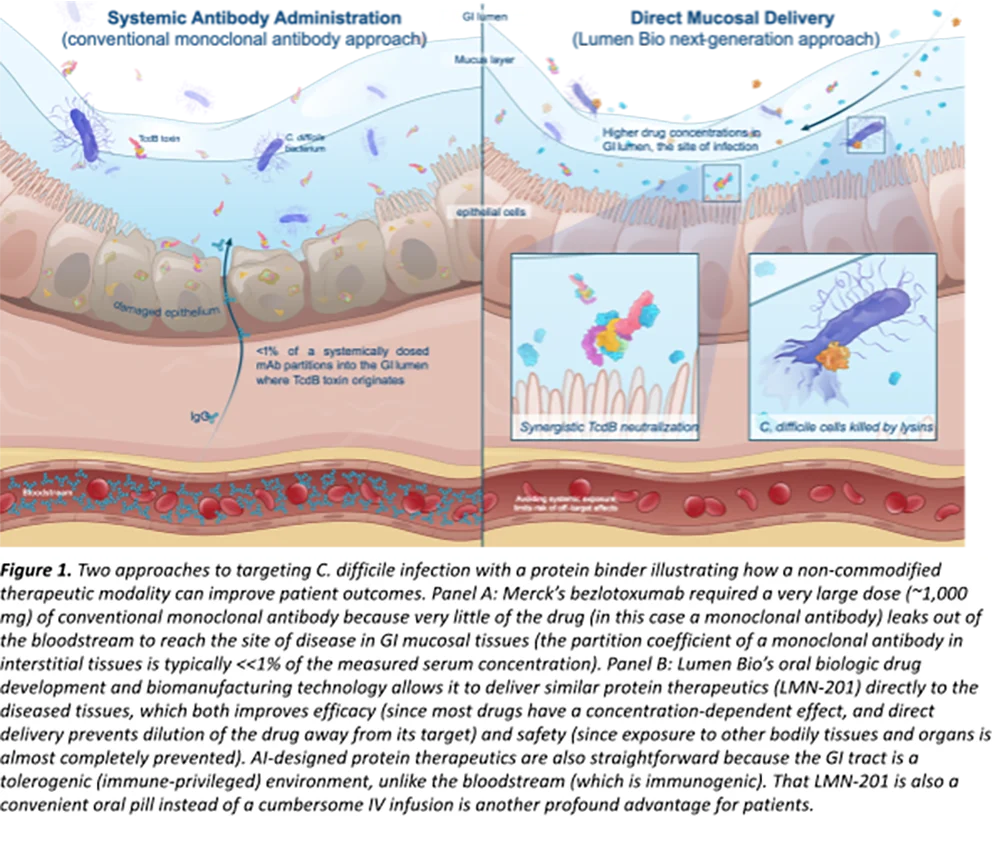
Beyond mere competitive considerations, new therapeutic modalities and manufacturing platforms represent fundamental breakthroughs that can address unmet medical needs in entirely new ways. For example, Lumen Bio’s LMN-201 attacks the same target as Merck’s intravenously infused antibody bezlotoxumab but delivers it orally, not by injection. This oral delivery mechanism dramatically simplifies the treatment of Clostridioides difficile (C. diff) infection, a severe and often recurrent bacterial infection. The shift from an inconvenient intravenous infusion requiring healthcare professional administration to a simple oral regimen offers immense patient convenience and expands access to treatment.
Moreover, the very lack of pre-existing manufacturing capacity for a novel platform creates a formidable barrier to entry for would-be competitors. When a new product launched via a disruptive platform gains traction, rival companies face a much steeper climb to catch up, requiring them to build entirely new infrastructure or invest heavily in adapting their processes. Moderna’s groundbreaking success with its Covid-19 mRNA vaccine serves as a potent illustration of this upside potential. Despite initial skepticism from the pharmaceutical establishment regarding mRNA technology, Moderna’s novel platform proved capable of rapidly developing and manufacturing a highly effective vaccine at scale, while many legacy vaccine manufacturing approaches ultimately struggled to meet the urgent global demand. This demonstrates that while platform risk is real, the opportunity for market disruption, new market creation, and significantly reduced product costs can be transformative.
Broader Implications and The Geopolitical Landscape
The strategic choices facing American biotech firms extend beyond mere business models; they intersect with broader geopolitical and economic imperatives. The robust growth of China’s biotech sector, fueled by state support and regulatory efficiency, is not just a commercial challenge but also a strategic one. Maintaining leadership in drug discovery and development is crucial for national health security, economic competitiveness, and global scientific influence. The ability of U.S. firms to innovate and protect their IP directly impacts their capacity to bring life-saving therapies to market and retain a competitive edge in a rapidly evolving global ecosystem.
Policymakers in the U.S. are increasingly recognizing the need to balance regulatory oversight with innovation incentives. While U.S. regulators prioritize safety and efficacy, potentially leading to longer approval times, the challenge is to find ways to streamline processes without compromising standards, thereby fostering a more agile domestic industry. The strategies employed by companies like Variant Bio, Spyre, Kailera, and Lumen Bio reflect an industry grappling with these macro-level shifts and attempting to find innovative solutions from within.
Conclusions
In an increasingly complex and competitive global landscape, deep and durable innovation in American biotech demands not only a sustained appetite for risk but also a keen ability to identify both a viable market and a practical pathway to product delivery. The "keep secret" approach, as practiced by Variant Bio, offers the potential for huge payoffs if intellectual property can be meticulously guarded and investors maintain patience. It’s a high-risk, high-reward strategy for truly novel discoveries.
Conversely, the strategy of polypharmacology, exemplified by Spyre and Kailera, leverages the commodification of drug modalities to reduce development risk for individual components. However, it necessitates proving significantly increased efficacy and achieving successful market differentiation to justify the substantial development costs and premium pricing. This approach is for established markets where incremental but impactful improvements can capture market share.
Finally, developing and deploying entirely new platform technologies, as seen with Lumen Bio, inherently runs real risks due to their novelty and the challenges of adoption. Yet, this path also carries with it the transformative opportunity to unlock entirely new markets, dramatically reduce product costs, and address unmet medical needs through novel delivery mechanisms.
The key to American biotech retaining its competitive edge amidst the formidable rise of Chinese competition lies in the artful and strategic balancing of the inherent tradeoffs among these three distinct approaches. It is through this strategic agility and relentless pursuit of innovation that the U.S. biotech sector can continue to blaze new paths, deliver groundbreaking therapies, and secure its position as a global leader.
Brian Finrow is CEO, co-founder, and co-chair of Lumen Bioscience, a clinical-stage biotechnology company in Seattle. Kevin Klowden is an economist and principal at Melcene Advisory and senior fellow at the Milken Institute.