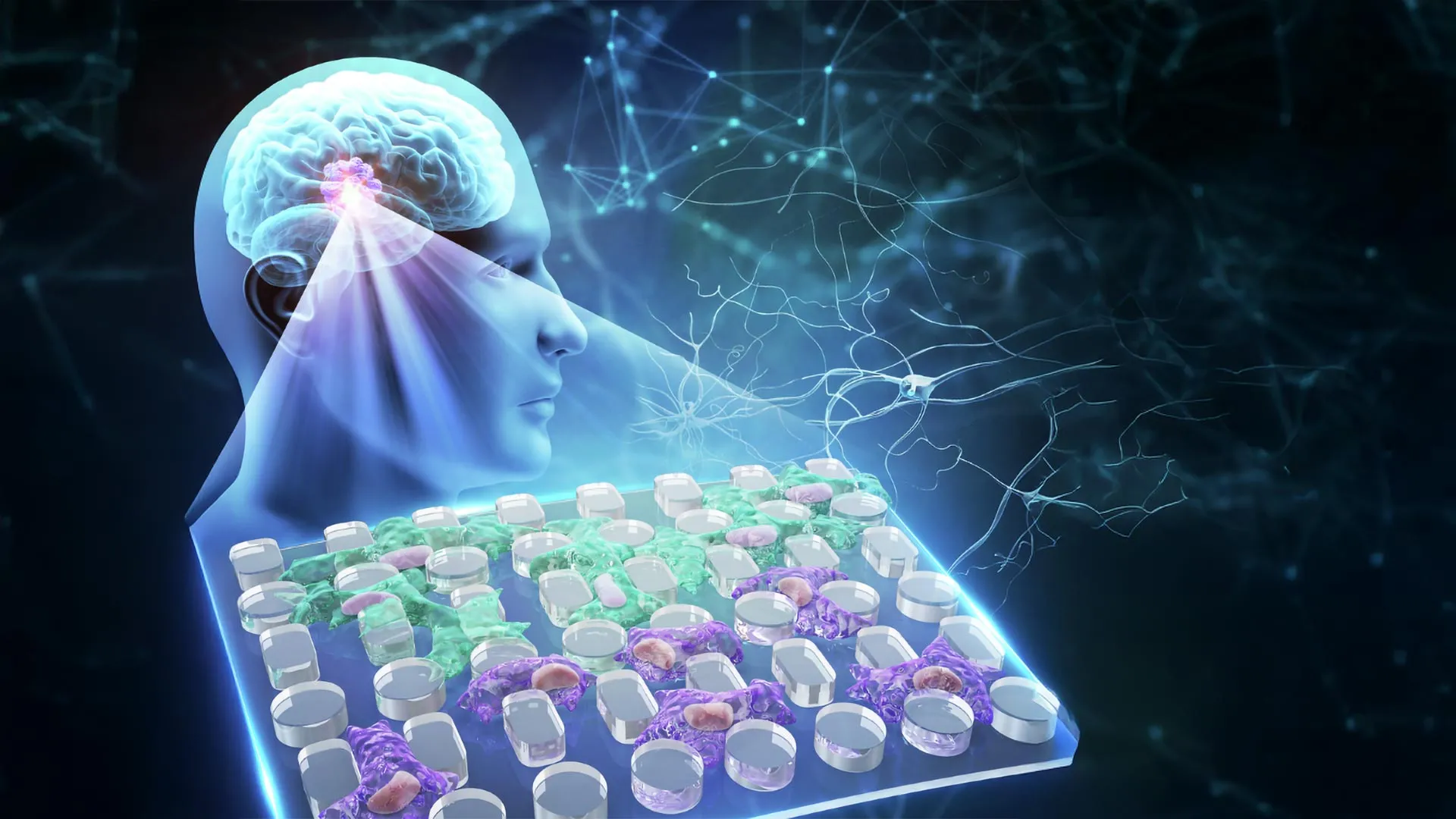
Scientists at the University of Illinois Urbana-Champaign have uncovered evidence that could reshape how researchers think about both the brain and artificial intelligence, suggesting that decision-making begins much earlier in the brain than traditional theories propose. This groundbreaking research, conducted at The Grainger College of Engineering, offers fresh insights for designing future AI systems that are not only more capable but also far more energy-efficient than current models. Led by Yurii Vlasov, a professor of electrical and computer engineering, the study was recently published in the Proceedings of the National Academy of Sciences (PNAS). The findings point to an unexpected and vital role for early sensory brain regions in the decision-making process, challenging the long-accepted view that decisions emerge only after information moves through a strict, one-way hierarchy of brain regions.
Challenging the Hierarchical Model of Neural Processing
For decades, the prevailing model in neuroscience has suggested that the brain processes information in a linear, step-by-step fashion. In this "bottom-up" hierarchy, sensory data—such as what we see, hear, or feel—is collected by peripheral organs and sent to primary sensory regions. From there, the data is refined and passed upward to higher-order regions, eventually reaching the frontal cortex. It is in this advanced stage of the hierarchy that scientists believed the brain integrated information to make a final decision or initiate an action.
This traditional model served as the foundational inspiration for many modern artificial intelligence systems, particularly convolutional neural networks (CNNs). In a CNN, data passes through various "layers" of artificial neurons, with each layer extracting increasingly complex features until the system reaches a classification or decision. However, Professor Vlasov and his team at the University of Illinois have increasingly questioned whether this linear picture is complete.
The new research suggests that the human brain, refined over hundreds of millions of years of evolution, does not rely solely on this one-way flow. Instead, the brain utilizes a complex architecture of interconnected feedback loops. These loops allow information to move in both directions—not just from the "bottom up" but also from the "top down." This bidirectional communication means that even the earliest stages of sensory processing are actively involved in the decision-making process, rather than acting as mere passive relays for data.
The Experiment: Virtual Reality and Neural Mapping
To investigate these complex processes, the research team focused on the brain’s earliest stages of perception. They conducted experiments using mice navigating a virtual reality corridor. During these trials, the mice were required to make perceptual decisions based on sensory input. Using advanced neural recording techniques, the scientists monitored activity across various brain regions in real-time as the animals processed their surroundings and made choices.
The data revealed significant decision-related activity in the primary somatosensory cortex (S1). Traditionally, S1 is classified as an early sensory processing area responsible for handling tactile information. However, the UIUC study found that S1 was not simply passing information forward to the "higher" centers of the brain. Instead, the activity in S1 was being influenced by feedback from those higher regions. This "top-down" regulation indicates that decision-making is a continuous, distributed process involving multiple brain areas simultaneously.
This discovery aligns with the "Grand Challenges for Engineering" identified by the National Academy of Engineering in 2008, which cited reverse-engineering the brain as one of the 14 most critical goals for the 21st century. By uncovering that decision-making is baked into the very first stages of sensory perception, the UIUC team has provided a new piece of the puzzle for understanding how biological intelligence achieves its unparalleled efficiency.
The Energy Efficiency Gap: Biology vs. Silicon
One of the primary motivations for this research is the staggering disparity in energy consumption between biological brains and artificial intelligence. The human brain is capable of performing remarkably complex tasks—ranging from language processing to physical coordination—while consuming approximately 20 watts of power. This is roughly the amount of energy required to power a dim lightbulb.
In contrast, modern AI systems, particularly large language models and deep learning architectures, require massive amounts of electricity. A single training run for a high-level AI model can consume as much energy as hundreds of households use in a year. Furthermore, the hardware required to run these models—specialized GPUs and TPUs—generates significant heat and requires extensive cooling infrastructure.
"We want to learn from a billion years of evolution," Professor Vlasov stated. "How is that biological intelligence organized architecturally? Can we learn from the architectural side of the brain and emulate that to make AI more effective, less power-hungry, and more intelligent than it currently is?"
The UIUC study suggests that the secret to the brain’s efficiency may lie in its non-linear, feedback-heavy architecture. By processing decisions locally and globally at the same time through feedback loops, the brain avoids the massive computational overhead required by the rigid, layer-by-layer processing seen in current AI.
Technical Analysis of Feedback Loops in AI
In current artificial neural networks, "feedback" is primarily used during the training phase through a process called backpropagation. During backpropagation, the error of a decision is sent backward through the network to adjust the weights of the connections. However, once the model is trained and enters the "inference" phase (making real-time decisions), the flow of information becomes largely one-way.
The UIUC findings suggest that incorporating feedback loops into the inference phase itself—allowing "higher" layers to influence "lower" layers in real-time—could lead to more dynamic and efficient processing. This would move AI away from a "static" model of processing and toward a "dynamic" model that more closely resembles the fluid communication of the human nervous system.
If AI architectures can emulate this top-down regulation, they may be able to filter out irrelevant information much earlier in the processing chain. This "early gating" would reduce the total number of calculations required to reach a decision, thereby drastically lowering the energy consumption of the hardware.
Implications for the Future of Machine Learning
While the researchers emphasize that their study does not yet provide a literal "blueprint" for building a new kind of computer, it offers a conceptual shift that could inspire the next generation of neuromorphic computing. Neuromorphic engineering aims to design hardware that mimics the neuro-biological architectures of the nervous system.
The UIUC research provides a theoretical framework for why neuromorphic systems might outperform traditional silicon-based architectures. By demonstrating that the primary somatosensory cortex (S1) is a participant in decision-making, the study validates the idea that intelligence should be "distributed" rather than "centralized."
Potential impacts of this research include:
- Sustainable AI: Reducing the carbon footprint of data centers by creating architectures that require less power for complex reasoning.
- Edge Computing: Enabling sophisticated AI to run on small, battery-powered devices (like smartphones or drones) without needing to offload data to the cloud.
- Improved Robotics: Developing robots that can process sensory information and make decisions with the same speed and fluidity as biological organisms.
- Advanced Prosthetics: Better integration between brain-machine interfaces and the brain’s natural sensory-feedback loops.
Chronology of the Discovery and Next Steps
The journey toward these findings began with the realization that the classical "feed-forward" model of the brain was insufficient to explain the speed and efficiency of animal behavior. Over the last decade, Vlasov and his colleagues have been refining the tools necessary to observe the brain’s "fast temporal dynamics"—the split-second timing of neural signals.
The publication in PNAS marks a milestone in this timeline, providing empirical evidence that sensory regions are not just data collectors. Following this success, the team at The Grainger College of Engineering plans to delve deeper into the timing of these signals. They intend to develop new technologies for measuring neural activity with even higher precision to see exactly when and how these feedback loops engage.
"By looking at the fast temporal dynamics of neural activity, maybe we can understand better how these feedback loops are engaged in making decisions," Vlasov explained. "Maybe that’s the approach that potentially uncovers these currently unknown mechanisms—how these feedback loops are organized dynamically and how they form and shape different levels of processing. Maybe that can be implemented in new architectures for AI."
Conclusion: A New Era of Biologically-Inspired Engineering
The research conducted at the University of Illinois Urbana-Champaign serves as a reminder that despite the rapid advancement of technology, the human brain remains the gold standard for efficient computation. By bridging the gap between neuroscience and electrical engineering, Professor Vlasov’s team is paving the way for a future where artificial intelligence is not just a digital imitation of thought, but a system that mirrors the sophisticated, multi-directional elegance of biological life.
As the AI industry continues to grapple with the limits of silicon and the soaring costs of energy, the answers may not lie in bigger datasets or more powerful processors, but in a fundamental rethinking of the architecture itself. The discovery that decision-making begins in the earliest sensory stages of the brain provides a vital clue in the ongoing quest to solve one of the 21st century’s greatest engineering challenges.