For several years, the landscape for American biotechnology firms has grown increasingly challenging, with success becoming a more elusive commodity. Even during the more robust investment climates preceding 2022, nurturing and expanding a biotech enterprise inherently demanded a unique blend of risk appetite and patient capital. This fundamental requirement stood in stark contrast to the rapid exit strategies often observed in other technology sectors, where quick returns on investment were more typical. However, a significant shift in the investment climate has exacerbated these inherent difficulties. The confluence of heightened caution from U.S. regulators and investors, alongside a surge of capital and streamlined regulatory processes in China, has created an exceptionally complex environment for innovative biotech companies. This dynamic necessitates a profound re-evaluation of strategies for American firms to maintain their competitive edge and continue driving groundbreaking advancements in drug discovery and development.
The Shifting Landscape of Biotech Investment
The period post-2022 has marked a notable cooling in the once-heated biotech investment sphere. Historically, the sector has been characterized by substantial upfront R&D costs, lengthy clinical trials, and a high rate of failure, making it a realm for investors with a long-term outlook. Prior to this recent downturn, particularly during the COVID-19 pandemic, there was an unprecedented influx of capital into biotech, fueled by a surge in public interest, scientific breakthroughs, and the urgent need for novel therapeutics and vaccines. This era saw record-breaking venture capital rounds and numerous successful initial public offerings (IPOs), creating a buoyant market where promising startups could secure significant funding.
Investment Downturn and Regulatory Scrutiny
The current climate, however, tells a different story. Venture capital funding for biotech, while still substantial, has seen a tightening, with investors adopting a more conservative stance. The exuberance of the pandemic era has given way to a more discerning approach, prioritizing companies with clear clinical pathways, validated science, and robust financial projections. This shift is partly attributable to broader macroeconomic pressures, including rising interest rates and inflationary concerns, which make long-term, high-risk investments less attractive. Public markets, too, have become less hospitable, with many biotech IPOs underperforming and a general reluctance to fund early-stage ventures that lack immediate revenue streams or late-stage clinical data.
Concurrently, U.S. regulatory bodies, such as the Food and Drug Administration (FDA), have continued to uphold stringent standards for drug approval. While essential for patient safety and efficacy, these rigorous processes contribute to the extended timelines and high costs of drug development. The FDA’s methodical approach, though globally respected, can sometimes be perceived as a hurdle for innovators seeking to accelerate their path to market, especially when compared to the evolving regulatory landscape in other nations.
China’s Ascendance: A Dual-Edged Sword
In stark contrast to the increasing caution in the U.S., China has rapidly emerged as a formidable force in the global biopharma arena. Over the past decade, the Chinese government has strategically invested heavily in its domestic biotech industry, viewing it as a critical sector for economic growth and national health security. This commitment has manifested in several key areas:
- Capital Surplus: Chinese venture capital and government-backed funds have poured billions into biotech startups, creating an environment rich in funding opportunities.
- Regulatory Streamlining: The National Medical Products Administration (NMPA) in China has significantly reformed its drug approval processes. Once criticized for being slow and opaque, the NMPA has implemented measures to accelerate reviews for innovative drugs, especially those addressing unmet medical needs. This streamlining has dramatically reduced the time from preclinical development to market entry for many domestic firms.
- Talent Pool: China has cultivated a vast pool of scientific talent, with many researchers trained in top Western institutions returning home to contribute to the burgeoning industry.
- Cost Advantages: Lower operational costs, including labor and manufacturing, provide Chinese firms with a significant competitive edge in drug development and production.
This rapid growth has led to an explosion of innovation within China, fostering a vibrant ecosystem of drug discovery. However, it also presents a significant challenge to American biotech, particularly concerning intellectual property (IP) appropriation and the phenomenon of "target herding."
The Challenge of Intellectual Property and Target Herding
The core dilemma for U.S. biotech lies in forging a new path that effectively navigates the threat of IP appropriation by lower-cost Chinese firms. This involves not only maximizing investment in popular and lower-risk drug development areas but also finding innovative operational models that can open new markets and create cost efficiencies. Each potential approach inherently carries risks but also offers the potential to differentiate not only from crowded markets for existing drugs and their derivatives but, crucially, from increasingly agile Chinese competition.
The Commodification Conundrum
Elliott Hershberg’s insightful analysis highlights how biopharma modality commodification has inevitably led to the modern phenomenon of "target herding." This occurs when the instant a promising new drug target emerges publicly with supporting clinical data, numerous companies—often dozens—spring up overnight to pursue the same therapeutic idea. Given their inherent development cost advantages and expedited regulatory pathways, these "fast followers" are increasingly originating from China.
A historical example underscores the severity of this issue: a decade ago, the field saw over 200 distinct PD-1/PD-L1 inhibitor programs simultaneously in development. While many of these programs did not reach commercialization, the sheer volume illustrates the competitive intensity. The race to be first-to-market or to secure significant market share in such a crowded space becomes a brutal battle, often leading to diminished returns for all involved.
AI’s Amplifying Effect on Target Duplication
The advent and rapid advancement of artificial intelligence (AI) have supercharged this target-herding phenomenon. For protein therapeutics and, even more so, for chemical drugs, AI algorithms can now trivially identify alternative molecular structures that achieve the same therapeutic effect while circumventing existing patent claims. This capability significantly shortens the time required for competitors to develop "bio-similar" or "me-too" drugs.
Once a new molecule that performs an identical function is identified, the profound development cost and speed advantages offered by China’s regulatory system become critical. A copycat program from China might beat the innovator to market, or at least follow so quickly that it effectively shortens the patent exclusivity period. This truncation of exclusivity directly impacts the innovator’s ability to recover the enormous clinical development costs, undermining the economic incentive for true novelty. The average cost of bringing a new drug to market, including failures, is estimated to be in the billions of dollars, making a robust period of market exclusivity absolutely vital for profitability and reinvestment into future R&D.
Forging New Paths: American Biotech’s Strategic Responses
In response to this complex environment, American biotech firms are exploring diverse strategies to maintain their competitive edge and foster innovation. Three distinct approaches illustrate the varied solutions to this conundrum.
Strategy 1: The Sanctuary of Secrecy (Variant Bio)
One innovative solution is championed by Variant Bio, a company that has adopted a strategy of deep secrecy regarding its novel targets. The company’s approach is disarmingly simple yet profoundly effective: develop proprietary technology to uncover novel targets that are not easily discernible by others, and then strategically delay patent filings until the absolute last possible moment.

Variant Bio achieves this by leveraging privileged access to genomic sequencing data derived from very rare, often isolated human populations. These unique genetic cohorts can provide novel clues into the genetic underpinnings of human diseases that are otherwise obscured in more diverse populations. By working in relative isolation, Variant Bio can pursue its research and early development phases away from the intense scrutiny and rapid duplication that characterizes the commodity target space. This grants them a durable advantage, allowing them to progress significantly before rivals can even identify the same targets, let alone begin their own development efforts. This strategy demands immense patience and a high tolerance for risk from investors, as the payoff remains hidden for an extended period. However, if successful, it promises a substantial return by establishing a truly unique market position.
The ethical considerations of working with isolated populations are paramount, requiring rigorous informed consent and benefit-sharing protocols, which Variant Bio emphasizes in its operational model. This niche approach allows them to sidestep the frantic race for known targets and instead cultivate truly novel therapeutic avenues.
Strategy 2: Polypharmacology and Portfolio Power (Spyre Therapeutics & Kailera)
Another strategic response leverages a silver lining of modality commodification: the industry’s advanced proficiency in developing certain types of drug molecules, particularly monoclonal antibodies and peptides. This accumulated expertise translates into lower development risk for individual components. The natural progression of this proficiency is to combine these well-understood modalities for enhanced efficacy, leading to the concept of polypharmacology.
Combinatorial therapies offer several strategic advantages. Firstly, the combination itself can generate an additional layer of patent protection, making it more difficult for copycats to replicate the full therapeutic profile. Secondly, the successful development and execution of a complex combination therapy often demand a superior level of scientific and operational expertise, likely beyond the capabilities of most fast-following competitors. Thirdly, and most importantly, the synergistic effects unlocked by combinatorial approaches can lead to significantly better therapeutic efficacy, allowing the developer to capture substantial market share from existing single-agent incumbents.
Spyre Therapeutics exemplifies this strategy by aggressively pursuing a portfolio of "bio-better" monoclonal antibody drugs for Inflammatory Bowel Disease (IBD). Their pipeline targets established, "old-school" pathways such as IL-23, TL1A, and α4β7. While individual targets may be known, Spyre aims to create superior combinations or next-generation molecules that offer significantly improved efficacy over current standards of care. For instance, while biosimilars of blockbuster drugs like Humira (adalimumab) are becoming widely available at drastically reduced prices, a drug that effectively doubles therapeutic efficacy, even for a known target, commands a premium in healthcare systems like the U.S., where superior patient outcomes are highly valued.
Similarly, Kailera is applying this combinatorial strategy to weight-loss peptides. Semaglutide, targeting GLP-1, has revolutionized obesity treatment, but Kailera is developing bivalent, trivalent, or even quadrivalent peptide constructs designed to achieve far greater efficacy. While the basic GLP-1 target is not novel, the multi-component approach aims to unlock unprecedented metabolic benefits. This strategy, however, comes with a significant caveat: while development risk for individual modalities might be lower, the overall development costs for sprawling clinical programs involving multiple components are exceptionally high. Both Spyre and Kailera have reportedly raised over a billion dollars each to fund these ambitious programs, underscoring the capital-intensive nature of this path.
Strategy 3: Disruptive Platforms and Manufacturing Innovation (Lumen Bio)
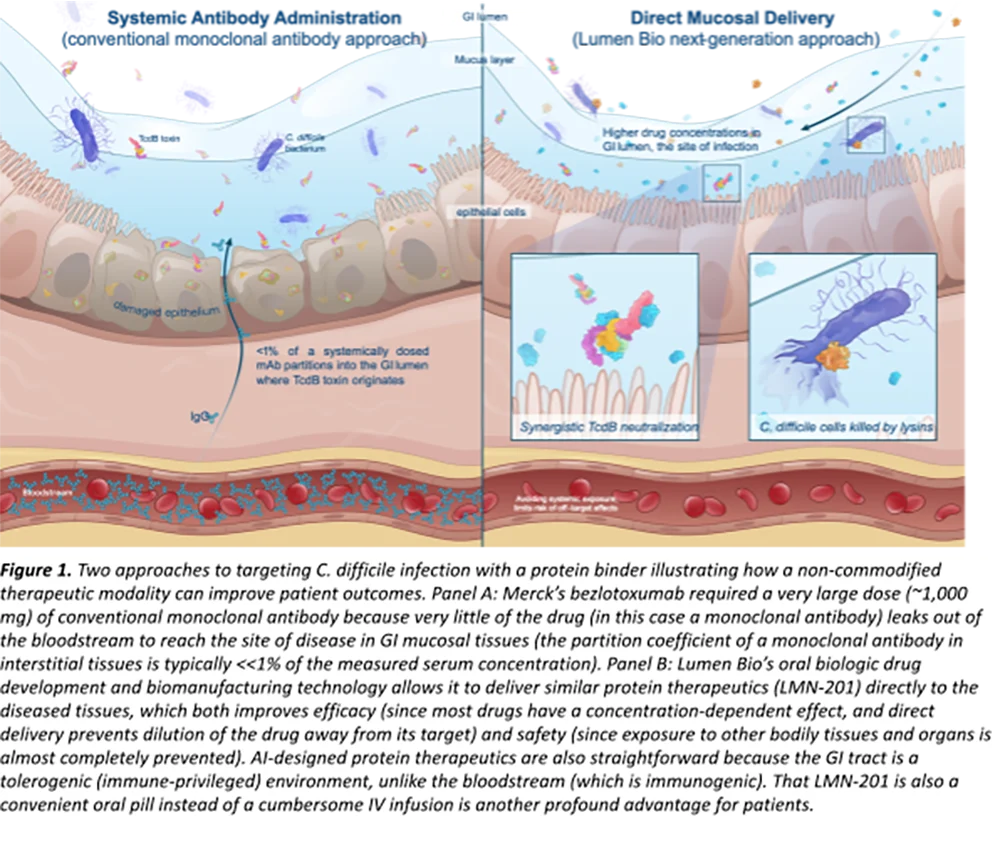
A third, potentially more cost-efficient, yet equally ambitious, approach involves the development of entirely novel biomanufacturing platform technologies. Seattle-based Lumen Bio (co-founded by co-author Brian Finrow) represents this strategy. Like Spyre and Kailera, Lumen Bio’s pipeline includes biologic cocktail drugs designed for powerful therapeutic synergies. However, their differentiating factor lies in leveraging a completely novel biomanufacturing platform technology.
This platform offers far greater scalability and significantly reduced delivered cost advantages. These efficiencies open up entirely new market possibilities, particularly for preventive drugs and underserved international markets, which are often economically inaccessible with traditional manufacturing methods. For example, Lumen Bio’s LMN-201 targets Clostridioides difficile (C. diff) infection. While Merck’s bezlotoxumab targets the same pathogen, it is administered intravenously. LMN-201, developed on Lumen Bio’s platform, offers an oral administration route, dramatically simplifying treatment and improving patient access and compliance for a debilitating infection.
However, the path of novel platforms is not without its challenges. A significant disadvantage is that novel biomanufacturing platforms have fallen out of favor with investors since the end of the COVID-19 pandemic in 2022. The market tends to prefer established, commodified modalities that are compatible with existing manufacturing infrastructures of large biopharma companies. This makes securing investment for truly disruptive platforms a steeper uphill battle.
Nevertheless, the competitive advantages of a novel platform can significantly outweigh these considerations. Beyond just competitive differentiation, new therapeutic modalities and their associated manufacturing platforms represent fundamentally new ways of addressing unmet medical needs. The lack of pre-existing manufacturing capacity for such novel approaches means that would-be competitors face a much steeper hill to climb when attempting to catch up to a pioneering product launch. Moderna’s triumph with its mRNA COVID-19 vaccine serves as a powerful illustration of this potential. When traditional vaccine manufacturing approaches struggled to meet the global demand during the pandemic, Moderna’s novel mRNA platform proved its immense scalability and speed, ultimately delivering a critical solution and securing a massive market position. This demonstrates the huge upside potential when a novel platform successfully addresses a critical need.
Broader Implications for the Global Biotech Ecosystem
The strategic choices made by American biotech firms in this era of intense global competition will have profound implications not only for their individual success but for the broader landscape of pharmaceutical innovation, patient access, and national economic competitiveness.
Sustaining U.S. Leadership in Biopharma
For decades, the United States has been the undisputed global leader in biopharmaceutical innovation, driven by robust venture capital, world-class research institutions, and a generally supportive regulatory framework. The current challenges, particularly from China, threaten this dominance. The ability of U.S. firms to adapt, innovate, and strategically differentiate will be crucial in sustaining this leadership. This requires continued investment in foundational scientific research, fostering an environment that rewards true novelty, and potentially re-evaluating aspects of the regulatory and intellectual property protection landscape to ensure American innovators can reap the rewards of their significant investments. Policymakers and industry leaders must collaborate to create frameworks that encourage both radical innovation and fair competition.
The Future of Drug Development and Patient Access
The strategies discussed also have significant implications for patients worldwide. The "keep secret" approach, while protecting IP, could potentially delay broader access to groundbreaking discoveries if the development timeline is prolonged. Conversely, polypharmacology and novel platforms hold the promise of significantly improved efficacy and lower costs, respectively, which could lead to better patient outcomes and greater accessibility, especially in developing nations. The push for cost-efficient platforms, such as Lumen Bio’s, aligns with a global need for more affordable medicines, including preventive therapies, which are often neglected due to high production costs. As global health challenges continue to mount, innovative approaches to drug development and manufacturing that prioritize affordability and accessibility will become increasingly vital.
Conclusions
Deep, durable innovation in American biotech today demands more than just scientific prowess; it requires an astute understanding of market dynamics, an appetite for calculated risk, and a clear pathway to commercial delivery. The strategies being deployed by companies like Variant Bio, Spyre Therapeutics, Kailera, and Lumen Bio illustrate the diverse approaches to navigating this complex terrain.
Keeping a product secret offers a huge potential payoff, provided the secrecy can be maintained through the lengthy development cycle and investors demonstrate exceptional patience. Modality commodification, while reducing individual development risks, necessitates proving both superior efficacy and successful market differentiation to stand out in crowded therapeutic areas. Developing an entirely new platform, while carrying the inherent risks associated with any fully novel approach, also presents the unparalleled opportunity to unlock new markets, address previously intractable medical needs, and drastically reduce product costs, as exemplified by Moderna’s success. The key to American biotech retaining its competitive edge amidst rising global competition, particularly from China, lies in the artful and strategic balancing of the tradeoffs inherent in these diverse approaches. The future of biopharmaceutical innovation hinges on this strategic agility and relentless pursuit of transformative solutions.
Brian Finrow is CEO, co-founder, and co-chair of Lumen Bioscience, a clinical-stage biotechnology company in Seattle. Kevin Klowden is an economist and principal at Melcene Advisory and senior fellow at the Milken Institute.